.svg)
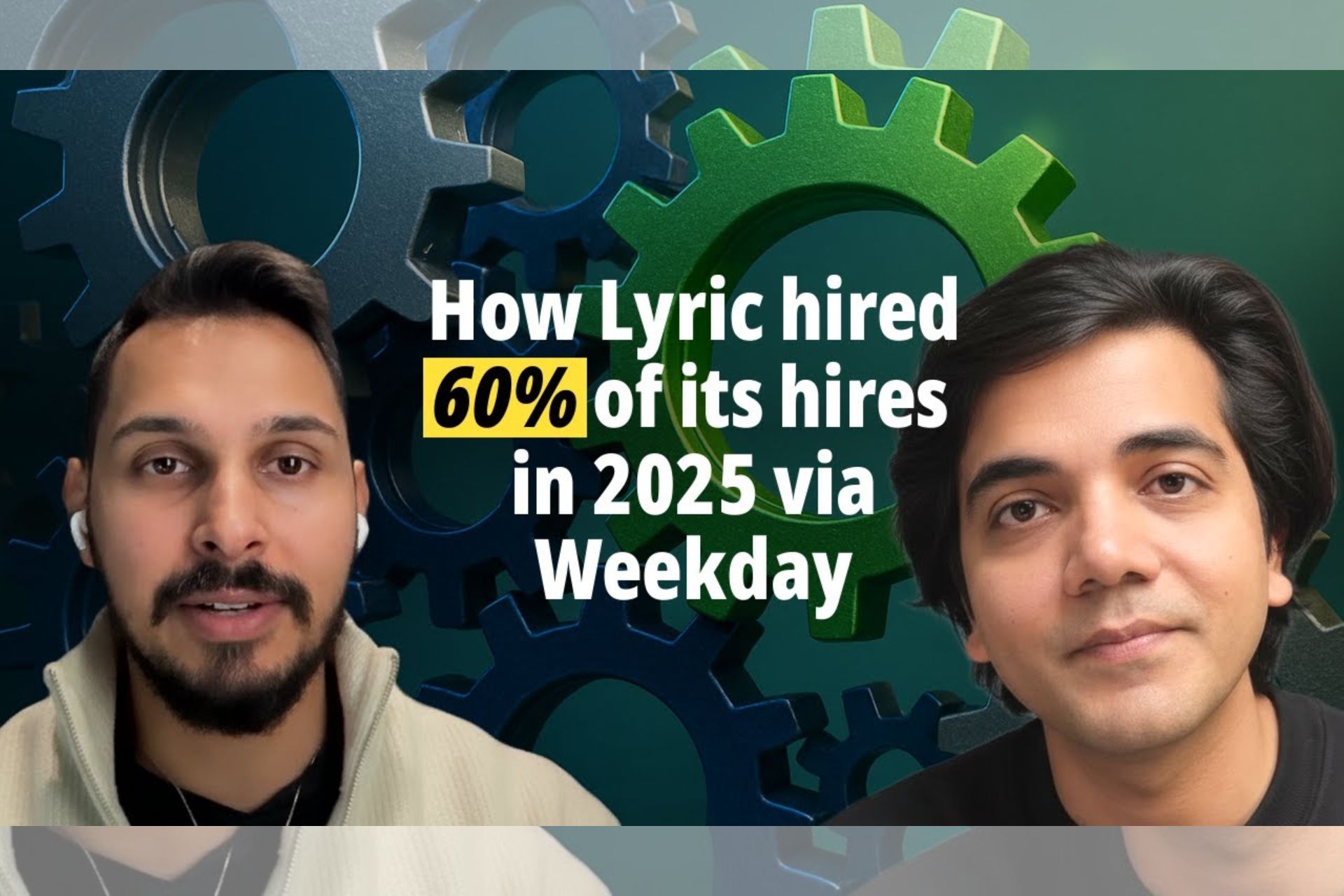
Hiring at scale is less about ambition and more about endurance.
This becomes clear very early in the conversation between Amit Singh, founder of Weekday, and Anjanay, the Talent leadership at Lyric. Lyric is a decision intelligence platform helping Fortune 500 companies optimise supply chains using data, algorithms, and compute. Backed by Insight Partners, the company raised a $50M Series B, grew 10× in two years, and expanded its headcount from 50 to 240 in just 24 months. And yet, despite this momentum, hiring remains one of its hardest operational challenges.
Not because candidates don’t exist — but because finding the right ones, consistently, without burning out the team, is a different problem altogether.
By the end of 2025, Lyric would make close to a hundred hires in India alone. 60% of the hires at Lyric in 2025 came from one source only: Weekday.
The conversation is a reflection on how a high-growth company like Lyric solved a very real constraint: how to hire specialised talent continuously, without scaling the recruiting team in parallel. The reasons become clear only when you follow the conversation carefully.
Understanding Lyric’s Hiring Needs
When Amit opens by asking Anjanay to describe Lyric and the kinds of roles the company hires for, the answer immediately frames the challenge. Anjanay talks about Lyric not as a typical SaaS company, but as a decision intelligence platform used by Fortune 500 enterprises to optimise supply chains. Customers don’t simply use Lyric; they build on top of it.
That distinction raises the hiring bar. Lyric is not looking for engineers who can execute narrow tasks. It needs people who can think in systems, work across data platforms, and build products meant to scale in unpredictable environments. Most of the hiring demand sits in R&D, where profiles are specialised and interchangeable talent is rare.
This is why, as Anjanay describes it, inbound applications alone were never going to be enough. This framing matters because it sets up everything that follows. Lyric is not trying to hire fast at any cost. It is trying to hire right, repeatedly.
Scaling Hiring through Weekday Without Scaling the Recruiting Team
At Lyric, the hiring challenge was defined less by growth targets and more by sheer bandwidth. A recruiting team of just three to four people was responsible for building out a rapidly scaling organisation that needed to hire over 100 highly specialised R&D professionals every year — backend engineers for data platforms, platform engineers working on composite products, and other niche technical roles where the talent bar was non-negotiable.
Under normal circumstances, this kind of demand would force a company to either lower standards or dramatically expand its recruiting function. Instead, Weekday became the leverage point. In 2025, Lyric closed 98 hires in India with the same lean team, 60% of whom came through Weekday. Multi-channel outreach through email, WhatsApp, and calls consistently delivered response rates above 50%, far outperforming LinkedIn’s 20–30%, while accurate contact data ensured that recruiters weren’t wasting time on dead leads. As a result, each recruiter could comfortably manage 10–15 roles at a time and close over 50 hires a year — more than one offer a week — without compromising on quality. For Lyric, Weekday didn’t just supplement a small recruiting team; it made high-bar, large-scale hiring possible without having to grow the recruiting team itself.
The Tools Lyric Had Tried Before Weekday
A key part of the conversation focused on tools and channels Lyric had used before turning to Weekday. Anjanay listed a range of platforms he had experience with across multiple companies and years: Naukri, Instahire, Cutshort, LinkedIn, and other boutique sourcing tools. He also mentioned working with agency-like models that at first felt helpful. Yet none of these tools gave the consistent performance Lyric needed:
- Naukri and Instahyre provided reach but not the accuracy or engagement Lyric required for niche technical roles.
- LinkedIn offered visibility but inconsistent response rates and limited reach beyond passive inbound.
- Juicebox had some interesting features and AI aspects, but its outreach was mostly email-centric and came with high costs for limited results.
Anjanay said that while these tools had some strengths, none solved two critical pieces simultaneously: accurate sourcing of candidates and reliable multi-channel outreach.
It was here that Weekday started to show a meaningful difference.
Lyric’s Early Window Into Weekday
Anjanay’s first real exposure to Weekday came through another company he had worked at, where his talent leader introduced him to the platform. At first, it felt like an agency solution — someone on the Weekday team was doing outreach for them. That experience gave him confidence in the quality of talent Weekday could surface.
He later realised that the same capabilities were available directly through Weekday’s platform, allowing Lyric to own the outreach themselves rather than relying on external agents. That shift — from depending on people doing work for them to using a tool that enabled their own team to do that work at scale — was crucial.
Weekday’s Impact on Lyric’s Hiring Mix
Once Lyric began using Weekday as a regular part of their hiring stack, the results were stark. Of the 98 hires Lyric made in India in 2025:
- 60% came through Weekday
- 35% came through referrals and inbound applications
- 5% came through agencies
This spread was significant. Referrals and inbound often make up a large share of hires in many companies. But at Lyric, Weekday outpaced every other channel, including LinkedIn, agencies, and direct inbound.
According to Anjanay, this wasn’t luck — it was systematic.
What Weekday Did Differently
1. A Reliable Foundation of Candidates
Recruiting at scale requires a dependable database of profiles and accurate contact details. Anjanay pointed out that many tools have stale data, which kills response rates before outreach even begins.
Weekday’s APIs and integrations ensured that about 99% of candidate email addresses and phone numbers were correct. This meant outreach messages actually reached real people — a basic but often missing ingredient in hiring systems.
With reliable contact data, recruiters stopped chasing ghosts. That alone removed a significant inefficiency.
2. Multi-Channel Outreach That Worked
One of the biggest differences Anjanay emphasised was how Weekday handled outreach.
Most tools he had used earlier — such as LinkedIn, Instahyre, or Juicebox — relied primarily on a single channel, usually email or LinkedIn messages. But even strong messages on LinkedIn often failed to produce sustained engagement.
With Weekday, outreach was sequenced across email, WhatsApp, and phone calls, organised into drip campaigns spaced out over 48 hours. Anjanay explained how this approach worked:
Recruiters set up a sequence.
By the third touchpoint, they would typically have closure — either a candidate was interested or clearly not interested.
This multi-channel sequencing repeatedly delivered 50%+ response rates across more than 400 reachouts. Compared to LinkedIn response rates of around 20–30%, this was a major improvement in engagement quality.
The system didn’t just increase responses — it sharpened them. Recruiters weren’t left wondering if someone saw a message. They got clear replies, which meant actionable next steps.
3. Filters That Didn’t Lose Strong Candidates
Weekday’s filtering and tagging system helped Lyric sift through large volumes of profiles quickly. Anjanay noted that filters could sometimes mark unusual or unconventional profiles as “low fit” or “can’t evaluate.” But rather than seeing that as a drawback, he said it often surfaced interesting candidates who would otherwise be overlooked.
This meant Lyric didn’t have a rigid dependence on perfect keyword matches. The system surfaced profiles worth reviewing; the recruiters applied their judgement.
4. Taking Candidates Into the Hiring Stack Smoothly
Once outreach yielded responses, Lyric didn’t treat Weekday as its applicant tracking system (ATS). They used Ashby for that purpose. Weekday’s role was to bring candidates in — and bring them in at the right bar and scale.
When a candidate replied “yes” or “no,” the recruiter moved them out of Weekday and into Ashby for the next steps. This clear separation of sourcing + outreach (Weekday) from tracking + interviewing (Ashby) ensured the right tool was doing the right job.
How Weekday Changed Recruiter Capacity
The single biggest operational change Anjanay mentioned was not just higher response rates or deeper talent pools — it was capacity.
Before Weekday, managing a large number of roles felt like firefighting. Recruiters had to craft personalised LinkedIn notes, manually track responses, and chase down contact information.
With Weekday, that work became systematic. As a result:
- Each recruiter could handle 10–15 roles at a time
- Each recruiter could confidently close 50+ hires per year
- Hiring velocity increased without increasing headcount in the recruiting team
That shift turned hiring from being reactive and exhausting into something predictable and scalable.
Why Weekday Outperformed Other Platforms
Anjanay had used everything from job boards to sourcing tools to LinkedIn. His evaluation of Weekday compared to others was grounded in real experience, not marketing:
- Naukri, Instahyre, Cutshort: Good for general sourcing, but not deep or reliable enough for specialised roles.
- LinkedIn: Offers visibility but doesn’t close conversations reliably, leaving recruiters uncertain and often chasing silence.
- Juicebox: Had some interesting technical features, but outreach was mostly email-centric and expensive without matching results.
- Agencies: Added cost and dependency without giving ownership of the hiring motion to the internal team.
In Anjanay’s words, Weekday was a league ahead. The combination of accurate data, deep talent access, and effective multi-channel sequencing made the difference.
—-------
What Lyric’s Recruiting Looks Like Now
In a situation where a small recruiting team is responsible for hiring across hundreds of roles, two things matter most:
- Never run out of candidates
- Get definitive answers quickly
Weekday helped Lyric do both. Recruiters always had a deep pool to pull from, so they could confidently pass on “maybe” fits. And they weren’t stuck waiting for responses — the outreach framework drove clarity by the third touchpoint.
Lyric went from 50 to 240 people in two years without scaling the recruiting team proportionally. In 2025, 60% of hires came through Weekday. In 2026, they plan another 80–90 hires with the same core team.
For Teams Facing Similar Hiring Constraints
Lyric’s experience is not unique. Many fast-growing companies reach a point where hiring quality talent becomes a bottleneck, not because ambition is lacking, but because recruiting capacity is finite. What made the difference for Lyric was not adding more recruiters or outsourcing judgment to agencies, but using a system that gave their existing team leverage.
If you are a company hiring specialised engineering, data, or product talent at scale, Weekday offers the same foundation Lyric relied on: deep access to vetted candidates, accurate contact data, and multi-channel outreach that consistently gets responses.
You can explore how Weekday works, or book a short exploratory call to see if it fits your hiring goals here.

Conclusion: Why Weekday Worked for Lyric
Lyric’s hiring story is ultimately a lesson in what modern recruiting needs to look like when companies scale quickly and standards remain uncompromising. Faced with aggressive growth, deeply specialised roles, and a talent market that doesn’t respond well to cold LinkedIn messages or generic databases, Lyric tested nearly every conventional option — job boards, inbound funnels, agencies, and sourcing tools that solved only part of the problem. What worked consistently was a system like Weekday that combined depth of talent, accuracy of data, and outreach that met candidates where they actually respond.
Weekday enabled Lyric to hire with clarity rather than urgency, to reject “almost right” candidates without fear, and to operate at a pace that matched business growth without expanding the recruiting function itself. 60% of Lyric’s 2025 hires came through Weekday not as an experiment, but as proof of repeatable execution. For teams hiring critical engineering and product talent at scale, the takeaway is simple: when the goal is not just to hire faster, but to hire better and sustainably, Weekday becomes the most reliable choice in the stack.