.jpg)
Hiring more people won’t fix your growth problem. In many cases, it quietly makes it worse.
There’s a pattern you’ll notice across companies. Roles open, hiring ramps up, and suddenly there’s a flood of applicants. It feels like progress - more resumes, more options.
Then things slow down.
Roles get paused. Requirements get stricter. Teams become extremely selective. What started as momentum turns into friction.
This isn’t random. It’s how most hiring systems are designed.

When More Becomes Noise
Most hiring funnels are built to maximize volume. Post a job, get as many applicants as possible, then filter down.
In reality, more applicants often create more noise.
As volume increases:
- Screening becomes inconsistent
- Decisions take longer
- Good candidates get overlooked
In many cases, only a small portion of applicants are actually reviewed properly. The rest are ignored or rejected later.
So the problem isn’t a lack of candidates. It’s a lack of signal.
The Hidden Cost of Scaling Hiring
There’s a simple way to understand this: as hiring expands, complexity expands with it.
More applicants mean more resumes to screen. More stakeholders get involved. More interview rounds get added to reduce uncertainty.
Instead of clarity, you get coordination overhead.
Instead of speed, you get delays.
This is why hiring more doesn’t always help you move faster. Sometimes, it does the opposite.
Why Teams Become Overly Selective
When teams struggle to evaluate candidates clearly, they compensate by raising the bar.
Requirements increase. Interview loops get longer. Decisions slow down.
You’ll often see companies swing between two extremes - hiring aggressively at one point, then rejecting almost everyone the next.
It’s not a talent shortage.
It’s a signal problem.
What Works Better
The teams that hire well don’t chase volume. They focus on clarity, signal, and speed.
They start with better candidates instead of more candidates. Instead of relying only on inbound applications, they use curated talent pools where quality is already filtered. That’s the idea behind models like Weekday Subscription Access , you begin with relevance not randomness.

Execution also matters more than most teams think. Even strong candidates get lost in poor follow-ups or inconsistent outreach. That’s why some companies rely on structured support like Weekday Modern Recruiting Agency to actually run hiring workflows properly.

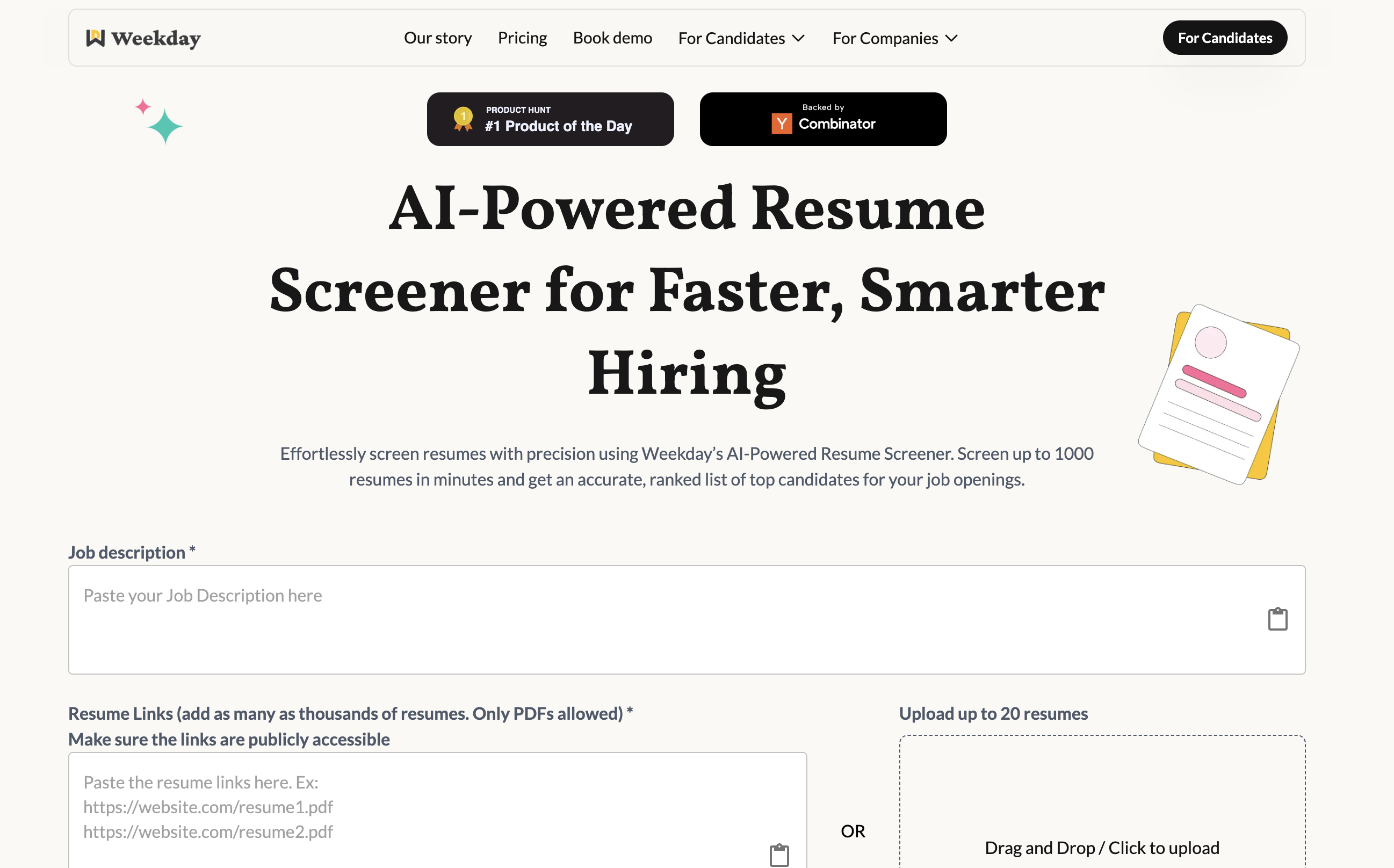
Screening is another bottleneck. When applications pile up, manual review slows everything down. Tools like Weekday Resume Screener help surface the right candidates faster, so teams don’t waste time on low-signal profiles.
And importantly, strong teams don’t treat hiring as a one-time effort. They build systems — pipelines, processes, and workflows that are ready before urgency hits. For teams that don’t have time to build this internally, Weekday Forward Deployed Solutions helps set that up end-to-end.
A Better Question to Ask
Before pushing for more applicants, it’s worth stepping back.
Are you lacking candidates, or struggling to identify the right ones?
Are you evaluating well, or just filtering more?
Is your process creating clarity, or adding complexity?
Growth doesn’t come from adding more by default. It comes from doing fewer things, better. That applies to hiring too. More applicants won’t fix the problem. A better system might.