Written by Amit Singh, Founder & CEO at Weekday
In August 2023, Forbes published a story about Weekday with a headline that didn't hedge: "Weekday Raises $2.2 Million As It Pledges To Take On LinkedIn." Written by contributor David Prosser, the article announced Weekday's seed round and framed the company as a classic David versus Goliath bet. A small YC-backed startup, two years into building, going up against a 20-year-old platform that had become the default for hiring worldwide.
Nearly three years later, that article is worth revisiting. Not because press coverage ages well on its own, but because the thesis it captured is the same one Weekday still runs on today. The numbers have changed dramatically. The bet has not.
A seed round built on a simple observation
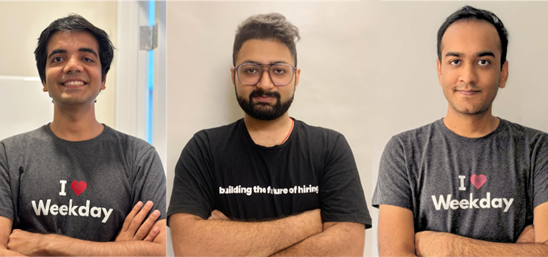
Weekday was founded in 2021 by Amit Singh, Anubhav Malik, and Chetan Dalal, and went through Y Combinator's Winter 2021 batch. By the time Forbes covered the company, the founders had spent two years quietly building before turning on sales. The seed round was led by Venture Highway, with a group of angel investors joining in.
The observation driving everything was about trust. Recruiters in 2023 had access to millions of profiles across platforms, but profiles only told them who existed, not who was good. The one signal that could answer that question, references, was broken in two ways. References came too late in the process, usually after weeks of interviews were already invested in a candidate. And they came from the wrong people, because candidates handpicked their own referees, turning references into testimonials rather than honest signals.
Singh put the ambition bluntly in the article, describing Weekday as "what LinkedIn should have been."
The bet on references
Weekday's product at the time worked differently from anything else in talent sourcing. Software engineers signed up and connected their professional networks. When a recruiter searched for candidates, Weekday didn't just return matching profiles. It reached out to the closest contacts of shortlisted candidates and collected references upfront, often before the first interview ever happened. Automated reference forms went out over WhatsApp and email, and for most candidates, quality references came back within 24 hours.
The analogy Singh drew for Forbes was online shopping. Nobody buys a product without reading reviews from other buyers, yet companies were making lakhs-per-month hiring decisions with no equivalent signal. Weekday wanted to be that review layer for engineering talent.
The timing helped the argument. Remote work was becoming the norm in software engineering, which meant recruiters were increasingly hiring people they would never meet in person. Independent trust signals were becoming more valuable, not less.
By August 2023, the platform had a database of more than 800,000 engineers, and around 120 companies had hired through it. Using Weekday was free. Companies paid only when they made a successful hire, a pricing structure that survives unchanged today.
Why investors backed the underdog
Venture Highway's Aviral Bhatnagar explained the fund's reasoning in the article, and it doubled as a critique of the entire recruiting industry. Nearly every other company function had seen breakthrough products in the preceding five or six years. Design had Figma. Dev tools, sales, and product had all been reinvented. Recruitment hadn't. LinkedIn, two decades old, was still the de facto platform, and Venture Highway partnered with Weekday specifically to change that.
That framing matters because it explains why a $2.2 million seed round against a Microsoft-owned giant wasn't as lopsided as it sounds. The opportunity wasn't to out-build LinkedIn's network. It was to build the layer LinkedIn never did: verified signal about who is actually worth hiring.
What the 2023 snapshot looks like from 2026
The Forbes article captured Weekday at the starting line, and the distance covered since tells its own story.
The candidate database has grown from 800,000 engineers to over 300 million profiles, covering roughly 90% of India's tech workforce. The reference engine Forbes described evolved into a full AI-driven outbound recruiting platform that proactively reaches candidates across email, WhatsApp, and phone, with outreach campaigns seeing 50%+ response rates. After Y Combinator and the Venture Highway-led seed, General Catalyst joined as a backer. And the success-based model stayed intact: companies pay a contingency fee only on successful hires, backed by a 60-day replacement guarantee.
The core idea connecting 2023 to 2026 is that better signal beats bigger inventory. The reference layer was the first expression of that idea. Today it runs through everything Weekday does: how candidates are sourced, how they're verified, and how companies decide who to interview.
The Forbes feature timestamped the beginning of that journey. Anyone evaluating Weekday today can draw a straight line from the thesis the founders described in 2023 to the product companies use now, which is about the best outcome a seed announcement can age into.
Read the original article on Forbes: Weekday Raises $2.2 Million As It Pledges To Take On LinkedIn.
Last updated: June 2026