.svg)
ctc meaning — the short answer
CTC stands for cost to company. it's the total amount a company spends on you in a year: your salary, plus the money it puts into your PF, gratuity, insurance, bonuses, and sometimes stock. it is not the amount that lands in your bank account every month.
the amount that lands in your account is your in-hand salary (also called take-home or net salary). it's what's left after PF, professional tax, and income tax are cut from your gross salary.
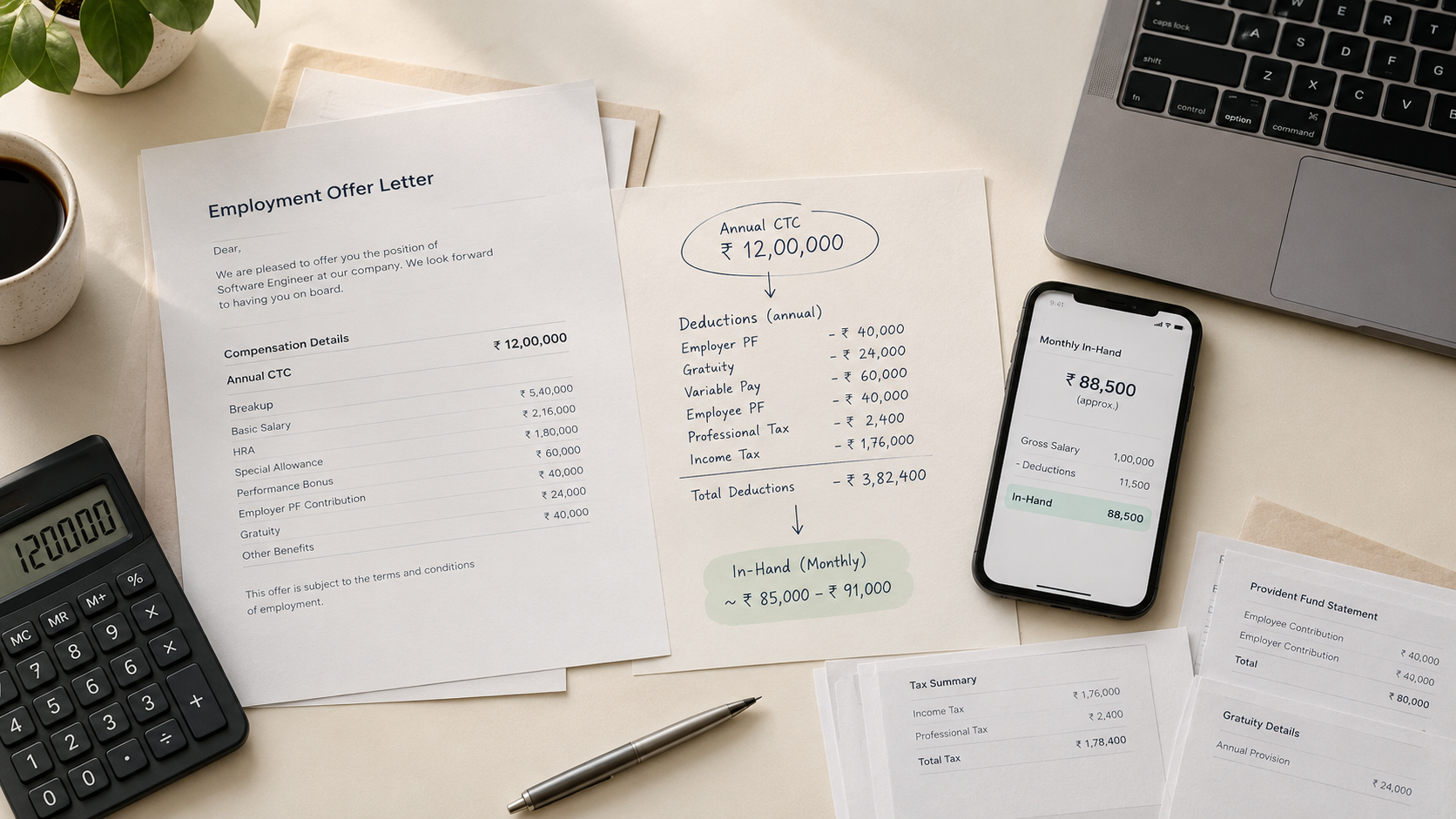
so when an offer says "12 LPA," that's the company's cost. your monthly credit will be something like ₹85,000–₹91,000, not ₹1,00,000. this guide shows you exactly where the gap goes, what changed in 2026, and how to read an offer letter before you sign it.
ctc vs gross salary vs in-hand salary
every offer letter in india has three numbers hiding in it. most people only look at the first one.
| term | what it means | who it matters to |
|---|---|---|
| CTC (cost to company) | everything the company spends on you in a year — salary + employer PF + gratuity + variable pay + benefits | the company's budget, and the number recruiters quote |
| gross salary | CTC minus the parts you never touch monthly (employer PF, gratuity, and usually variable pay) | the starting point for your payslip and tax |
| in-hand salary | gross minus your PF contribution, professional tax, and income tax (TDS) | you — this is what pays your rent |
the simple formula: in-hand = CTC − employer PF − gratuity − variable pay − employee PF − professional tax − income tax.
what's inside your ctc
not every company uses the same structure, but most CTCs in india are built from these pieces:
| component | paid monthly? | what to know |
|---|---|---|
| basic salary | yes | the base everything else is calculated on. under the new labour codes, it now has to be at least 50% of your pay (more on this below) |
| HRA, special allowance, other allowances | yes | the flexible part of your salary. HRA only saves tax if you're in the old tax regime |
| employer PF contribution | no — goes to your PF account | 12% of your PF wage. it's your money, but you can't spend it this month |
| gratuity | no — paid when you leave | usually budgeted at 4.81% of basic. you only get it after 5 years of service (1 year for fixed-term employees) |
| variable pay / performance bonus | no — usually yearly or quarterly | depends on your rating and company performance. full payout is not guaranteed |
| joining bonus | once | one-time. often has a clawback if you leave within 6–24 months |
| health insurance premium | no | some companies count the premium they pay for your group policy inside CTC |
| ESOPs / RSUs | no | usually vest over 3–4 years. some offers show the full multi-year grant as if it's one year's pay |
that last row is where a lot of frustration comes from. on forums like blind, engineers regularly complain that indian CTC figures bundle the employer's retirement contribution, four years of unvested stock and the bonus into a single yearly number. the headline looks great. the payslip doesn't.
what gets cut before your salary hits your account
once you're down to gross salary, three deductions come out every month.
1. employee PF — 12% of your PF wage. this goes to your EPF account. many companies calculate it only up to the statutory wage ceiling, which was ₹15,000 a month until september 2026 and is now ₹25,000. at the ceiling, that's ₹3,000 a month from you, and another ₹3,000 from your employer. some companies calculate PF on your full basic instead, which means a bigger deduction.
2. professional tax — up to ₹200 a month. this is a state tax. karnataka, maharashtra, telangana, west bengal and gujarat charge ₹200 a month at most salary levels (maharashtra charges ₹300 in february). tamil nadu charges it half-yearly. delhi, haryana, uttar pradesh and rajasthan don't charge it at all.
3. income tax (TDS). your employer estimates your yearly tax and deducts it in equal parts every month. under the new tax regime, salaried people pay zero tax on taxable income up to ₹12 lakh, thanks to the ₹75,000 standard deduction and the section 87A rebate. above that, the slabs kick in.
what changed in 2026 (and why your payslip might look different)
if you joined a company before this year, your in-hand salary may have shifted even though your CTC didn't. three changes are behind it.
1. the new labour codes: the 50% basic rule
the four labour codes came into force on 21 november 2025. the big one for salaries: "wages" (basic + dearness allowance + retaining allowance) must be at least 50% of your total pay. if allowances take up more than half your package, the excess gets counted as wages anyway.
for years, companies kept basic at 30–40% of CTC and loaded the rest into allowances. that kept PF and gratuity small and in-hand big. with basic pushed to 50%, PF and gratuity go up and monthly in-hand typically drops by 2–5% at the same CTC. the upside is a bigger retirement corpus and a bigger gratuity cheque when you leave.
2. EPF wage ceiling raised to ₹25,000 (from 17 september 2026)
the union cabinet approved raising the EPF wage ceiling from ₹15,000 to ₹25,000 a month — the first change since 2014. two things follow:
if you earn between ₹15,000 and ₹25,000 a month, you're now covered by EPF mandatorily. that means a new PF deduction on your payslip.
if your company caps PF at the statutory limit, the cap moved from ₹1,800 to ₹3,000 a month. since employer PF also sits inside your CTC, your monthly in-hand can drop by up to ₹2,400 at the same CTC unless your company restructures your pay. that money isn't lost — it's in your PF account — but it's not in your bank account either.
3. the new income tax act and "tax year"
the income tax act, 2025 replaced the 1961 act from 1 april 2026. "financial year" and "assessment year" are now just "tax year." budget 2026 didn't change the slabs, the ₹75,000 standard deduction, or the ₹12 lakh zero-tax limit under the new regime. if you're in the old regime and pay rent, the 50% HRA exemption now covers bengaluru, hyderabad, pune and ahmedabad too, not just the original four metros.
ctc to in-hand: monthly salary for common packages
here's roughly what lands in your account each month at different CTCs, for tax year 2026-27.
| CTC (per year) | monthly gross | yearly income tax | monthly in-hand | in-hand as % of CTC |
|---|---|---|---|---|
| ₹4 LPA | ₹30,532 | ₹0 | ₹28,332 | 85% |
| ₹6 LPA | ₹45,798 | ₹0 | ₹42,598 | 85% |
| ₹8 LPA | ₹62,063 | ₹0 | ₹58,863 | 88% |
| ₹10 LPA | ₹78,329 | ₹0 | ₹75,129 | 90% |
| ₹12 LPA | ₹94,595 | ₹0 | ₹91,395 | 91% |
| ₹15 LPA | ₹1,18,994 | ₹86,256 | ₹1,08,606 | 87% |
| ₹20 LPA | ₹1,59,658 | ₹1,74,907 | ₹1,41,883 | 85% |
| ₹25 LPA | ₹2,00,323 | ₹2,93,508 | ₹1,72,664 | 83% |
| ₹30 LPA | ₹2,40,988 | ₹4,42,057 | ₹2,00,949 | 80% |
assumptions: no variable pay, basic at 50% of CTC, PF at 12% capped at the ₹25,000 ceiling (₹3,000/month each from you and your employer), gratuity at 4.81% of basic, professional tax of ₹200/month, new tax regime with 4% cess. your actual number will move with your company's structure — use this as a sanity check, not a promise.
notice the % column rises up to 12 LPA, then falls. that's because PF stops growing once it hits the ceiling, and income tax is zero until about 12.75 LPA of gross. past that, tax takes a bigger bite with every lakh.
worked example: 12 LPA, line by line
CTC                                 ₹12,00,000
− employer PF (₹3,000 × 12)          −₹36,000
− gratuity (4.81% of ₹6L basic)      −₹28,860
= gross salary                      ₹11,35,140

− employee PF (₹3,000 × 12)          −₹36,000
− professional tax (₹200 × 12)        −₹2,400
− income tax                               ₹0   (taxable ₹10.6L, under the ₹12L limit)
= in-hand per year                  ₹10,96,740

in-hand per month                      ₹91,395
if this company calculated PF on your full basic (₹50,000/month) instead of capping it, both PF lines would double and your in-hand would fall to about ₹85,400 a month. same CTC, ₹6,000 less every month. that's why you ask how PF is calculated.
what ctc do you need for a given in-hand salary?
if you know the monthly number you need, work backwards. same assumptions as the table above.
| monthly in-hand you want | approximate CTC needed |
|---|---|
| ₹25,000 | ₹3.5 LPA |
| ₹30,000 | ₹4.2 LPA |
| ₹40,000 | ₹5.6 LPA |
| ₹50,000 | ₹6.9 LPA |
| ₹75,000 | ₹10 LPA |
| ₹1,00,000 | ₹13.1 LPA |
add your variable pay on top of these. a variable component doesn't help you pay monthly bills.
the parts of ctc people regret not asking about
the formula is the easy part. the surprises come from the fine print.
variable pay that isn't really yours yet. take a 20 LPA offer with ₹2 lakh variable. your monthly in-hand is calculated on the ₹18 lakh fixed part — about ₹1,29,000, not ₹1,41,900. that's ₹13,000 a month less than you'd assume, and the ₹2 lakh only arrives if your rating and the company's year cooperate. on blind offer threads, a common move is asking the recruiter to fold the variable into fixed pay and leave everything else unchanged.
joining bonuses with clawbacks. a joining bonus inflates your first-year CTC. if you leave within the lock-in period (usually 12 months), you may have to pay it back. check whether the recovery is on the gross amount or what you actually received after tax — some contracts ask for the gross back.
gratuity you may never get. it sits in your CTC from day one, but if you're a permanent employee and leave before 5 years, you don't receive it. if you switch jobs every 2–3 years, mentally delete it from your CTC.
ESOPs counted as yearly pay. if an offer shows ₹8 lakh of ESOPs inside a ₹30 lakh CTC, ask whether that ₹8 lakh vests in one year or over four. at a startup, also ask what the strike price is and whether there's ever been a buyback.
insurance and "benefits" inside CTC. a ₹15,000 group health premium is useful, but it's not salary. if a company includes it in CTC and another doesn't, the two offers aren't comparable on CTC alone.
questions to ask HR before you accept an offer
you don't need to be awkward about this. recruiters get these questions every day.
1. can you share the full salary breakup — basic, allowances, PF, gratuity, variable?
2. what will my monthly in-hand be in the first month?
3. is PF calculated on my full basic or capped at the statutory ceiling? can I choose?
4. how much of the CTC is variable, how often is it paid, and what was the average payout last year?
5. is the joining bonus part of CTC? what's the clawback period, and is it on gross or net?
6. are ESOPs or insurance included in the CTC number?
7. is there a service bond or notice period buyout clause?
if you're a fresher vs if you're switching jobs
freshers: compare offers on monthly in-hand, not CTC. a 4.5 LPA offer with a service bond and 15% variable can pay less every month than a clean 4 LPA offer. look at what people in the same role actually earn at that company — for mass recruiters, check real numbers on weekday's salary pages for TCS, infosys, wipro, accenture, cognizant and capgemini.
switchers: negotiate your hike on fixed pay, not total CTC. a 30% hike on CTC is not a 30% hike in your account. going from 12 LPA to 15.6 LPA moves your in-hand from about ₹91,400 to ₹1,12,700 a month — a 23% increase — because you've crossed the ₹12 lakh tax-free line. and if your new company wants you to join early, ask whether they'll cover your notice period buyout. that's real money, and it's negotiable. (more on that in our guide to what "immediate joiner" means.)
frequently asked questions
is CTC the same as gross salary?
no. gross salary is CTC minus the parts that never come to you monthly — mainly employer PF, gratuity, and variable pay. without variable pay, gross is usually 4–9% lower than CTC.
is PF part of in-hand salary?
no. both your PF contribution and your employer's go to your EPF account. it's your money and earns interest, but it isn't part of your monthly in-hand.
why is my in-hand lower than CTC divided by 12?
because CTC includes employer PF, gratuity, variable pay and benefits that aren't paid monthly, and then employee PF, professional tax and income tax come out of what's left. at most salary levels, in-hand is 80–90% of CTC divided by 12.
is 7.5 LPA a good CTC?
it depends on your role and city, but at 7.5 LPA your monthly in-hand would be roughly ₹54,800 with zero income tax under the new regime. compare it against what your role pays at similar companies before deciding.
how do I calculate my exact tax?
the income tax department has an official income and tax calculator. put in your gross salary and deductions to see both regimes side by side.
know what the market pays before you negotiate
the best defence against a confusing CTC is knowing what people in your role actually take home. search real salaries by company on weekday — role by role, by years of experience.
then browse open roles on weekday and filter by salary range, so you're comparing real offers instead of headline numbers. if you're applying soon, run your resume through the free ATS resume checker first, and practise with the interview question predictor for the role you want.
a good offer isn't the one with the biggest CTC. it's the one where you know exactly what lands in your account on the first of the month.