.svg)
Frontend engineering plays a crucial role in shaping how users experience a digital product. From intuitive layouts to lightning-fast load times, frontend engineers are responsible for building the visual and interactive aspects of websites and applications that users see and interact with every day.
For companies, a well-crafted frontend engineering job description does more than list skills — it communicates the scope of the role, the impact it has on the product, and the kind of expertise needed to succeed. A clear, accurate job description helps attract candidates who are both technically proficient and aligned with your team’s vision.
In this guide, we’ll cover what to include in a frontend engineering job description, the core responsibilities and requirements for the role, and a ready-to-use template you can adapt for your hiring needs.
TL;DR (Key Takeaways)
- A frontend engineer builds the visual and interactive parts of a digital product using HTML, CSS, JavaScript, and frameworks like React or Vue.
- The job description should go beyond listing skills—it must clarify responsibilities, tools, collaboration scope, and expected impact on user experience.
- Essential skills include responsive design, API integration, performance optimization, and accessibility compliance.
- Clear job descriptions improve both quality and relevance of applicants.
- Weekday helps companies connect with pre-vetted frontend talent through multi-channel outreach and data-backed sourcing tools.
What is a Frontend Engineer?
A frontend engineer is a software professional who specializes in building the client-facing side of applications — the parts users see, click, and interact with. They work at the intersection of design and technology, turning static design mockups into fully functional user interfaces.
Frontend engineers collaborate closely with UX/UI designers to ensure visual accuracy, with backend engineers to integrate APIs and data, and with product managers to deliver features that meet business goals. Beyond coding, they optimize performance, maintain accessibility standards, and ensure consistency across devices and browsers.
Whether it’s creating a single-page application with React, building reusable components in Vue, or fine-tuning animations for a better user experience, frontend engineers ensure that the digital face of your product is as seamless and engaging as possible.
Key Responsibilities in a Frontend Engineering Job Description
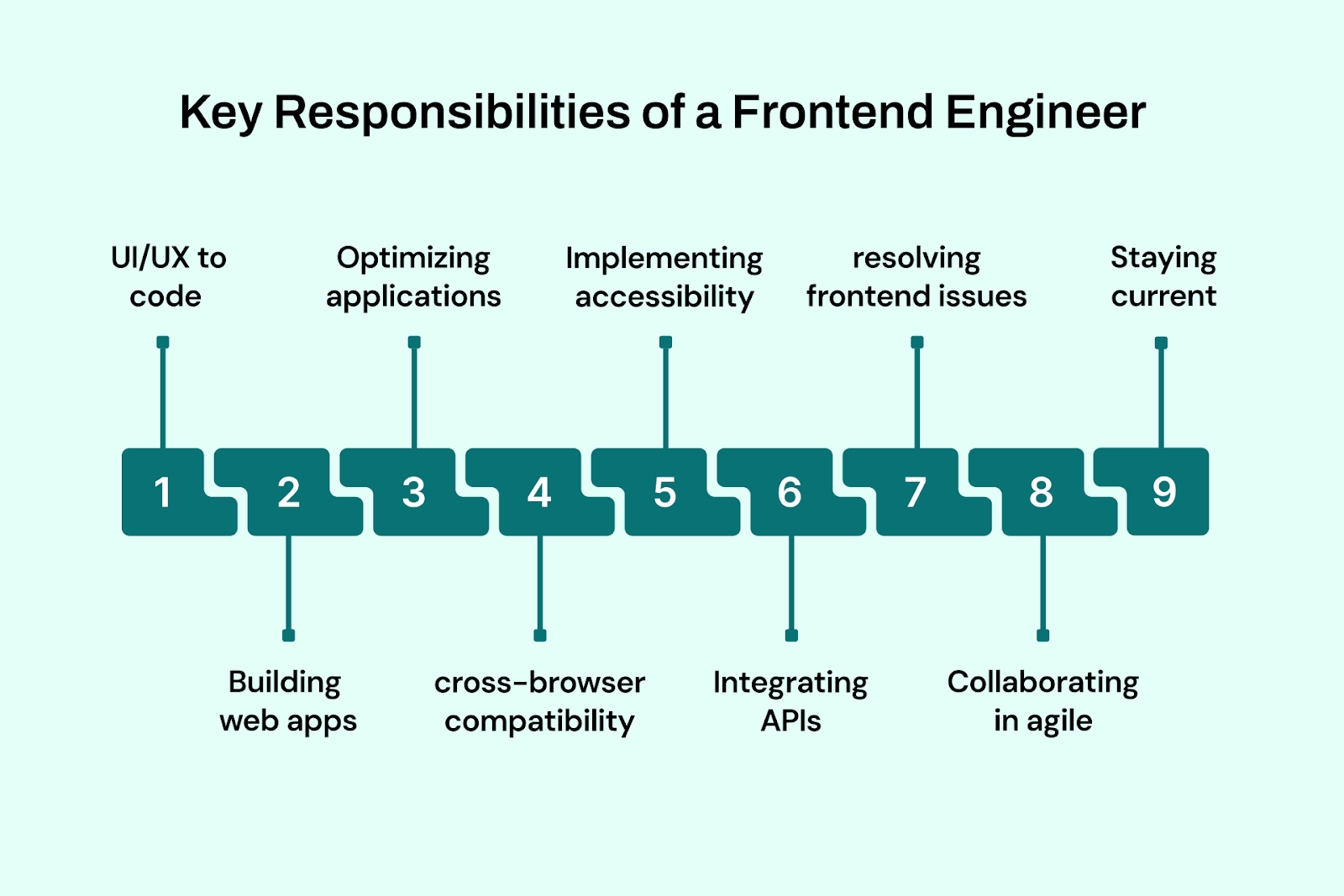
While the exact duties vary by company and project, most frontend engineering job descriptions include the following responsibilities:
- Translating UI/UX designs into functional code using HTML5, CSS3, and JavaScript (or TypeScript).
- Building and maintaining responsive web applications that perform well on desktops, tablets, and mobile devices.
- Optimizing applications for maximum speed and scalability, reducing load times, and improving rendering performance.
- Ensuring cross-browser compatibility so features work consistently across different browsers.
- Implementing accessibility best practices to meet WCAG and other relevant guidelines.
- Integrating APIs and working closely with backend teams to connect user interfaces with application logic.
- Debugging and resolving frontend issues, including layout inconsistencies, performance bottlenecks, and JavaScript errors.
- Collaborating in agile development environments, participating in code reviews, sprint planning, and stand-ups.
- Staying current with frontend technologies such as new JavaScript frameworks, CSS techniques, and build tools.
Also read: Exploring Automated Sourcing Tools for Recruitment
Frontend Engineering Job Requirements (Skills & Qualifications)
When defining your frontend engineering job requirement, it’s important to cover both technical expertise and the soft skills that enable a developer to work effectively within a team. This ensures that candidates have not only the right coding abilities but also the mindset and communication skills needed to deliver high-quality work.
Technical Skills
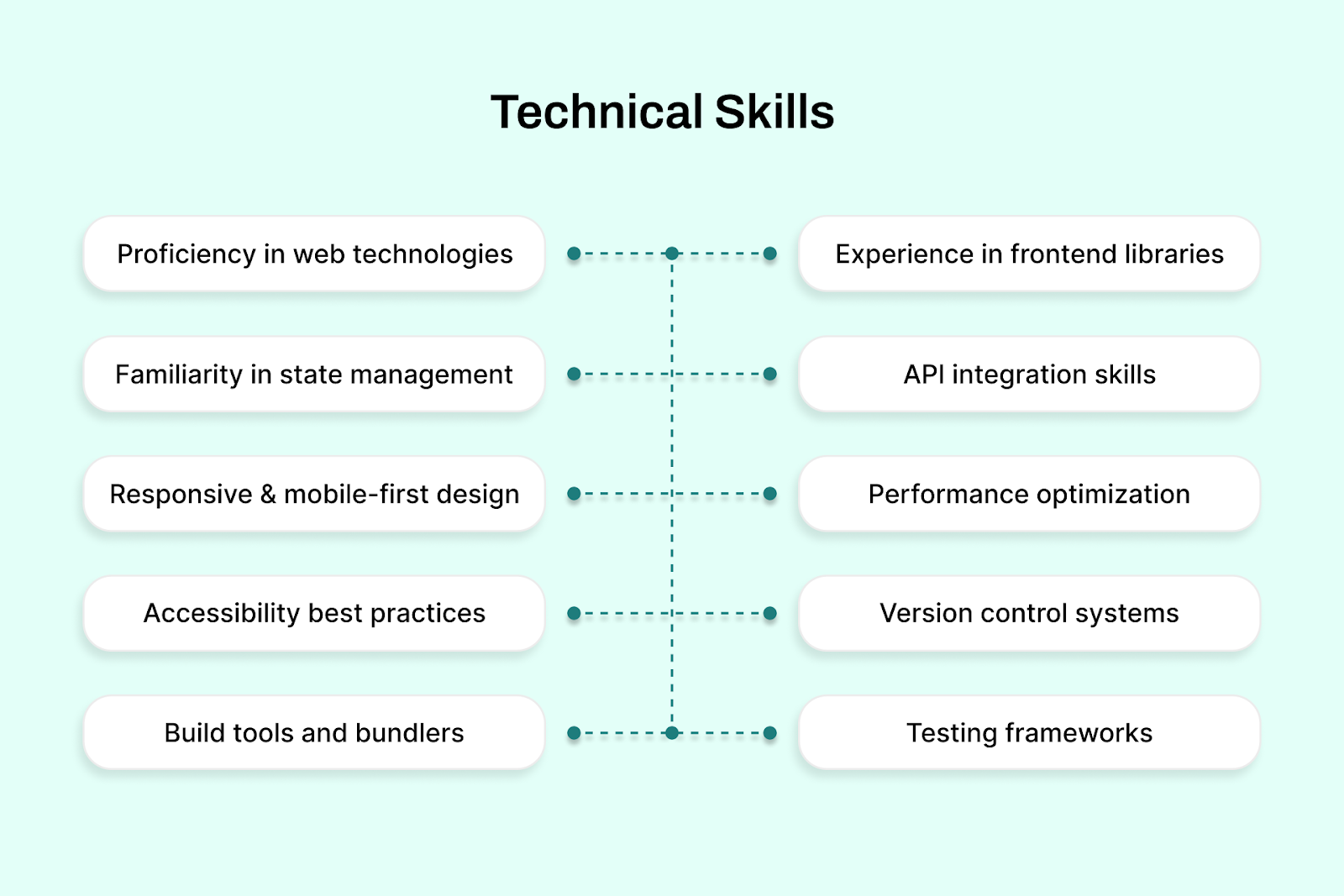
- Proficiency in core web technologies: HTML5, CSS3, and JavaScript (ES6+), with a strong understanding of semantic HTML and modern CSS techniques.
- Experience with frontend frameworks and libraries: React, Angular, or Vue.js for building scalable, modular applications.
- Familiarity with state management tools such as Redux, Vuex, or Zustand.
- API integration skills: Comfortable consuming RESTful APIs and working with GraphQL.
- Responsive and mobile-first design: Ability to create layouts that adapt smoothly across devices and screen sizes.
- Performance optimization: Techniques for reducing load times, improving rendering speed, and minimizing bundle size.
- Accessibility (a11y) best practices: Implementing ARIA roles, keyboard navigation, and color contrast compliance.
- Version control systems: Proficiency in Git for collaboration and code management.
- Build tools and bundlers: Webpack, Vite, Parcel, or similar for compiling, bundling, and optimizing code.
- Testing frameworks: Experience with Jest, Cypress, or React Testing Library for ensuring code quality.
Also read: Top 10 Tips for Building Stronger Connections with Engineering Talent
Soft Skills
- Attention to detail: Ensuring UI fidelity and consistent user experience.
- Problem-solving mindset: Ability to debug issues and find creative, maintainable solutions.
- Collaboration: Comfortable working with cross-functional teams, including designers, backend developers, and product managers.
- Adaptability: Willingness to learn new tools, frameworks, and best practices as the frontend ecosystem evolves.
- Communication: Clear verbal and written communication to explain technical decisions to both technical and non-technical stakeholders.
Educational Background & Experience
- Education: Bachelor’s degree in Computer Science, Software Engineering, or a related field (or equivalent practical experience).
- Experience:
- Entry-level roles: Strong portfolio or GitHub showcasing personal projects, internships, or open-source contributions.
- Mid-to-senior roles: 2–5+ years of professional experience in frontend development, preferably with large-scale or high-traffic applications.
- Entry-level roles: Strong portfolio or GitHub showcasing personal projects, internships, or open-source contributions.
Also read: Recruitment Strategies to Hire Top Talent in 2024
Frontend Engineering Job Description Template
You can use the following template as a starting point when creating your own listing. Customize it to reflect your company’s tech stack, culture, and project requirements.
Job Title: Frontend Engineer
Location: [Insert Location or “Remote”]
Job Type: [Full-time/Part-time/Contract]
Department: Engineering / Product Development
Job Overview:
We are looking for a skilled and motivated Frontend Engineer to join our development team. In this role, you will be responsible for building and optimizing the user-facing components of our applications, ensuring high performance, scalability, and a seamless user experience. You will collaborate closely with designers, backend developers, and product managers to deliver high-quality, maintainable code.
Key Responsibilities:
- Develop responsive, accessible, and high-performance web applications using HTML5, CSS3, and JavaScript (ES6+) or TypeScript.
- Build modular, reusable components using frameworks like React, Angular, or Vue.js.
- Collaborate with designers to translate UI/UX wireframes into functional interfaces with pixel-perfect accuracy.
- Integrate RESTful APIs and GraphQL endpoints into the frontend.
- Optimize applications for speed, scalability, and cross-browser compatibility.
- Implement accessibility best practices (WCAG) to ensure inclusive design.
- Debug, test, and troubleshoot UI-related issues across multiple devices and environments.
- Participate in code reviews, sprint planning, and team stand-ups in an agile environment.
- Stay updated on emerging frontend technologies, frameworks, and trends.
Requirements:
- Proficiency in HTML5, CSS3, and JavaScript (ES6+) or TypeScript.
- Experience with at least one modern frontend framework (React, Angular, or Vue.js).
- Strong understanding of responsive design principles and CSS preprocessors (SASS/LESS).
- Familiarity with version control tools like Git and build tools like Webpack, Vite, or Parcel.
- Experience with testing frameworks such as Jest, Cypress, or React Testing Library.
- Understanding of API integration (REST, GraphQL) and asynchronous programming.
- Strong problem-solving and debugging skills.
- Excellent collaboration and communication abilities.
Nice-to-Have Skills:
- Experience with design systems or UI component libraries (Material UI, Chakra UI, Tailwind CSS).
- Knowledge of server-side rendering (Next.js, Nuxt.js) for performance and SEO optimization.
- Familiarity with CI/CD pipelines and deployment workflows.
- Awareness of web security best practices.
Education & Experience:
- Bachelor’s degree in Computer Science, Software Engineering, or a related field (or equivalent experience).
- 2–5+ years of professional experience in frontend development (for mid/senior roles).
- Strong portfolio, GitHub, or live project links showcasing your work.
What We Offer:
- Competitive salary and benefits package.
- Opportunities for professional growth and skill development.
- Collaborative, innovative work environment.
- Access to the latest tools, frameworks, and technologies.
How to Apply:
If you’re passionate about building exceptional user interfaces and delivering high-quality digital experiences, we’d love to hear from you. Please submit your resume, portfolio, and relevant project links to [Insert Application Email/Link].
Tips for Writing an Effective Frontend Engineering Job Description
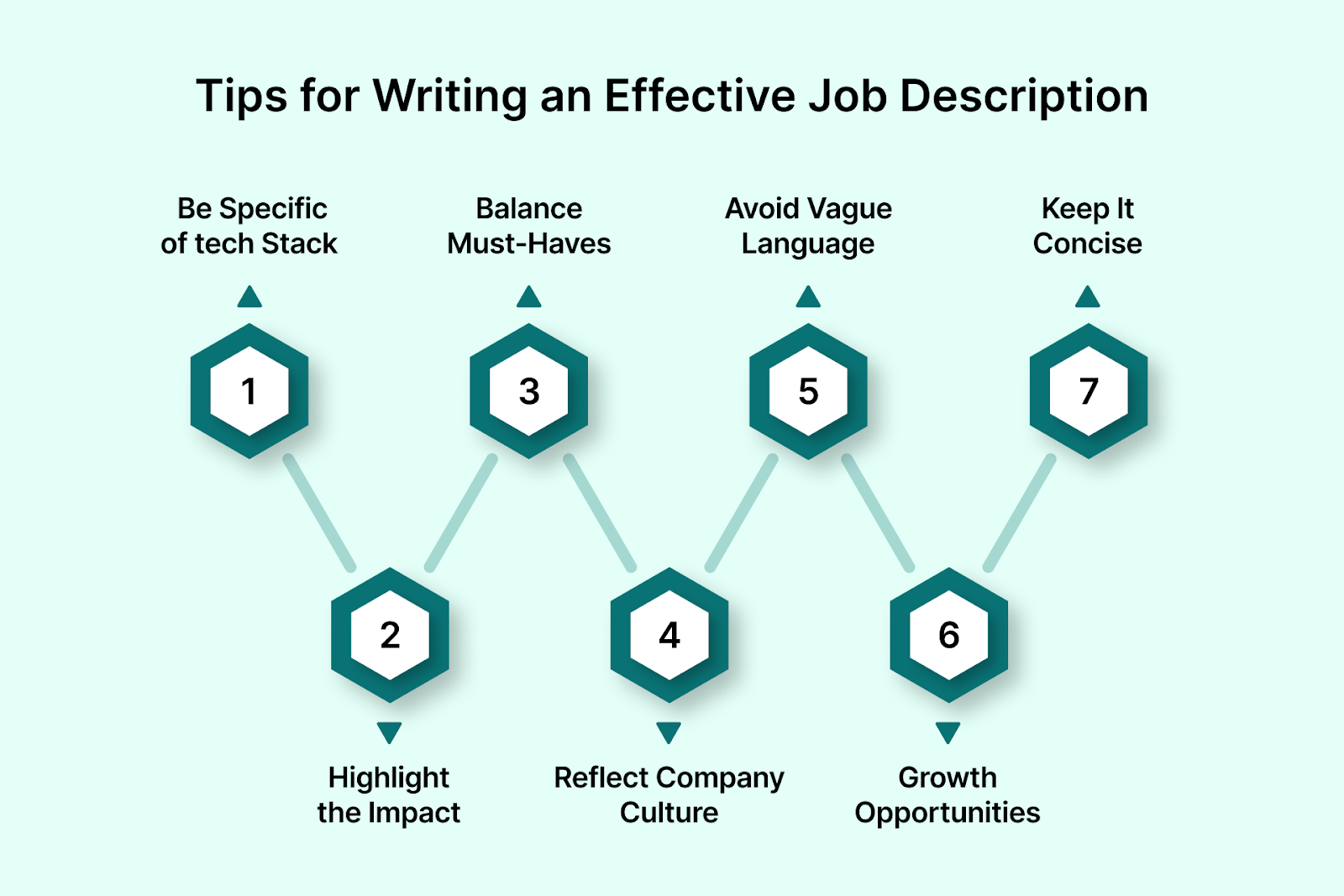
A job description is often the first impression a candidate has of your company. A clear, specific, and engaging description not only attracts more applicants—it helps attract the right applicants. Here are some best practices to keep in mind:
1. Be Specific About the Tech Stack
Frontend engineering covers a wide range of tools and frameworks. Candidates want to know whether you use React, Angular, Vue, or a mix of technologies. Listing your exact stack helps filter for those with relevant experience.
2. Highlight the Impact of the Role
Top engineers are motivated by meaningful work. Include examples of the types of projects they’ll work on—such as building a new customer dashboard, optimizing page load times for millions of users, or implementing a design system for the company.
3. Balance Must-Haves and Nice-to-Haves
Overloading the requirements section with every possible skill can discourage qualified candidates from applying. Separate essential skills from desirable extras so candidates can assess their fit more accurately.
4. Reflect Your Company Culture
Frontend engineers often collaborate with design, product, and backend teams. Give candidates a sense of your work environment—whether it’s fast-paced and startup-oriented, or more structured with well-defined processes.
5. Avoid Vague Language
Phrases like “must be a team player” or “strong work ethic” don’t convey much value. Instead, be clear about the kinds of collaboration or problem-solving the role requires.
6. Mention Growth Opportunities
Candidates are more likely to apply if they see potential for advancement. Share whether you offer professional development programs, mentorship, or opportunities to work on different product areas.
7. Keep It Concise but Comprehensive
Your goal is to provide enough information for a candidate to evaluate the role without overwhelming them with unnecessary detail. Aim for clarity and structure.
Also read: How to Source Candidates on LinkedIn (Effective Methods in 2025) – Learn proven sourcing strategies for finding frontend talent directly on LinkedIn.
Conclusion
A well-structured frontend engineering job description does more than list technical skills—it communicates the role’s responsibilities, the impact on the product, and the type of candidate who will thrive in your team. By clearly defining both the frontend engineering job requirements and the key outcomes expected, you can attract professionals who not only match your technical needs but also align with your culture and work style.
Whether you’re hiring your first frontend engineer or expanding an established team, having the right recruitment tools in place makes a difference. That’s where Weekday can help.
With access to over 80% of India’s white-collar workforce, multi-channel outreach via email, WhatsApp, and calls, and both White Glove and Subscription hiring models, Weekday enables you to connect with top frontend talent faster and more effectively.
If you’re ready to find skilled frontend engineers *who can turn your designs into high-performing, user-friendly applications, let Weekday streamline the process for you.
Start your hiring journey today – Find Your Next Frontend Engineer with Weekday.
Frequently Asked Questions (FAQ)
1. What are the key skills for a frontend engineer?
Core skills include proficiency in HTML, CSS, JavaScript, frontend frameworks like React or Angular, responsive design, performance tuning, and API integration. Familiarity with accessibility standards and testing frameworks is also important.
2. What should be included in a frontend engineer's job description?
Include a summary of the role, day-to-day responsibilities, technical requirements (frameworks, tools), soft skills, education/experience expectations, and a brief about your company culture or project focus.
3. How is a frontend engineer different from a frontend developer?
While the terms are often used interchangeably, "engineer" may imply a stronger focus on scalable architecture, performance, and long-term maintainability. The difference depends on the company and scope of the role.
4. What’s a good format for a frontend engineering job description?
Use clear sections: Job Overview, Responsibilities, Requirements (technical & soft skills), Education/Experience, and What You Offer. You can customize the provided job description template in this blog.
5. What are common mistakes when writing frontend job descriptions?
Vague role expectations, unclear tech stack, unrealistic skill demands, and no mention of impact or growth opportunities. Candidates value clarity and purpose.
6. How can I hire better frontend engineers faster?
Use sourcing tools like Weekday to tap into verified passive candidates. Weekday’s multi-channel outreach (email, WhatsApp, calls) and AI filters help identify and engage top frontend talent efficiently.