
Last updated: 16 November 2026
- What AI/ML interns actually do
- The skills you need, and how to prove each one
- 8 project ideas that stand out
- Where to find AI/ML internships
- Indicative stipends
- 10 interview questions with answers
- A resume tip that changes replies
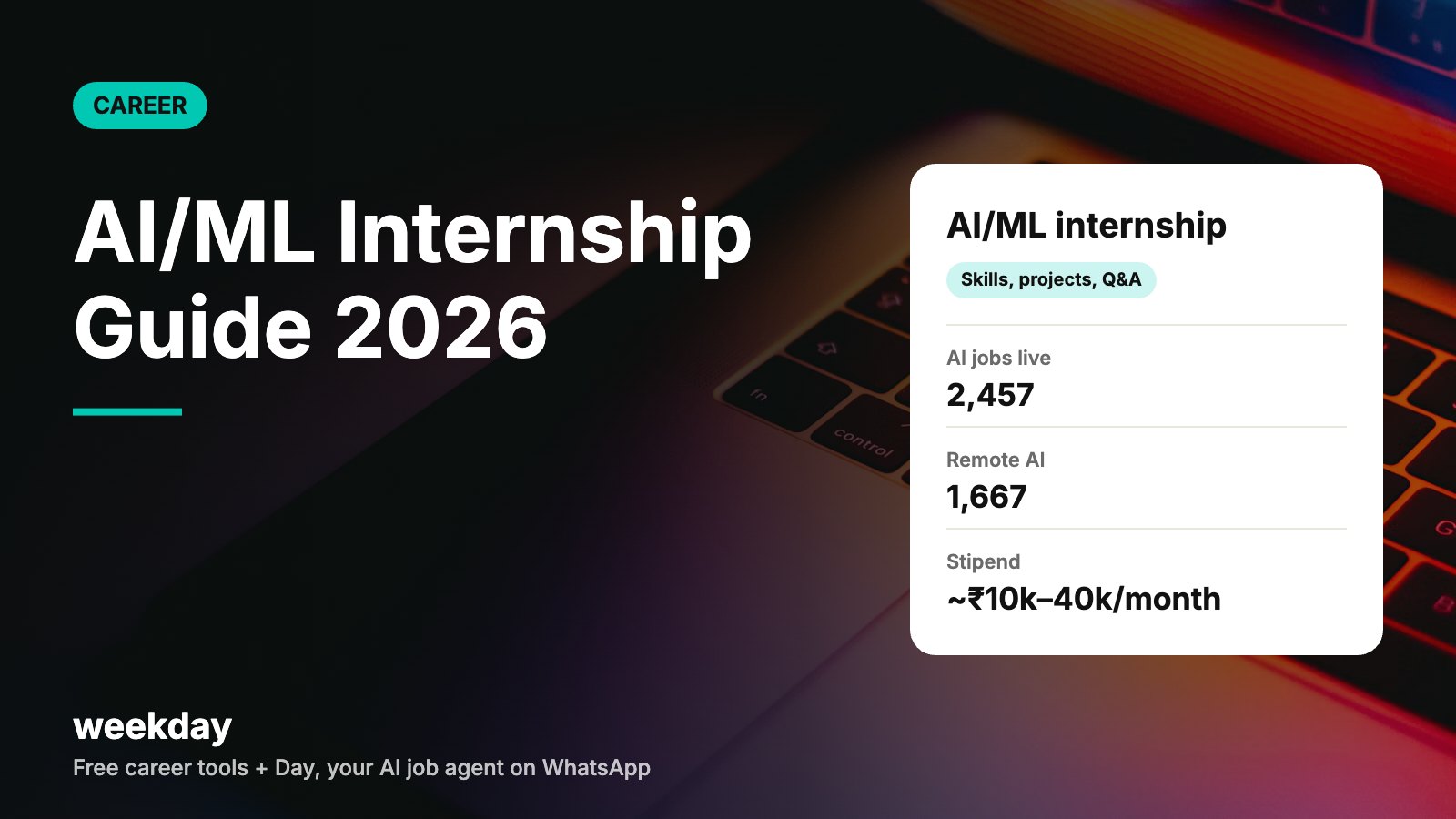
- AI jobs in India: 2,457 live, 409 new this week (browse AI jobs).
- Remote AI jobs: 1,667 live, 210 new this week (see remote AI jobs).
- All internships: 4,188 live, 931 new this week (see internships).
- Remote share of AI jobs: 67.8% (1,667 ÷ 2,457).
Sources: Weekday job listings (jobs.weekday.works), counts as of 16 November 2026. "New this week" = jobs first posted in the last 7 days.
- Open ChatGPT and go to Plugins.
- Search Weekday Jobs and tap Try in chat (or open Weekday Jobs in ChatGPT).
- Ask in plain words, for example:
- “Find AI or machine learning internships for freshers posted this week”
- “Show remote AI jobs open to 0–1 years of experience with Python and PyTorch”
- “Find LLM or GenAI internships at startups in India with a stipend above ₹20,000”
Day, Weekday's free AI job agent, finds jobs that match your skills and pay, and applies when you say yes. On WhatsApp.
Say hi to Day on WhatsAppHow Day works →What do AI/ML interns actually do?
Less model-building than you'd think, and more data work. In most teams, an intern spends the first weeks cleaning data, running experiments someone else designed and writing up results. That's normal, and it's where you learn the most.
| Task | Tools you'll likely use | What you hand in |
|---|---|---|
| Clean and explore data | pandas, NumPy, Jupyter | A cleaned dataset and a short notebook of findings |
| Train a baseline model | scikit-learn | A model with a clear metric (accuracy, F1, RMSE) |
| Run experiments | PyTorch, experiment trackers | A table comparing runs and what changed |
| Build an LLM feature | An LLM API, prompt templates, a vector store | A working prototype, e.g. Q&A over documents |
| Evaluate model outputs | Python scripts, spreadsheets, labelled test sets | An evaluation report with failure examples |
| Ship a small demo | FastAPI or Streamlit, Git | A demo link and a README |
Common AI/ML intern roles
| Role title | Focus | Best for |
|---|---|---|
| Machine learning intern | Classic ML on tabular data | Strong in pandas and scikit-learn |
| Data science intern | Analysis, experiments, dashboards | Good at statistics and SQL |
| GenAI / LLM intern | Prompts, retrieval (RAG), evaluation | Comfortable with APIs and Python |
| Computer vision intern | Image classification, detection | Some PyTorch and a GPU notebook |
| NLP intern | Text classification, extraction, search | Interested in language data |
| MLOps intern | Pipelines, deployment, monitoring | Like engineering more than research |
| AI data / evaluation intern | Labelling, rating and testing AI outputs | Strong English or domain knowledge |
The skills you need, and how to prove each one
You don't need a research paper. You need to show that you can take a messy problem, get data into shape, train something sensible and explain the result.
| Skill | Level expected for an intern | How to prove it |
|---|---|---|
| Python | Functions, classes, list/dict comprehensions, reading files, virtual environments | Clean code in a public GitHub repo |
| NumPy and pandas | Indexing, groupby, merge, handling missing values, vectorised operations | A data-cleaning notebook on a real dataset |
| scikit-learn | Train/test split, pipelines, cross-validation, common models, metrics | One end-to-end tabular project |
| PyTorch | Tensors, a training loop, Dataset/DataLoader, fine-tuning a pretrained model | A small image or text classifier |
| LLM basics | Prompting, embeddings, retrieval (RAG), evaluating answers, token limits | A Q&A bot over your own documents |
| Maths and stats | Mean/variance, probability, gradients in plain words, overfitting | Explaining your model choices in a README |
| SQL | SELECT, JOIN, GROUP BY, window functions basics | Queries in a project or a short exercise repo |
| Git | Branches, commits, pull requests | A tidy commit history |
A simple 8-week learning order
| Weeks | Learn | Build |
|---|---|---|
| 1–2 | Python refresh, NumPy, pandas | Clean and explore one public dataset |
| 3–4 | scikit-learn, metrics, cross-validation | Project 1: tabular prediction with a README |
| 5–6 | PyTorch basics, fine-tuning a pretrained model | Project 2: image or text classifier |
| 7–8 | LLM APIs, embeddings, RAG, evaluation | Project 3: document Q&A with an evaluation table |
8 AI/ML project ideas that stand out
Pick projects with Indian or real-world data where you can, and always report a number. "Built a model" is weak. "Cut error from 18% to 11% against a simple baseline" is strong.
| # | Project | Skills shown | What to report |
|---|---|---|---|
| 1 | House or rent price prediction for an Indian city | pandas, feature engineering, scikit-learn | Error vs a simple baseline |
| 2 | Customer churn prediction for a subscription dataset | Classification, imbalanced data | Precision, recall and what you'd act on |
| 3 | Hindi or Hinglish sentiment classifier | NLP, fine-tuning a small transformer | F1 on a held-out set |
| 4 | Crop or plant-leaf disease image classifier | PyTorch, transfer learning | Accuracy per class and confusion matrix |
| 5 | Q&A bot over a long PDF (e.g. a government scheme document) | Embeddings, RAG, prompt design | Correct answers on 30 test questions |
| 6 | Resume-to-job-description matcher | Text similarity, embeddings | How often the top match is right |
| 7 | Spam or fraud SMS detector | Text features, classic ML | False positives per 100 messages |
| 8 | LLM output evaluator | Test sets, scoring rubrics, scripts | Pass rate before and after a prompt change |
Sample project README summary (copy the structure)
Hindi-English sentiment classifier

Problem: classify short Hinglish product reviews as positive, negative or neutral.
Data: 6,000 public reviews; 80/20 train-test split.
Baseline: TF-IDF + logistic regression, F1 = 0.71.
Model: fine-tuned a small multilingual transformer, F1 = 0.82.
What I learned: most errors came from sarcasm and mixed-script slang. Next step: add 500 hand-labelled sarcastic examples.
Run it: pip install -r requirements.txt, then python train.py
Put these projects in one place. Our guide to a developer portfolio shows how to present them so a recruiter can judge you in two minutes.
Where to find AI/ML internships
- Weekday: filter AI jobs and remote AI jobs for internships and 0–1 years of experience. With 409 new AI listings this week, check every two or three days.
- LinkedIn: search "machine learning intern" or "GenAI intern", filter by Past week, and message the hiring team with one project link.
- Startup career pages: AI startups often hire interns without posting widely. A cold email with a relevant project works well.
- College labs and professors: research internships at your own or nearby institutes are a strong first line on a resume.
- Open source: fixing documentation or small issues in an ML library gets your name in front of maintainers.
- Let an agent do the shortlisting: Weekday's AI job agent can find matching AI roles and apply when you approve.
Indicative AI/ML internship stipends
Stipends depend on the company's funding, the city and how technical the role is. These ranges are indicative, not guaranteed.
| Type of employer | Usual monthly stipend (indicative) |
|---|---|
| Early-stage startups and small firms | around ₹10,000–₹25,000 |
| Growth-stage startups and mid-size tech firms | around ₹20,000–₹40,000 |
| Large tech and well-funded AI companies | often ₹40,000 and above |
| Research labs at institutes | varies widely; sometimes a fixed fellowship |
Worked example. A 6-month internship at ₹25,000 a month pays ₹1,50,000 in total (₹25,000 × 6). A 3-month one at ₹40,000 pays ₹1,20,000. The longer one pays more overall and gives you more time to ship something real, which matters for your next role.
10 AI/ML internship interview questions, with answers
1. What is overfitting, and how do you reduce it?
Overfitting is when a model learns the training data too closely, including noise, so it does well on training data and badly on new data. I check for it by comparing training and validation scores. To reduce it I use more data, simpler models, regularisation like L2 or dropout, cross-validation and early stopping.
2. Explain the bias-variance trade-off.
Bias is error from a model that's too simple to capture the pattern. Variance is error from a model that's too sensitive to the training data. Making a model more complex usually lowers bias but raises variance. The goal is the point where total error on unseen data is lowest.
3. Precision vs recall: when would you prefer each?
Precision is: of the cases I flagged, how many were right. Recall is: of all the true cases, how many I caught. For fraud or disease screening I'd favour recall, because missing a case is costly. For a spam filter I'd favour precision, because blocking a real email annoys users.
4. How do you handle missing values?
First I check why they're missing and how many. If a column is mostly empty I may drop it. Otherwise I impute: median for skewed numbers, mode or an 'Unknown' category for categories, and sometimes add a flag column saying the value was missing. I do the imputation inside a pipeline so the test data doesn't leak into it.
5. What is data leakage? Give an example.
Leakage is when information that wouldn't be available at prediction time gets into training. Example: scaling the whole dataset before splitting into train and test, or using a 'refund issued' column to predict churn. It makes validation scores look great and real-world results poor.
6. How does a random forest work?
It trains many decision trees, each on a random sample of rows and a random subset of features at each split, then averages their predictions (or takes a vote). The randomness makes the trees different, so averaging them reduces variance compared with one deep tree.
7. Walk me through a PyTorch training loop.
For each epoch, for each batch from the DataLoader: move data to the device, run a forward pass, compute the loss, call optimizer.zero_grad(), call loss.backward() to compute gradients, then optimizer.step() to update weights. After each epoch I run the model in eval mode on validation data with torch.no_grad() and log the metric.
8. What is RAG, and why use it?
Retrieval-augmented generation: I split documents into chunks, turn them into embeddings and store them. When a user asks a question, I retrieve the most relevant chunks and pass them to the LLM with the question. It lets the model answer from up-to-date or private data and makes answers easier to check against the source.
9. How would you evaluate an LLM-based feature?
I'd build a test set of real questions with expected answers or a scoring rubric, then measure how often answers are correct, grounded in the source and in the right format. I'd keep failure examples, change one thing at a time, such as the prompt or chunk size, and re-run the same test set to see if the pass rate improves.
10. Tell me about a project you're proud of.
Sample answer (structure: problem, baseline, result, what you fixed)
I built a crop-leaf disease classifier with PyTorch using transfer learning on about 5,000 images. A simple baseline got 74% accuracy; fine-tuning a pretrained model got 91%. The confusion matrix showed two diseases being mixed up, so I added more examples of those and got per-class accuracy above 85% for both. The code and a short demo are on my GitHub.
A resume tip that changes replies
Put projects above education, and write every project bullet as what you built + the number it moved + the tools. Link each project. Recruiters for AI roles often open GitHub before they read anything else.
| Weak bullet | Strong bullet |
|---|---|
| Made a sentiment analysis project | Fine-tuned a multilingual transformer for Hinglish reviews; F1 from 0.71 to 0.82 (PyTorch, Hugging Face) |
| Worked on a chatbot | Built a RAG Q&A bot over a 120-page PDF; 26 of 30 test questions answered correctly (Python, embeddings) |
| Knowledge of ML algorithms | Predicted churn on 7,000 customers; recall 0.78 at precision 0.65 (scikit-learn, pandas) |
Sample resume projects section
PROJECTS
RAG document Q&A bot | Python, embeddings, Streamlit | github.com/yourname/rag-bot
• Answered 26 of 30 test questions correctly over a 120-page scheme document
• Cut wrong answers from 9 to 4 by changing chunk size and adding source citations

Crop-leaf disease classifier | PyTorch, transfer learning | github.com/yourname/leaf-cv
• 91% test accuracy on 5,000 images vs 74% for a baseline CNN
Common mistakes, and the fix
| Mistake | Fix |
|---|---|
| Only tutorial projects (Titanic, MNIST) | Use a real or Indian dataset and report a baseline |
| No README | Problem, data, baseline, result, how to run: five short lines |
| Listing every library you've heard of | List what you used in your projects |
| Can't explain your own model | Practise explaining each project in 2 minutes |
| Paying for a 'guaranteed AI internship' | Never pay. Real internships don't charge. |
FAQs
What skills do I need for an AI/ML internship?
Python, NumPy and pandas, scikit-learn, basic PyTorch, LLM basics such as prompting and RAG, some statistics, SQL and Git.
How many AI jobs are there in India right now?
On 16 November 2026, Weekday listed 2,457 AI jobs, with 409 new this week, and 1,667 remote AI jobs.
What is the stipend for an AI/ML internship in India?
Indicatively, around ₹10,000–₹25,000 a month at early-stage startups, ₹20,000–₹40,000 at growth-stage firms, and often more at large or well-funded AI companies.
Can I get an AI/ML internship without a CS degree?
Yes, if you can show projects. Many interns come from maths, statistics, electronics and other branches. Strong projects with clear results matter more than the degree name.
How many projects should I have?
Two or three good ones are enough: one tabular ML project, one deep learning project and one LLM project, each with a README and a result.
Do I need to know deep learning maths?
You should understand gradients, loss functions and overfitting in plain words. You don't need to derive backpropagation by hand for most internship interviews.
Are remote AI/ML internships common?
Fairly. About 67.8% of AI jobs on Weekday are remote (1,667 of 2,457 on 16 November 2026).
Is Kaggle useful for getting an AI internship?
Yes, as practice and proof. A well-written notebook with a clear result is a good project link. A high rank helps but isn't required.
Can I search AI internships inside ChatGPT?
Yes. Open ChatGPT, go to Plugins, search Weekday Jobs and tap Try in chat, then ask for AI or ML internships for freshers posted this week.





