
Last updated: 25 November 2026
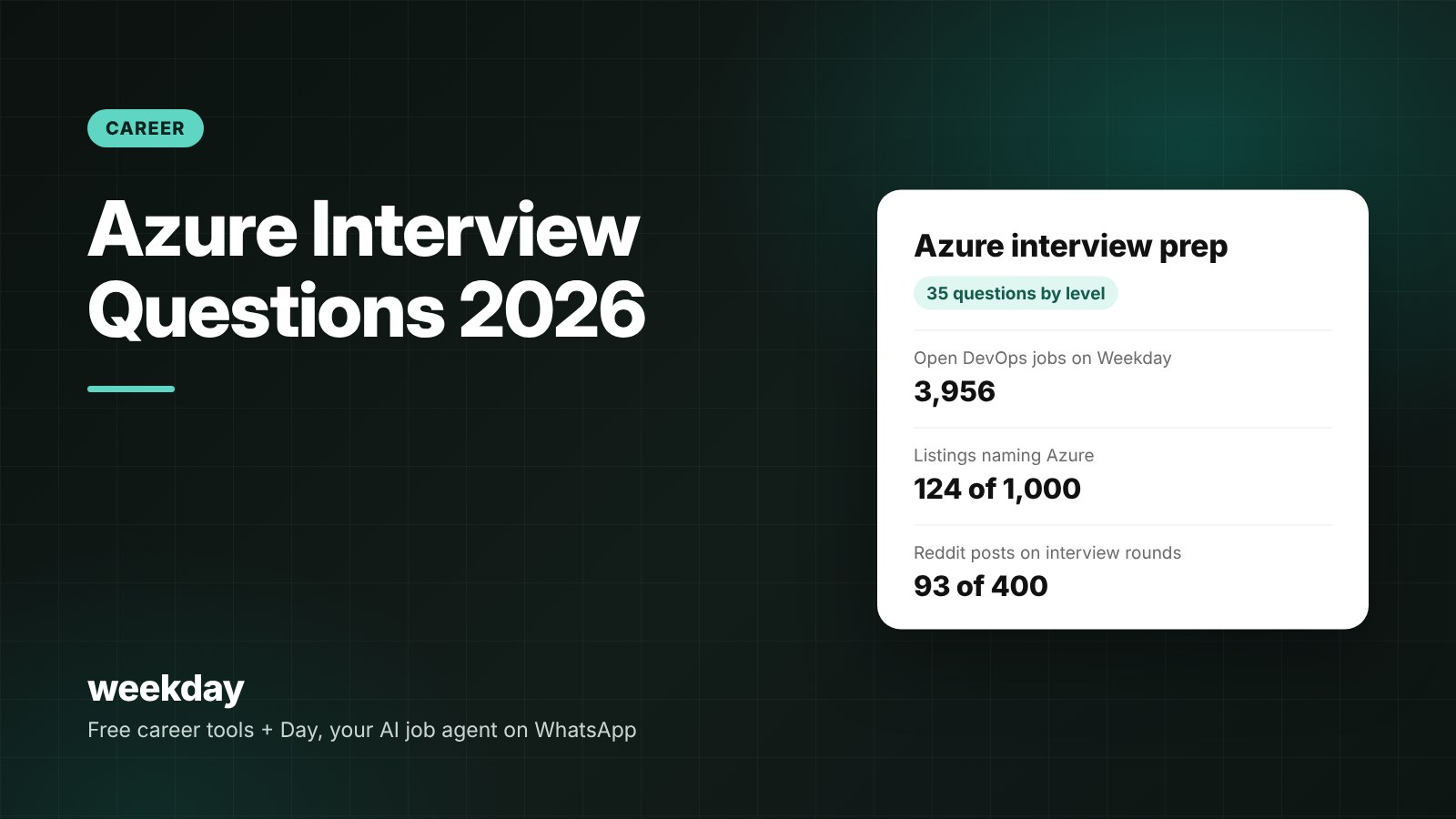
Short answer: Azure interviews test five things: identity and access, networking, storage, compute and monitoring. Freshers get concept questions. With 2–5 years, you get "how would you set this up" questions. Senior rounds are scenarios: outages, cost spikes and security gaps. Below are 35 questions with short answers, grouped by level. Interviews are getting longer, too. In a Weekday analysis of 400 top Reddit posts from the last 30 days, interview rounds and assessments came up in 93 of them. On 25 November 2026, Weekday listed 3,956 open DevOps engineer jobs, and Azure showed up in 124 of the first 1,000, second only to AWS.
This guide covers core Azure: Entra ID, RBAC, VNets, storage, VMs, App Service, Functions, AKS and Key Vault. If your role is mostly pipelines and release management, read our Azure DevOps interview questions too. That's a different product with a different set of questions.
What Azure interviewers actually test
We read the first 1,000 listings on Weekday's DevOps engineer jobs page on 25 November 2026 and counted how many named each tool in the title, skill tags or summary.
| Skill | Listings that mention it (of 1,000) |
|---|---|
| AWS | 174 |
| Azure | 124 |
| Kubernetes | 110 |
| Terraform | 78 |
| GCP | 60 |
| Azure DevOps | 31 |
Summaries are short, so these are floor numbers. Still, the pattern is clear. Azure jobs rarely ask for Azure alone. They want Azure plus Kubernetes plus infrastructure as code.
Microsoft's own AZ-104 exam is a good map of what panels ask. Its study guide weights the topics like this:
| AZ-104 skill area | Weight | What it looks like in an interview |
|---|---|---|
| Identities and governance | 20–25% | Entra ID, RBAC, Azure Policy, subscriptions |
| Compute | 20–25% | VMs, scale sets, App Service, containers |
| Storage | 15–20% | Redundancy, access tiers, secure access |
| Virtual networking | 15–20% | VNets, NSGs, peering, private endpoints |
| Monitoring and backup | 10–15% | Azure Monitor, Log Analytics, Backup |
Expect more rounds than before. A r/jobs thread titled "Is this normal? 9 round interviews???" drew 659 comments. A r/recruitinghell post about a junior role whose technical assessment was the company's Q3 backlog got 5,884 upvotes. So practise in a real Azure subscription, not just from notes.
Azure interview questions for freshers
1. What is Azure, and what are IaaS, PaaS and SaaS?
Azure is Microsoft's public cloud. IaaS gives you raw infrastructure you manage yourself, like Azure VMs. PaaS runs your code while Azure manages the servers, like App Service. SaaS is finished software, like Microsoft 365.
2. What are regions, region pairs and availability zones?
A region is a set of datacenters in one area, like Central India. Availability zones are physically separate locations inside a region, each with its own power, cooling and network. Many regions are paired with another region in the same geography for disaster recovery.
3. How are Azure resources organised?
Management groups hold subscriptions. Subscriptions hold resource groups. Resource groups hold resources. Access and policies set at a higher level flow down to everything below.
4. What is a resource group?
A logical container for resources that share a lifecycle. Each resource belongs to exactly one resource group. Delete the group and everything inside it goes too, which is handy for test setups.
5. What is Microsoft Entra ID?
Azure's cloud identity service, formerly called Azure Active Directory. It handles users, groups, sign-in, MFA and app registrations. It's not the same as on-premises Active Directory Domain Services.
6. How does Azure RBAC work?
A role assignment has three parts: who (user, group or managed identity), what (a role like Owner, Contributor or Reader) and where (a scope like a subscription or resource group). Give the smallest role at the smallest scope that does the job.
7. What services does a storage account offer?
Blob storage for objects, Azure Files for SMB/NFS shares, Queue storage for simple messages and Table storage for key-value data. Managed disks for VMs are a separate service.
8. What are the blob access tiers?
Hot, Cool, Cold and Archive. Cool, Cold and Archive have minimum retention periods of 30, 90 and 180 days in general-purpose v2 accounts. Archive is offline: you rehydrate a blob before reading it, which can take up to 15 hours (Microsoft Learn).
9. What's the difference between LRS, ZRS, GRS and GZRS?
LRS keeps copies in one datacenter. ZRS spreads them across availability zones in one region. GRS and GZRS also copy data to a secondary region. Add "RA-" (RA-GRS, RA-GZRS) if you need to read from the secondary without a failover.
10. What are a VNet, a subnet and an NSG?
A VNet is your private network in Azure. Subnets split it into ranges. A network security group (NSG) is a set of allow and deny rules for traffic, attached to a subnet or a network interface.
11. When would you use a VM, App Service, Functions or AKS?
VMs when you need full OS control. App Service for web apps and APIs without managing servers. Functions for short, event-driven code. AKS when you run many containers and need Kubernetes features.
12. Create a resource group and a VM with the Azure CLI.
az login
az group create --name rg-demo --location centralindia
az vm create --resource-group rg-demo --name vm-demo \
  --image Ubuntu2204 --admin-username azureuser --generate-ssh-keys
Azure interview questions for 2–5 years
13. Availability set, availability zones or scale set?
An availability set spreads VMs across fault and update domains in one datacenter. Zones spread them across separate datacenters. Microsoft's VM SLA is 99.95% for two or more VMs in an availability set and 99.99% for two or more across zones (Microsoft Learn). Scale sets add autoscaling on top.
14. NSG, application security group or Azure Firewall?
NSGs filter traffic with simple rules. Application security groups let you write those rules by role ("web servers") instead of IPs. Azure Firewall is a managed, stateful firewall for central control across VNets, with FQDN filtering and threat intelligence.
15. How does VNet peering work?
It connects two VNets over Microsoft's backbone with private IPs. Peering isn't transitive: if A peers with B and B with C, A can't reach C. That's why teams use a hub-and-spoke design with shared services in the hub.
16. Which load balancer would you pick?
Azure Load Balancer for layer 4 (TCP/UDP) in a region. Application Gateway for layer 7 routing and WAF in a region. Front Door for global HTTP traffic with WAF and caching. Traffic Manager for DNS-based routing.
17. What is a managed identity?
An identity Azure creates for a resource so it can call other services without stored secrets. System-assigned lives and dies with the resource. User-assigned is a separate resource you can attach to many.
18. Service endpoint or private endpoint?
A service endpoint keeps traffic on Azure's backbone, but the service still has a public endpoint. A private endpoint gives the service a private IP inside your VNet, so you can switch off public access entirely.
19. Azure Policy vs RBAC?
RBAC controls who can do what. Policy controls what's allowed, whoever does it. Example: a policy that denies resources outside Central India and South India, or blocks public IPs on VMs.
20. ARM templates, Bicep or Terraform?
ARM templates are JSON. Bicep is Microsoft's cleaner language that compiles to ARM. Terraform works across clouds and keeps its own state file. A small Bicep example:
param location string = resourceGroup().location

resource sa 'Microsoft.Storage/storageAccounts@2023-01-01' = {
  name: 'stweekdaydemo01'
  location: location
  sku: {
    name: 'Standard_LRS'
  }
  kind: 'StorageV2'
}
21. How do you monitor an Azure app?
Azure Monitor collects metrics and logs. Log Analytics stores logs you query with KQL. Application Insights tracks requests, failures and dependencies. Set alerts on what users feel, like error rate and latency. Example query for VMs that stopped reporting:
Heartbeat
| summarize LastSeen = max(TimeGenerated) by Computer
| where LastSeen < ago(15m)
22. What are the Azure Functions hosting plans?
Flex Consumption, Premium, Dedicated (App Service plan) and Container Apps. The older Consumption plan is now legacy. Microsoft's docs say to use Flex Consumption for new serverless apps (Microsoft Learn).
23. How do you store secrets safely?
In Key Vault, with soft delete and purge protection on. Give apps access through a managed identity and an RBAC role like Key Vault Secrets User, not through access keys in config files.
24. How do deployment slots help?
You deploy to a staging slot, warm it up and test it, then swap with production. If something breaks, swap back. Mark settings like connection strings as slot settings so they don't move with the swap.
25. How does AKS split responsibility?
Azure runs the Kubernetes control plane. You manage node pools, upgrades, networking choices and workloads. Pull images from Azure Container Registry, and give pods Azure access through Microsoft Entra Workload ID instead of secrets.
Senior and scenario questions
26. Design a highly available web app for Indian users.
Run App Service or AKS zone-redundant in Central India, with Azure SQL zone-redundant behind it. Put Front Door with WAF in front. Keep a warm or cold copy in South India for regional failure, and agree RTO and RPO with the business first.
27. A VM won't accept SSH. How do you debug it?
Check NSG effective rules and run IP flow verify in Network Watcher. Check route tables and any firewall in the path. Look at boot diagnostics and use the serial console to rule out OS firewall or disk issues.
28. The monthly bill jumped 40%. What do you do?
Open Cost Management and group cost by service, resource group and tag to find the jump. Then act: rightsize from Advisor, buy reservations or a savings plan for steady load, shut down dev VMs at night, add storage lifecycle rules and delete orphaned disks and public IPs.
29. How would you lock down a storage account?
Disable anonymous blob access and shared key access. Use Entra ID auth and RBAC. Add a private endpoint and switch off public network access. Turn on soft delete and versioning. Use customer-managed keys if compliance asks for it.
30. Your primary region goes down. What happens?
That depends on what you built before the outage. With GRS or GZRS, you can fail storage over to the secondary. Azure Site Recovery replicates VMs. Databases need geo-replication or failover groups. Run a DR drill before you need one.
31. How do you govern Azure for 20 teams?
Use a landing zone: management groups by environment or business unit, a subscription per workload, policies assigned at the top, a hub VNet for shared networking and central logging. Teams get freedom inside guardrails.
32. Let an app read a Key Vault secret without credentials.
Turn on a managed identity, grant it Key Vault Secrets User, then use DefaultAzureCredential:
from azure.identity import DefaultAzureCredential
from azure.keyvault.secrets import SecretClient

client = SecretClient(vault_url="https://kv-demo.vault.azure.net/",
                      credential=DefaultAzureCredential())
password = client.get_secret("db-password").value
33. Site-to-site VPN or ExpressRoute?
VPN runs encrypted over the internet. It's cheap and quick to set up. ExpressRoute is a private connection through a provider, with steadier latency and more bandwidth. Banks and large enterprises often use ExpressRoute with a VPN as backup.
34. How do you ship to App Service with zero downtime?
Deploy to a staging slot, run smoke tests, use swap with preview or auto-swap after warm-up, and keep the old version in the other slot for a fast rollback. Add health checks so bad instances are pulled out.
35. Pods in AKS need Azure SQL access. How?
Use Microsoft Entra Workload ID: a federated credential links a Kubernetes service account to a managed identity, and the identity gets a database role. No passwords in pods. Add a private endpoint for the database too.
A 2-week Azure interview prep plan
| Days | Focus | Do this |
|---|---|---|
| 1–2 | Identity and governance | Create users, groups, role assignments and one deny policy |
| 3–4 | Networking | Build a hub-and-spoke with peering, NSGs and a private endpoint |
| 5–6 | Storage | Set up tiers, a lifecycle rule and private access |
| 7–8 | Compute | Deploy a VM scale set, then the same app on App Service with slots |
| 9–10 | Containers and IaC | Deploy a small AKS app; rebuild your setup in Bicep or Terraform |
| 11–12 | Monitoring and security | Write 5 KQL queries, add alerts, move a secret to Key Vault |
| 13–14 | Mock rounds | Answer questions 26–35 out loud and draw each design on paper |
Delete resource groups at the end of each day so the bill stays small.
What Azure skills pay
On 25 November 2026, the 46 DevOps listings on Weekday that showed pay had a median of ₹26 LPA, with half paying ₹20–38 LPA. Weekday's DevOps engineer salary guide puts freshers at ₹5–9 LPA at product companies and 2–4 years at ₹12–22 LPA. It also estimates a 12–20% pay lift for the Azure DevOps Engineer Expert (AZ-400) certification. Most openings are mid-level: 1,158 asked for 4–6 years and 84 for 0–1 year.
Free tool: Paste a job description into Weekday's Interview Question Predictor to see which questions that role is likely to ask, then practise those first.
Find Azure and DevOps roles that are hiring now
Weekday lists thousands of open DevOps roles, updated daily, with quick-apply jobs shown first. Filter by city, work mode and experience.
Frequently asked questions
What are the most common Azure interview questions for freshers?
Expect regions and availability zones, resource groups, Entra ID, RBAC, storage redundancy and access tiers, VNets and NSGs, and when to use VMs, App Service, Functions or AKS. Questions 1 to 12 above cover them.
Which Azure certification helps most in interviews?
AZ-900 covers basics for freshers. AZ-104 matches what most admin and DevOps panels ask. Weekday's DevOps salary guide estimates a 12–20% pay lift for AZ-400, but interviewers still ask what you built.
How are Azure interview questions different from Azure DevOps interview questions?
Azure questions are about the cloud itself: identity, networking, storage and compute. Azure DevOps questions are about Boards, Repos, Pipelines and release management. Many DevOps roles ask both.
How many Azure jobs are open right now?
Weekday listed 3,956 open DevOps engineer jobs on 25 November 2026, and Azure appeared in 124 of the first 1,000 listings. AWS appeared in 174.
Sources
- Weekday DevOps engineer jobs (3,956 open roles, 25 Nov 2026; first 1,000 listings read for skill counts; median pay from 46 listings)
- Weekday analysis of 400 top Reddit posts from the last 30 days (Nov 2026): r/jobs 9-round thread, r/recruitinghell Q3 backlog thread
- Microsoft Learn: AZ-104 study guide
- Microsoft Learn: blob access tiers
- Microsoft Learn: VM availability SLAs
- Microsoft Learn: Azure Functions hosting options
- Weekday: DevOps engineer salary in India 2026





