
Last updated: 18 November 2026
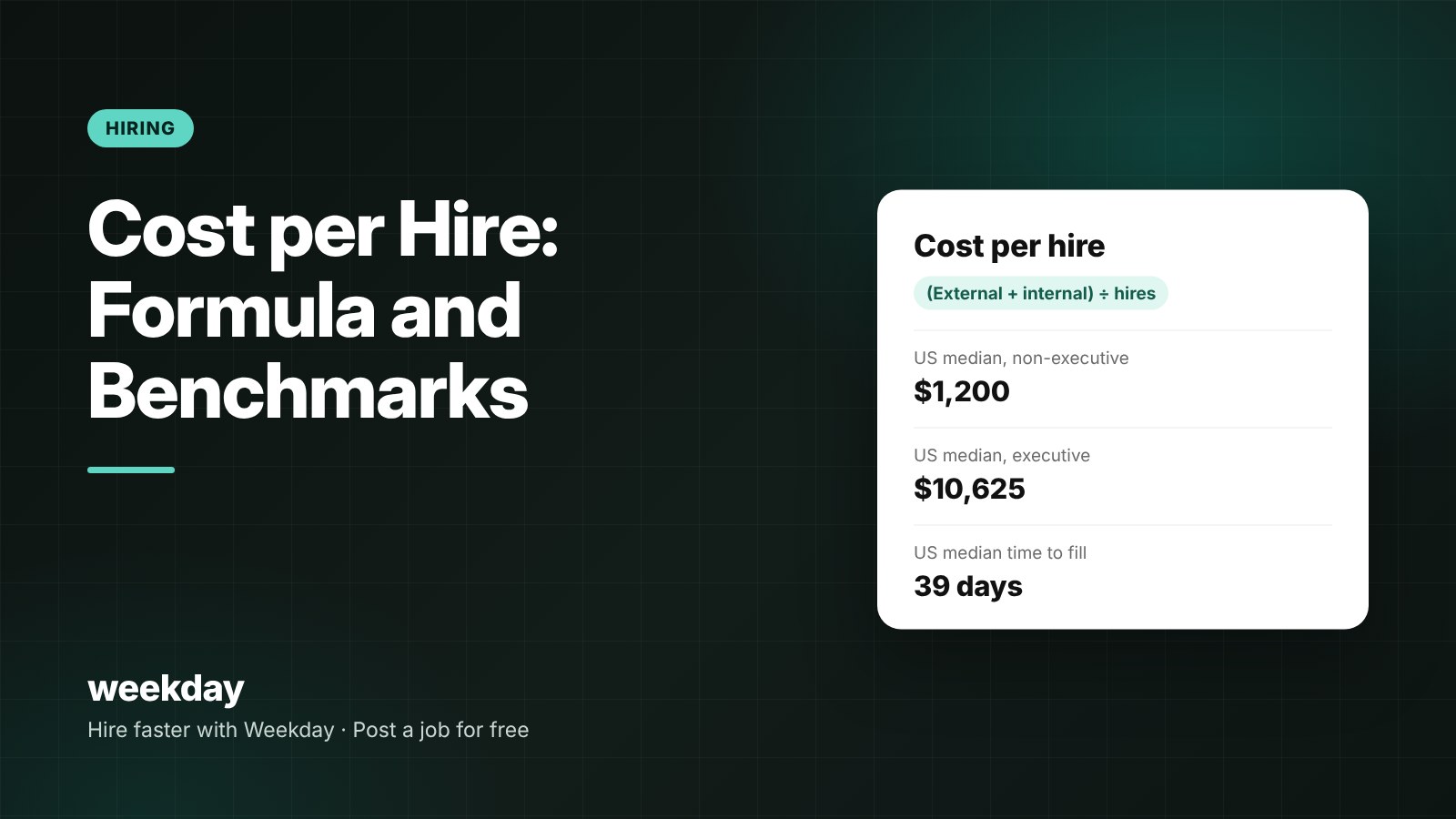
Quick answer: Cost per hire = (external hiring costs + internal hiring costs) ÷ number of hires in the same period. In SHRM's 2025 benchmarking data, the median cost per hire in the US was $1,200 for non-executive roles and $10,625 for executive roles. There is no reliable public benchmark for India, so calculate your own each quarter and track it by channel.
Most founders know what they pay a recruiter or a job board. Few know what one hire actually costs once you add the time your team spends on interviews. Cost per hire puts one number on it, so you can compare channels and decide where to spend.
The cost per hire formula
SHRM describes cost per hire as the costs involved with new hires, such as agency fees, job board fees, referral costs and recruiter pay and benefits, divided by the number of hires (SHRM 2025 Recruiting Benchmarking). Use the same time period for both costs and hires, usually a quarter or a year.
| External costs (money paid to others) | Internal costs (your own people and tools) |
|---|---|
| Agency and recruiter fees | In-house recruiter salaries and benefits (share spent on hiring) |
| Job board and LinkedIn subscriptions | Hiring manager and interviewer time |
| Sourcing tools and databases | Referral bonuses |
| Assessment and background check fees | ATS and other internal software |
| Campus drive travel, events, ads | Onboarding admin time |
A worked example (India startup)
The numbers below are made up to show the method. Swap in your own.
A 40-person startup in Bengaluru makes 5 hires in a quarter.
| Item | Cost for the quarter |
|---|---|
| Job board subscription (quarter share) | ₹1,00,000 |
| Agency fee for 1 senior hire (15% of ₹20 lakh annual salary) | ₹3,00,000 |
| Assessment tool | ₹25,000 |
| External total | ₹4,25,000 |
| Recruiter salary (share of time on these roles) | ₹3,00,000 |
| Interviewer time (40 hours × ₹1,500 per hour) | ₹60,000 |
| Referral bonuses (1 hire) | ₹50,000 |
| Internal total | ₹4,10,000 |
Cost per hire = (₹4,25,000 + ₹4,10,000) ÷ 5 = ₹1,67,000.
Now split it by channel. In this example, the agency hire alone cost ₹3,00,000 in fees, while the referral hire cost ₹50,000 plus interview time. That split tells you far more than the average.
Cost per hire benchmarks (US)
SHRM's 2025 benchmarking data, based on 2,371 member responses, gives these medians (SHRM):
| Role type | Median cost per hire (2025) | Change |
|---|---|---|
| Non-executive | $1,200 | Down 27% since 2017; $1,244 in 2022 |
| Executive | $10,625 | Up 113% since 2017 and 21% since 2022 |
You will still see an older figure of $4,129 quoted online. That came from SHRM's 2016 report on fiscal year 2015 data, and it was an average, not a median (SHRM, 2016). Averages get pulled up by a few very expensive hires, so the two numbers are not directly comparable.
What about India?
There is no large public cost-per-hire benchmark for India that is as solid as SHRM's. Two reference points help:
- Agency fees: on a success-fee model, the fee is a percentage of salary. Weekday's published contingency fee, for example, is 15% of the hire's annual salary, with no fee if you do not hire and a 60-day replacement period. On a ₹20 lakh salary, that is ₹3 lakh before taxes (Weekday). Always check whether a fee is on annual salary or total CTC.
- Job board seats: edtech company Edoofa found that LinkedIn corporate packages cost ₹3–4 lakh a year, which was hard to justify because it hires in bursts of 20–25 people a quarter, not every month (Weekday case study).
For the full cost of employing someone in India, including statutory costs, see our guide to recruitment expenses in India.
Cost per hire and time to hire go together
Slow hiring is expensive hiring. Every extra week means more interview hours, more follow-ups and a seat that stays empty. SHRM defines time to fill as the days from opening the job requisition to the candidate accepting the offer, and reports a median of 39 calendar days for non-executive roles in its 2026 data (SHRM). Track both numbers side by side. If one channel is cheap but takes twice as long, it may not be cheap.
6 ways to lower your cost per hire
- Measure by channel. Average cost per hire hides the problem. Calculate it for referrals, agencies, job boards and outbound separately.
- Fix response rates before buying more reach. Edoofa sent up to 300 LinkedIn InMails a day and got 2–3 replies, roughly a 1% response rate. If replies are that low, more messages just cost more.
- Grow referrals. A referral hire costs a bonus plus interview time, with no agency or job board fee. Share a short list of open roles with your team every week.
- Pay agencies only on success. Use contingency terms with a replacement period, so you do not pay for a hire who leaves in the first months. Edoofa had an agency hire leave within 2 months with no refund and no replacement.
- Cut interview rounds. Every round costs interviewer hours. For most roles, a screen, one skills round and one manager round is enough.
- Keep your silver medallists. Strong candidates who came second last quarter are the cheapest people to hire next quarter.
Common mistakes
- Counting only external costs. For a small team, interview time can be one of the biggest costs.
- Mixing senior and junior hires in one number. Track them separately, like SHRM does for executive and non-executive roles.
- Chasing the lowest cost per hire. A cheap hire who leaves in three months can end up the most expensive hire you make. Track quality of hire next to cost.
Where Weekday fits
Weekday's AI sourcing agent finds candidates for your role, including passive ones, and follows up over email, WhatsApp and phone. Weekday reports a 50%+ response rate across its platform (Weekday; a platform figure, not a promise for every role). After switching, Edoofa found that reaching out to 100 people got about 25% to walk in for interviews within 3–4 days.
Want to bring your cost per hire down?
See how Weekday's sourcing and outreach agents fill roles with fewer paid seats and fewer wasted hours.
Book a demoFrequently asked questions
What is cost per hire?
It is the average amount a company spends to make one hire, including both money paid to outside parties and the cost of its own team's time.
What is the cost per hire formula?
(External costs + internal costs) ÷ number of hires, for the same period.
What is the average cost per hire in the US?
SHRM's 2025 data shows a median of $1,200 for non-executive roles and $10,625 for executive roles.
What is a good cost per hire in India?
There is no solid public benchmark. Calculate your own by channel each quarter and aim to lower it without hurting quality of hire.
Is cost per hire the same as the cost of a new employee?
No. Cost per hire covers the hiring process only. Salary, benefits and statutory costs after joining are part of the cost of employment.





