
Last updated: 25 November 2026
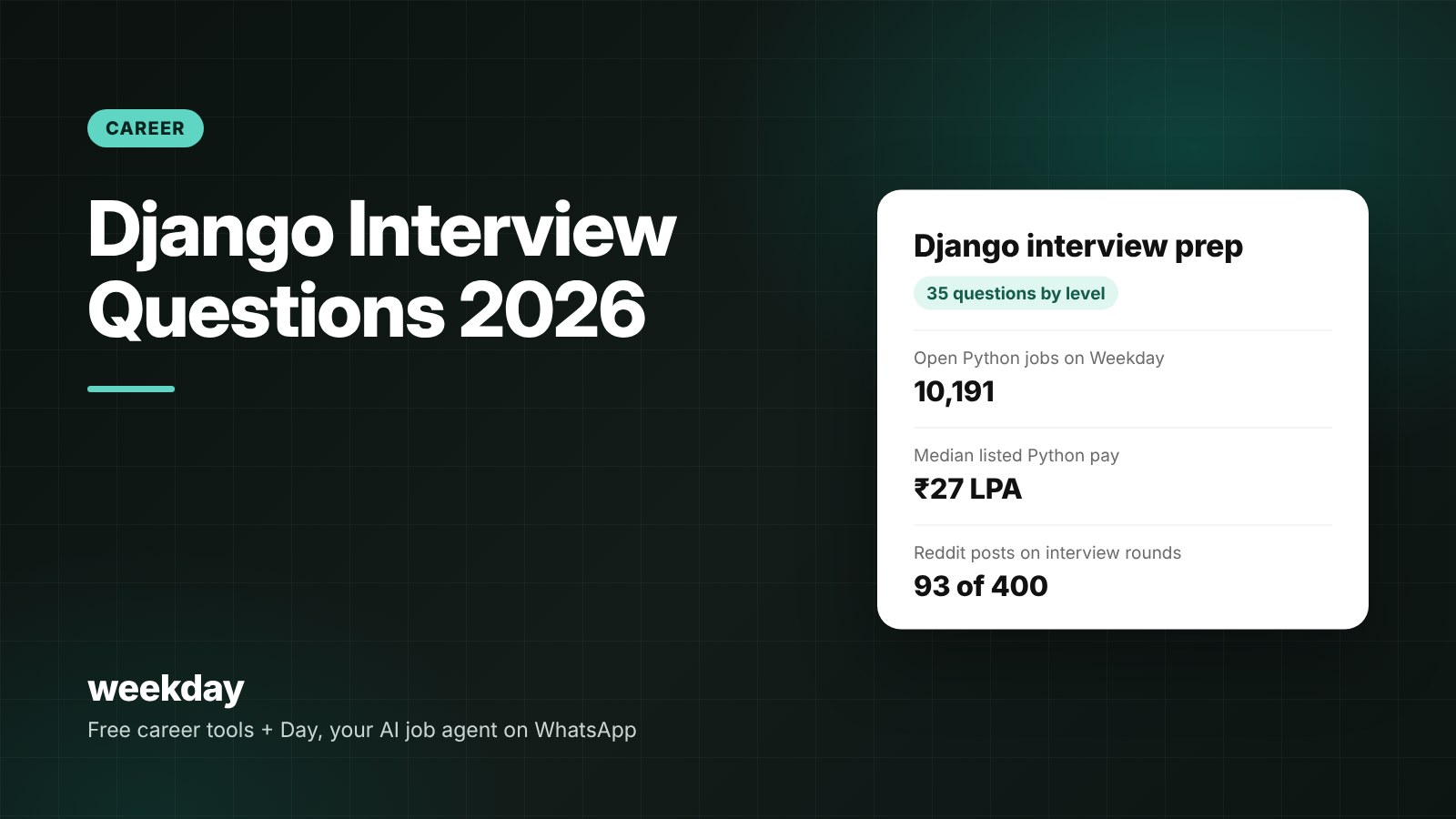
Short answer: Django interviews test the ORM (and N+1 queries), migrations, Django REST Framework, security and how you'd fix a slow page. Freshers get concept questions. With 2–5 years, you write ORM code and DRF views. Senior rounds are production scenarios. Below are 35 questions with short answers. Prepare for a long loop: in a Weekday analysis of 400 top Reddit posts from the last 30 days, interview rounds and assessments came up in 93. On 25 November 2026, Weekday listed 10,191 open Python developer jobs.
Django 6.1 is the current feature release, and 6.1.3 came out on 3 November 2026 (PyPI). Django 5.2 is the long-term support release. Interviewers like to check whether you know what changed recently, so the answers below include Django 6.0 features where they matter.
What Django interviewers actually test
Weekday's own guide for employers hiring Django developers tells them to test the ORM, Django REST Framework, database design, security, background jobs, testing and deployment. It suggests a 30-minute screen, a 90-minute practical task (a small DRF API, then fixing a planted N+1 query) and a 45–60 minute design round. So prepare for all three.
We also read the first 1,000 listings on Weekday's Python developer jobs page and the first 1,000 on its backend developer jobs page on 25 November 2026, counting mentions in titles, skill tags and summaries.
| Framework or tool | Python listings (of 998) | Backend listings (of 996) |
|---|---|---|
| Django | 17 | 21 |
| FastAPI | 15 | 21 |
| PostgreSQL | 40 | not counted |
| Flask | 2 | not counted |
Summaries are short, so treat these as floor numbers. The takeaway: Django and FastAPI show up almost equally. The JetBrains Python Developers Survey 2024 found the same split, with FastAPI at 38%, Django at 35% and Flask at 34% of respondents (JetBrains). Expect a "Django or FastAPI?" question.
The loop can be long even for good engineers. A r/developersIndia post about a 35 LPA switch described a developer with about 3 years of experience who applied to 500+ jobs over 1.5 years and was rejected after multiple rounds before landing two offers. Take-home tasks are getting heavier too: a r/recruitinghell post about a junior role whose assessment was the company's Q3 backlog got 5,884 upvotes.
Django interview questions for freshers
1. What is Django, and what is MTV?
Django is a Python web framework with an ORM, admin, auth, forms and migrations built in. MTV means Model (data), Template (HTML) and View (the logic that takes a request and returns a response).
2. Project vs app?
A project is the whole site with settings and root URLs. An app is a reusable piece, like "orders" or "payments". One project has many apps.
django-admin startproject shop
python manage.py startapp orders
3. What happens when a request reaches Django?
It passes through middleware, the URLconf matches a view, the view uses models and maybe a template, and the response goes back out through middleware.
4. How do migrations work?
makemigrations writes migration files from model changes. migrate applies them to the database. sqlmigrate shows the SQL, and showmigrations shows what's applied.
5. What is a QuerySet, and why is it lazy?
A QuerySet is a query you build in Python. It doesn't hit the database until you use the results: loop, slice with a step, call list(), len() and so on. That lets you chain filters cheaply.
6. get() vs filter()?
filter() returns a QuerySet, possibly empty. get() returns one object and raises DoesNotExist if none match or MultipleObjectsReturned if more than one does.
7. Function-based or class-based views?
Function views are simple and explicit. Class-based views reuse behaviour through generic views and mixins, like ListView and LoginRequiredMixin. Use whichever keeps the code clearer.
8. How does the admin work?
Register a model in admin.py and Django builds a full CRUD interface. Customise it with ModelAdmin: list_display, search_fields, list_filter.
9. What is template inheritance?
A base template defines {% block %} sections, and child templates extend it and fill those blocks. Django 6.0 also added template partials with {% partialdef %} and {% partial %} for named reusable fragments.
10. Static files vs media files?
Static files are your CSS, JS and images, gathered with collectstatic for a web server or CDN. Media files are user uploads, stored under MEDIA_ROOT or in object storage.
11. Form vs ModelForm?
A Form defines fields by hand. A ModelForm builds fields from a model and can save it. Validate one field in clean_<field>() and cross-field rules in clean().
12. How does Django protect against common attacks?
CSRF middleware plus {% csrf_token %} in forms. Auto-escaping in templates against XSS. Parameterised queries in the ORM against SQL injection. You break these when you use |safe carelessly or build raw SQL with string formatting.
Django interview questions for 2–5 years
13. What is the N+1 problem, and how do you fix it?
Looping over objects and touching a relation runs one extra query per row. select_related uses a SQL join for foreign keys and one-to-one. prefetch_related runs one extra query for many-to-many and reverse relations.
orders = (Order.objects
          .select_related("customer")
          .prefetch_related("items"))
14. What are F() and Q()?
F() refers to a column value in the database, so updates happen in SQL. Q() builds OR and NOT conditions.
Product.objects.filter(pk=pid).update(stock=F("stock") - 1)
Order.objects.filter(Q(status="failed") | Q(amount__gt=50000))
15. annotate() vs aggregate()?
aggregate() returns one dict for the whole QuerySet, like total revenue. annotate() adds a value to each row, like order count per customer.
16. How do transactions work?
Wrap related writes in transaction.atomic(). Use select_for_update() inside it to lock rows you're about to change.
with transaction.atomic():
    acct = Account.objects.select_for_update().get(pk=pk)
    acct.balance -= amount
    acct.save(update_fields=["balance"])
17. When should you avoid signals?
Signals hide side effects, which makes code hard to follow and test. Prefer an explicit service function. If you must send an email after a save, use transaction.on_commit() so it doesn't fire for a rolled-back write.
18. Write a simple middleware.
import time

class TimingMiddleware:
    def __init__(self, get_response):
        self.get_response = get_response

    def __call__(self, request):
        start = time.monotonic()
        response = self.get_response(request)
        response["X-Elapsed-ms"] = str(int((time.monotonic() - start) * 1000))
        return response
19. Why set a custom user model early?
Changing AUTH_USER_MODEL after the first migration is painful. Start with a model that extends AbstractUser, even if it adds nothing yet.
20. Explain DRF serializers and viewsets.
Serializers convert models to JSON and validate input. ModelSerializer builds fields from a model. ViewSets group list, create, retrieve, update and delete, and routers generate the URLs.
21. How do auth and permissions work in DRF?
Authentication classes identify the user (session, token, or JWT through a package like SimpleJWT). Permission classes decide access, like IsAuthenticated or a custom has_object_permission for "only the owner can edit".
22. How do you cache in Django?
Per-view with cache_page, template fragments, or the low-level cache.get/cache.set API. Django has a built-in Redis backend since 4.0. Cache expensive reads, and plan how each key gets invalidated.
23. How do you run background jobs?
Most teams use Celery with Redis or RabbitMQ. Django 6.0 added a built-in Tasks framework for defining and queuing tasks, but it ships no worker, so you still need something to run them (Django 6.0 release notes).
24. How do you test Django code?
Use TestCase (each test runs in a transaction), DRF's APIClient, or pytest-django with factories. assertNumQueries catches N+1 regressions before they ship.
25. Does Django support async?
Yes. Write async def views and run under ASGI with Uvicorn or Daphne. The ORM has async methods like aget() and acreate(). Wrap sync-only code with sync_to_async. Async helps with slow external calls, not CPU work.
Senior and scenario questions
26. An order list page takes 6 seconds with 100,000 orders. What do you check?
Count queries with Django Debug Toolbar or logs, then fix N+1 with select/prefetch. Add pagination. Check EXPLAIN for missing indexes on filter and sort columns. Fetch fewer columns with only() or values(). Cache the result if it's read-heavy.
27. Add a NOT NULL column to a huge table without downtime.
Add it as nullable first, or with db_default (Django 5.0+) if your database handles that cheaply. Backfill in batches. Then add the constraint in a later deploy. Never rename or drop a column in the same release that stops using it.
28. Two users buy the last item at the same time. How do you stop overselling?
Use a conditional update and check the result:
sold = Product.objects.filter(pk=pid, stock__gt=0).update(stock=F("stock") - 1)
if not sold:
    raise OutOfStock()
update() returns the number of rows changed, so 0 means someone else got it.
29. What's your production security checklist?
Run python manage.py check --deploy. Set DEBUG = False, ALLOWED_HOSTS, a secret key from the environment, HTTPS redirects, secure cookies and HSTS. Django 6.0 adds built-in Content Security Policy support through SECURE_CSP.
30. How do you scale Django?
Keep app servers stateless behind a load balancer, with Gunicorn or Uvicorn workers. Cache hot reads in Redis. Serve static files from a CDN. Use read replicas with a database router. Pool connections with CONN_MAX_AGE, PgBouncer, or the built-in PostgreSQL pool added in Django 5.1.
31. Django or FastAPI?
Django when you want admin, auth, ORM and migrations included, like an internal tool plus API. FastAPI for small, async, API-only services where you pick your own parts. Many teams run both.
32. How would you build a multi-tenant SaaS?
Three options: a shared schema with a tenant_id on every table (simple, but every query must filter), a schema per tenant (with a package like django-tenants) or a database per tenant (strongest isolation, most ops work).
33. How do you upgrade from Django 4.2 to 5.2 LTS?
Django 4.2's support has ended, so move one feature release at a time: 5.0, 5.1, then 5.2. At each step, run tests with python -Wa manage.py test to see deprecation warnings, fix them, and upgrade third-party packages.
34. How do you write a data migration?
Use RunPython with the historical model from apps.get_model(), not a direct import. For millions of rows, update in batches and keep it out of the deploy's critical path.
35. How do you version, paginate and rate-limit a DRF API?
Version through the URL (/api/v1/) or a header with DRF's versioning classes. Use CursorPagination for big, changing lists. Add throttling classes per user or IP.
A 2-week Django interview prep plan
| Days | Focus | Do this |
|---|---|---|
| 1–2 | Core and ORM | Build a shop app with 3 related models; write 10 queries |
| 3–4 | Query speed | Seed 100,000 rows, find an N+1 with Debug Toolbar, fix it |
| 5–6 | DRF | Build CRUD with filtering, pagination and owner-only edits |
| 7–8 | Transactions and jobs | Write the oversell fix and one Celery task |
| 9–10 | Testing | Add API tests and an assertNumQueries test |
| 11–12 | Deploy and security | Deploy with Gunicorn and PostgreSQL, pass check --deploy |
| 13–14 | Mock rounds | Answer 26–35 out loud; time a 90-minute DRF task |
What Django skills pay
Weekday doesn't track Django separately, so Python roles are the closest benchmark. On 25 November 2026, the 86 Python developer listings on Weekday that showed pay had a median of ₹27 LPA, with half paying ₹16–42 LPA. Most roles want experience: 3,320 asked for 4–6 years, 1,840 for 2–3 years and 210 for 0–1 year.
Free tool: Paste a job description into Weekday's Interview Question Predictor to see which questions that role is likely to ask.
Find Python and Django roles hiring now
Weekday lists over 10,000 open Python developer roles, updated daily, with quick-apply jobs shown first. Filter by city, work mode and experience.
Frequently asked questions
What are the most asked Django interview questions?
The N+1 problem with select_related and prefetch_related, how migrations work, QuerySet laziness, DRF serializers and permissions, transactions, and how you'd speed up a slow page.
Is Django still worth learning in 2026?
Yes. Django 6.1 is the current release, and 35% of respondents in the JetBrains Python Developers Survey 2024 used it. Weekday listings name Django and FastAPI at about the same rate, so knowing both helps.
What is the latest Django version?
Django 6.1, with 6.1.3 released on 3 November 2026. Django 5.2 is the long-term support release.
What do Django developers earn in India?
Weekday doesn't track Django separately. Python developer listings on Weekday with a disclosed salary had a median of ₹27 LPA on 25 November 2026, with half paying ₹16–42 LPA.
Sources
- Weekday Python developer jobs and backend developer jobs (25 Nov 2026; first 1,000 listings of each read for skill counts)
- Weekday: How to hire Django developers
- Weekday analysis of 400 top Reddit posts from the last 30 days (Nov 2026); r/developersIndia thread (paraphrased)
- JetBrains Python Developers Survey 2024
- PyPI: Django release history
- Django 6.0 release notes





