
Last updated: 25 November 2026
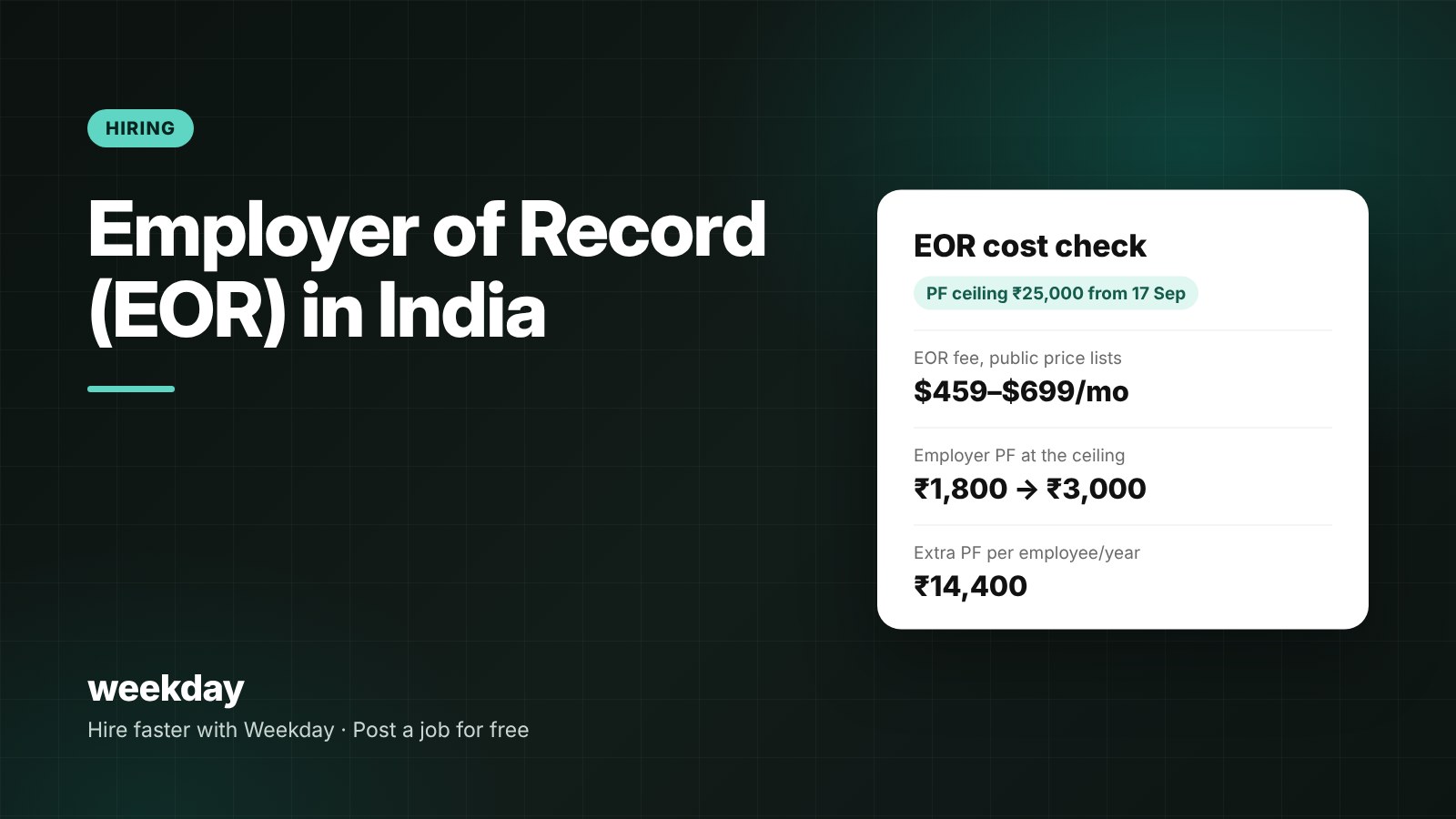
Quick answer: An employer of record (EOR) in India legally employs your team for you, runs payroll and handles PF, taxes and contracts, while you manage the work. Public prices start at $459 a month per employee (Multiplier, annual plan), $599 (Deel; Remote on annual contracts) and $699 (Oyster). That's on top of salary and statutory costs. One of those costs just went up: from 17 September 2026, the EPF wage ceiling rose from ₹15,000 to ₹25,000 a month. If PF is capped at the ceiling, the employer's monthly PF rises from ₹1,800 to ₹3,000 per person. That's ₹14,400 more a year for each employee, or ₹1.44 lakh for a team of 10. Use an EOR for your first India hires; consider your own entity once India is a long-term bet.
Say you're a US or Singapore startup and you've found a great engineer in Pune. You don't have an Indian company. You can pay them as a contractor, set up an entity, or use an EOR. This employer of record India guide walks through the cost and the compliance of each, with the 2026 rule changes built in.
What an employer of record in India does
The EOR is the legal employer on paper. It signs the employment contract, pays salary in rupees, deducts and deposits PF, ESIC and income tax, provides benefits and handles exits. You decide the role, pay, goals and daily work. The employee works for you in every practical sense.
This is different from a staffing agency, which supplies people from its own pool, and from a payroll provider, which only runs payroll for an entity you already own.
EOR vs own entity vs contractor
| EOR | Your own Indian entity | Contractor | |
|---|---|---|---|
| Legal employer | The EOR | You | Nobody; it's a services contract |
| Time to first hire | Fast; the EOR's entity already exists | Slow; incorporation, registrations, bank account | Fastest |
| Ongoing fee | $459–$699 per employee per month on public price lists | Accounting, payroll, legal and filing costs you run yourself | Platform fee if you use one: from $29 (Remote) or $49 (Deel) per contractor per month |
| PF, ESIC, gratuity, leave | Handled by the EOR, paid by you | Handled and paid by you | Not applicable, which is part of the risk |
| Misclassification risk | Low | Low | Higher if they work like employees |
| Candidate appeal | Good: a real job with PF and benefits | Best: a local employer | Weaker for senior people who want stability |
| Best for | First 1–10 hires, testing India | Long-term India team | Short, clearly scoped projects |
What an EOR costs: public prices
Here is what EOR India pricing looks like on public pages. We only list prices that vendors publish on their own pricing pages (checked 25 November 2026). Most also pass through statutory costs and may add country-specific charges, so ask for an India quote.
| Provider | Published EOR price per employee per month | Per year, one employee |
|---|---|---|
| Multiplier (Core) | $459 on annual contracts, $499 monthly | $5,508 (annual plan) |
| Deel | From $599 | $7,188 |
| Remote | From $599 on annual contracts | $7,188 |
| Oyster | $699 (annual discounts available) | $8,388 |
Sources: Multiplier pricing, Deel pricing, Remote pricing, Oyster pricing. The yearly column is simply the monthly price times 12.
The 2026 PF change and what it does to your cost
The EPF wage ceiling went from ₹15,000 to ₹25,000 a month from 17 September 2026 (notification S.O. 5109(E)), the first change since 2014. PF is 12% of PF wages (mostly basic plus DA) from the employee and 12% from the employer. Many employers cap PF at the ceiling for higher salaries. For them, the numbers change like this (Keka, CAclubindia):
| Per employee, per month | Before (₹15,000 ceiling) | From 17 Sep 2026 (₹25,000 ceiling) |
|---|---|---|
| Employer pension (EPS) | ₹1,250 | ₹2,083 |
| Employer PF (EPF) | ₹550 | ₹917 |
| Employer total | ₹1,800 | ₹3,000 |
| Employee's own PF | ₹1,800 | ₹3,000 |
Worked example
You hire a backend engineer through an EOR. Their basic pay is ₹40,000 a month, and PF is capped at the ceiling.
- Employer PF goes from ₹1,800 to ₹3,000 a month: ₹1,200 more a month, ₹14,400 more a year.
- For a team of 10 like this, that's ₹1,44,000 more a year.
- The engineer's own PF also rises by ₹1,200 a month. If their CTC stays fixed and the employer share sits inside CTC, take-home can drop by up to ₹2,400 a month (Weekday PF guide).
- If you already pay PF on full basic (12% of ₹40,000 = ₹4,800), nothing changes.
Two more things to know. The ESIC ceiling stays at ₹21,000 gross a month, so most engineers remain outside ESIC. And under the new wage rules, if allowances are more than half of total pay, the extra counts back into PF wages, so a low basic doesn't always keep PF low. Our PF new rules guide explains this with tables.
Ask your EOR how it calculates PF (capped or full basic) and whether your quote was updated after 17 September 2026. The difference can change candidates' in-hand pay, which matters when you're negotiating.
Compliance basics an EOR should cover
India's four labour codes came into force on 21 November 2025, replacing 29 older laws, and they make appointment letters mandatory for all workers (PIB, Ministry of Labour). A good EOR handles:
- A compliant appointment letter and employment contract, with IP assigned to you.
- Monthly PF and, where it applies, ESIC deposits.
- Income tax deduction (TDS) on salary and year-end tax forms.
- State professional tax and labour registrations.
- Leave, gratuity and full and final settlement on exit.
- Benefits such as health insurance, if you choose them.
Rules differ by state and change often. Check with your HR or a lawyer before you finalise contracts.
When you need an employer of record in India
An employer of record India setup makes sense when:
- You have no Indian entity and want to hire full-time employees now.
- You're testing India with your first few hires before committing to an entity.
- Your contractors have become full-time in practice: fixed hours, your manager, years of work. Moving them to an EOR lowers your risk.
- Candidates ask for PF and benefits. Senior Indian engineers often prefer a proper employment contract to a contractor invoice.
When to set up your own entity instead
Once India is a long-term bet and the team keeps growing, compare a year of EOR fees with the cost of running your own entity: accountants, payroll, filings and a local director or adviser. Get quotes for both. Many companies start with an EOR and move employees to their own entity later. If you plan to do that, ask the EOR about transfer terms upfront.
Free tools: Show candidates their real take-home with the in-hand salary calculator, and draft the offer with the offer letter generator.
Hiring your first team in India?
Post your role for free and Weekday will find engineers, product people and operators across India, including people who aren't actively applying. Want help planning the hires? Book a demo.
Frequently asked questions
What is an employer of record in India?
An employer of record (EOR) is a company with its own Indian entity that legally employs people on your behalf. It handles contracts, payroll, PF, tax and exits, while you manage the person's daily work.
How much does an EOR cost in India?
Published prices checked on 25 November 2026 start at $459 per employee per month (Multiplier, annual plan), $599 (Deel; Remote on annual contracts) and $699 (Oyster). You also pay the salary and statutory costs such as employer PF.
How does the new PF wage ceiling affect EOR costs?
From 17 September 2026 the EPF wage ceiling is ₹25,000 a month. If PF is capped at the ceiling, the employer share rises from ₹1,800 to ₹3,000 a month per employee, which is ₹14,400 more a year.
Should I use an EOR or hire contractors in India?
Use contractors for short, clearly scoped projects. Use an EOR when people work for you full-time, follow your hours and report to your managers, because that looks like employment and carries misclassification risk as a contract.
Can a foreign company hire in India without an entity?
Yes. The two common routes are an employer of record, which employs the person through its own Indian entity, or a contractor agreement for project work.





