
Last updated: 25 November 2026
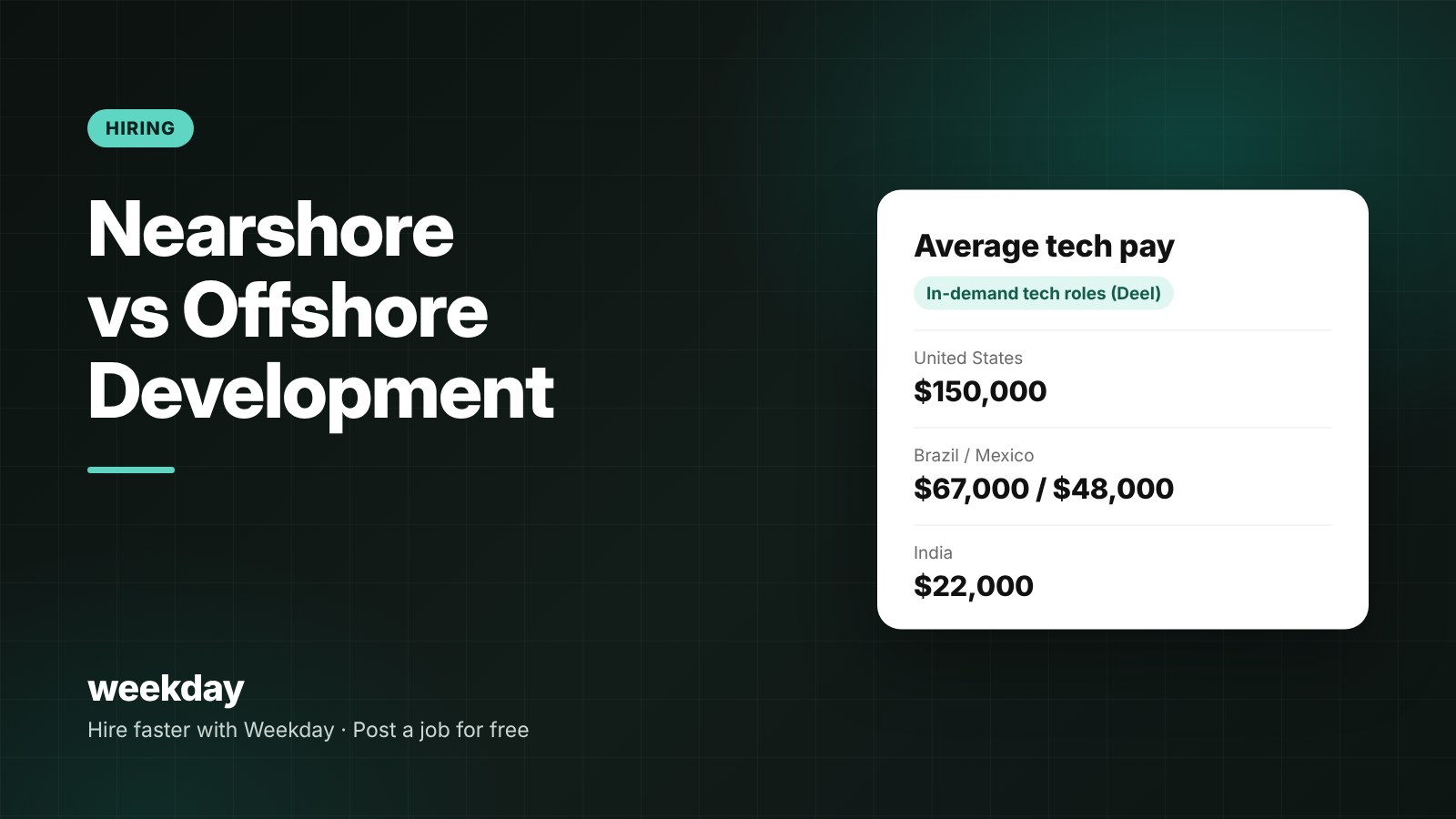
Quick answer: Nearshore (for a US company, usually Latin America) buys you time-zone overlap. Offshore (usually India) buys you cost and scale. Deel's pay data for in-demand tech roles puts the average at $150,000 a year in the US, $37,000–$67,000 across Colombia, Argentina, Mexico and Brazil, and $22,000 in India. A São Paulo team overlaps a New York workday by 7–8 hours. An India team overlaps by 2.5–3.5 hours if it works 1pm–10pm IST. India wins when you need a larger team, a deep talent pool and work that can run partly async. Nasdaq-listed IT services firm Cognizant had 256,900 of its 351,600 people in India at the end of 2025, versus 41,600 in North America.
If you run a US startup, sooner or later someone suggests building part of the team abroad. Then the debate starts. Mexico or Brazil, where people are awake when you are? Or India, where the talent pool is huge and pay is lower? Both can work. The nearshore vs offshore choice comes down to which problem you need to solve: overlap or scale.
Onshore, nearshore and offshore in one line each
- Onshore: hiring in your own country. For a US company, US engineers.
- Nearshore: hiring in a nearby country with a similar time zone. For the US, that's mostly Latin America.
- Offshore: hiring far away, usually with a big time difference. For the US, India is the largest option.
Nearshore vs offshore: the comparison
| Onshore (US) | Nearshore (LatAm) | Offshore (India) | |
|---|---|---|---|
| Average pay, in-demand tech roles (Deel) | $150,000 | Colombia $37,000, Argentina $42,000, Mexico $48,000, Brazil $67,000 | $22,000 |
| Overlap with a 9am–5pm New York day | Full day | 7–8 hours from São Paulo on a 9am–6pm day | None on a 9am–6pm IST day; 2.5–3.5 hours on a 1pm–10pm IST day |
| Talent pool signal | Largest US market, highest cost | About 6 new GitHub developers a minute from all of LatAm in 2025 | India alone added 5 million+ GitHub developers in 2025 |
| Hiring demand signal | n/a | n/a | IT roles growing 20.28% a year (foundit); 26,785 remote software engineer jobs on Weekday |
| Pay pressure | High | Rising, varies by country | GCC salary hikes projected at 9.4% for 2027 (Aon) |
| Best for | Leadership, customer-facing roles, regulated work | Small teams embedded in US standups | Larger teams, platform work, 24-hour coverage |
Where the pay numbers come from
The pay row uses one dataset so the countries are comparable. Forbes Brasil reported Deel's ranking, built with Carta from over 1 million active contracts in about 150 countries. It covers AI, software development, cloud, data and cybersecurity roles (Forbes Brasil, Nov 2025). A second source agrees on the size of the gap: in the Stack Overflow Developer Survey 2025, the median back-end developer earns $175,000 in the US and $22,086 in India (Stack Overflow).
Averages hide a lot. Strong engineers in Bengaluru at product companies and GCCs earn far more than the India average. Weekday's data shows a median fixed salary of ₹23 lakh at Microsoft and ₹20 lakh at Google for people with 2–3 years of experience (Weekday salaries). If you want the best people, budget for the top of the market, not the average.
Time zones: the real nearshore vs offshore overlap math
India Standard Time is UTC+5:30 all year, with no daylight saving (timeanddate). New York is UTC−5 from early November to mid-March and UTC−4 the rest of the year (timeanddate). So India is 10.5 hours ahead of New York in winter and 9.5 hours ahead in summer.
- Standard India day (9am–6pm IST): that's 10:30pm–7:30am in New York in winter. Zero overlap.
- Shifted India day (1pm–10pm IST): that's 2:30am–11:30am New York time in winter, so 2.5 hours of overlap from 9:00 to 11:30am. In summer it's 3.5 hours.
- São Paulo (UTC−3, no daylight saving): a 9am–6pm day there is 7am–4pm in New York in winter, so 7 hours of overlap. In summer, 8 hours (timeanddate).
The West Coast is harder for India. Pacific time is three hours behind New York, so the overlap shrinks further. If your whole team sits in California, plan for mostly async work with India, or a short early-morning call.
When India wins
- You need more than a few engineers. Cognizant's 2025 annual report (Form 10-K) lists about 351,600 employees, with 256,900 in India and 41,600 in North America (Cognizant 10-K). That's roughly six people in India for each one in North America. Large teams get built where the talent pool is deepest.
- The pool keeps growing. GitHub's Octoverse 2025 says India added more than 5 million developers in a year, over 14% of all new accounts (GitHub). foundit expects IT roles in India to grow 20.28% a year (Business Standard).
- The work can run partly async. Platform, data, QA, internal tools and backend services work well with clear specs and a short daily overlap.
- You want 24-hour coverage. An India team can handle on-call and support while your US team sleeps.
- You're building for the long term. If you'll have 20+ engineers abroad in three years, India's scale matters more than a few extra hours of overlap.
When nearshore wins
- Heavy real-time collaboration. Pairing, design reviews and frequent product calls are easier with 7–8 shared hours.
- Small teams inside US squads. Two or three engineers who join every standup fit nearshore well.
- Customer-facing roles in US hours. Solutions engineers and support for US customers.
- Spanish or Portuguese markets. If you sell in Latin America, local language and context help.
The mistake to avoid: hiring India for "cheap"
India is cheaper, but it isn't cheap at the top, and it's getting more expensive. Aon's 2026–27 survey of 1,200+ organisations projects 9.1% average hikes in India for 2027, with GCCs at 9.4%, and found attrition at 18% in 2026 (Aon). If you pay the average, you'll get average people and lose the good ones to GCCs. Pay at the 75th percentile for your city and stack, and you'll still spend far less than in the US.
How to make an India team work from the US
- Fix a 2–3 hour overlap window and protect it for standups, reviews and decisions.
- Write things down. Specs, decisions and handovers in one place, so work doesn't wait for a call.
- Hire a strong local lead early. One senior engineer in India who owns delivery saves you many late-night calls.
- Visit. One trip a year builds more trust than a year of video calls.
- Choose your model on purpose. Direct hires through an employer of record, your own entity, or a vendor team. Each has trade-offs in cost and control.
Free tool: Check what a candidate actually takes home from an India offer with Weekday's in-hand salary calculator.
Building an engineering team in India?
Weekday's AI agents find and reach out to engineers across India who aren't actively applying, including people open to US-overlap hours. See matched profiles for your roles.
Frequently asked questions
What's the difference between nearshore and offshore development?
Nearshore means hiring in a nearby country with a similar time zone, which for US companies is usually Latin America. Offshore means hiring farther away with a bigger time difference, which for US companies is usually India.
Is nearshore more expensive than offshore?
Usually yes. Deel's pay data for in-demand tech roles puts the average at $37,000–$67,000 a year across Colombia, Argentina, Mexico and Brazil, against $22,000 in India and $150,000 in the US.
How many hours overlap between India and the US East Coast?
None on a standard 9am–6pm IST day. If the India team works 1pm–10pm IST, you get about 2.5 hours of overlap with New York in winter and 3.5 hours in summer.
When should a US startup choose India over Latin America?
Choose India when you need a larger team, a deep talent pool, lower cost per engineer, or 24-hour coverage, and the work can run partly async. Choose Latin America for small teams that need many shared hours with US colleagues.
Sources
- Forbes Brasil: Deel ranking of tech pay, Nov 2025
- Stack Overflow Developer Survey 2025: salary by country
- Cognizant Form 10-K for 2025 (filed 12 Feb 2026), human capital section
- GitHub Octoverse 2025
- Business Standard: foundit Insights Tracker, Nov 2026
- Aon Annual Salary Increase and Turnover Survey India 2026–27
- timeanddate: India Standard Time, Eastern Standard Time, São Paulo
- Weekday: Company salaries in India
- Weekday: Remote software engineer jobs in India (live count, 25 Nov 2026)





