
Last updated: 13 November 2026
- Live online teaching jobs on Weekday
- Six types of online teaching work
- Pay ranges by type
- Where the jobs are (platform types)
- Requirements and setup
- Demo class tips and a sample lesson plan
- Scams and red flags
- How to apply
- Teaching jobs: 21,357 open, 6,411 new this week.
- Remote teaching jobs: 1,528 open, 326 new this week.
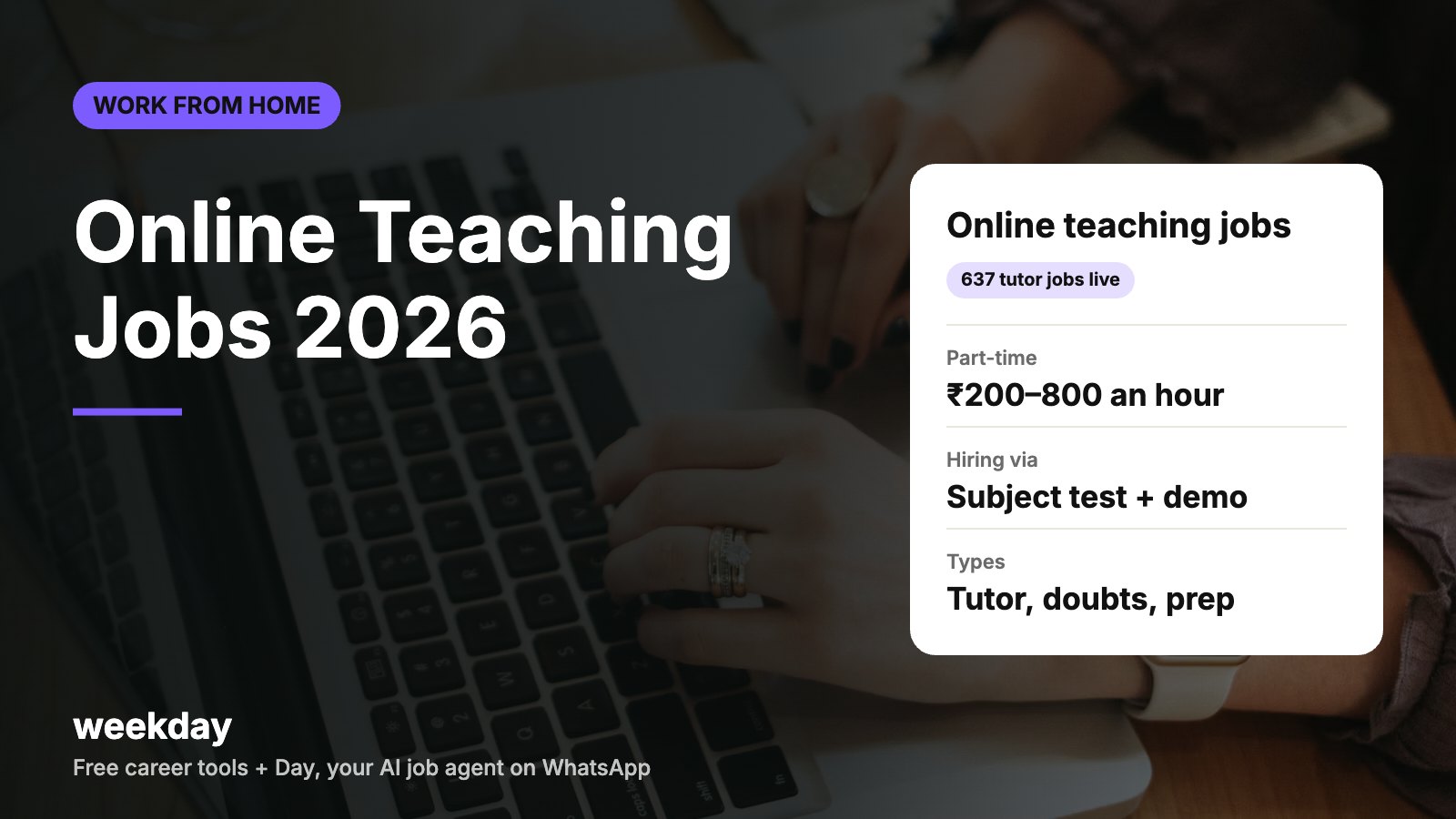
- Online tutor jobs: 637 open, 172 new this week.
- Remote online tutor jobs: 65 open, 13 new this week.
Sources: Weekday job listings (jobs.weekday.works), counted on 13 November 2026. Counts change daily.
- Open ChatGPT and go to Plugins.
- Search Weekday Jobs and tap Try in chat (or open Weekday Jobs in ChatGPT).
- Ask in plain words, for example:
- “Find remote online tutor jobs for maths, classes 6 to 10, posted this week”
- “Show part-time doubt solver jobs for chemistry graduates with hourly pay”
- “Find online English teaching jobs for freshers that pay above ₹20,000 a month”
Day, Weekday's free AI job agent, finds jobs that match your skills and pay, and applies when you say yes. On WhatsApp.
Say hi to Day on WhatsAppHow Day works →Six types of online teaching work
“Online teaching” covers very different jobs. A doubt solver answers short questions in text, often at night. A test-prep faculty member teaches live batches of 200 students. A coding-for-kids tutor runs one-on-one classes with a 9-year-old. Pick the type that fits your degree, your voice and your hours.
| Type | What you do | Who it suits | Typical format |
|---|---|---|---|
| K-12 tutoring | Teach school subjects (maths, science, English) to classes 1–12, often for CBSE, ICSE or state boards | B.Sc, B.Ed, B.Tech graduates, school teachers | 1:1 or small groups, 45–60 min |
| Doubt solving | Answer students' questions with step-by-step solutions, by text, image or short video | Strong subject graduates; works around a day job | Async, per question or per hour |
| Test prep | Teach JEE, NEET, CAT, GATE, UPSC, bank exams or IELTS | Experienced teachers, toppers, subject experts | Live batches, recorded lectures |
| Language | Spoken English, IELTS, or foreign languages like German, French, Spanish, Japanese | Fluent speakers; certified language learners | 1:1 conversation classes |
| Coding for kids | Teach Scratch, Python, web basics or robotics to ages 6–16 | CS graduates, engineers, patient explainers | 1:1, usually 60 min, parent sees progress |
| College subjects | Engineering, commerce, accounts, statistics, nursing subjects; assignment help | Postgraduates, industry professionals | 1:1 or small batch, often evenings |
Many tutors combine two types. A common mix is K-12 maths in the evening plus doubt solving late at night, which fills dead hours without new prep.
Pay ranges by type
Pay depends on subject, board, the student's country and your track record more than your degree. These are indicative India ranges seen across job posts in 2026; your offer may be higher or lower.
| Type | Part-time pay (usual range) | Full-time pay (usual range) | What pushes pay up |
|---|---|---|---|
| K-12 tutoring | ₹200–600 per hour | ₹15,000–35,000 a month | Board results, classes 11–12, maths and physics |
| Doubt solving | ₹10–50 per question, or ₹150–400 per hour | ₹15,000–30,000 a month | Speed, accuracy rating, hard subjects |
| Test prep | ₹500–1,500 per hour | ₹6–20 LPA for experienced faculty | Selections of past students, video presence |
| Spoken English / IELTS | ₹250–800 per hour | ₹18,000–40,000 a month | IELTS band, certifications, accent clarity |
| Foreign languages | ₹500–1,500 per hour | ₹25,000–60,000 a month | Higher levels (B2/C1) and Japanese/German demand |
| Coding for kids | ₹300–700 per class | ₹20,000–45,000 a month | Renewals, parent reviews, Python and AI topics |
| College subjects | ₹400–1,200 per hour | Mostly part-time | Rare subjects, postgraduate degree, industry work |
Worked example: a part-time tutor's month
Priya, a B.Sc Maths graduate, teaches classes 8–10 maths for 2 hours each weekday evening at ₹350 an hour, and solves doubts for 1.5 hours on four nights at ₹200 an hour.
| Work | Hours a month | Rate | Earnings |
|---|---|---|---|
| Evening tutoring (22 days × 2 hrs) | 44 | ₹350/hr | ₹15,400 |
| Doubt solving (17 nights × 1.5 hrs) | 25.5 | ₹200/hr | ₹5,100 |
| Total | 69.5 | ₹20,500 |
At 17–18 hours a week she earns about ₹20,500 a month. If she gets a 30% rise after strong class 10 results, the same hours pay around ₹26,500. That is the usual path: rates rise with results and reviews, not with time spent on the platform.
Where the jobs are
You will find online teaching work in five kinds of places. Each pays and hires differently.
| Platform type | How it works | Pay style | Watch out for |
|---|---|---|---|
| Large ed-tech companies | Hire faculty and tutors on salary or contract; strong process | Monthly salary or per class | Sales targets mixed into teaching roles |
| Tutoring marketplaces | You list a profile; parents pick you | You set your rate; platform takes a cut | Slow start until you get reviews |
| Doubt-solving apps | You pass a subject test, then solve questions in a queue | Per question or per hour | Strict accuracy scores; account can be paused |
| International platforms | Teach students abroad (English, maths, coding) | Often in USD per hour | Odd hours due to time zones |
| Schools and coaching centres hiring remote staff | Live classes for their own students | Salary | Fixed timetables |
Weekday lists roles from many of these employers in one place. Browse online tutor jobs for part-time and contract work, or remote teaching jobs for salaried roles. If you're open to other home-based work too, our work from home jobs guide covers 20+ roles.
Requirements and setup
Most platforms ask for a graduate degree in the subject (or related), clear spoken English or Hindi, and a stable setup. A B.Ed helps for school roles but is rarely required online. Coding-for-kids roles usually want a CS or engineering background.
| Item | Minimum | Better |
|---|---|---|
| Internet | Stable broadband, 20 Mbps or more | Broadband plus a mobile hotspot as backup |
| Device | Laptop with a working webcam | Laptop plus a second screen |
| Audio | Wired earphones with a mic | USB headset with noise reduction |
| Writing | Digital whiteboard with a mouse | Pen tablet (around ₹2,500–5,000) |
| Room | Quiet, plain background, front lighting | Ring light, neat backdrop |
| Power | Charged laptop | Inverter or UPS for long batches |
A one-time spend of ₹5,000–8,000 on a pen tablet, headset and light usually pays for itself in the first month, because demo selection rates and student renewals depend on clear audio and neat writing.
Demo class tips
The demo is a 10–20 minute class with an academic reviewer acting as the student, or a real trial with a child and parent. Reviewers score a few things again and again.
| What they score | What good looks like | Common mistake |
|---|---|---|
| Opening | Greet by name, check audio, state the goal in one line | Starting the lesson without checking the student can hear you |
| Concept clarity | One idea at a time, an Indian everyday example | Reading slides aloud |
| Engagement | A question every 2–3 minutes | Talking for 10 minutes straight |
| Board work | Neat, large, step by step | Tiny writing, skipped steps |
| Checking understanding | Ask the student to solve one problem | “Did you understand?” and moving on |
| Close | Recap in 3 points, set homework, end on time | Running over or no summary |
Sample demo-lesson plan (copy and adapt)
Demo: Class 7 Maths – Introduction to Integers (15 minutes)

0:00–1:30  Hello and check
"Hi Aarav, can you hear me clearly? Great. Today we'll learn what negative numbers are and where you already use them."

1:30–4:00  Hook with a real example
Show a thermometer: Shimla at -3°C, Chennai at 31°C. Ask: "Which is colder? By how much?"
Let him guess before explaining.

4:00–8:00  Concept
Draw a number line from -5 to 5. Zero in the middle. Right is positive, left is negative.
Two more examples: a lift going to basement B2 (-2), a bank balance after spending more than you have.

8:00–11:00  Student tries
Ask him to mark -4 and 3, then say which is bigger. Then: "Shimla warms up by 5 degrees. What is the new temperature?"
Praise the method, correct gently if needed.

11:00–13:30  Quick check
Two quick questions: arrange -2, 4, -7, 0 in order; what is 2 less than -1?

13:30–15:00  Recap and homework
1. Numbers below zero are negative.
2. On a number line, further right means bigger.
3. We use them for temperature, floors and money.
Homework: 5 questions from the shared sheet. "See you on Thursday!"
Write your plan with minute markers like this and keep it beside your screen. Reviewers notice when a tutor finishes on time with a recap, because that is what parents notice too.
What to say if the reviewer asks a hard question
Sample reply that keeps the student involved
"That's a good question. Let me show it on the number line rather than give a rule. If we start at -1 and move 2 steps left, we land on -3. So 2 less than -1 is -3. Would you like to try one more like this?"
Doubt solver jobs: how they work
Doubt-solving roles are the easiest way in for graduates without teaching experience. You take a subject test (usually 20–40 questions, often timed), then a writing test where you solve problems step by step. Once approved, you pick questions from a queue and get paid per accepted answer or per logged hour.
- Speed matters: many queues expect an answer in 10–30 minutes.
- Accuracy is tracked: wrong or copied answers lower your rating and can pause your account.
- Explain, don't just solve: show each step and the reason in one line.
- Never paste from another site or an AI tool without checking: plagiarism checks are common and copied answers are rejected.
Scams and red flags
Teaching is a popular target for job scams because the work sounds simple. Real employers don't charge you to work for them.
| Red flag | What it usually means | What to do |
|---|---|---|
| “Pay ₹1,500–5,000 registration or training fee” | You are the customer, not the employee | Walk away. Never pay to get a job |
| Offer on WhatsApp after no test or demo | No real screening, likely fake | Ask for a company email and website; verify |
| Asked to buy a course to “unlock” students | Course sales disguised as a job | Decline |
| Pay promised far above the market (₹2,000/hr for class 5) | Bait | Compare with the ranges above |
| Request for Aadhaar, PAN and bank OTP before an offer | Identity theft risk | Share documents only after a written offer; never share OTPs |
How to apply
- Choose one or two types and subjects. Narrow beats broad.
- Record a 2-minute intro video: who you are, what you teach, one quick example.
- Make a one-page teaching CV with subjects, boards, classes, results and setup.
- Prepare a demo plan like the one above for your top subject.
- Apply to 10–15 roles a week on Weekday online tutor jobs, or let Day apply for you to the roles you approve.
- Track demos and feedback in a sheet; fix one thing after each demo.
For the intro in your demo and interview, our self-introduction guide has short scripts you can adapt. If you only have evenings free, see our list of part-time work from home jobs.
FAQs
What are online teaching jobs?
Paid work teaching students over video, chat or recorded lessons: school tutoring, doubt solving, test prep, language teaching, coding for kids and college subjects.
How much do online tutors earn in India?
Part-time tutors usually earn around ₹200–800 an hour. Experienced test-prep faculty can earn ₹6–20 LPA full-time. Pay depends on subject, level and results.
What is a doubt solver job?
You answer students' questions with step-by-step solutions in a subject you know, usually from home, paid per question or per hour after passing a subject test.
Can freshers get online tutor jobs?
Yes. Doubt solving and K-12 tutoring often accept fresh graduates who pass a subject test and a demo class.
Do I need a B.Ed for online teaching?
Usually not for online platforms. It helps for school roles. Subject knowledge and a good demo matter more.
What is asked in an online teaching demo class?
A 10–20 minute lesson on a topic you choose or are given. Reviewers score clarity, engagement, board work, checking understanding and time management.
What equipment do I need?
A laptop with a webcam, a stable internet connection, a headset with a mic and, ideally, a pen tablet for writing.
Is it safe to pay a registration fee for a tutor job?
No. Genuine employers don't charge you to work. Treat any fee request as a red flag.
How many online tutor jobs are on Weekday?
On 13 November 2026 Weekday listed 637 online tutor jobs (172 new that week) and 1,528 remote teaching jobs.





