
Last updated: 18 November 2026
Quick answer: A pre-placement offer (PPO) is a full-time job offer you give an intern before the college placement season starts. It is one of the cheapest and safest ways to hire freshers: you see weeks or months of real work before you commit. To run it well, pay a fair stipend, give interns real projects with a mentor, set clear conversion criteria on day one, and make offers before placement season so you are not competing with every other company.
What is a PPO?
PPO stands for pre-placement offer. In India, it usually means a full-time offer made to a student based on their internship, before campus placements begin. The student skips the placement process for that company, and you skip the risk of hiring someone after a few short interviews.
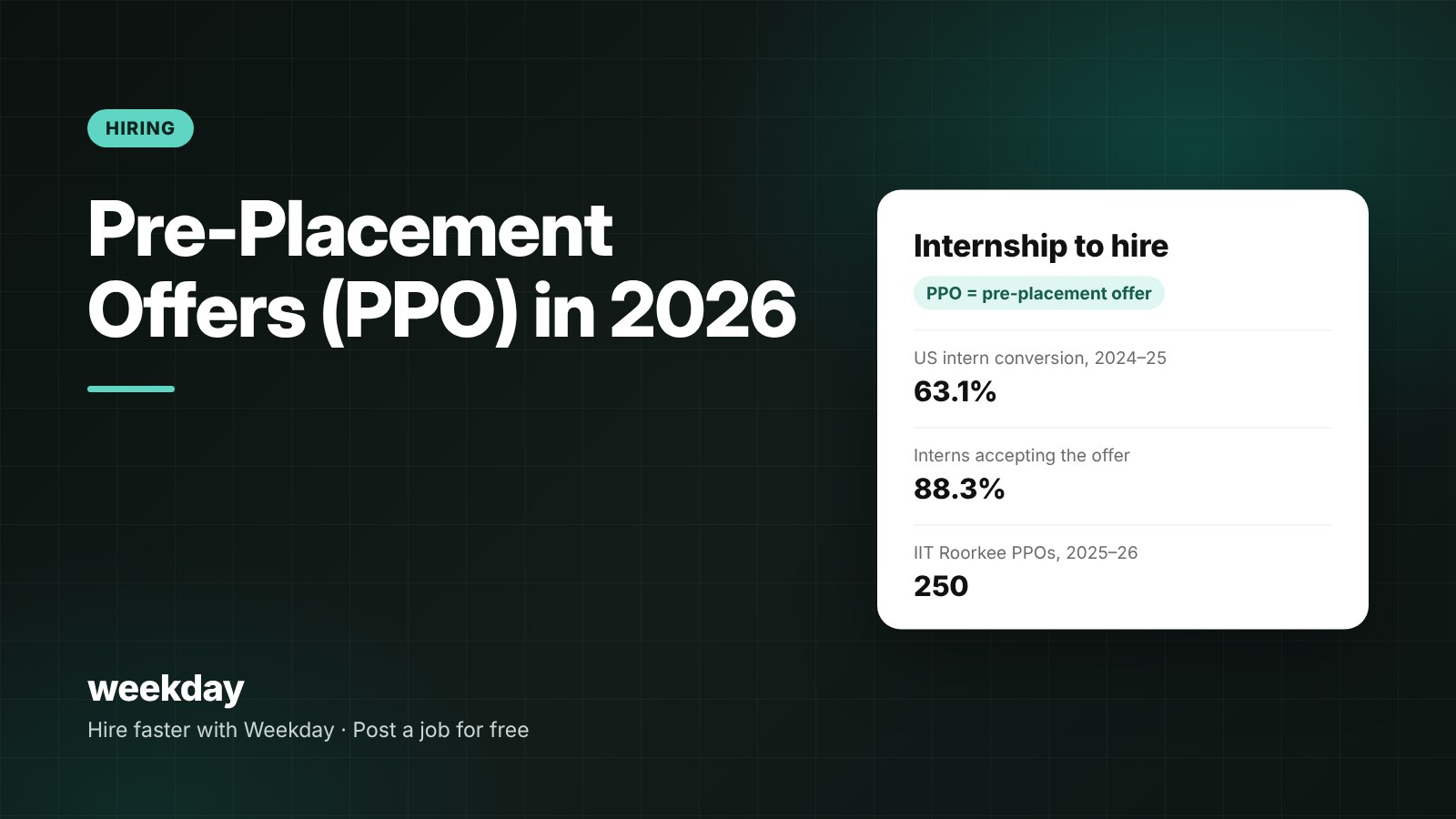
PPOs are growing. At the IITs, PPOs rose by 10–20% across campuses in the 2025–26 season. IIT Roorkee, for example, saw 250 students receive PPOs, up from 200 a year earlier (Careers360). At IIT Kanpur, 253 PPOs were part of the offers counted at the start of the placement season (IIT Kanpur).
Why internship-to-hire works
US data from NACE shows how well this route converts and retains:
- Conversion: the share of interns who became full-time hires reached 63.1% for the 2024–25 intern class, the highest in five years. 88.3% of interns who got an offer accepted it (NACE, April 2026).
- Retention: more than three-quarters of hires who interned with the same employer were still there after one year, and more than half after five years. Among hires with no internship experience, less than half stayed one year (NACE, May 2026).
- In-person helps: employers offered full-time jobs to 72% of in-person interns, against about 56% for mixed remote and in-person programs (NACE, August 2025).
The logic holds in India too. A two-month internship is a much longer, more honest test than any interview loop.
Step 1: Decide roles and headcount
Start with the full-time roles you will need 6–12 months from now. Then work backwards: if you want three freshers to join after graduation, take in five or six interns. Not everyone will convert, and not everyone will accept.
Good roles for internship-to-hire include software development, data and analytics, QA, design, sales development and operations. Roles in demand among Indian employers right now include AI application developers and data centre operations associates, according to TeamLease EdTech's H2 2026 survey (People Matters).
Step 2: Set the stipend
Always pay interns. A paid internship signals that you have real work and a budget. Weekday's internships report (16 November 2026) gives these indicative monthly stipends in India:
| Internship type | Usual monthly stipend |
|---|---|
| Marketing, content, HR, operations | around ₹5,000–₹15,000 |
| Sales / business development | around ₹8,000–₹20,000, sometimes plus incentives |
| Design (UI/UX, graphic) | around ₹8,000–₹25,000 |
| Data / analytics | around ₹10,000–₹30,000 |
| Software development | around ₹10,000–₹40,000 |
If you want top interns from strong colleges, pay at the top of these ranges. The stipend is small next to the cost of a bad full-time hire.
Step 3: Time it around placement season
The goal of a PPO program is to make offers before campus placements begin, so your best interns do not end up in a bidding war. At the IITs, Phase 1 of placements for 2025–26 started on 1 December 2025 (Careers360). Each college runs its own calendar, so ask the placement cell early.
A simple calendar for final-year students:
- January–March: pick colleges, open internship applications.
- May–July: summer internship.
- July–August: conversion review and PPO decisions.
- Before the college's placement season: send PPOs with a clear deadline.
Choosing colleges for your internship program
You do not need a top-ten college to run a good program. Pick three to five colleges where your current team studied, where you can get a reasonable slot, and where students have skills that match your work. Ask each placement cell for its internship calendar and past intern stipends, so your offer is in the right range. Build a relationship with one faculty member per college; they can point you to students who build things outside class. Over a few years, these colleges become a steady, low-cost hiring channel.
Step 4: Make the internship a real test
- One real project per intern, with a business owner and a demo at the end.
- A named mentor who gives feedback every week.
- Written conversion criteria from day one: for example, "ships the project, takes feedback well, meets deadlines, scores 3+ on our core skills".
- A mid-point review so nobody is surprised at the end.
Step 5: Make the PPO and close
- Be clear on pay. Use fresher salary benchmarks for the role. Weekday's role guides, such as the full stack salary guide, list fresher ranges.
- Know the competition. Big IT services firms pay freshers roughly ₹3.36–9 LPA+ at TCS and ₹4.5–9 LPA at Accenture, according to Weekday's off-campus drives guide.
- Expect some rejections. More IIT students are turning down PPOs to try the final placement phase. IIT Roorkee saw 24 PPO rejections, up from 18 (Careers360). A clear growth path and a fair offer help more than pressure.
- Stay in touch until joining. Months can pass between the PPO and the joining date. A monthly check-in keeps them engaged.
Common mistakes
- Unpaid internships. They narrow your pool to students who can afford to work free.
- No mentor. Interns without guidance fail for reasons that have nothing to do with ability.
- Deciding PPOs at the last minute, after placement season has started.
- Using interns only for busywork. You learn nothing about whether to hire them.
What to put in a PPO letter
- Role, team and reporting manager.
- Full CTC breakdown and the monthly in-hand estimate.
- Expected joining date, usually after graduation.
- Conditions, such as completing the degree.
- Acceptance deadline. Give enough time to decide, but set a date before the college's placement season.
- Any joining bonus, relocation support or laptop policy.
How to measure your internship-to-hire program
| Metric | How to calculate |
|---|---|
| Offer rate | Interns who received a full-time offer ÷ all interns |
| Acceptance rate | Interns who accepted ÷ interns who received offers |
| Conversion rate | Interns who joined full-time ÷ all interns |
| One-year retention | Converted hires still with you after 12 months ÷ converted hires |
Track these every year. If offer rates are low, your intern selection needs work. If acceptance is low, your offer or timing does.
Looking for interns who could become your next hires?
Post your internship or fresher role on Weekday for free. Your first role includes 200 reach-outs to matching candidates, with no credit card.
Post a free jobFrequently asked questions
What is the full form of PPO?
PPO stands for pre-placement offer: a full-time job offer given to a student, usually after an internship, before campus placements begin.
How is a PPO different from a campus placement offer?
A placement offer comes through the college's placement process after tests and interviews. A PPO comes from the company directly, based on the student's internship work.
Can a student reject a PPO?
Yes. Some students reject PPOs to try for other companies in the placement season, so make your offer clear and competitive.
How much stipend should I pay interns in India?
Indicatively, ₹10,000–₹40,000 a month for software development and ₹10,000–₹30,000 for data roles, based on Weekday's internships report. Pay more to attract top candidates.
Do startups give PPOs?
Yes. Any company can offer a full-time role to an intern. For startups, it is one of the most reliable ways to hire freshers.





