
Last updated: November 2026 · Salary data from Weekday salary pages
An AI engineer builds products that use AI models. Think of a bank chatbot that answers questions from the bank's own policy documents, or a tool that reads 500 resumes and shortlists the best 20. The AI engineer picks the model, connects it to the company's data, tests that the answers are right, and ships it to real users.
This roadmap shows the skills you need, in the right order, with a week-by-week plan, projects, and what AI engineers earn in India.
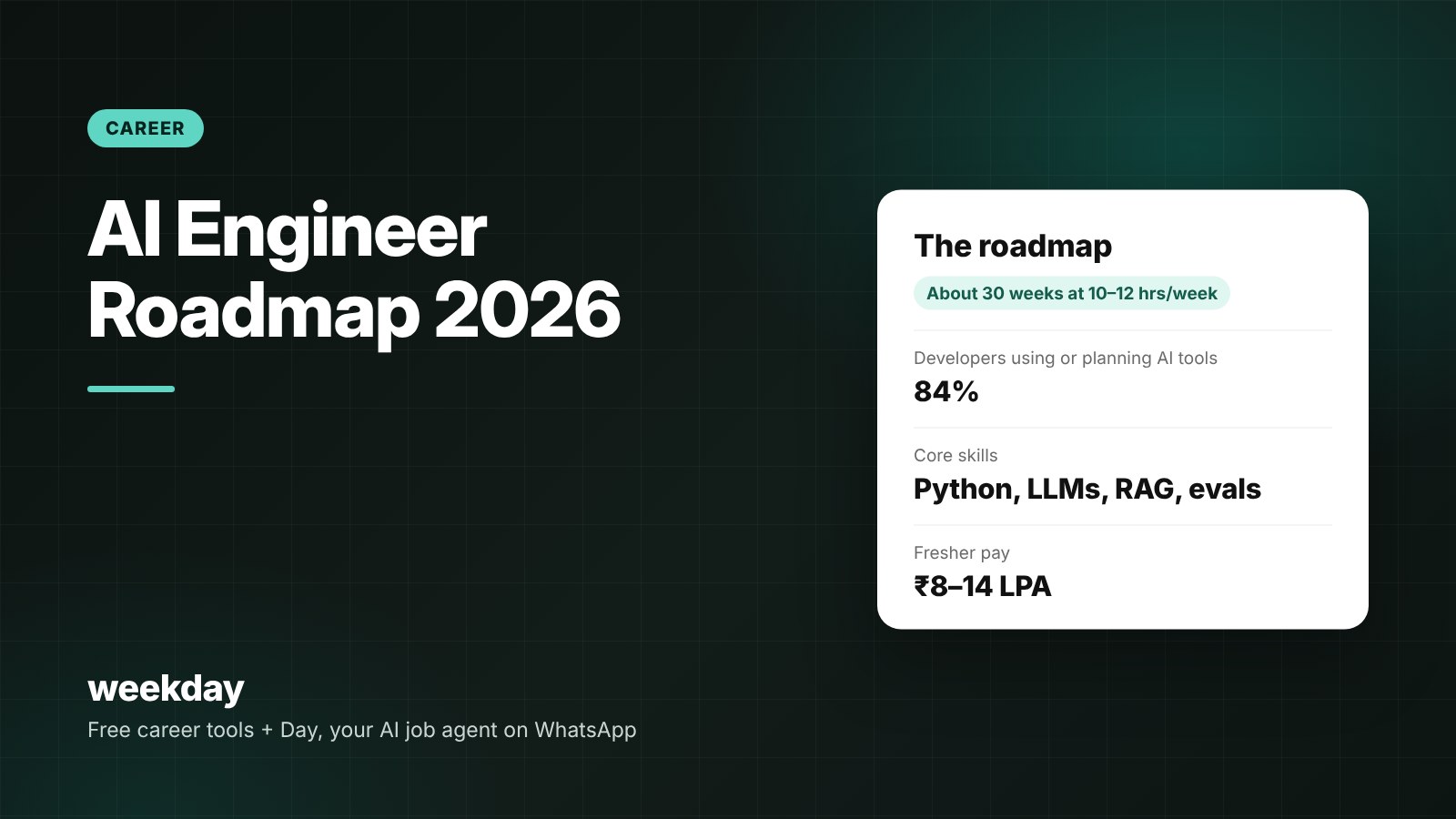
The roadmap in one line: Python and software basics → maths you actually need → machine learning basics → deep learning with PyTorch → LLMs and prompting → RAG with embeddings and vector databases → evaluation → fine-tuning basics → deployment → three projects. Our suggested plan fits this into about 30 weeks at 10 to 12 hours a week.
AI engineer vs ML engineer vs data scientist
| Role | Main job | Typical tools |
|---|---|---|
| AI engineer | Builds products on top of AI models, often large language models (LLMs) | Python, LLM APIs, RAG, vector databases, FastAPI |
| ML engineer | Trains, deploys and scales machine learning models | Python, PyTorch, MLOps tools, cloud |
| Data scientist | Finds insights and builds predictive models from data | Python, SQL, statistics, scikit-learn |
The lines blur at many companies. In practice, an AI engineer is a strong software engineer who also understands models well enough to use them safely. Read more in our AI engineer role description.
Why now?
In Stack Overflow's 2025 Developer Survey, 84% of developers said they use or plan to use AI tools, up from 76% in 2024. The same survey found 46% do not trust the accuracy of AI output (Stack Overflow). That gap is the AI engineer's job: making AI features that are useful and reliable enough to trust.
The AI engineer roadmap: 9 steps
Step 1: Python and software basics (weeks 1–4)
- Python: functions, classes, error handling, virtual environments
- Working with APIs and JSON
- Git, the command line and writing tests
- SQL basics, because company data lives in databases
Revise with our Python interview questions.
Step 2: The maths you actually need (weeks 5–6)
- Vectors and matrices, dot products (this is how embeddings compare text)
- Probability basics and averages vs medians
- What a loss function and gradient descent are, at an intuitive level
You do not need a maths degree. You need enough to understand why a model behaves the way it does.
Step 3: Machine learning basics (weeks 7–10)
- pandas and NumPy for data
- scikit-learn: regression, classification, train/test split
- Overfitting, metrics such as precision and recall
You are ready when: you can train a simple model, explain its accuracy honestly, and say where it fails. Test yourself with our machine learning interview questions.
Step 4: Deep learning with PyTorch (weeks 11–14)
- Neural networks, training loops, GPUs
- Transformers at a high level: tokens, attention, context window
- Using pre-trained models from model hubs
Step 5: LLMs and prompting (weeks 15–17)
- Calling LLM APIs: messages, temperature, token limits, cost
- Prompt design: clear instructions, examples, structured JSON output
- Tool use and function calling
- Open-weight models you can run yourself
Step 6: RAG, embeddings and vector databases (weeks 18–21)
RAG (retrieval-augmented generation) means the model first looks up the right documents, then answers using them. Many company AI features, such as document Q&A and support bots, are built this way.
- Chunking documents and creating embeddings
- Vector search with a vector database or PostgreSQL with a vector extension
- Re-ranking, citations and handling "I don't know"
You are ready when: your bot answers from a 50-page PDF with the right page cited, and refuses questions the PDF cannot answer.
Step 7: Evaluation and safety (weeks 22–23)
- Building a test set of real questions with expected answers
- Measuring accuracy, hallucinations, speed and cost
- Guardrails: blocking harmful input, protecting personal data
This is the step most learners skip, and the one interviewers push hardest on.
Step 8: Fine-tuning and agents (weeks 24–25)
- When fine-tuning helps and when better prompts or RAG are enough
- Parameter-efficient fine-tuning (LoRA) on a small model
- Agents: a model that plans steps and calls tools, with limits on what it can do
Step 9: Deployment (weeks 26–27)
- Serving your app with FastAPI
- Docker and one cloud
- Logging prompts and answers, monitoring cost and latency
Week-by-week plan
| Weeks | Focus | Output by the end |
|---|---|---|
| 1–6 | Python, SQL, maths | Clean Python projects on GitHub with tests |
| 7–10 | ML basics | One trained model with an honest write-up |
| 11–14 | Deep learning | A fine-tuned pre-trained model on a small dataset |
| 15–21 | LLMs, RAG | A document Q&A bot with citations |
| 22–25 | Evaluation, fine-tuning, agents | A test set and score report for your bot |
| 26–30 | Deployment, projects, applications | 3 projects live, resume ready, applying every week |
3 projects that stand out
- Policy Q&A bot. Upload an HR or insurance policy PDF and answer questions with page citations. Add a test set of 30 questions and report accuracy.
- Resume-to-job matcher. Compare a resume against job descriptions using embeddings, explain the match score, and flag missing skills.
- Bilingual support assistant. Answer customer questions in English and Hindi from an FAQ, and hand off to a human when unsure.
Show the evaluation, not just the demo. "Answers 27 of 30 test questions correctly, with citations" is far stronger than a screen recording.
AI engineer salary in India
Weekday's AI engineer salary guide puts freshers at ₹8–14 LPA (₹6–12 LPA for general ML roles), engineers with 2 to 4 years at ₹22–38 LPA, and mid-level engineers with 5 to 7 years at ₹38–65 LPA. Hands-on LLM work such as RAG, fine-tuning, evaluation and production deployment is the biggest pay lever, according to the same guide.
For closely related titles, here is median fixed pay from Weekday's salary pages (all experience levels, read on 20 November 2026):
| Company and role | Median | Typical range |
|---|---|---|
| PayPal, Data Scientist | ₹24 LPA | ₹16.8–35 LPA |
| Ericsson, Data Scientist | ₹20 LPA | ₹16.3–24.6 LPA |
| Optum, Data Scientist | ₹18 LPA | ₹12.5–24 LPA |
| Tiger Analytics, Data Scientist | ₹16 LPA | ₹12–20 LPA |
| Tredence, Data Scientist | ₹14 LPA | ₹9.4–18 LPA |
| Ford, Data Scientist | ₹11 LPA | ₹6.3–15 LPA |
| Quantiphi, Machine Learning Engineer | ₹9.9 LPA (freshers ₹8.5 LPA) | ₹8.5–12 LPA |
At big tech, overall engineering pay is higher still: the engineering median is ₹25 LPA at NVIDIA and ₹30 LPA at Google on Weekday. Use the in-hand salary calculator to see any of these per month.
Three ways into AI engineering
- From software engineering: the fastest path. You already ship code; add Steps 3 to 7. Our guide on moving from full stack to AI engineer shows how.
- From data analysis or data science: you know data and models; strengthen software skills, APIs and deployment. If you are earlier on, start with our data analyst roadmap.
- As a fresher: follow the full roadmap and apply for AI, ML and software roles that mention LLMs. Projects with evaluation numbers make up for no work experience.
How AI engineer interviews work
- Coding round: Python and DSA problems
- ML and LLM concepts: embeddings, RAG, fine-tuning vs prompting, hallucinations
- System design: "Design a support chatbot for 1 lakh users a day. How do you keep cost and wrong answers low?"
- Project deep dive and HR round
For your resume, see our AI engineer resume templates.
Mistakes that slow people down
- Skipping software basics. Most AI engineering work is still engineering: APIs, data, tests, deployment.
- Only building demos. Add a test set and measure results.
- Fine-tuning too early. Better prompts and RAG solve most problems first.
- Chasing every new model. Learn the patterns; models change every few months.
Ready to apply?
See open AI and machine learning roles on Weekday, from startups to GCCs, with filters for experience and city.
Frequently asked questions
How long does it take to become an AI engineer?
Our suggested plan takes about 30 weeks at 10 to 12 hours a week if you start from basic Python. Working software engineers can move faster because they can skip the first steps.
Can a fresher become an AI engineer?
Yes, with strong Python, software basics and projects that show evaluation. Weekday's salary guide puts AI engineer freshers at ₹8–14 LPA.
Do I need a master's degree to become an AI engineer?
Not for most AI engineering roles that build products on existing models. Research roles that create new models usually prefer a master's or PhD.
Which language is best for AI engineering?
Python. Most AI libraries, model hubs and LLM tools support it first. Some teams also use TypeScript for AI features inside web apps.
What is the difference between an AI engineer and an ML engineer?
An AI engineer mainly builds products on top of existing models, often LLMs. An ML engineer mainly trains, deploys and scales models. Many job posts mix the two.





