Last reviewed: November 4, 2026
Compare Weekday and other contingency recruiters for tech startups in 2026 by success fees, technical expertise, replacement guarantees and upfront costs.
Contingency recruiting means paying a placement fee only when you hire a recruiter-introduced candidate. For tech startups, that keeps the fee tied to a hire. Our success-based shortlist covers Weekday, Recruiting from Scratch, KORE1’s contingent searches and Paraform. We compare fees, technical specialization, service scope and replacement terms. Weekday is our editorial first pick for smaller teams needing managed sourcing and recruiting. That’s an editorial recommendation, rather than a claim of independently proven market leadership. Conditional marketplace options and retained or upfront-fee alternatives receive separate treatment, so you can distinguish no-hire-no-fee arrangements from other hiring models.
Why use contingency recruiting agencies for tech startup hiring?
Contingency recruiting can help when you need hiring support and have limited time to run the search yourself. In a straightforward contingency arrangement, you pay a placement fee only when you hire a candidate introduced by the recruiter. That gives you a clear payment trigger, while the recruiter’s scope determines how much work comes off your plate. Before choosing a partner, check who owns sourcing, candidate engagement and scheduling. Also confirm whether the agreement includes any upfront payment: success-based language alone doesn’t tell you the full commercial model.
What hiring problems can contingency recruiting help tech startups address?
- Limited internal bandwidth: If founders are handling recruiting between other priorities, dedicated support can take candidate search and coordination off their calendar. Weekday’s Contingency service is designed for smaller teams with less recruiting bandwidth.
- Finding technically relevant candidates: Match the recruiter’s coverage to your role and seniority. Recruiting from Scratch, for example, covers tech-centric positions from individual contributors through senior management and C-suite, including early-stage startup hiring.
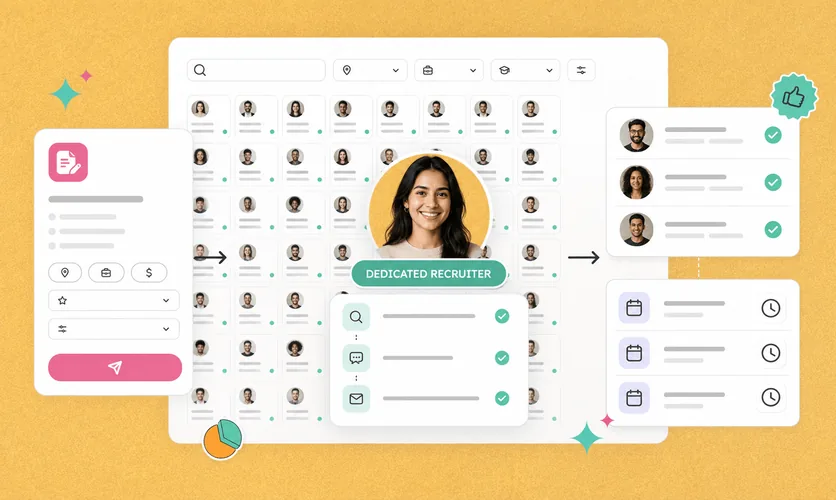
- Managing outreach and interview coordination: Establish who turns a candidate list into interested people and scheduled interviews. With Weekday Contingency, a dedicated senior recruiter owns finding candidates, generating interest and scheduling interviews end to end.
- Distinguishing success fees from upfront charges: Ask explicitly about retainers and deposits. Rocket describes a small retainer per role, with the remainder due on a hire, so its terms differ from a zero-upfront contingency arrangement.
For a smaller team, our Contingency service puts a dedicated senior recruiter in charge of the search so you can focus on interviews. We use Weekday to find candidates, get them interested and coordinate interviews end to end. The fee is 15% of annual salary for a hire through Weekday; if you make no hire through us, there’s no fee. A 60-day replacement period applies if the candidate leaves. Those terms clarify payment and replacement support. They don’t promise that every search will produce a hire.
What should tech startups look for in a contingency recruiting agency?
Start with the agreement, then test whether the recruiter can handle your actual search. A percentage alone tells you little without the payment trigger and compensation basis. Ask whether the fee applies to annual salary, first-year salary, first-year base salary or total target compensation, and get the included components in writing. Technical expertise matters just as much: ask for evidence relevant to your stack, startup stage and seniority needs. You also need clear ownership of sourcing and coordination, so you know what stays on your plate.
Which features and contract terms matter for technical startup hiring?
- Explicit payment model and fee basis: Confirm when payment becomes due, what compensation it covers and whether any upfront charges apply.
- Startup-stage and technical-role fit: Check relevant search experience and confirm specialist or leadership coverage before committing.
- Sourcing and coordination ownership: Establish who finds candidates, generates interest, handles outreach and schedules interviews.
- Written replacement remedy and exclusions: Check the remedy, start date, duration, covered departures, exclusions, payment obligations and notice requirements. A replacement guarantee funds another search; it does not automatically mean a refund.
- Comparable candidate-delivery evidence and workflow fit: Request examples from similar searches, clarify what counts as a qualified candidate and agree on delivery expectations.
Our Contingency service illustrates several criteria: for smaller teams with limited bandwidth, we charge 15% of annual salary, with no fee if no hire is made through Weekday, and a 60-day replacement period if the candidate leaves. A dedicated senior recruiter finds candidates, generates interest and schedules interviews. Confirm unusual leadership or specialist requirements during intake. For shortlist delivery, use “timeline confirmed during intake.” Apply the same checks to the comparison below, and obtain the agreement before treating a public guarantee summary as complete coverage.
How can tech startups use contingency recruiting agencies to manage technical hiring?
If your team has little recruiting bandwidth, use contingency support to delegate the work between defining a role and meeting interested candidates. Our Weekday Contingency model gives smaller teams a dedicated senior recruiter to run sourcing, candidate outreach and interview scheduling. We report a 50%+ outbound response rate across our platform, though that isn't a Contingency-specific promise. The six strategies below show how to structure that engagement, clarify responsibilities and check commercial terms before you commit to a search with us.
Strategy 1: Delegate sourcing and coordination to a dedicated recruiter
- Give one recruiter ownership: Our dedicated senior recruiter finds candidates, generates interest and schedules interviews end to end. You take the interviews.
- Understand the delivery model: Weekday assigns a dedicated senior recruiter. Paraform combines independent specialist recruiters, AI matching and dedicated talent-strategy support. Ask who will own your search and coordinate candidate conversations.
- Keep the models separate: Weekday Subscription serves larger teams with an in-house recruiting function. Its self-serve database access and filters are separate from the Contingency service described here.
Strategy 2: Reach candidates through marketplace-supported sourcing
- Use the marketplace through your recruiter: Our sourcing agent and recruiting tool are supported by a marketplace candidates join themselves. That direct participation supports richer, more current candidate information than static internet profiles.
- Keep scale in perspective: We describe our marketplace as a large and growing base of active, self-registered profiles. For your search, focus the conversation on role fit and candidate interest.
- Reach beyond applicants: Your recruiter uses Weekday for proactive sourcing, including outreach to passive candidates.
Strategy 3: Coordinate outreach across email, WhatsApp and phone
- Delegate all three channels: Our outreach workflow uses email, WhatsApp and phone, with AI-drafted messages and follow-ups to obtain candidate responses.
- Connect responses to interviews: In Contingency, the dedicated recruiter owns outreach and interview coordination, so your team doesn't need to run those steps itself.
- Read the metric correctly: The 50%+ outbound response rate is a company-reported platform result. It isn't a guaranteed response rate for your role or a published Contingency-specific benchmark.
Strategy 4: Confirm technical role and seniority fit during intake
- Start with the role family: Our published coverage includes engineering, product, design, GTM and sales, with an emphasis on technical hiring.
- Make seniority explicit: Explain whether you need an individual contributor, specialist or leader before the search begins.
- Check unusual requirements: We don't publish a standardized seniority-by-service coverage matrix. Confirm specialist and leadership requirements during intake rather than assuming every search fits the service.
Strategy 5: Tie placement spending to a successful hire
- Use the published success fee: Weekday Contingency costs 15% of annual salary.
- Confirm the no-hire condition: The service is free if no hire is made through Weekday.
- Budget for the placement: Use the role's expected annual salary to estimate the fee, then confirm the applicable salary basis and payment terms in your agreement.
Strategy 6: Review replacement terms before signing
- Check the stated protection: Weekday Contingency includes a 60-day replacement period if the candidate leaves.
- Read the agreement: Verify when the period starts, what conditions apply and how to request a replacement.
- Separate replacement from refund: A replacement period should not be read as a refund promise. Confirm the remedy in writing before signing.
For a bandwidth-constrained startup, the practical question is who owns the recruiting work and what happens when a placement doesn't last. Use intake to confirm role and seniority fit. Give the dedicated recruiter ownership of sourcing, interest generation and scheduling. Then review the 15% success fee and 60-day replacement terms together. That gives you a clear basis for deciding whether Weekday Contingency fits your team, while keeping your attention on interviewing candidates and making the hiring decision for the role.
How do contingency recruiting agencies and adjacent alternatives compare for tech startups?
Start with the payment trigger. A success-only fee, a refundable access deposit and an upfront retainer create different commitments for your startup. This table separates verified contingency options from conditional engagements and adjacent alternatives. Timelines refer to first-candidate delivery where that milestone is published.
| Provider | Payment model and no-hire-no-fee status | Published fee and salary basis | Technical specialization | Startup stage or team fit | Seniority | Service scope | Replacement terms | Time to first candidates |
|---|---|---|---|---|---|---|---|---|
| Weekday | Verified success-based Contingency: free if no hire is made through Weekday | 15% of annual salary | Engineering, product and design; also GTM and sales | Smaller teams with limited recruiting bandwidth | Standardized coverage matrix not publicly disclosed; confirm directly. Specialist and leadership requirements confirmed during intake | Our dedicated senior recruiter runs sourcing, generates candidate interest and schedules interviews end to end | 60-day replacement period if the candidate leaves | Standardized Contingency benchmark not publicly disclosed; confirm directly. Timeline confirmed during intake |
| Recruiting from Scratch | Verified contingency: no upfront fee or retainer | Percentage of first-year salary; percentage not publicly disclosed; confirm directly | Tech-centric roles | Early-stage startups | Individual contributor through senior management and C-suite | Software-assisted sourcing and screening, ATS collaboration and shared Slack workflows; no temporary recruitment | Replacement guarantee with no additional replacement fee; duration not publicly disclosed; confirm directly in agreement | First shortlist in 1-2 weeks, provider-reported |
| KORE1 | Verified for contingent direct hire: no upfront retainer; payment on successful placement | 20% cited in current terms guidance; startup page quotes 20%-25% of first-year base salary. Confirm proposal | Developers, engineers, data specialists and technical leaders | Pre-seed through Series C | Technical practitioners and leaders | Direct hire, contract and contract-to-hire available; contingency terms here apply to direct hire | 60-day direct-hire replacement for most cause-related reasons; contract placements excluded | Qualified candidate presentation in 7-14 days, provider-reported |
| Paraform | Verified success-based recruiter marketplace: payment only when a hire is made | Approximately 25% of first-year salary; some guidance quotes 20%-25%. Confirm agreement | Software and forward-deployed engineering; also GTM and legal | Early-stage and growth-stage startups through enterprise | Standardized seniority coverage not publicly disclosed; confirm directly | Specialist recruiters, AI matching and talent-strategy support; technical guide describes 3-5 recruiters per role | Published 90-day replacement coverage, subject to employer agreement | Roughly 10 days to interview-ready candidates, provider-reported |
| Dover | Conditional: choose a pay-per-hire engagement. Other options include hourly and retainers. Refundable access deposit applies | Recruiter-specific percentage of first-year base salary or fixed fee; universal rate not publicly disclosed; confirm directly | Depends on selected recruiter | Depends on selected recruiter; standardized startup-stage fit not publicly disclosed; confirm directly | Depends on selected recruiter | Sourcing, strategy, screening, scheduling, offers and closing within existing hiring systems | Duration and remedy vary by engagement; may include replacement sourcing, prorated refund or a choice | Universal benchmark not publicly disclosed; confirm directly |
| Rocket | Adjacent hybrid: small upfront per-role retainer, remainder due on hire. Not an unconditional no-hire-no-fee option | Custom fee percentage and salary basis not publicly disclosed; confirm directly | Engineering, AI/ML, product and design; also sales, marketing, finance and operations | Founding-engineer, IC and GTM hiring; executive and embedded needs have separate services | Founding engineers and ICs through C-suite | Distinct contingency, executive-search and embedded-recruiting services; confirm the specific agreement | Published 90-day replacement at no additional cost | Comparable first-candidate benchmark not publicly disclosed; confirm directly |
| Candidate Labs | Conditional/unverified for IC contingency: payment terms not publicly disclosed; confirm directly. Leadership searches are explicitly retained | Fee percentage and salary basis not publicly disclosed; confirm directly | Full-stack, backend, infrastructure and research engineering; early GTM roles | Small number of venture-backed startups; high-context, low-volume searches | Engineering and GTM ICs; leadership via retained search | Kickoff calibration, detailed candidate context, ATS collaboration and shared Slack channel | Not publicly disclosed; confirm directly | Not publicly disclosed; confirm directly |
| Hunt Club | Adjacent leadership-search alternative: primarily retained, with contained engagements depending on scope. Pure no-hire-no-fee status unverified | Customized percentage of first-year total target compensation; percentage not publicly disclosed; confirm directly | Engineering and technology, product and GTM; also finance and people | Series A and later investor-backed companies | C-suite, senior leadership and selected high-impact ICs | Expert-network introductions supported by search technology; executive search and team buildout | Duration not publicly disclosed; confirm directly | Executive-search benchmark not publicly disclosed; confirm directly. First 3 candidates within a week is a marketed team-buildout commitment only |
For strict no-hire-no-fee hiring, compare Weekday, Recruiting from Scratch, KORE1's contingent direct hire and Paraform first. Evaluate Dover's selected engagement separately: confirm how its deposit is applied, its offer-acceptance fee trigger and failed-start treatment. Rocket's upfront retainer and the retained leadership services at Candidate Labs and Hunt Club involve different commitments. Keep speed comparisons equally precise: Recruiting from Scratch's 29-day signed-offer average, Paraform's 27-day average time to hire and Rocket's search-duration estimates measure later milestones, not first-candidate delivery. Confirm replacement exclusions and the applicable agreement before signing.
What are the best no-hire-no-fee contingency recruiting agencies for tech startups in 2026?
Our editorial shortlist is Weekday, Recruiting from Scratch, KORE1 and Paraform. Each publishes a success-based hiring arrangement relevant to startup technical recruiting. This is a fit-based assessment of public evidence, not a hands-on performance ranking. Provider-reported timelines measure different milestones, so confirm scope, fees and replacement terms before signing.
1. Weekday
Weekday is our proactive, AI-powered sourcing agent and recruiting tool, supported by a marketplace where candidates sign up themselves. That produces richer, more current candidate data than static internet profiles and supports our company-reported 50%+ outbound response rate across email, WhatsApp and phone. For smaller teams with limited hiring bandwidth, our Contingency service puts a dedicated senior recruiter in charge of finding candidates, getting them interested and scheduling interviews end to end. You take the interviews; we handle the sourcing and coordination.
Company Summary: We place Weekday first for small startup teams that need recruiter ownership and published commercial terms. The fit is specific: managed hiring, a 15% success fee and a 60-day replacement period, backed by sourcing technology and a candidate marketplace.
Key Features
- Dedicated senior recruiter managing candidate sourcing, outreach and interview scheduling.
- Outreach across email, WhatsApp and phone. The 50%+ response rate is a company-reported platform result, not a Contingency-specific guarantee.
- A large and growing base of active, self-registered profiles supporting proactive sourcing.
Tech Startup Hiring Offerings: Engineering, product, design, GTM and sales coverage. We are Y Combinator W21-backed and emphasize technical hiring. Confirm specialist requirements, seniority and the expected first-shortlist timeline during intake.
Pricing: 15% of annual salary, payable when you hire through Weekday. No hire, no fee. A 60-day replacement period applies if the candidate leaves.
Pros and Cons
- Pros: Dedicated recruiter ownership suits founders with little recruiting bandwidth. The fee and replacement period are public.
- Cons: We don't publish a Contingency-specific average time to first shortlist or a standardized seniority-by-service coverage matrix. Confirm both against your role requirements.
Our differentiation starts with the marketplace underneath the sourcing. Candidates come to Weekday and build their own profiles, giving our sourcing agent richer, more current information to work with. Contingency adds a senior recruiter who uses that recruiting tool on your behalf and manages the work through interview scheduling.
2. Recruiting from Scratch
Recruiting from Scratch is a contingency option for early-stage startups hiring tech-centric talent from individual contributors through senior management and the C-suite. It combines software-assisted sourcing and screening with recruiter delivery, using ATS collaboration and shared Slack workflows to work with hiring teams. The firm publishes a first-shortlist window of one to two weeks, giving founders a concrete planning reference. Its commercial model has no upfront fee or retainer, although the exact success-fee percentage and replacement-guarantee duration need confirmation in the agreement.
Key Features
- Software-assisted sourcing and screening.
- ATS collaboration and shared Slack workflows.
- Provider-reported first shortlist within one to two weeks.
Tech Startup Hiring Offerings: Early-stage, tech-centric hiring from individual contributor to C-suite. The firm says it does not currently recruit temporary positions.
Pricing: A percentage of first-year salary, charged on a contingency basis with no upfront fee or retainer. The reviewed public page does not disclose the percentage. A replacement guarantee is standard on contingency searches, with no additional replacement fee; its duration is disclosed in the agreement.
Pros and Cons
- Pros: Explicit early-stage startup coverage, broad seniority coverage and a published first-shortlist window.
- Cons: Budgeting requires a fee quote, and the replacement window needs written confirmation. Temporary recruiting is outside its stated scope.
3. KORE1
KORE1 serves startups from pre-seed through Series C, with coverage spanning developers, engineers, data specialists and technical leaders. Its direct-hire contingent search is the relevant no-hire-no-fee option here; contract and contract-to-hire are separate engagement models. KORE1 reports presenting qualified candidates within seven to fourteen days. That makes it a relevant shortlist option for founders evaluating contingency recruiters for engineers, including teams hiring across technical disciplines and leadership. Its public pricing statements differ, so use the proposal to establish the actual fee and replacement obligations.
Key Features
- Startup-specific coverage from pre-seed to Series C.
- Direct-hire contingent searches with no upfront retainers.
- Provider-reported qualified candidate presentation within seven to fourteen days.
Tech Startup Hiring Offerings: Developers, engineers, data specialists and technical leaders. Contract and contract-to-hire services are also available, with separate commercial terms.
Pricing: The startup staffing page quotes 20%-25% of first-year base salary, payable on successful placement. Its October 2026 staffing-agreement guidance cites a 20% direct-hire fee. Confirm the applicable rate in your proposal. That guidance describes a 60-day replacement guarantee for most cause-related reasons.
Pros and Cons
- Pros: Explicit startup-stage coverage, technical individual-contributor and leadership roles, and a published candidate-presentation window.
- Cons: Public pricing is not fully consistent. Replacement conditions apply to direct hire, and contract placements are excluded from replacement guarantees.
4. Paraform
Paraform combines independent specialist recruiters, AI matching and dedicated talent-strategy support for employers ranging from early-stage startups to enterprises. Its technical recruiting guide describes assigning three to five specialized recruiters per role, with interview-ready candidates arriving in roughly ten days. Software engineering, forward-deployed engineering and GTM are among its published specialties, making it relevant for startups hiring across technical and commercial functions. Pricing is success-based, and its guidance describes replacement protection. Confirm both in the employer agreement, which governs the commercial details of your search.
Key Features
- Three to five specialized recruiters per role, according to its technical recruiting guide.
- AI matching and dedicated talent-strategy support.
- Provider-reported interview-ready candidates in roughly ten days.
Tech Startup Hiring Offerings: Software engineering, forward-deployed engineering, GTM and legal, with early-stage and growth-stage startup use cases. Confirm the seniority requirements for your specific role during scoping.
Pricing: Approximately 25% of first-year salary, payable only when a hire is made. Some published technical recruiting guidance quotes 20%-25%. Provider guidance describes a 90-day replacement period, including a free replacement search, subject to the employer agreement.
Pros and Cons
- Pros: Multiple specialist recruiters per role, technical and GTM coverage, and published first-candidate timing and replacement guidance.
- Cons: Final fees and replacement obligations require agreement-level confirmation. The separately named “Paraform Guarantee” concerns eligible recruiter compensation; it should not be treated as employer replacement protection.
Which conditional and adjacent recruiting alternatives should tech startups consider?
These four providers belong in a broader startup recruiting comparison, but their commercial terms need a closer look. Dover depends on the recruiter engagement you select. Rocket discloses an upfront retainer. Candidate Labs doesn't publicly confirm contingency terms for individual-contributor (IC) searches. Hunt Club primarily uses retained or contained search. None should be treated as a verified zero-upfront recommendation across all services.
Dover: Conditional pay-per-hire marketplace option
Dover connects you with recruiters who set their own pricing. You can select a contingency engagement, but the marketplace also supports hourly and retainer arrangements.
- Key Features: Recruiters can handle sourcing, hiring strategy, screening, scheduling, offers and closing within your existing hiring systems.
- Tech Startup Hiring Offerings: Role coverage and seniority depend on the recruiter's expertise. Check their fit for your engineering, leadership or other hiring needs. Dover doesn't publish a universal time to first candidates.
- Pricing: Recruiter-set hourly rates, flat weekly or monthly retainers, or contingency fees based on first-year base salary or a fixed amount. A refundable marketplace-access deposit applies toward expert work and is refunded if you don't engage an expert. Under standard terms, the success fee is triggered by offer acceptance, with payment normally due within 30 days. Replacement duration and remedies are engagement-specific, potentially including replacement sourcing or a prorated refund.
- Pros and Cons: Flexible engagement options and broad recruiting support are useful if you want to choose your recruiter. The trade-off is contract-level diligence: confirm the fee basis, deposit treatment, failed-start provisions and replacement terms before committing. A contingency selection doesn't establish zero pre-hire outlay.
Rocket: Hybrid recruiting with an upfront retainer
Rocket offers contingency recruiting alongside executive search and embedded recruiting. Its disclosed contingency structure includes a small retainer per role, so we classify it as an upfront-retainer hybrid.
- Key Features: Separate services address IC and go-to-market hiring, critical leadership searches, and additional in-house recruiting capacity.
- Tech Startup Hiring Offerings: Coverage spans engineering, AI/ML, product, design, sales, marketing, finance, operations and executive leadership, from founding engineers and ICs through C-suite. Confirm which roles fall under your specific contingency agreement.
- Pricing: A small retainer per role, with the remainder due when a hire is made. The fee percentage and retainer amount aren't publicly disclosed. Rocket publishes a 90-day, no-additional-cost replacement policy; confirm its application to your selected service.
- Pros and Cons: Broad functional coverage and a published replacement period make Rocket worth evaluating. The upfront retainer limits its fit for a strict no-hire-no-fee shortlist. Its four-to-eight-week mid-level and six-to-twelve-week senior search estimates describe search duration, not time to first candidates.
Candidate Labs: Startup specialist with unverified IC contingency terms
Candidate Labs focuses on a small number of venture-backed startups, with engineering and early go-to-market IC hiring among its stated specialties. Its startup fit is clear. Its current IC contingency terms require direct confirmation.
- Key Features: A high-context, low-volume approach built around kickoff calibration, detailed candidate context, ATS collaboration and a shared Slack channel.
- Tech Startup Hiring Offerings: Engineering IC searches cover full-stack, backend, infrastructure and research. Early go-to-market coverage includes sales, solutions, forward-deployed roles, partnerships and marketing. Leadership searches are explicitly retained.
- Pricing: IC fee percentages, payment terms, replacement guarantee length and time to first candidates aren't publicly disclosed. Confirm each directly before treating an IC search as contingency.
- Pros and Cons: The focused startup remit and collaborative workflow may suit founders who want detailed candidate context. Commercial uncertainty prevents a verified no-hire-no-fee recommendation. Missing public terms don't establish that contingency is unavailable, either.
Hunt Club: Retained or contained leadership search
Hunt Club is an adjacent option for leadership hiring, particularly from Series A through later investor-backed stages. Its executive-search FAQ describes a primarily retained model, with contained arrangements depending on scope.
- Key Features: Expert-network introductions supported by search technology.
- Tech Startup Hiring Offerings: C-suite, senior leadership and selected high-impact IC roles across engineering and technology, product, go-to-market, finance and people. Its team-buildout offering also lists director, senior-manager and manager roles.
- Pricing: Retained pricing uses a customized percentage of first-year total target compensation. The reviewed FAQ doesn't publish a specific percentage or replacement guarantee duration. Obtain the proposal and payment schedule before comparing costs.
- Pros and Cons: Leadership coverage and network-led introductions make Hunt Club relevant when the search extends beyond individual contributors. Its published terms don't establish a standard pure-contingency, no-upfront service. The promise of the first three candidates within a week belongs specifically to its marketed team-buildout offering; it isn't a universal executive-search benchmark.
How these differ from Weekday: For smaller teams with limited recruiting bandwidth, our published Contingency arrangement charges 15% of annual salary, is free if no hire is made through Weekday, and includes a 60-day replacement period if the candidate leaves. Use that clear fee structure as your baseline when reviewing these engagement-dependent or retained alternatives.
How were these contingency recruiting agencies evaluated for tech startups?
We checked the research on November 4, 2026, using public provider pages and terms, without hands-on performance testing. Published outcomes are provider-reported, with no standardized cross-provider dataset supplied. Our evidence hierarchy puts current provider service pages and agreement guidance ahead of third-party comparisons, which can mix engagement models or describe terms a provider no longer verifies publicly. Where Weekday materials conflict, supplied organization guidance governs. The weights below are an editorial decision framework, not measured results or numerical provider scores.
Mandatory payment-model eligibility checklist
- Placement-fee trigger: Confirm that the placement fee becomes payable only after a successful hire. Check the agreement for the exact invoicing trigger.
- Upfront retainer or deposit: Check for mandatory payments before a hire. Retained, hourly and deposit-based searches must be distinguished from strict no-hire-no-fee contingency recruiting.
- Separate service models: Evaluate each offering separately. A provider's contingency option does not make its retained search, subscription or other services contingency-based.
- Verified versus conditional or adjacent classification: Use the verified group only where current public evidence supports the payment model. Keep unclear terms conditional and different engagement models in the adjacent-alternatives group. Missing terms remain unverified.
| Category | Editorial Weight | High-Performance Use Case | Evidence or Measurable Outcome |
|---|---|---|---|
| Technical and startup fit | 25% | Finding a partner for your specific technical role and startup stage | Documented role coverage, seniority levels and funding-stage focus |
| Total fee transparency | 20% | Understanding the full hiring cost before committing | Published percentage or fixed fee, salary basis, upfront costs and payment trigger |
| Guarantee quality | 20% | Understanding your remedy if a hire leaves | Replacement versus refund, coverage start date and duration, exclusions, notice requirements and payment obligations |
| Managed-service scope | 15% | Reducing the hiring workload for a bandwidth-constrained team | Explicit ownership of sourcing, outreach, screening and interview coordination |
| First-candidate evidence | 10% | Setting expectations for the first usable candidate pipeline | A defined shortlist or interview-ready-candidate milestone, distinct from total time to hire |
| Workflow fit | 10% | Keeping your team and recruiting partner aligned | Named recruiter ownership, ATS collaboration and a documented communication process |
Vendor timelines are not statistically comparable benchmarks. We distinguish first-candidate milestones from completed hires and leave unsupported timings unverified.
For Weekday, we use the company-reported 50%+ outbound response rate. We describe our marketplace as a large and growing base of active, self-registered profiles that supports our sourcing agent and recruiting tool. Neither claim establishes an individual customer's expected result.
Public descriptions are a starting point. Private contracts may differ, so reconfirm fees, payment triggers, service scope and replacement terms before engaging a provider.
Why is Weekday a strong contingency recruiting choice for bandwidth-constrained tech startups?
For smaller teams short on recruiting bandwidth, we recommend Weekday Contingency first. A dedicated senior recruiter manages sourcing, candidate interest and interview coordination. Our published fee is 15% of annual salary, with no fee if you make no hire through Weekday and a 60-day replacement period if the candidate leaves. Your technical scope, workflow needs and agreement terms determine fit; conditional or retained alternatives need separate evaluation. Confirm specialist or leadership requirements and candidate-delivery timing during intake. Discuss your role requirements and Contingency terms with Weekday.
FAQs about contingency recruiting agencies for tech startups
What is contingency recruiting, and when does a startup pay the fee?
Contingency recruiting means you pay a placement fee only when you hire a candidate introduced by the recruiter. The exact payment trigger depends on the agreement, so don't assume billing always starts on the candidate's first day. Recruiting from Scratch describes contingency with no retainer or upfront fee. Dover's standard success-fee trigger is offer acceptance, with payment normally due within 30 days. Check the trigger, payment deadline and failed-start provisions before signing. At Weekday, our Contingency service is free if you make no hire through us.
What are the best contingency recruiting agencies for tech startups in 2026?
The core shortlist is Weekday, Recruiting from Scratch, KORE1's contingent direct-hire service and Paraform. Choose based on role fit, recruiter involvement and the service your team needs. Our Weekday Contingency model suits smaller teams with limited recruiting bandwidth and provides a dedicated senior recruiter. Recruiting from Scratch explicitly offers contingency without an upfront fee or retainer. For startups seeking contingency recruiters for engineers, KORE1 lists developers, engineers, data specialists and technical leaders. Paraform matches companies with specialized recruiters per role. Confirm each provider's proposed scope before choosing.
How much do contingency recruiting agencies charge for technical hires?
Weekday Contingency costs 15% of annual salary. KORE1's current staffing-agreement guidance cites 20%, while its startup page quotes 20%-25% of first-year base salary. Paraform describes approximately 25% of first-year salary, with some published guidance quoting 20%-25%. Recruiting from Scratch charges a percentage of first-year salary without publicly disclosing that percentage on its reviewed contact page. These are provider-specific figures, not a market average. Ask for the applicable percentage, compensation basis and payment trigger in writing so you can compare the actual proposals on consistent terms.
What does Weekday's 15% Contingency service include?
Our Contingency service gives smaller teams with limited hiring bandwidth a dedicated senior recruiter who runs candidate sourcing, generates interest and schedules interviews end to end. The recruiter uses Weekday as the recruiting tool and sourcing agent on your behalf, including outreach and interview coordination. You take the interviews while we handle that recruiting work. The fee is 15% of annual salary, and you pay nothing if you make no hire through Weekday. The service also includes a 60-day replacement period if the candidate leaves.
How does Weekday Contingency differ from its Subscription offering?
Weekday Contingency is for smaller teams that need a dedicated senior recruiter to find candidates, generate interest and coordinate interviews. It costs 15% of annual salary, with no fee if no hire is made through Weekday. Subscription is a separate, custom-priced offering for larger teams with an in-house recruiting function. Your team gets self-serve marketplace database access, AI-enabled sourcing filters and outreach credits. We still email, WhatsApp and call candidates you express interest in. Subscription access and credits are not included in the 15% Contingency service.
How quickly can a contingency recruiter deliver qualified candidates?
Provider-reported timelines use different milestones, so compare them carefully. Recruiting from Scratch reports one to two weeks to a first shortlist. KORE1 reports seven to fourteen days to qualified candidate presentation. Paraform reports roughly ten days to interview-ready candidates. At Weekday, your Contingency timeline is confirmed during intake; our website's broader “within days” language does not establish a measured Contingency shortlist average. None of these figures guarantees delivery for your role. Confirm what each provider counts as a qualified candidate and which milestone its quoted timeline actually measures.
Does a 60-day or 90-day replacement guarantee include a refund?
No. A replacement guarantee generally covers another search; a refund returns some or all of the placement fee. One does not automatically include the other. When comparing contingency recruiting agencies with replacement guarantees, check the remedy, coverage start date, covered departures, exclusions, payment requirements and notice deadlines. Weekday includes a 60-day replacement period if the candidate leaves. Paraform publishes 90-day replacement coverage, subject to its employer agreement. Dover's remedies vary by engagement and can include replacement sourcing, a prorated refund or a choice. Read the actual terms before relying on a headline.
Are Dover, Rocket, Candidate Labs and Hunt Club no-hire-no-fee options?
These providers need qualification before you treat them as no-hire-no-fee options. Dover supports contingency engagements alongside hourly and retainer work, so select the payment model explicitly. It also requires a marketplace-access deposit, refundable if no expert is engaged. Rocket discloses a small upfront retainer per role, with the remainder due on hire. Candidate Labs' current homepage does not verify individual-contributor contingency terms, so confirm directly. Hunt Club says it primarily uses retained or contained models. None should be presented unconditionally as a zero-upfront contingency option.
Related hiring guides
Hiring specifically in India? See our India contingency recruitment agency comparison. For a Bengaluru shortlist, use the Bangalore startup hiring guide.