Last updated: 9 November 2026
- What leave encashment means
- When it's paid: during service vs at exit
- The formula, with 3 worked examples
- Tax: Section 10(10AA) and the ₹25 lakh limit
- What the labour codes say about earned leave
- How to check and claim yours
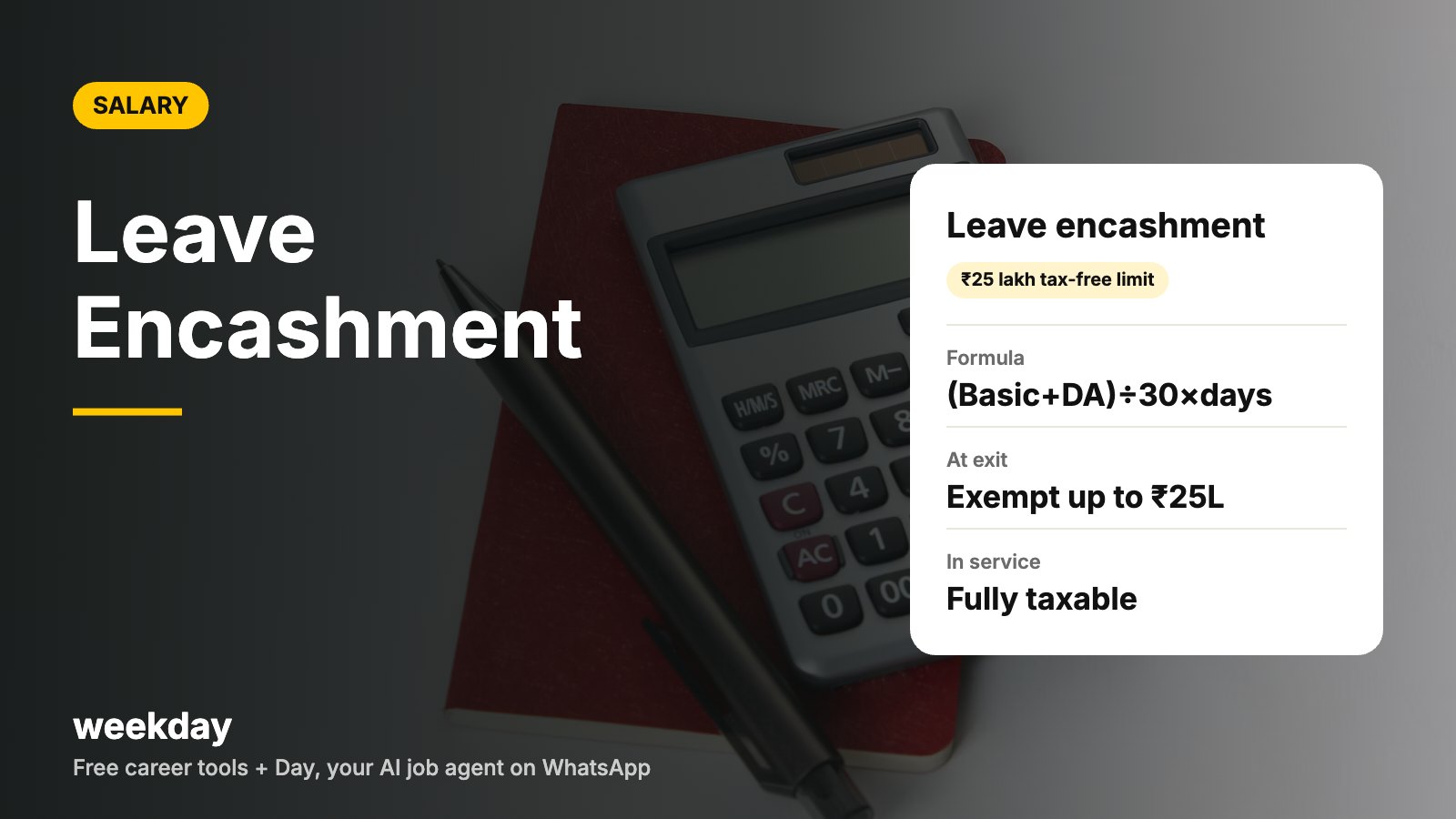
- Exemption limit for non-government employees at retirement or resignation: ₹25 lakh (raised from ₹3 lakh, effective 1 April 2023). It's a lifetime limit.
- Government employees: leave encashment at retirement is fully exempt.
- Encashment while in service is fully taxable as salary.
- Final settlement, including leave encashment, is due within 2 working days of exit under the Code on Wages (s.17(2)).
Sources: Income Tax Act, 1961, s.10(10AA); CBDT notification (May 2023); Code on Wages, 2019; OSH Code, 2020.
Day, Weekday's free AI job agent, finds jobs that match your skills and pay, and applies when you say yes. On WhatsApp.
Say hi to Day on WhatsAppHow Day works →What leave encashment means
Most employers give you a set number of paid leave days a year. Casual and sick leave usually lapse if unused. Earned leave (also called privilege leave, PL or annual leave) can often be carried forward, and when you have too much or when you leave, the company pays you for it. That payment is leave encashment.
| Leave type | Can it usually be encashed? | Notes |
|---|---|---|
| Earned / privilege leave (EL/PL) | Yes | Main source of encashment |
| Casual leave (CL) | Rarely | Usually lapses at year end |
| Sick leave (SL) | Rarely | Some companies allow partial encashment |
| Comp off | Sometimes | Often must be used within a set window |
| Maternity / paternity leave | No | Not a leave balance you can cash |
When it's paid: during service vs at exit
| During service | At exit (resignation / retirement) | |
|---|---|---|
| When | At year end, or when the balance crosses a cap | In the final settlement |
| Who allows it | Company policy (some don't allow it) | Most companies pay unused EL |
| Usual cap | Often 10–15 days a year | Often 30–60 days, or the full balance, by policy |
| Tax | Fully taxable | Exempt up to ₹25 lakh (non-government) |
| Where you see it | Payslip of that month | F&F statement |
If you're resigning, check the encashment line in your full and final settlement. Some companies adjust leave against the notice period instead of paying it; that depends on your policy and what you agree with HR.
The leave encashment formula
Formula
Leave encashment = (Basic + DA) ÷ Divisor × Unused earned leave days

Divisor:
  30 – calendar days in a month (most common)
  26 – working days in a month (common in factories and some PSUs)

Some companies use gross salary instead of basic + DA. Check your HR policy.
Two policy choices change the answer a lot: the salary base (basic + DA vs gross) and the divisor (30 vs 26). The worked examples below show the effect.
Example 1: IT employee resigning, basic only, ÷ 30
Example 1
Basic: ₹40,000 a month (no DA)
Unused earned leave: 24 days
Policy: basic ÷ 30

One day's value: 40,000 ÷ 30 = ₹1,333.33
Encashment: 1,333.33 × 24 = ₹32,000

Tax: paid at resignation, so it falls under Section 10(10AA). Well under the ₹25 lakh limit, so likely fully exempt (subject to the other limits below).
Example 2: factory supervisor, basic + DA, ÷ 26
Example 2
Basic: ₹22,000 a month
DA: ₹6,000 a month
Unused earned leave: 30 days
Policy: (basic + DA) ÷ 26

One day's value: 28,000 ÷ 26 = ₹1,076.92
Encashment: 1,076.92 × 30 = ₹32,308

Same employee with ÷ 30: 28,000 ÷ 30 × 30 = ₹28,000
Difference: ₹4,308 just from the divisor.
Example 3: encashment while in service
Example 3
Basic: ₹60,000 a month
Policy: up to 10 days a year can be encashed in March; rest carries forward
Days encashed: 10

Encashment: 60,000 ÷ 30 × 10 = ₹20,000

Tax: fully taxable as salary in March. At a 30% slab (plus 4% cess), roughly ₹6,240 goes in tax, leaving about ₹13,760.
| Case | Base | Divisor | Days | Amount | Taxable? |
|---|---|---|---|---|---|
| IT, resignation | ₹40,000 | 30 | 24 | ₹32,000 | Exempt within limits |
| Factory, exit | ₹28,000 | 26 | 30 | ₹32,308 | Exempt within limits |
| In service | ₹60,000 | 30 | 10 | ₹20,000 | Fully taxable |
Tax on leave encashment: Section 10(10AA)
For non-government employees, leave encashment received at retirement or resignation is exempt up to the lowest of these four:
| # | Limit | Notes |
|---|---|---|
| 1 | Actual amount received | |
| 2 | ₹25,00,000 | Raised from ₹3 lakh for exits from 1 April 2023; lifetime limit across employers |
| 3 | 10 months' average salary | Average of the 10 months before exit; salary = basic + DA (if part of retirement benefits) + commission on turnover |
| 4 | Cash value of unused leave | Leave capped at 30 days for each completed year of service, × average monthly salary |
Anything above the lowest figure is taxable as salary. Government employees (central and state) get full exemption at retirement. Encashment while in service is taxable for everyone, though you may claim relief under Section 89 if it pushes you into a higher slab because of arrears.
Worked example: checking the four limits
Section 10(10AA) example
Employee: private sector, resigns after 8 years
Leave encashment received: ₹4,20,000
Average salary (basic + DA) over last 10 months: ₹70,000
Leave entitlement used for the test: 30 days × 8 years = 240 days
Leave taken during service: 150 days
Unused leave for the test: 240 − 150 = 90 days = 3 months

Limit 1: Actual received = ₹4,20,000
Limit 2: ₹25,00,000
Limit 3: 10 × 70,000 = ₹7,00,000
Limit 4: 3 × 70,000 = ₹2,10,000

Exempt: ₹2,10,000 (the lowest)
Taxable: 4,20,000 − 2,10,000 = ₹2,10,000
The 30-days-per-year test is a tax rule, not your company's leave rule. Your company may give you more leave, but only this formula decides the exemption. If you've claimed this exemption from an earlier employer, it reduces the ₹25 lakh you have left.
Old vs new tax regime
As generally understood, the Section 10(10AA) exemption for leave encashment at retirement or resignation is available in both the old and the new tax regime. Confirm with your employer's payroll team or a tax adviser for your case.
What the labour codes say about earned leave
The four labour codes took effect on 21 November 2025. The leave rules sit mainly in the Occupational Safety, Health and Working Conditions (OSH) Code. In broad terms:
- Workers covered by the code earn 1 day of annual leave for every 20 days worked.
- Eligibility starts after 180 days of work in a calendar year, down from 240 days under the old factory law.
- Unused leave can be carried forward, usually up to 30 days.
- The code provides for cash in lieu of unused leave in certain cases, such as at the end of the year or when employment ends. How this applies depends on the rules your state notifies.
- Leave encashment is part of what must be paid in the final settlement, which the Code on Wages requires within 2 working days of exit.
Offices and IT companies are often covered by their state's Shops and Establishments Act, which may set different leave counts. Your appointment letter and HR policy are the best place to check what applies to you.
Leave encashment vs gratuity
Both show up in your exit payout, and both have tax-free limits, so people often confuse them.
| Leave encashment | Gratuity | |
|---|---|---|
| What it pays for | Unused earned leave | Long service |
| Eligibility | Any encashable leave balance, per policy | 5 years (1 year for fixed-term employees) |
| Formula | (Basic + DA) ÷ 30 or 26 × days | 15 days' wages × years of service (÷ 26 under the Gratuity Act) |
| Tax-free limit | ₹25 lakh, lifetime (non-government) | ₹20 lakh |
| When it's due | In the final settlement | Within 30 days of becoming payable |
For the gratuity side, our guide on the gratuity calculation formula walks through the maths.
How to check and claim your leave encashment
- Check your leave balance on the HR portal before you resign.
- Read the leave policy: which leave is encashable, the cap, the base and the divisor.
- Ask HR whether leave will be paid out or adjusted against notice.
- Check the F&F statement: days, rate and tax deducted.
- In your ITR, claim the 10(10AA) exemption if your employer hasn't already shown it in Form 16.
Sample: email to HR before your last day
Hi Anjali,

My last working day is 18 December 2026. The HR portal shows 26 days of earned leave. Could you confirm:

1. Whether all 26 days will be encashed, or only up to a cap
2. Whether the rate is based on basic or gross, and divided by 30 or 26
3. That the exemption under Section 10(10AA) will be applied in my Form 16

Thanks,
Karan Mehta
Planning leave instead of cashing it? Our leave application formats help you apply properly.
Mistakes to avoid
| Mistake | Fix |
|---|---|
| Assuming casual or sick leave will be paid | Usually only earned leave is encashable |
| Not checking the divisor | 26 vs 30 changes the amount by about 15% |
| Paying tax on the full exit amount | Claim the 10(10AA) exemption in your ITR |
| Forgetting the exemption is lifetime | Track what you claimed from earlier employers |
| Resigning without checking the balance | Take a screenshot of the leave balance before you resign |
FAQs
What is leave encashment?
Cash paid by your employer for unused earned or privilege leave, either during service (by policy) or when you resign or retire.
How is leave encashment calculated?
Usually (basic + DA) ÷ 30 or 26 × unused earned leave days. Some companies use gross salary. The exact base and divisor come from your HR policy.
Is leave encashment taxable?
While in service, it's fully taxable. At resignation or retirement, non-government employees can claim exemption up to ₹25 lakh under Section 10(10AA); government employees are fully exempt at retirement.
What is the leave encashment exemption limit?
₹25 lakh for non-government employees, for retirements or resignations on or after 1 April 2023. It's a lifetime limit across all employers.
Is leave encashment exempt on resignation?
Yes. Section 10(10AA) covers retirement and resignation, subject to the lowest of the four limits.
Can casual leave be encashed?
Usually no. Casual leave generally lapses at year end. Earned leave is the type normally encashed.
Is leave encashment part of full and final settlement?
Yes. Unused encashable leave is usually paid in the final settlement, which the Code on Wages requires within 2 working days of exit.
Is the 10(10AA) exemption available in the new tax regime?
As generally understood, yes, for encashment at retirement or resignation. Check with payroll or a tax adviser for your situation.
What do the labour codes say about earned leave?
The OSH Code gives 1 day of leave for every 20 days worked, with eligibility after 180 days in a year, carry-forward usually up to 30 days, and cash in lieu of unused leave in certain cases. State rules fill in the details.