Last updated: 9 November 2026
- EPF interest rate history (FY 2015-16 onwards)
- Who decides the rate, and when
- How EPF interest is calculated
- Worked examples: ₹15,000 and ₹50,000 basic
- Is EPF interest taxable?
- Inoperative accounts and interest
- How to check interest in your passbook
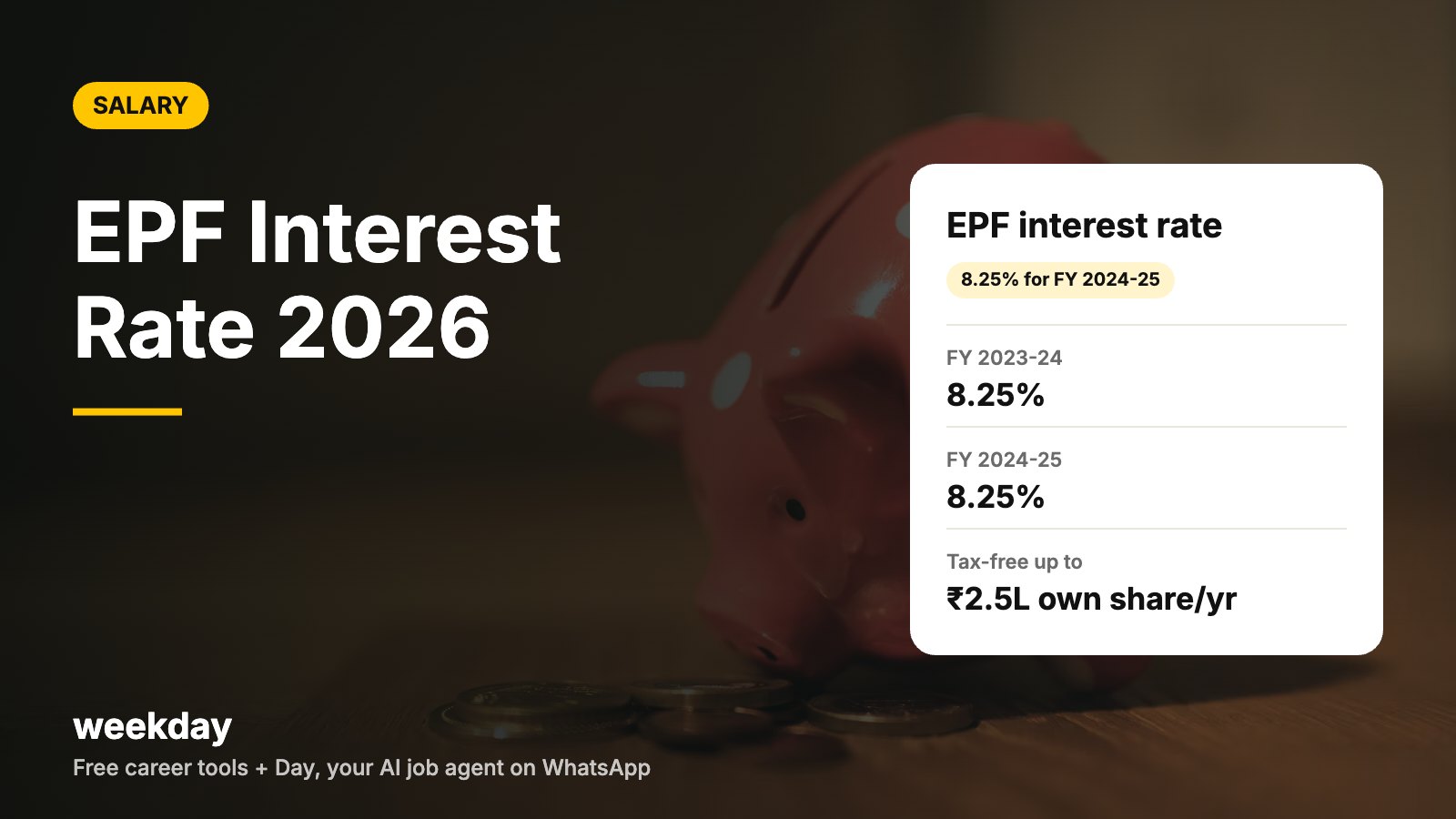
- EPF interest: 8.25% for FY 2023-24 and FY 2024-25. Check EPFO for the FY 2025-26 rate.
- You contribute 12% of basic + DA. Your employer also pays 12%, but 8.33% (capped at ₹1,250 a month) goes to the pension scheme (EPS), which earns no interest. The rest goes to EPF.
- Interest on your own contribution above ₹2.5 lakh a year is taxable (₹5 lakh where there is no employer contribution).
- Interest is calculated monthly and credited annually.
Sources: EPFO circulars and notifications (epfindia.gov.in); Income Tax Act, 1961, s.10(12) and Rule 9D.
A better-paid job grows your PF faster than any rate change. Day, Weekday's free AI job agent, finds jobs that match your skills and pay, and applies when you say yes. On WhatsApp.
Say hi to Day on WhatsAppHow Day works →EPF interest rate history
These are the rates EPFO declared and the government notified for each financial year. The rate applies to the full year, even though it is usually announced partway through the next year.
| Financial year | EPF interest rate | Note |
|---|---|---|
| FY 2025-26 | Check EPFO | See the latest notification on epfindia.gov.in |
| FY 2024-25 | 8.25% | Same as the year before |
| FY 2023-24 | 8.25% | Raised from 8.15% |
| FY 2022-23 | 8.15% | |
| FY 2021-22 | 8.10% | Lowest in several decades |
| FY 2020-21 | 8.50% | |
| FY 2019-20 | 8.50% | |
| FY 2018-19 | 8.65% | |
| FY 2017-18 | 8.55% | |
| FY 2016-17 | 8.65% | |
| FY 2015-16 | 8.80% |
If you see a different FY 2025-26 figure elsewhere, trust only the EPFO website or a government press release.
How EPF compares with other safe options
| Option | Typical return | Tax on returns | Lock-in |
|---|---|---|---|
| EPF | 8.25% (FY 2024-25) | Tax-free up to the ₹2.5 lakh limit | Till exit or retirement, with partial withdrawals |
| PPF | Set every quarter by the government | Tax-free | 15 years |
| Bank FD | Varies by bank and tenure | Fully taxable | Your choice |
| VPF (extra EPF) | Same as EPF | Same ₹2.5 lakh rule | Same as EPF |
That is why many salaried people treat EPF as the safe, debt part of their savings. VPF (Voluntary Provident Fund) lets you put in more than 12%, but remember the ₹2.5 lakh limit on tax-free interest.
Who decides the EPF rate, and when
- EPFO's Central Board of Trustees (CBT), chaired by the Labour Minister, recommends a rate, usually in February or March.
- The Finance Ministry approves it.
- EPFO issues a circular and offices start crediting interest. Credits often reach passbooks between June and August, though this varies year to year.
The rate depends on what EPFO earns on its investments (mostly government and corporate bonds, plus some equity through ETFs) and how much surplus it keeps.
How EPF interest is calculated
Here's the logic in plain words:
- Each month, your employee share (12%) and the employer's EPF share (12% minus the EPS part) are added to your balance.
- Interest for each month = running balance × annual rate ÷ 12.
- The monthly interest is not added to the balance during the year. It is totalled and credited once, at the end of the financial year.
- Next year, interest is earned on the new opening balance, which now includes last year's interest. That's where the compounding comes from.
- The EPS (pension) part earns no interest. It builds your pension, not your PF balance.
| Part of salary | Who pays | Where it goes | Earns EPF interest? |
|---|---|---|---|
| 12% of basic + DA | You | EPF | Yes |
| 8.33% of basic + DA (max ₹1,250/month) | Employer | EPS (pension) | No |
| Rest of employer's 12% | Employer | EPF | Yes |
| Admin and EDLI charges | Employer, on top | EPFO costs and insurance | No |
Worked example 1: basic + DA of ₹15,000
Assume you start the year with a zero balance, contribute every month at the same basic, and the rate is 8.25%.
Year 1 at ₹15,000 basic
Basic + DA: ₹15,000 a month

Employee share (12%): ₹1,800
Employer share: 12% = ₹1,800
  EPS (8.33% of 15,000): ₹1,250
  EPF: 1,800 − 1,250 = ₹550
Total into EPF each month: 1,800 + 550 = ₹2,350

Running balance at end of month 1: ₹2,350
… month 12: ₹28,200

Sum of the 12 monthly balances:
2,350 × (1 + 2 + … + 12) = 2,350 × 78 = ₹1,83,300

Interest for the year = 1,83,300 × 8.25% ÷ 12 = ₹1,260 (rounded)

Balance after interest credit: 28,200 + 1,260 = ₹29,460
Small in year one, because the money only sits for part of the year. It grows once there's an opening balance.
Worked example 2: basic + DA of ₹50,000
Many employers cap the EPS part at ₹1,250 and send the rest of their 12% to EPF. That is the common setup, so we use it here.
Two years at ₹50,000 basic
Basic + DA: ₹50,000 a month

Employee share (12%): ₹6,000
Employer share: 12% = ₹6,000
  EPS (capped): ₹1,250
  EPF: 6,000 − 1,250 = ₹4,750
Total into EPF each month: ₹10,750

Year 1 (opening balance ₹0)
Sum of monthly balances: 10,750 × 78 = ₹8,38,500
Interest: 8,38,500 × 8.25% ÷ 12 = ₹5,765 (rounded)
Closing balance: 1,29,000 + 5,765 = ₹1,34,765

Year 2 (opening balance ₹1,34,765)
Interest on opening balance: 1,34,765 × 8.25% = ₹11,118
Interest on new contributions: ₹5,765
Total interest: ₹16,883
Closing balance: 1,34,765 + 1,29,000 + 16,883 = ₹2,80,648
Your employee contribution here is ₹72,000 a year, well under the ₹2.5 lakh limit, so all this interest is tax-free.
Quick table: interest in the first year
| Basic + DA (monthly) | Into EPF / month | Year-1 interest at 8.25% | Year-end balance |
|---|---|---|---|
| ₹15,000 | ₹2,350 | ≈ ₹1,260 | ≈ ₹29,460 |
| ₹25,000 | ₹4,750 | ≈ ₹2,547 | ≈ ₹59,547 |
| ₹50,000 | ₹10,750 | ≈ ₹5,765 | ≈ ₹1,34,765 |
| ₹1,00,000 | ₹22,750 | ≈ ₹12,200 | ≈ ₹2,85,200 |
Assumes the EPS cap of ₹1,250 and no opening balance. Real figures differ slightly with mid-year joining, arrears, VPF or withdrawals.
Is EPF interest taxable?
Mostly no, with three exceptions to know.
| Situation | Tax treatment |
|---|---|
| Your own contribution is up to ₹2.5 lakh a year | Interest is tax-free |
| Your contribution (including VPF) is above ₹2.5 lakh a year | Interest on the excess is taxable each year, at your slab rate |
| No employer contribution (e.g. some government funds) | The limit is ₹5 lakh |
| Withdrawal before 5 years of continuous service | Withdrawal can be taxable; TDS may be cut if it's over ₹50,000 (exceptions apply, such as job loss due to ill-health or closure) |
| Interest earned after you stop working | Generally taxable, even if the account is still earning |
Worked example: the ₹2.5 lakh rule
When the limit kicks in
Basic: ₹2,50,000 a month
Employee EPF (12%): ₹30,000 × 12 = ₹3,60,000 a year

Tax-free limit: ₹2,50,000
Excess contribution: ₹1,10,000

Interest on the excess portion is taxable. EPFO keeps the excess in a separate 'taxable' sub-account and reports the interest; you add it to 'Income from other sources'.
Most people earning under about ₹20 lakh basic a year are nowhere near this limit. It mostly matters for high earners and heavy VPF users.
Inoperative accounts: do you still get interest?
This is where people get confused. As the rules are usually explained:
- If you leave a job and don't transfer or withdraw, your PF account keeps earning interest until you reach 58, the retirement age under the scheme.
- After 58, if there's still no claim for 3 years, the account is treated as inoperative and stops earning interest.
- Interest earned during a gap when you were not employed may be taxable, even though the account earns it.
- Accounts with no activity are harder to claim later, because KYC and employer details go stale.
The fix is simple: when you change jobs, share your UAN so the old account is transferred. If you need to withdraw, follow our step-by-step PF withdrawal process. Lost your UAN? See how to find your UAN number.
How to check EPF interest in your passbook
- Go to the EPFO member passbook portal (passbook.epfindia.gov.in) and log in with your UAN and password. Your UAN must be activated.
- Pick the member ID (one per employer).
- Scroll to the end of the financial year. Look for the line "Int. Updated upto 31/03/YYYY". It shows interest credited to the employee share and employer share separately.
- Check the Taxable Data tab if your contribution crossed ₹2.5 lakh.
- No interest yet? It may simply not be credited for that year. Check again in a few weeks.
| Method | How | What you see |
|---|---|---|
| Passbook portal | UAN + password | Full monthly entries and interest lines |
| UMANG app | Search 'EPFO', log in with UAN and OTP | Passbook and claim status |
| SMS | Send 'EPFOHO UAN ENG' to 7738299899 from your registered mobile | Last contribution and balance |
| Missed call | Call 9966044425 from your registered mobile | Balance by SMS (if UAN is linked to KYC) |
What actually grows your EPF interest
You can't change the rate, but you can change the base it works on. A higher basic (for example, after a hike or a job switch) raises both your share and the employer's EPF share. Keeping one UAN and transferring old accounts means interest compounds on a single, larger balance. And avoiding early partial withdrawals keeps the opening balance high, which is where most of the interest comes from after the first few years.
Common EPF interest mistakes
| Mistake | Fix |
|---|---|
| Thinking interest is credited every month | It's calculated monthly but credited once a year |
| Expecting interest on the EPS (pension) part | EPS earns no interest; it funds your pension |
| Leaving old accounts untransferred | Transfer them to your current UAN account online |
| Ignoring the ₹2.5 lakh limit with high VPF | Check the Taxable Data tab and report the interest |
| Trusting unofficial rate figures | Check the EPFO website for the current year's rate |
FAQs
What is the EPF interest rate for FY 2024-25?
8.25%, the same as for FY 2023-24.
What is the EPF interest rate for FY 2025-26?
Check the latest EPFO notification on epfindia.gov.in. The rate is recommended by EPFO's Central Board of Trustees and notified after Finance Ministry approval.
How is EPF interest calculated?
Interest is calculated each month on the running balance at the annual rate divided by 12, totalled for the year and credited once at year end.
When is EPF interest credited?
Once a year, for the full financial year. The credit often shows in passbooks a few months after the rate is notified.
Is EPF interest taxable?
Interest is tax-free on your own contribution up to ₹2.5 lakh a year (₹5 lakh if there's no employer contribution). Interest on contributions above that is taxable.
Does the EPS pension part earn interest?
No. Only the EPF balance earns interest. EPS builds your monthly pension.
Do I get interest if I stop contributing?
Yes, as generally applied, the account keeps earning interest until you turn 58. After that it can become inoperative if no claim is made. Interest earned while not employed may be taxable.
How can I check EPF interest credited?
Log in to the EPFO passbook portal with your UAN, choose the member ID and look for the 'Int. Updated upto 31/03' line for each year.
Does VPF get the same interest rate?
Yes, VPF earns the EPF rate, but your total contribution including VPF counts toward the ₹2.5 lakh tax-free limit.