Last updated: 5 November 2026
- What F&F includes, line by line
- A complete sample F&F statement
- 5 worked examples: leave, notice, bonus, gratuity, negative F&F
- The 2-working-day rule and other timelines
- Tax on F&F, worded carefully
- Documents to collect before you leave
- Follow-up emails and dispute steps
- Labour codes notified: 21 November 2025.
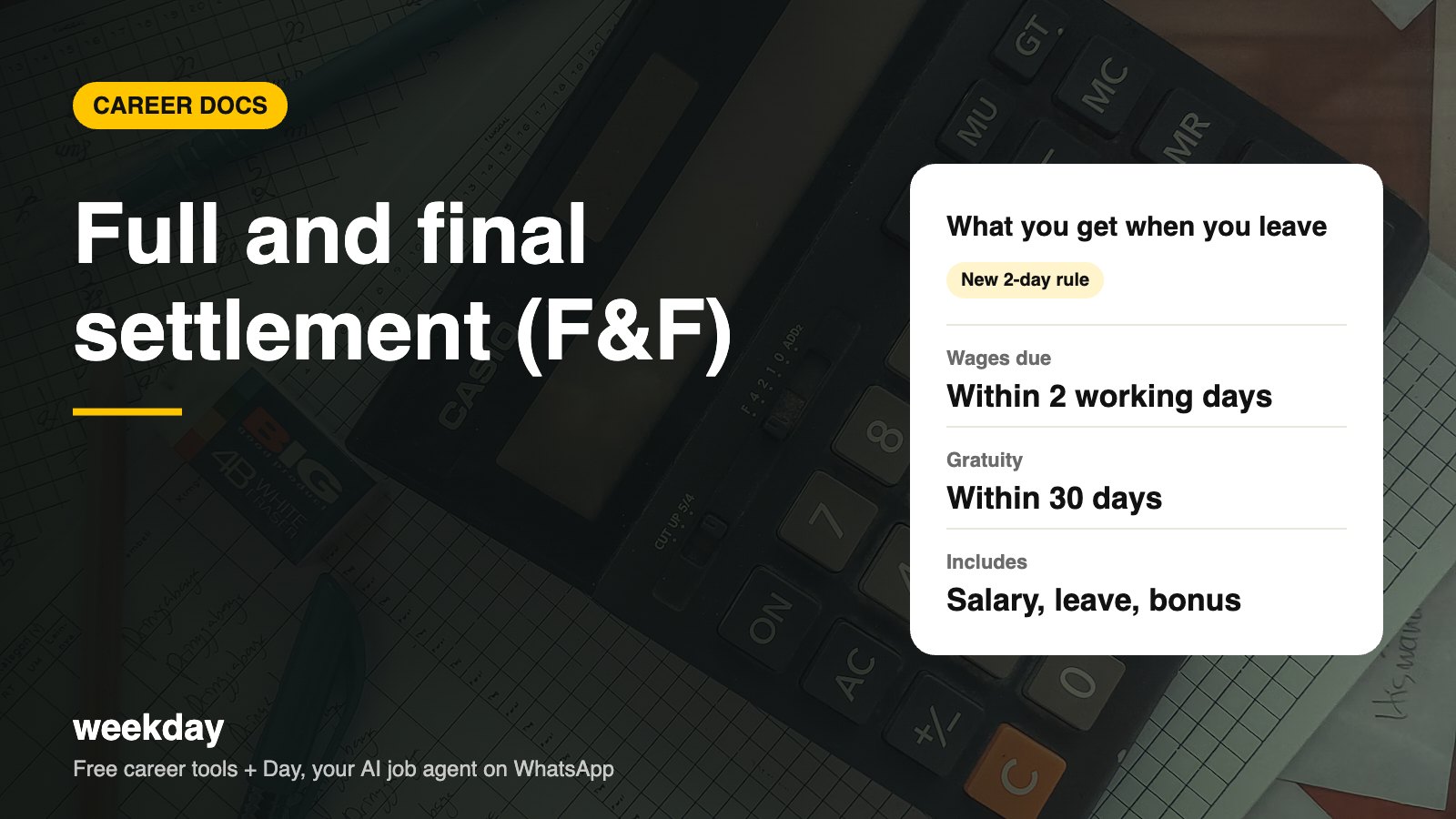
- Final wages: within 2 working days of resignation, removal or dismissal (Code on Wages, s.17(2)).
- Gratuity: within 30 days; after 5 years (1 year for fixed-term staff); up to ₹20 lakh tax-free in the private sector.
- "Wages" must be at least 50% of total pay; this can raise gratuity and leave payouts.
- Before the codes, many companies took 30–60 days for F&F; HR processes are still catching up.
Sources: Code on Wages, 2019; Code on Social Security, 2020; Ministry of Labour & Employment FAQs; Income Tax Act.
Day, Weekday's free AI job agent, finds jobs that match your skills and pay, and applies when you say yes. On WhatsApp.
Say hi to Day on WhatsAppHow Day works →What goes into F&F
| Earnings (you receive) | How it's usually worked out |
|---|---|
| Salary for days worked in the last month | Monthly gross × days worked ÷ days in month (or ÷ 30) |
| Leave encashment | Basic (or basic + DA) ÷ 30 or 26 × unused earned leave, per policy |
| Pending bonus / variable pay | As per policy; some pay pro-rata, some only if you're on the rolls on the payout date |
| Reimbursements | Approved travel, internet, phone claims |
| Gratuity | Basic + DA × 15 × years ÷ 26, if eligible; often paid separately |
| Notice pay (if the employer let you go early) | Pay in lieu of notice |
| Deductions (taken out) | Notes |
|---|---|
| Notice period shortfall | Gross or basic ÷ 30 × days short |
| Employee PF (12% of basic) and ESI | On the final month's wages |
| Professional tax | State-wise; e.g. ₹200 a month in several states |
| Income tax (TDS) | On the full year's income, including F&F items |
| Unreturned assets | Laptop, ID card, accessories, at a stated value |
| Loans and salary advances | Outstanding balance |
| Joining or retention bonus clawback | Only if your agreement says so |
| Excess leave taken | Negative leave balance, if policy allows recovery |
A complete sample F&F statement
Sample F&F statement
Employee: Priya Sharma | Emp ID 10234 | Bengaluru
Joined: 1 September 2021 | Last working day: 18 December 2026
Service: 5 years, 3 months, 18 days
Monthly gross: ₹1,00,000 (Basic ₹50,000 · HRA ₹20,000 · Special ₹30,000)
Notice: 60 days | Served: 50 days | Short: 10 days

EARNINGS
Salary 1–18 Dec (1,00,000 × 18 ÷ 31)        ₹58,065
Leave encashment, 15 days (50,000 ÷ 30 × 15)  ₹25,000
Variable pay, Q2 (as per policy)              ₹30,000
Reimbursements (internet, travel)             ₹4,500
Total earnings                                ₹1,17,565

DEDUCTIONS
Employee PF (12% of 29,032 basic earned)      ₹3,484
Professional tax                              ₹200
Notice shortfall (1,00,000 ÷ 30 × 10)         ₹33,333
Unreturned charger                            ₹2,000
TDS (illustrative)                            ₹8,000
Total deductions                              ₹47,017

NET F&F PAYABLE                               ₹70,548

GRATUITY (paid separately, within 30 days)
50,000 × 15 × 5 ÷ 26                          ₹1,44,231

TOTAL YOU RECEIVE                             ₹2,14,779
Priya's basic is exactly 50% of her gross, so the 50% wage rule doesn't change anything here. If her basic had been ₹35,000 with ₹65,000 in allowances, the excess ₹15,000 would be added to "wages" for gratuity under the new code.
5 worked examples
1. Leave encashment
Example 1
Basic + DA: ₹36,000 | Unused earned leave: 22 days
Policy: ÷ 30 → 36,000 ÷ 30 × 22 = ₹26,400
Policy: ÷ 26 → 36,000 ÷ 26 × 22 = ₹30,462
If policy caps encashment at 15 days: 36,000 ÷ 30 × 15 = ₹18,000
2. Notice shortfall recovery
Example 2
Gross: ₹75,000 | Notice: 90 days | Served: 60 | Short: 30
Recovery on gross: 75,000 ÷ 30 × 30 = ₹75,000
Recovery on basic (₹37,500): ₹37,500
3. Pro-rata bonus
Example 3
Annual bonus target: ₹1,20,000 (financial year April–March)
You leave on 30 September after 6 months
Pro-rata (if policy allows): 1,20,000 × 6 ÷ 12 = ₹60,000
If the policy requires you to be on the rolls on the payout date: ₹0
4. Gratuity with the 50% rule
Example 4
Gross: ₹1,00,000 | Basic + DA: ₹35,000 | Allowances: ₹65,000
Excess over 50%: ₹15,000 → wages for gratuity = ₹50,000
Service: 7 years
Gratuity: 50,000 × 15 × 7 ÷ 26 = ₹2,01,923
Old method (35,000): ₹1,41,346
5. Negative F&F (you owe money)
Example 5
Salary for 5 days worked: ₹12,903
Leave encashment: ₹0 (no balance)
Notice shortfall, 45 days at ₹2,667/day: ₹1,20,000
Joining bonus clawback: ₹50,000
Net: 12,903 − 1,70,000 = −₹1,57,097 (you owe this)
If your F&F is negative, ask for the full statement, check each line against your contract, and negotiate. Many companies reduce or waive amounts if the handover was good, and a new employer may cover the buyout part.
Timelines: what's due when
| Item | Usual timeline | Basis |
|---|---|---|
| Final wages (salary, dues that count as wages) | Within 2 working days of exit | Code on Wages, s.17(2) |
| Gratuity | Within 30 days of becoming payable | Code on Social Security, 2020 |
| Relieving and experience letter | On or soon after the last day | Company policy |
| Form 16 | By 15 June after the financial year ends | Income Tax rules |
| PF transfer or withdrawal | Online through EPFO; transfer is often automatic when you join a new employer | EPFO process; check current withdrawal rules |
| Bonus and variable pay | Per policy; often the regular payout cycle | Company policy |
The 2-working-day rule is new for many companies, and some still follow older 30–45 day cycles. Some items, such as variable pay or reimbursements, may be argued not to be "wages". If your F&F is late, a polite email citing the rule usually speeds things up.
Tax on F&F (worded carefully)
| Item | Tax treatment (private sector) |
|---|---|
| Final salary and bonus | Taxed as salary at your slab rate |
| Leave encashment on leaving | Exempt up to the lowest of: actual amount, ₹25 lakh, 10 months' average salary and unused leave value (max 30 days per year of service); balance taxable (Section 10(10AA)). Check with a CA whether resignation qualifies in your case. |
| Gratuity | Exempt up to the lowest of actual, ₹20 lakh and the formula amount |
| Notice pay recovered from you | Generally not reduced from taxable salary; get advice if the amount is large |
| Joining bonus from new employer | Taxable as salary |
Your PF after you leave
| Option | When it fits | What to know |
|---|---|---|
| Keep the same UAN and transfer | You're joining a new employer | Transfer is often automatic once the new employer links your UAN; check your passbook |
| Leave it in the account | Short gap between jobs | Your balance stays with EPFO; check current rules on interest for inactive accounts |
| Withdraw | Long unemployment or leaving salaried work | Eligibility rules and waiting periods have changed in recent years; check the EPFO portal before applying |
| Partial advance | Specific needs (medical, education, housing) | Allowed under EPFO rules, with limits |
Withdrawing PF before 5 years of continuous service can also make the amount taxable, so think twice before cashing out between jobs.
Exit checklist: the last two weeks
| When | Do this | Why |
|---|---|---|
| 14 days before | Check leave balance and pending reimbursements on the HR portal | Avoid losing leave or claims |
| 10 days before | Submit all bills and expense claims | Late claims are often rejected after exit |
| 7 days before | Ask HR for the F&F calculation method (gross or basic, ÷ 30 or 26) | Spot errors early |
| Last day | Return assets and get a written acknowledgement | Stops asset deductions |
| Last day | Download payslips and tax proofs | Portal access usually ends on exit |
| Within a week | Request the F&F statement and relieving letter | Start the clock in writing |
Documents to collect before you leave
- Relieving letter and experience letter
- Final payslip and F&F statement
- Form 16 (from your old employer) for the year
- PF account details (UAN) and service history
- Gratuity nomination and payment confirmation
- No-dues or asset return acknowledgement
- Any written waiver of notice or bonus clawback
Follow-up emails
Email 1: first F&F request
Subject: Full and final settlement – Priya Sharma (Emp ID 10234)

Dear HR team,

My last working day was 18 December 2026. Could you please share my F&F statement and the payment date? Under the Code on Wages, final wages are due within 2 working days of exit.

I have returned my laptop and ID card (acknowledgement attached).

Thank you,
Priya Sharma
Email 2: disputing a line item
Subject: Query on F&F statement – Priya Sharma

Dear HR team,

Thank you for the statement. I have two questions:
1. Leave encashment shows 10 days; my leave balance on 18 December was 15 days (screenshot attached).
2. Notice shortfall is calculated on gross salary; my appointment letter (clause 9.2) says basic salary.

Could you please review and share a revised statement?

Regards,
Priya
Dispute steps
| Step | Action | Tip |
|---|---|---|
| 1 | Ask for the itemised F&F statement | Never accept a single net figure |
| 2 | Compare each line with your contract and payslips | Note clause numbers |
| 3 | Email HR with specific corrections | Attach proof |
| 4 | Escalate to the HR head or grievance cell | Give 7–10 days |
| 5 | Send a legal notice | Often resolves it quickly |
| 6 | Approach the labour authority (wages, gratuity) or civil court | Keep every email |
Related: gratuity formula with 8 examples, notice period buyout and early release and what to check in your next offer letter.
FAQs
What is full and final settlement?
The final payment when you leave a job: salary for days worked, leave encashment, bonus and reimbursements, minus notice shortfall, PF, tax and other deductions.
How many days does F&F take in India?
Under the Code on Wages, final wages are due within 2 working days of exit. Gratuity is due within 30 days. Some companies still take longer, so follow up in writing.
Is gratuity part of full and final settlement?
It's often shown in the F&F statement but may be paid separately, within 30 days, if you have 5 years of service (1 year for fixed-term staff).
How is leave encashment calculated in F&F?
Usually basic (or basic + DA) ÷ 30 or 26 × unused earned leave days, depending on company policy and any cap.
Can my company deduct notice pay from F&F?
Yes, if your contract allows it. It's usually gross or basic ÷ 30 × days short.
What if my F&F is negative?
You owe the company money. Check each line, negotiate, and ask whether your new employer can cover the buyout.
Is F&F taxable?
Final salary and bonus are taxable. Leave encashment and gratuity have exemption limits; amounts above them are taxable.
What documents should I get after F&F?
Relieving letter, experience letter, F&F statement, final payslip and Form 16.
Can the company hold my relieving letter until F&F?
Many companies link them, but holding documents to force payment is widely seen as improper. Ask in writing and escalate if needed.
Where do I complain if F&F isn't paid?
First escalate inside the company, then send a legal notice, and then approach the labour authority for your area.