Last updated: 5 November 2026
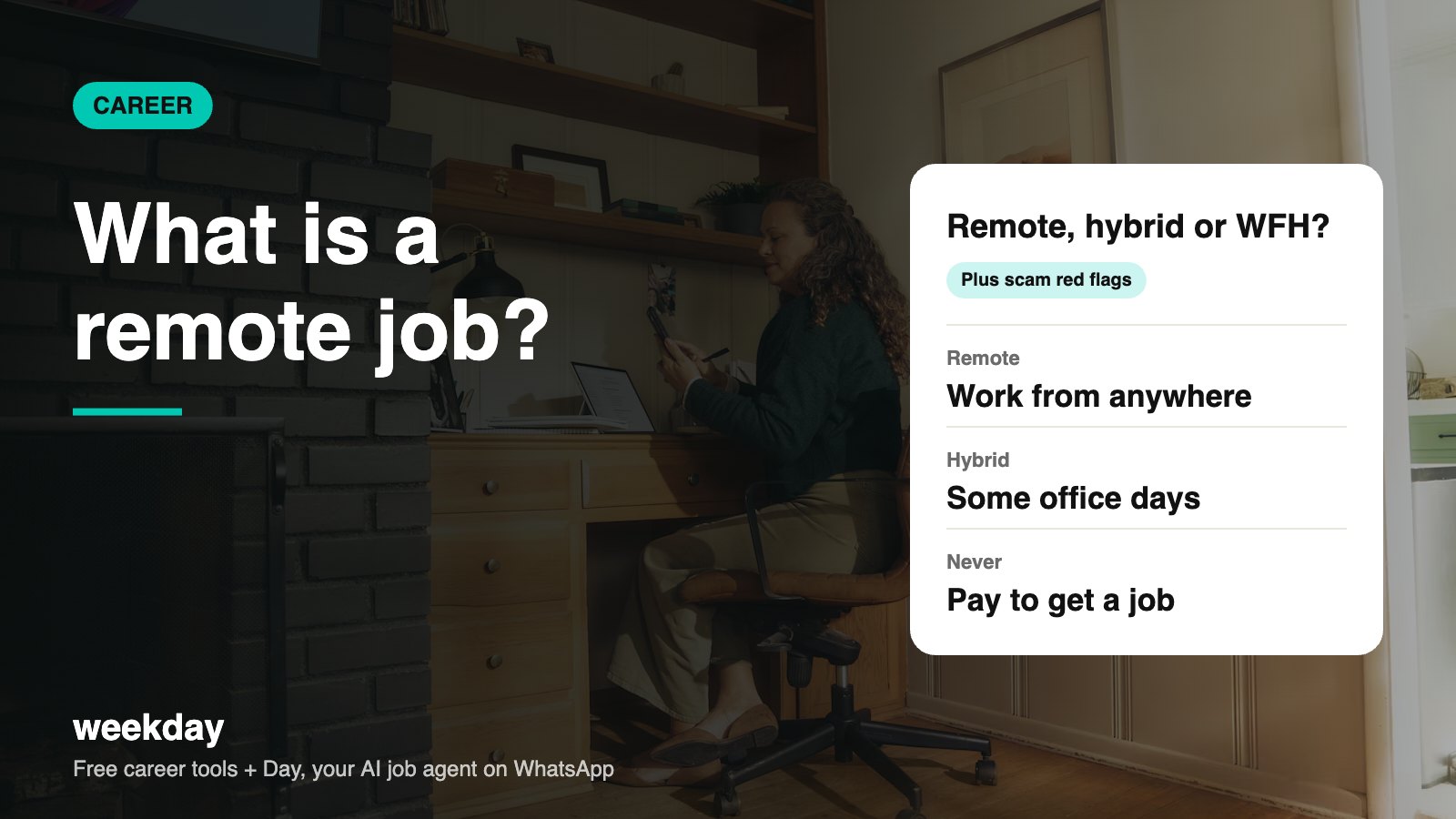
- Remote vs hybrid vs WFH vs work-from-anywhere
- Remote-friendly roles and indicative salary ranges
- Where to find genuine remote jobs
- Scam red flags
- Setup costs and tax basics
- Sample remote interview answers
- A remote-ready resume and profile checklist
- Remote work in India is most common in tech, data, design, content, marketing and support.
- Many Indian companies moved to hybrid (2–3 office days) after 2022; fully remote roles get far more applicants per opening.
- Under the new tax regime, salaried income up to ₹12.75 lakh (₹12 lakh plus ₹75,000 standard deduction) is effectively tax-free for FY 2025–26.
- Freelancers above ₹20 lakh a year in turnover generally need GST registration (lower limits apply in some states).
- Red flag: any "remote job" that asks for a registration, training or security fee.
Sources: Income Tax Act (FY 2025–26 slabs); CGST Act; Weekday job data.
Day, Weekday's free AI job agent, finds remote and hybrid jobs that match your skills and pay, and applies when you say yes. On WhatsApp.
Say hi to Day on WhatsAppHow Day works →Remote vs hybrid vs WFH vs work-from-anywhere
| Type | What it means | Office visits | Location limit | Good for |
|---|---|---|---|---|
| Fully remote | No office; the whole team works online | None or rare offsites | Usually within India (or a time zone) | Focused, self-driven people |
| Hybrid | Mix of office and home days | 2–3 days a week is common | Must live near an office | People who want flexibility plus team time |
| WFH (work from home) | Office job done from home, often temporary or partial | When called | Home city | Short-term needs, support roles |
| Work from anywhere | Remote with freedom to travel | None | Any city, sometimes any country | Experienced, independent workers |
| Remote freelance / contract | Paid per project or hour, not an employee | None | None | Writers, designers, developers |
Read the job post carefully. "Remote" on Naukri or LinkedIn sometimes means "remote for now" or "remote, but must be in Bengaluru". Ask in the first call: Is this role permanently remote, and are there any office or travel expectations?
Remote-friendly roles and indicative salaries in India
| Role | Typical experience | Indicative range (₹ LPA) | Where demand comes from |
|---|---|---|---|
| Software developer | 1–8 years | 6–35 | SaaS, product companies, global startups |
| Data analyst | 0–5 years | 4–15 | Startups, analytics firms |
| UI/UX designer | 1–6 years | 5–20 | Product companies, agencies |
| Digital marketer / SEO | 1–5 years | 3–12 | D2C brands, agencies |
| Content writer / editor | 0–5 years | 3–9 | Media, SaaS, agencies |
| Customer support (chat/email) | 0–3 years | 2.5–6 | SaaS, e-commerce, global support teams |
| Recruiter / sourcer | 1–5 years | 3–10 | Staffing firms, startups |
| Bookkeeper / accountant | 1–5 years | 3–8 | Accounting firms, overseas clients |
| Virtual / executive assistant | 0–4 years | 2.5–6 | Founders, overseas small businesses |
| Product manager | 4–10 years | 15–45 | SaaS and global product companies |
Ranges are indicative, based on listings we see, and vary widely with skill, company, city and whether the employer is Indian or overseas. Overseas employers sometimes pay more, but usually as contracts without Indian benefits.
Where to find genuine remote jobs
| Source | Best for | Tip |
|---|---|---|
| LinkedIn Jobs (Remote filter) | Mid-level and senior roles | Set alerts; apply within 48 hours of posting |
| Naukri (Work from home filter) | Indian companies, freshers to mid-level | Check whether "WFH" is permanent |
| Weekday | Verified tech and non-tech roles | Browse remote jobs in India or use Day on WhatsApp |
| Company career pages | Remote-first companies | Look for "remote-first" or "distributed" in the About page |
| Freelance platforms | Project work | Start with small fixed-price jobs to build reviews |
| Referrals and communities | Every level | Slack/Discord groups and alumni networks often share roles first |
Freshers: start with our list of work from home jobs for freshers.
Scam red flags
| Red flag | Why it's a scam sign | What to do |
|---|---|---|
| Pay a fee for registration, training, kit or ID | Real employers don't charge candidates | Walk away |
| Paid to like videos, rate hotels or do "tasks" | Classic task scam; asks you to "invest" later | Block and report |
| Offer without any interview | No real company hires blind | Ask for a video interview with the team |
| Recruiter uses Gmail/Telegram only | No company domain | Check the company site and LinkedIn page |
| Asks for OTP, bank login or Aadhaar copies early | Identity or money theft | Never share OTPs; give KYC only after a verified offer |
| Salary far above market for simple work | Bait | Compare with ranges above |
| Pressure to decide today | Stops you checking | Take a day; verify |
If you've lost money, report it quickly on the national cybercrime portal (cybercrime.gov.in) or by calling 1930, and inform your bank.
Setup costs (indicative)
| Item | Indicative cost | Who usually pays |
|---|---|---|
| Laptop | ₹40,000–₹90,000 | Most employers provide one; freelancers buy their own |
| Broadband (100–200 Mbps) | ₹600–₹1,200 a month | You; some employers give an allowance |
| Mobile hotspot backup | ₹300–₹600 a month | You |
| UPS for router / inverter | ₹2,500–₹15,000 | You |
| Ergonomic chair and desk | ₹8,000–₹25,000 | You; some firms give a one-time setup allowance |
| Headset with mic | ₹1,500–₹6,000 | You or employer |
| Coworking hot desk (optional) | ₹4,000–₹12,000 a month | You, or a co-working allowance |
Worked example: first-year setup vs commute saved
Laptop (provided by employer): ₹0
Broadband: ₹900 × 12 = ₹10,800
Hotspot backup: ₹400 × 12 = ₹4,800
Router UPS: ₹3,000
Chair + desk: ₹12,000
Headset: ₹2,500
Year 1 total: ₹33,100

Saved commute (₹150/day × 220 days): ₹33,000
Tax basics (worded carefully)
| You are | How you're taxed (simplified) |
|---|---|
| Remote employee of an Indian company | Same as office staff: TDS on salary, Form 16, choice of old or new regime |
| Employee of a foreign company via an Indian entity or employer-of-record | Usually salaried in India, with TDS deducted locally |
| Contractor/freelancer for Indian clients | Business or professional income; clients may deduct TDS; file ITR-3 or ITR-4 |
| Freelancer for foreign clients | Income taxable in India if you're resident; export of services under GST once registration applies; keep bank remittance records |
| Professional using presumptive tax (Section 44ADA) | Declare 50% of receipts as income if receipts are within the limit (₹75 lakh when cash receipts are 5% or less) |
Tax rules change every year and depend on your residency and contracts. For freelance or overseas income, speak to a CA before your first ITR.
Sample remote interview answers
"Why do you want to work remotely?"
I work best with clear goals and written updates. In my last role, our team was spread across Pune, Kochi and Berlin. I started each day by checking the board, posted a short plan in Slack, and wrote an end-of-day note with blockers. My manager said it was the main reason she never needed status calls with me.
"How do you manage your time without supervision?"
I block my calendar in two deep-work slots, 10–1 and 3–5, and keep messages for the gaps. I track tasks in Notion and review them every Friday. When I fell behind once because of a power cut, I told my lead within the hour and moved the deadline by a day rather than surprising anyone.
"How do you communicate with a distributed team?"
I over-communicate in writing. If a task is unclear, I write back what I understood and ask the person to confirm. For bigger decisions, I write a one-page doc with options and a recommendation so people can respond asynchronously.
"What does your remote setup look like?"
I have a separate desk, a 150 Mbps fibre line with a 4G hotspot backup and a UPS for the router. I can join calls with a headset, and I can overlap with European mornings until 1 pm IST if needed.
Hinglish version: "Remote kyun kaam karna chahte hain?"
Mujhe written updates dena aur khud se kaam plan karna aata hai. Pichhli job mein meri team teen cities mein thi; main roz subah plan aur shaam ko update Slack par daalta tha. Isliye manager ko alag se status call ki zaroorat nahi padti thi.
"How do you handle conflict on a remote team?"
I'd first check in with the person directly, on a quick call rather than in a long thread. If a teammate kept missing handoffs, I'd ask what's getting in the way, agree on a simple written checklist, and set a short daily check-in for a week. If nothing changed, I'd raise it with our lead with specific examples, not complaints.
"What do you do when you're stuck and your manager is offline?"
I'd share what I've done, what's blocking me and two options I've considered, in one message. Then I'd keep working on something else useful until I hear back, instead of waiting. If it's urgent, I'd tag the person and say clearly why it can't wait.
Questions to ask before accepting a remote offer
| Ask | Why it matters |
|---|---|
| Is the role permanently remote, in writing? | Some "remote" roles turn hybrid later |
| Are there office days, offsites or travel? | Affects where you can live |
| Which hours must overlap with the team? | Global teams can mean late nights |
| Is there an internet or setup allowance? | Can be worth ₹10,000–₹30,000 a year |
| Am I an employee or a contractor? | Changes PF, gratuity, leave and tax |
| Which laptop and tools are provided? | Avoids surprise costs |
Remote-ready resume and profile checklist
- Add "Open to remote" in your LinkedIn job preferences (see how Open to Work works).
- Mention remote tools you've used: Slack, Jira, Notion, Zoom, Google Workspace.
- Show results achieved with distributed teams.
- Link a portfolio, GitHub or writing samples.
- List your time-zone availability.
- Run your resume through the Resume Checker before applying.
FAQs
What is a remote job?
A job you do from outside the employer's office, usually from home, working with your team online.
What is the difference between remote and WFH?
Remote usually means the role is designed to be done away from the office. WFH often means an office job done from home, sometimes temporarily.
What is hybrid work?
A mix of office and home days, often 2–3 office days a week.
Which remote jobs pay well in India?
Software development, product management, UI/UX design and data roles usually pay the most, depending on skill and employer.
Are there remote jobs for freshers?
Yes, in customer support, content, data entry, data analysis, sales development and some junior tech roles, though competition is high.
How do I spot a fake remote job?
Any request for a fee, task-based pay, no interview, no company email domain or pressure to decide fast are red flags.
Do I need to pay tax on remote income from foreign clients?
If you're resident in India, generally yes. Freelance income from abroad is taxable in India, and GST rules can apply. Speak to a CA.
Who pays for internet in a remote job?
Usually you, though some companies give a monthly internet or work-from-home allowance.
Can I work remotely from another country for an Indian company?
Only if your employer allows it. It can raise tax and legal issues, so get written approval.
How do I find genuine remote jobs?
Use LinkedIn and Naukri filters, company career pages, verified platforms like Weekday, and referrals. Never pay to apply.