Last updated: 5 November 2026
- Typical notice periods by company type and level
- How to calculate your last working day
- 6 worked examples: recovery, buyout, leave set-off, tax
- What the law says, worded carefully
- Templates: resignation, buyout request, early release
- What happens if you don't serve notice
- Dispute steps
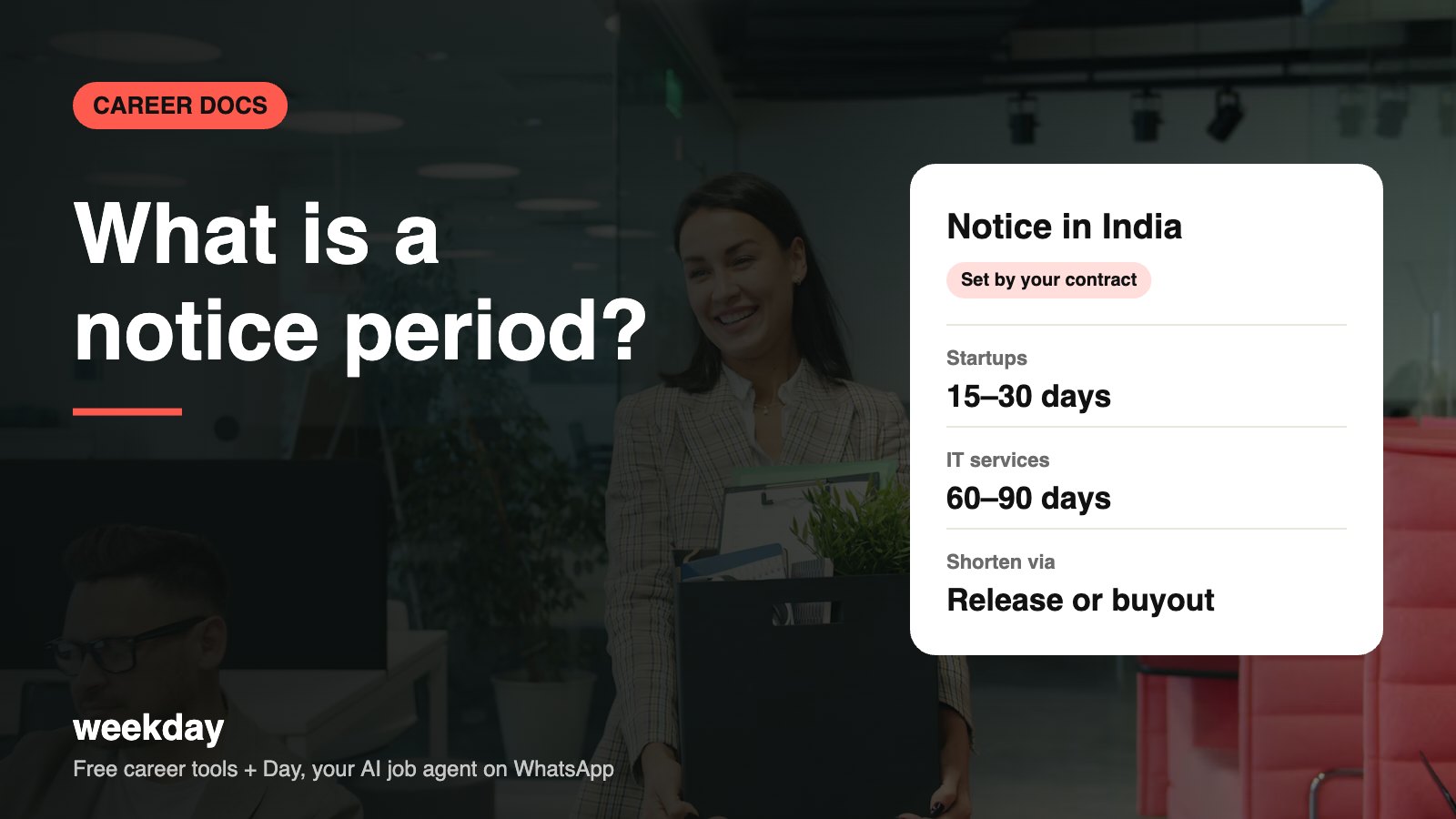
- Common notice periods: 30 days (startups), 60–90 days (IT services, MNCs), 90+ days (senior roles).
- Notice pay recovery is usually gross or basic ÷ 30 × days short, as your contract says.
- Final wages are due within 2 working days of exit under the Code on Wages, s.17(2), notified 21 November 2025.
- Gratuity, if you're eligible, is due within 30 days.
- Post-employment non-competes are generally void under Section 27 of the Indian Contract Act.
Sources: Code on Wages, 2019; Code on Social Security, 2020; Indian Contract Act, 1872; appointment letters reviewed by Weekday.
Day, Weekday's free AI job agent, finds jobs that match your skills, pay and notice period, and applies when you say yes. On WhatsApp.
Say hi to Day on WhatsAppHow Day works →Typical notice periods in India
| Company type / level | Typical notice | Buyout allowed? | Early release common? |
|---|---|---|---|
| Early-stage startup | 15–30 days | Sometimes | Yes |
| Product company / SaaS | 30–60 days | Often | Yes, with handover |
| Large IT services | 60–90 days | Varies by company and level | Depends on project |
| MNC / GCC | 60–90 days | Sometimes | Case by case |
| Banks and NBFCs | 30–90 days | Often, at the bank's discretion | Sometimes |
| BPO / customer support | 15–30 days | Often | Yes |
| During probation (any company) | 7–30 days | Usually | Yes |
| Director / VP and above | 90–180 days | Rarely | Negotiated |
Recruiters care a lot about notice. Many hiring managers prefer people who can join in 30 days or less, which is why "immediate joiner" and "serving notice" are common Naukri and LinkedIn filters.
How to calculate your last working day
Most companies count calendar days, starting from the day after your resignation is accepted or submitted. Some count the resignation day itself. Your HR portal usually shows the official date.
Example: last working day
Resignation submitted:  10 November 2026
Notice period:          60 days
Counting from next day: 11 Nov → 9 January 2027 (last working day)
If the resignation day counts: 8 January 2027

90 days from 10 Nov:     8 February 2027 (from next day)
6 worked examples
1. Notice pay recovery on gross salary
Example 1
Gross monthly salary: ₹90,000
Notice: 60 days | Served: 30 days | Short: 30 days
Per day: 90,000 ÷ 30 = ₹3,000
Recovery: 30 × 3,000 = ₹90,000
2. Same case, recovery on basic
Example 2
Basic: ₹45,000 (50% of gross)
Per day: 45,000 ÷ 30 = ₹1,500
Recovery: 30 × 1,500 = ₹45,000
Difference vs gross method: ₹45,000
3. Leave set-off reduces the shortfall
Example 3
Gross monthly salary: ₹1,20,000
Notice: 90 days | Served: 45 days | Short: 45 days
Earned leave balance set off (if policy allows): 12 days
Net shortfall: 33 days
Recovery: 33 × (1,20,000 ÷ 30) = 33 × 4,000 = ₹1,32,000
Without set-off: 45 × 4,000 = ₹1,80,000
Many companies don't allow leave set-off, or allow it only with manager approval. Some pay leave encashment and recover notice separately, which nets out to a similar result.
4. New employer pays your buyout
Example 4
Buyout amount: ₹1,32,000
New employer pays it as a joining bonus (taxable as salary)
If you're in the 30% slab (31.2% with cess): tax ≈ ₹41,184
What you keep after tax: ≈ ₹90,816

Ask for a grossed-up bonus of about ₹1,92,000 so you net ≈ ₹1,32,000 (1,32,000 ÷ 0.688)
5. Leave encashment in the final settlement
Example 5
Basic: ₹40,000 | Unused earned leave: 18 days
If policy divides by 30: 40,000 ÷ 30 × 18 = ₹24,000
If policy divides by 26: 40,000 ÷ 26 × 18 = ₹27,692
6. Early release after handover
Example 6
Notice: 60 days, resigned 1 December 2026
Official last day: 30 January 2027
You finish handover by 2 January 2027; manager agrees to release
Shortfall waived: 28 days → recovery ₹0
Get the waiver in writing (email from HR, not just your manager)
What the law says (carefully)
| Rule | What it means for you |
|---|---|
| Your contract | Sets your notice length, buyout and recovery terms. It's the main source. |
| Indian Contract Act, s.73–74 | An employer can generally recover reasonable compensation for breach, such as notice pay in lieu; courts tend to frown on penalties far above the actual loss. |
| Indian Contract Act, s.27 | Clauses that stop you working for a competitor after you leave are generally void. |
| Code on Wages, s.17(2) | Wages must be paid within 2 working days of resignation, removal or dismissal. |
| Industrial Relations Code, 2020 | For "workers" (not managerial or most supervisory staff) with a year's service, retrenchment needs a month's notice or pay in lieu plus compensation. |
| State Shops and Establishments Acts | Some states require notice or pay in lieu when an employer ends employment. Rules differ by state. |
An employer usually can't force you to keep working, but it can recover the agreed notice pay and may record that notice wasn't served. Withholding original certificates is widely seen as improper; if it happens, ask for them in writing. For real disputes, talk to a labour lawyer.
Email templates
Template 1: resignation
Subject: Resignation – Amit Verma (Emp ID 45120)

Dear Neha,

I am resigning from my position as Senior Analyst. As per my contract, my notice period is 60 days, which makes my last working day 9 January 2027.

I'll prepare a handover plan this week and make the transition as smooth as possible.

Thank you for the support over the last three years.

Regards,
Amit Verma
Template 2: buyout request
Subject: Request for notice period buyout – Amit Verma

Dear HR team,

I have resigned with a 60-day notice period (last working day 9 January 2027). My new employer needs me to join on 11 December 2026.

I would like to buy out the remaining 30 days. Could you share the buyout amount and whether it will be adjusted in my full and final settlement? I will complete my handover before 10 December.

Regards,
Amit Verma
Template 3: early release request
Hi Neha,

I've put together a handover plan that can be finished by 10 December:
• Documentation for the 3 dashboards I own – by 30 Nov
• Two knowledge-transfer sessions with Rahul – 2 and 4 Dec
• Client introductions – by 6 Dec

If the handover is complete, would you support releasing me on 10 December? I'm happy to be reachable for questions for two weeks after.

Thanks,
Amit
Template 4: getting the waiver in writing
Subject: Confirmation of early release

Dear HR team,

Neha has approved my release on 10 December 2026 (her email is below). Could you please confirm in writing that the remaining notice period is waived and no notice pay will be recovered?

Regards,
Amit
What happens if you don't serve your notice?
- The company can recover notice pay for the shortfall from your full and final settlement, or ask you to pay it.
- Your relieving letter may be delayed, and a background check may show "notice not served".
- Some companies mark you as not eligible for rehire.
- If your F&F turns negative (you owe money), the company may send a demand letter. Negotiate; don't ignore it.
Dispute steps
| Step | What to do | When |
|---|---|---|
| 1 | Email HR with your calculation and ask for theirs | Right after you see the F&F |
| 2 | Cite the contract clause and any written waiver | Within a week |
| 3 | Escalate to the HR head or ombudsperson | If no reply in 7–10 days |
| 4 | Send a polite legal notice through a lawyer | If money or documents are held back |
| 5 | Approach the labour department or civil court | As a last step |
How to talk about notice with a new employer
Recruiters will ask your notice period in the first call. Be exact and honest: say your contractual notice, how much you've served, and what you can realistically do. Over-promising an early join and then failing to get released is one of the fastest ways to lose an offer.
| Your situation | What to say | What to ask for |
|---|---|---|
| Not resigned, 90-day notice | "My notice is 90 days. My company allows buyout, so I can join in about 45 days." | Buyout reimbursement as a joining bonus |
| Resigned, 40 days left | "I'm serving notice; my last day is 9 January." | A joining date just after that |
| Early release likely | "My manager has agreed in principle to release me after handover, around 10 December." | Flexibility of a week either side |
| Immediate joiner | "I've completed my notice and can join within a week." | Faster process; it's your advantage |
Script: asking the new employer to cover your buyout
Thanks for the offer. My contractual notice is 60 days. My company allows a buyout, which would be about ₹1,32,000 for the days I'd skip. If you can cover that as a joining bonus, grossed up for tax, I can join on 11 December instead of 9 January. Would that work?
Common notice period terms
| Term | Meaning |
|---|---|
| LWD | Last working day |
| Notice pay / pay in lieu | Salary paid or recovered instead of serving notice |
| Buyout | Paying for unserved days, by you or your new employer |
| Garden leave | You're paid during notice but asked not to work |
| Immediate joiner | Someone who can join with no notice period |
Related: how your full and final settlement is calculated, notice rules during probation and the gratuity formula.
FAQs
What is a notice period in a job?
The time between resigning (or being let go) and your last working day, as set in your employment contract.
What is the usual notice period in India?
Usually 30 days at startups, 60–90 days at IT services firms and MNCs, and 90 days or more for senior roles.
How is notice pay calculated?
Usually monthly gross or basic salary ÷ 30 × days short. Your contract says which salary figure is used.
Can I buy out my notice period?
Often yes, if your company allows it. You pay (or your new employer pays) salary for the unserved days, usually adjusted in the full and final settlement.
Can leave be adjusted against notice?
Only if your company policy allows it. Many companies don't, or need manager approval.
What if I don't serve my notice period?
The company can recover notice pay and may delay your relieving letter. It's usually better to negotiate early release or a buyout.
Can an employer refuse early release?
Yes. Early release is at the employer's discretion. A good handover plan makes a yes more likely.
Is a joining bonus for buyout taxable?
Yes. It's taxed as salary, so ask your new employer to gross it up if you want the full amount in hand.
Is notice period counted in gratuity?
Yes. Your notice period is part of your service until your last working day.
Can my employer stop me joining a competitor?
Post-employment non-competes are generally void under Section 27 of the Indian Contract Act, though confidentiality obligations continue.