Short answer: with contingency recruiting, you pay only when you hire, usually a percentage of the hire's pay. With retained search, you pay a firm upfront in instalments, often one-third of first-year pay, whether or not you hire. With subscription recruiting, you pay a flat monthly fee for sourcing or a recruiter, sometimes plus a smaller success fee. Contingency suits most startup roles. Retained suits senior, confidential searches. Subscriptions suit teams hiring several roles at once.
Most founders hear "recruiter" and think of one model. In practice you're choosing how risk and cost get split between you and the firm. Get that wrong and you either pay for a search that goes nowhere, or you get a recruiter who sends you five CVs and moves on. Here's how the three models work, with real price points from India and the US.
The three models at a glance
| Contingency | Retained | Subscription | |
|---|---|---|---|
| When you pay | Only when someone you hire joins | In instalments, starting at kickoff | Every month, plus a success fee in some plans |
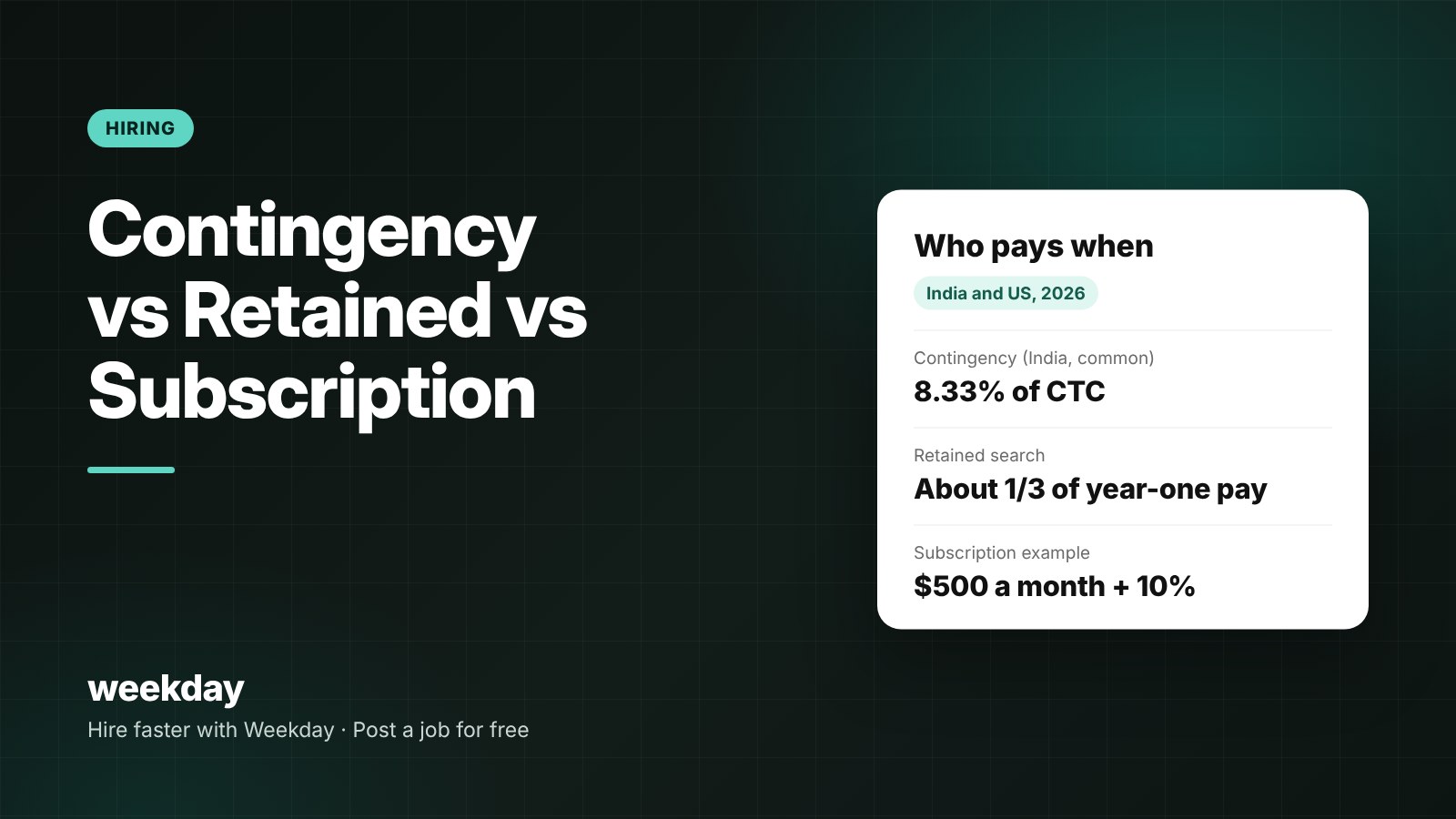
| Typical price | India: often 8.33% of annual CTC. US: often 20% to 30% of first-year salary | About one-third of first-year pay, with high minimums | Flat fee per role or per seat; for example $500 a month per role plus 10% on hire |
| Exclusive? | Usually not. You can use several firms | Yes, one firm | Usually you, plus the provider's team or tool |
| Your risk | Low cash risk, but recruiters may not prioritise your role | High. You pay even with no hire | Medium. You pay while the role is open |
| Best for | Most engineering, product and sales roles | CXO, board and confidential roles | Several open roles, or steady hiring |
Contingency recruiting: pay only on a hire
A contingency recruiter earns a fee only if you hire their candidate. That's why it's the default for startups. Your cash goes out only when a person joins.
The fee is a share of the hire's pay. In India, the most common rate is 8.33% of annual CTC, which is one month's salary, according to Cutshort's pricing roundup, last updated in October 2026. Niche or senior searches can run 10% to 12%. In the US, executive search firm Cowen Partners puts contingency fees at roughly 20% to 30% of first-year salary. Weekday's own contingency plan is 15% of annual salary, free if no hire is made through Weekday, with a 60-day replacement period.
The catch is focus. Contingency recruiters juggle many roles and get paid only on the ones that close. A recruiter on r/recruiting described the other side of this: clients asked senior candidates for detailed strategy work in interviews, then put roles on hold. The firm said it was too small to demand a retainer. Commenters suggested asking for a small upfront engagement fee, around $1,000 to $2,000, to filter out clients who aren't serious.
Before you sign, check the replacement guarantee. Our guide to recruiter replacement guarantees covers what's usually included.
Retained search: pay upfront for one firm's full focus
A retained firm works on your search exclusively and gets paid in stages, whether or not you hire. It's built for senior roles where a wrong hire costs far more than the fee.
Public contracts show how this is priced. A University of Wisconsin System list of approved executive search vendors shows two firms charging one-third of the hire's first-year cash compensation. One sets a minimum fee of $60,000, billed over the first three months. The other sets a minimum of $55,000. Cowen Partners describes the usual schedule as one-third to start, one-third about 60 days in, and the final third on hire.
Retained search rarely makes sense for a seed-stage startup's first ten hires. For a VP of Engineering or a CFO, it can.
Subscription recruiting: a flat monthly fee
Subscription models charge a monthly fee for recruiting capacity instead of a big fee per hire. They come in two flavours.
- Recruiter on subscription. Wellfound's Autopilot charges $500 a month per open role, plus a 10% placement fee on a successful hire. It promises a dedicated recruiter and 5 to 10 candidates a week, with no contract.
- Platform or credits on subscription. You get access to a candidate pool and outreach tools, and your team runs the process. Weekday's marketplace subscription works this way, with credits for email, WhatsApp and phone outreach, priced per team.
Subscriptions work best when you have several roles open, or you hire every month. They cost you money while a role stays open, so close roles you've paused.
Worked examples: what each model costs
India, one hire at ₹20 LPA:
- Contingency at 8.33%: about ₹1,66,600.
- Contingency at 15%: ₹3,00,000.
- Ask whether GST is on top of the quoted fee.
US, one hire at $150,000 first-year pay:
- Contingency at 15%: $22,500. At 25%: $37,500.
- Retained at one-third: $50,000. With a $55,000 minimum, you'd pay $55,000.
- Subscription at $500 a month plus 10%, hired in month three: $1,500 plus $15,000, so $16,500. No hire after three months: $1,500.
These use the rates quoted above. Your quote will depend on the role, city and firm. For more on fees, see how much recruitment agencies charge.
What about an in-house recruiter or RPO?
An in-house recruiter is a salaried hire who works only on your roles. It pays off once you're hiring steadily, often several roles a month. Recruitment process outsourcing (RPO) hands a provider part or all of your hiring process for a period of time. It suits larger companies with steady volume.
Founders in between often mix models. On r/startups, a founder growing faster than planned asked how to hire for several roles without a full-time recruiter. The replies kept coming back to the same mix: a fractional or freelance recruiter paid only on hires, a contract recruiter for the hardest role only, referral bonuses for the team, and a one-page scorecard for what each hire must get done in their first 90 days.
What our LinkedIn data shows about agencies
In our analysis of 148 LinkedIn hiring posts from November 2026, 26 (18%) were posted by recruiters or agencies on behalf of a client. That's contingency recruiting in action. Agencies post the same roles you could post yourself, then charge a fee when someone joins. If you can write a clear post and reach people directly, you can cover a lot of that ground without a fee.
How to pick
- Senior, confidential or board-level role: retained.
- One or two hard roles, little time: contingency, with a clear replacement guarantee.
- Three or more roles at once: a subscription, or contingency for the hardest one and your own sourcing for the rest.
- Volume hiring every month: an in-house recruiter or RPO.
Try the no-fee route first. Post your role on Weekday for free. Weekday's AI agent searches 400M+ profiles and reaches out to matches on email and WhatsApp. Your first role is free, with no credit card. If you'd rather hand it over, Weekday's contingency plan charges only when you hire.
FAQ
What is the difference between retained and contingency search?
With contingency, you pay only when you hire the recruiter's candidate. With retained search, you pay one firm in instalments for an exclusive search, whether or not you hire.
How much do contingency recruiters charge?
In India, 8.33% of annual CTC is the most common rate, with niche roles at 10% to 12%. In the US, rates often run 20% to 30% of first-year salary. Weekday charges 15%.
How much does retained search cost?
Often about one-third of the hire's first-year cash compensation, paid in three parts, with minimums such as $55,000 to $60,000 in public US contracts.
What is subscription recruiting?
You pay a flat monthly fee for a recruiter or for sourcing tools, instead of a big fee per hire. Some plans add a smaller success fee, such as $500 a month per role plus 10% on hire.
Which recruiting model is best for a startup?
For most early roles, contingency or your own sourcing. Use retained search only for senior, high-stakes roles. Move to a subscription once you have several roles open at once.
Sources
- Cutshort: Naukri, Resdex, LinkedIn and recruitment agency pricing in India
- Cowen Partners: The two types of executive search firms and fees
- University of Wisconsin System: Executive search vendor fee terms
- Wellfound: Recruiting pricing (Autopilot)
- Weekday: Pricing
- r/recruiting: Contingency based vs Retainer
- r/startups: How do you hire for multiple roles when you can't afford a full-time recruiter?
- Weekday analysis of 148 LinkedIn hiring posts, 14 to 23 Nov 2026