Compare recruitment agency fees in 2026, no-hire-no-fee providers and contract terms, including Weekday’s 15% Contingency model and hiring examples.
Contingency recruitment is the pay-on-successful-hire model, with documented options from Weekday, Adams and Sprintly. Our Contingency service for smaller teams costs 15% of annual salary, with no charge if you don’t hire through us. The engagement model and signed terms matter more than the agency name: Adams also offers retained options. This 2026 budgeting guide compares fees and provider-specific conditions, works through a $150,000 engineering salary, and covers India examples based on annual CTC. Use it to compare quotes, rather than as a statistically measured survey of average recruiter fees.
What Is No-Hire-No-Fee Recruitment?
What contingency recruitment means
Contingency recruitment makes the recruitment fee conditional on a successful hire under your agreement. The recruiter finds candidates, and you pay the agreed success fee if you hire through that service. It doesn't promise that you'll make a hire.
Our Contingency (white glove) service at Weekday is built for smaller teams with limited recruiting bandwidth. A dedicated senior recruiter finds candidates, gets them interested and schedules interviews end to end. You take the interviews. Our published fee is 15% of annual salary, with no charge if you don't hire through Weekday.
Check the specific service you're buying. A provider offering contingency recruitment may also sell other payment models. Adams, for example, offers contingency recruitment alongside partial-retainer and fully retained search options. Its contingency terms don't apply across every service.
When a successful hire triggers a fee
The fee trigger and the invoice payment deadline are separate terms. The trigger determines when you become liable for the fee. The payment deadline determines when that invoice must be paid.
Sprintly explicitly states that payment is due only when the candidate starts. Don't assume another provider uses the same milestone. “Placement,” an employment offer and a candidate's first day should never be treated as interchangeable without checking the agreement.
Before signing, ask: What exact event triggers the fee, and when is payment due? For Weekday, confirm the precise trigger, invoice deadline and any ancillary charges in the current agreement. The published no-hire-no-fee price alone doesn't establish those details.
How Much Do Recruitment Agencies Charge in 2026?
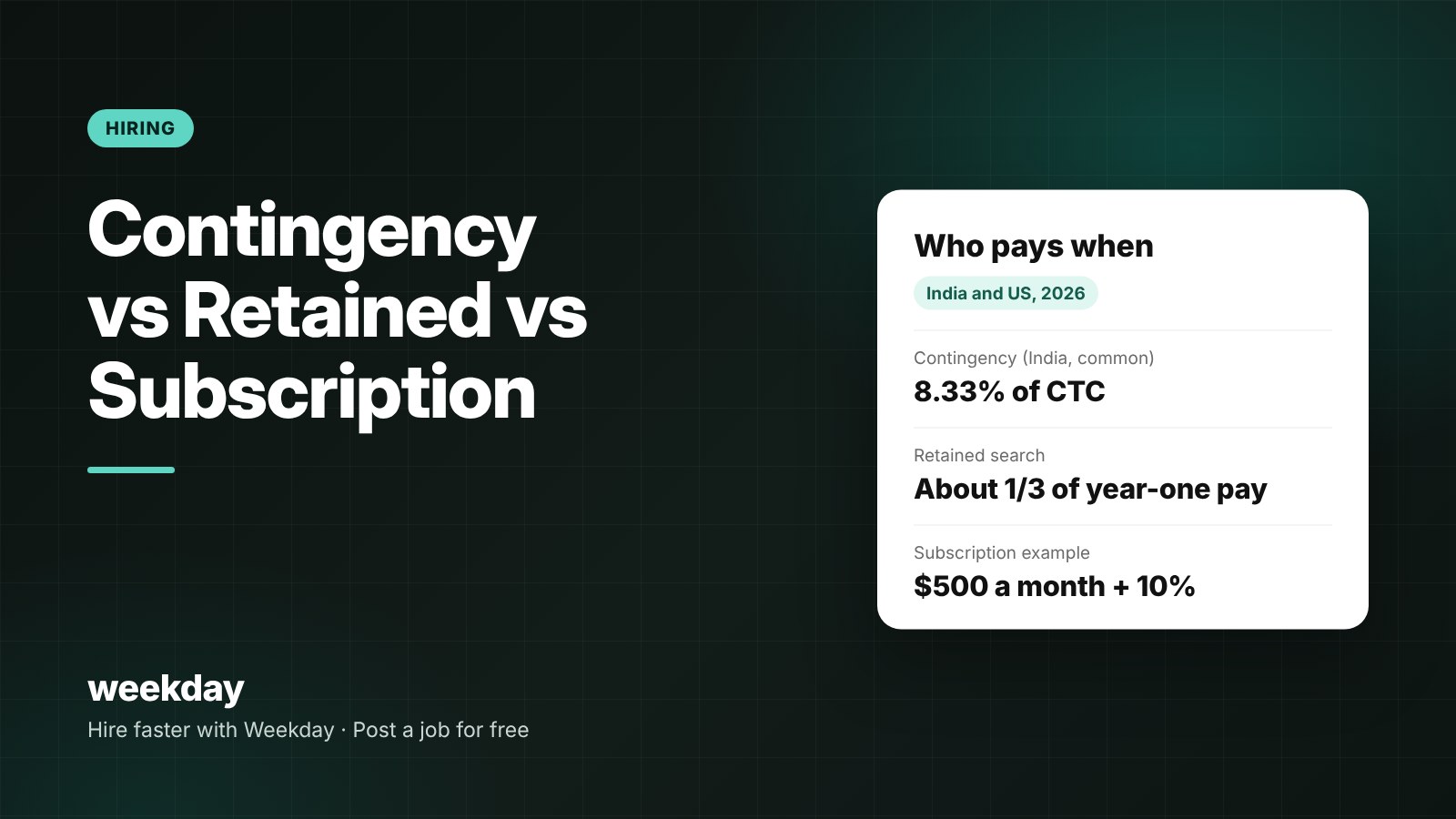
There’s no universal average across search models, roles, and markets. Use ranges as planning inputs. Recruiting from Scratch’s technical search guide describes typical contingency fees around 20% to 30% in its segment. Uplers’ published India offer and Weekday’s published rate show why a single average can mislead. Get quotes for the same role and fee basis. Technical recruiting cost guide · Weekday pricing · Uplers pricing
Which Recruitment Agencies Only Charge If We Make a Hire?
Weekday Contingency charges 15% of the hire’s annual salary and bills when a candidate placed through Weekday joins. The service includes a 60-day replacement period. Uplers Pay Per Hire publishes 10% to 15% of annual CTC, paid on joining, with the quoted rate varying by role. Recruiting from Scratch also describes its contingency engagement as having no upfront fee or retainer. Check the signed agreement for the fee basis and hiring trigger. Weekday pricing · Uplers pricing · Recruiting from Scratch
Read the name of the plan as carefully as the name of the vendor. For example, Wellfound Autopilot lists a $500 monthly charge per open role plus 10% on a successful hire. Its placement fee is contingent, but the monthly charge can accrue while the role remains unfilled. Wellfound pricing
Recruitment Fee Examples for a $150,000 Engineering Hire
At a 15% rate on $150,000 of qualifying annual compensation, the placement fee is $22,500. At 20%, it’s $30,000. A 30% engagement on the same basis totals $45,000, but installments may come due before the placement under a retained contract.
For a hybrid quote of $500 per open role per month plus 10%, three months and one hire at that salary would cost $16,500. With no hire after three months, the monthly fees would total $1,500. These examples exclude taxes and separately quoted costs.
How Much Do Recruitment Agencies Charge in India?
Some Indian placement agreements calculate fees on annual cost to company, or CTC. Decide whether bonuses, employer contributions or equity count under the agreement. At ₹30 lakh in eligible annual compensation, 10% equals ₹3 lakh and 15% equals ₹4.5 lakh before applicable taxes. Compare that one-time cost separately from payroll, contractor markup or employer-of-record fees. Uplers pricing · Wisemonk pricing
Common Recruitment Fee Challenges and Contract Terms to Check
Ask for a written quote covering the fee basis, invoice trigger, payment deadline and any upfront fees. Confirm candidate ownership if someone already applied directly or two recruiters introduce the same person. Read the replacement clause and clarify whether it offers another search, a credit, or a refund. Use the same three scenarios with every firm: zero hires, one hire and one hire who leaves early.
What to Look for in a Recruitment Agency and How to Compare Quotes
Start with three questions: how much recruiting work can your team handle, what will the provider actually do, and what will you owe if nobody gets hired? Compare quotes against those answers. A percentage fee and a monthly subscription cover different responsibilities and payment exposure, so the headline price alone won't settle the decision.
Essential service and pricing criteria
- Recruiter involvement: Is a dedicated recruiter running the search, or does your team manage candidate selection?
- Sourcing and outreach responsibilities: Who finds candidates, gets them interested and schedules interviews? Which outreach channels are included?
- Fee basis: Is the charge calculated on annual salary, broader remuneration or a recurring subscription?
- Payment trigger: What event makes the fee payable? Record the exact contractual trigger.
- Zero-hire charges: What do you owe if the engagement produces no hires?
- Additional costs: Ask whether sourcing, branding, background screening or other services carry separate charges.
- Replacement terms: Check the replacement period, eligibility conditions and whether the remedy is a replacement search or a refund.
Six best practices for comparing recruitment quotes
- Request the current local agreement for the exact service. Get the scope and commercial terms in writing. Historical contracts and agreements from another country can highlight questions to ask, but use the current agreement to evaluate your quote.
- Compare the same fee base. Ask which remuneration components count. A historical Michael Page agreement includes defined gross remuneration covering items such as guaranteed or sign-on bonuses and allowances. Two identical percentages can therefore produce different invoices. Request a calculation against the same compensation package.
- Model the full engagement, including zero hires. Compare total spend across your expected hiring period. As a generic illustration, three months at $5,000 per month costs $15,000: $15,000 per hire with one hire, $5,000 each with three, and $15,000 spent with zero unless the agreement provides relief. This is not a Weekday quote and excludes internal labor and other hiring costs.
- Record every payment obligation. Put the fee trigger, deposit terms, recurring charges and extras in one comparison sheet. ADP's RPO guidance identifies potential pass-through charges for sourcing, branding and background screening. Ask explicitly what's included rather than assuming an all-inclusive price.
- Clarify candidate ownership and replacement conditions. Ask how long an introduction remains chargeable and how candidates already known to your team are handled. Check replacement conditions too. Randstad's Australian terms illustrate requirements around timely payment, written notice, unchanged role specifications and an exclusive replacement-search window. A replacement undertaking isn't an automatic cash refund.
- Match responsibilities to your bandwidth. Our Contingency model suits smaller teams with limited recruiting capacity: a dedicated senior recruiter finds candidates, gets them interested and schedules interviews. The fee is 15% of annual salary, with no charge if no hire is made through Weekday and a 60-day replacement period if the candidate leaves. Separately, our Subscription model suits larger teams with an established in-house recruiting function. Custom pricing covers database access, smart filters and outreach credits; we email, WhatsApp and call candidates your team shows interest in. Subscription is not no-hire-no-fee. Choose based on the work you need covered and the payment exposure you can accept.
Benefits and Limits of No-Hire-No-Fee Recruitment
A hire-contingent fee gives you a clear payment condition: with Weekday Contingency, you pay only if you make a hire through us. That can suit smaller teams with limited recruiting bandwidth. You still need to budget for the placement bill, check the contract protections and recognize that recruiting support doesn't guarantee a hire.
- No hire through Weekday, no charge. Our Contingency fee is 15% of annual salary, payable only when you hire through us. This ties the recruitment fee to a successful placement, while leaving the hiring outcome uncertain.
- Dedicated support through interview scheduling. A dedicated senior recruiter finds candidates, gets them interested and schedules interviews on your behalf. For smaller teams, this provides hands-on recruiting support when internal bandwidth is limited.
- The placement bill can still be substantial. At our published 15% rate, an engineer hired on a $150,000 annual salary produces a $22,500 fee, excluding any separately applicable taxes. That's illustrative arithmetic, rather than a customer quote. Budget for the successful-hire scenario before you commit.
- Replacement coverage has boundaries. We offer a 60-day replacement period if the candidate leaves. Replacement coverage is distinct from an automatic cash refund, so check the applicable terms. For example, Randstad's Australian terms include conditions around timely payment, written notice and unchanged role specifications, plus exclusions for restructuring. Confirm what your own agreement covers.
How Weekday Supports No-Hire-No-Fee Recruiting
Weekday is an AI-powered sourcing and recruiting tool for proactive hiring. Our sourcing agent helps you find candidates and reach out to them, supported by a marketplace where candidates sign up themselves. You can choose dedicated recruiting through Contingency or a separate Subscription model for your in-house team.
Contingency: dedicated recruiting at a 15% success fee
For smaller teams with limited recruiting bandwidth, our Contingency service puts a dedicated senior recruiter on your search. We run the recruiting work end to end, so you can focus on interviews.
The process is straightforward:
- Find candidates: Your dedicated senior recruiter uses Weekday to source candidates for your role.
- Get them interested: The recruiter engages candidates and builds interest in the opportunity.
- Schedule interviews: We coordinate interviews so you can assess the candidates.
Our published fee is 15% of annual salary, with no charge if no hire is made through Weekday. The service also includes a 60-day replacement period if the candidate leaves. These are the terms to compare when you're evaluating Weekday against a success-fee recruitment agency.
How marketplace-supported sourcing and outreach work
We report a 50%+ response rate on outbound outreach, conducted across email, WhatsApp and phone. That's a Weekday-reported result, rather than an independently audited figure or a guaranteed response rate for your search.
The marketplace supports this sourcing workflow: candidates join Weekday directly, creating a large and growing base of active, self-registered profiles. Our AI sourcing agent uses that foundation to find suitable candidates, including passive candidates, and contact them proactively. You aren't limited to waiting for applications.
Marketplace Subscription: a separate model for in-house teams
Marketplace Subscription is for larger teams with an established in-house recruiting function. Your team gets database access, smart filters and outreach credits to find and select candidates. We then conduct outreach to the candidates you show interest in through email, WhatsApp and phone.
Pricing is custom. This is self-serve candidate selection with done-for-you outreach. It doesn't include Contingency's dedicated recruiting service, and its pricing is separate from our no-hire-no-fee terms.
Key Takeaways and Next Steps for Comparing Recruitment Fees
If your requirement is “we only pay when we hire,” choose contingency first, then compare providers and scope. Deposits, retainers and subscriptions create different payment exposure. A lower headline percentage alone won’t tell you what you could spend without making a hire.
- Choose the payment model before the provider. A deposit means the arrangement isn’t pure no-hire-no-fee. Subscription spending can also continue without a hire, unless your agreement provides relief. Confirm deposit crediting and refundability in writing.
- Compare the full terms alongside the percentage. Check the fee basis, payment trigger, zero-hire spending and replacement conditions. A replacement commitment and an automatic cash refund are different protections. Ask which conditions apply before signing.
- Match Weekday Contingency to your bandwidth. Our model is designed for smaller teams with limited recruiting capacity. The published fee is 15% of annual salary, with no charge if you don’t hire through Weekday and a 60-day replacement period if the candidate leaves.
Contact Weekday to discuss Contingency and request current engagement terms. Confirm the service fits your team and clarify the replacement conditions before proceeding.
FAQs About Recruitment Agency Fees and No-Hire-No-Fee
Does Weekday charge if we don’t hire?
Weekday’s Contingency model charges a 15% success fee only when a candidate placed through Weekday joins. Marketplace Subscription is a separate custom-priced model. Weekday FAQ
Does flat fee mean no hire, no fee?
A fixed fee describes the amount, while the contract determines when you owe it. A flat fee for running a search can be due even when it produces no hire.
What if the hire leaves?
The hiring agreement determines whether the provider owes a replacement search, credit, or refund. Confirm the start date, covered reasons, and notice deadline up front.