
Last updated: 18 November 2026
Quick answer: Contract to hire means a person joins on a fixed-term contract (often through a staffing firm) with the option to become a full-time employee at the end. It works best when you are unsure about the role, the budget or the fit. It works badly for in-demand senior people, who usually prefer a direct offer. If you use it, write the conversion terms, salary and timeline into the contract on day one.
What does contract to hire mean?
In a contract-to-hire setup, someone works for you as a contractor for a period agreed up front, for example three or six months. Often they are on a staffing firm's payroll during that time. At the end, you can offer them a permanent job, extend the contract or end it.
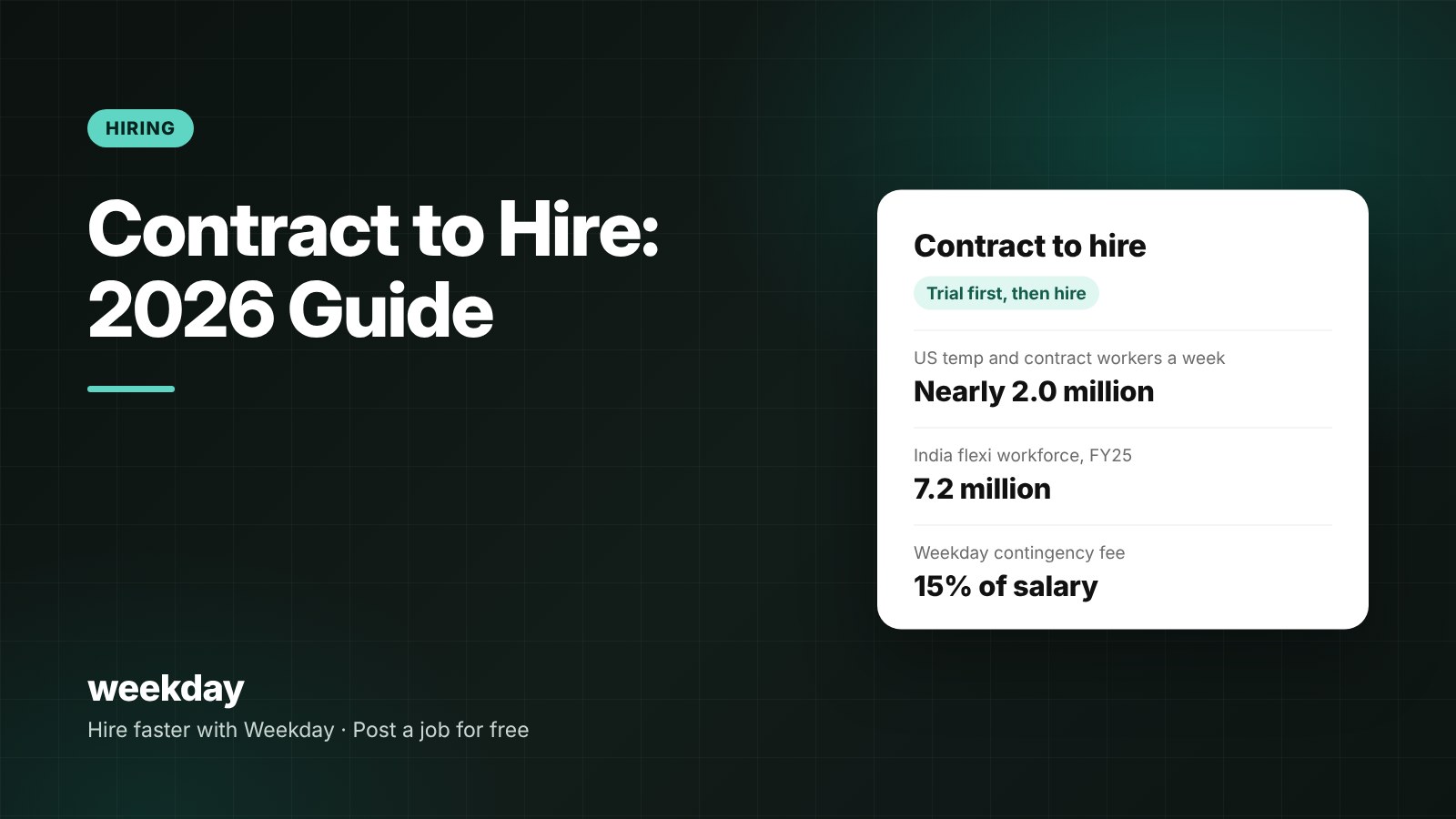
Temporary and contract work, the wider market that contract to hire belongs to, is large. In the US, nearly 2.0 million temporary and contract employees worked for staffing companies in an average week in 2025, and staffing firms hired 9.5 million of them over the year (American Staffing Association). In India, the flexi staffing workforce reached 7.2 million in FY25 and is projected to reach 9.16 million by FY27, growing 12.6% a year, according to the Indian Staffing Federation (IANS). IT staffing in India grew 7.8% in FY25 (DT Next).
Contract to hire vs direct hire vs pure contract
| Direct (permanent) hire | Contract to hire | Pure contract | |
|---|---|---|---|
| Commitment | Full from day one | Trial period, then decide | Fixed term only |
| Best for | Core roles you are sure about | Roles where fit or budget is uncertain | Short projects, cover for leave |
| Who is the employer during the trial? | You | Often a staffing firm | Staffing firm or the contractor |
| Appeal to top candidates | High | Lower, unless the pay or role is strong | Depends on rate |
| Main risk | Bad hire is costly to undo | Good people leave for a direct offer | Knowledge walks out at the end |
When contract to hire makes sense
- You are not sure about the role yet. For example, your first data engineer, when you do not know how much data work there will be.
- Budget is approved for a few months, not a year. A contract lets you start now and convert when budget is confirmed.
- You are hiring in a new country or city. A staffing firm can handle payroll and compliance while you test the market.
- The skills are hard to judge in interviews. A few months of real work shows more than any interview loop.
When it backfires
- Senior or in-demand roles. Strong engineers with several offers tend to pick a direct offer over a "maybe later" one.
- Vague conversion terms. If people do not know what they must do to convert, your best contractors leave first.
- Treating contractors as second class. Leaving them out of team meetings or tools means you cannot judge them fairly, and they disengage.
- Using it to avoid commitment forever. Rolling contracts with no conversion damage your reputation with candidates.
What contract to hire costs
When a staffing firm employs the contractor, you pay the firm an hourly or monthly rate that covers the contractor's pay plus the firm's margin. Some firms also charge a conversion fee when you hire the person permanently, and it may depend on how long they have worked for you. Get these terms in writing before the contractor starts.
Compare that with a direct hire through a recruiter. Weekday's published contingency fee for permanent hires, for example, is 15% of the hire's annual salary, with no fee if you do not hire and a 60-day replacement period (Weekday). For a role you are already sure about, a direct hire with a replacement guarantee can cost less and attract stronger people than a contract-to-hire setup. Read more on how replacement guarantees work.
How to run contract to hire well: 6 steps
- Decide the trial length. Long enough to see real work, short enough that good people do not drift away.
- Write the conversion terms on day one. Salary on conversion, title, benefits, start date and what "success" means.
- Agree the fee terms with the staffing firm. Rate, conversion fee, minimum period, and who owns the candidate relationship.
- Treat contractors like team members. Same tools, same meetings, same feedback.
- Review at the half-way point. Tell the contractor where they stand. Surprises at the end lose good people.
- Decide on time. Make the conversion call before the contract ends, not after.
Contract to hire in India: what to check
- Who is the legal employer during the contract: your company or the staffing firm.
- Statutory benefits: PF and other benefits should be covered by whoever is the employer. Confirm this in the contract.
- Notice periods: people moving from a permanent job may still serve 30–90 days of notice (Weekday notice period guide). A contract role does not remove that.
- Pay on conversion: benchmark against permanent roles, not the contract rate.
This is general guidance, not legal advice. Check contracts with your HR or legal team.
For candidates' trust: be upfront
Put "contract to hire" clearly in the job post, with the trial length and the expected salary on conversion. Candidates who know the deal from day one have no reason to feel misled halfway through.
Contract-to-hire agreement checklist
Before the contractor starts, make sure the written agreement covers:
- Duration and review dates: start date, end date and a mid-point review.
- Rate: the hourly or monthly rate, and how overtime or extra days are paid.
- Conversion terms: the salary band, title and benefits on conversion, and who decides.
- Fees: any conversion fee charged by the staffing firm, and when it applies.
- Notice: how much notice either side gives to end the contract early.
- IP and confidentiality: work done during the contract belongs to you.
- Equipment and access: laptop, accounts and security rules, same as employees.
Share a plain-English summary of these terms with the candidate before they sign. A contractor who understands the path to a permanent role is more likely to stay engaged for the whole trial, and you will have fewer awkward conversations at the end.
Not sure whether to go contract or direct?
Talk to Weekday about hiring for your role. See matching candidates, their expected pay and notice periods before you decide.
Book a demoFrequently asked questions
What does contract to hire mean?
A person works for you on a fixed-term contract, often through a staffing firm, with the option of becoming a permanent employee at the end.
Is contract to hire good for the employer?
Yes when the role or budget is uncertain, because you see real work before committing. No for in-demand senior roles, where strong candidates prefer direct offers.
How long is a typical contract-to-hire period?
It varies by company and role. Pick a period long enough to judge real work and write it into the contract.
Do contract-to-hire employees get benefits?
During the contract, benefits depend on who the legal employer is. After conversion, they get your standard employee benefits.
Is contract to hire common in India?
Flexi staffing is growing in India: the flexi staffing workforce reached 7.2 million in FY25 (Indian Staffing Federation). Contract-to-hire is one part of that market.





