
Last updated: November 2026
Short answer: a counter offer is a new deal made in reply to an offer. At work it usually means your current company offering more pay, a better title or a bonus to stop you from leaving after you resign. Accept it only if it fixes the reason you wanted to leave, it's in writing, and the fixed pay matches or beats the outside offer.
The phrase has two meanings in a job search, so let's separate them.
| Situation | Who makes the counter offer | Example |
|---|---|---|
| You resign | Your current employer | "Stay and we'll match the 40% hike." |
| You get a job offer | You, back to the new company | "Thanks for ₹14 LPA. Could you do ₹15.5 LPA fixed?" |
In plain contract terms, a counter offer replies to an offer with changed terms, so it rejects the first offer and puts a new one on the table. For the second case, how to counter a job offer, see our salary negotiation guide. The rest of this page is about the first case: your company asking you to stay.
Why companies make counter offers
Replacing you costs time. A manager has to open a role, interview, wait out the new hire's notice and then train them. Keeping you with a raise is often cheaper and faster.
The new company is in a hurry too. In a Weekday analysis of 148 LinkedIn hiring posts (Nov 2026), 85 named an Indian city or India as the location. Of those, 6 asked for immediate joiners and 3 capped notice at 30 days to 2 months. So your notice period is a race: the new employer wants you soon, and your current one has the same weeks to change your mind. Read up on notice periods before you resign.
3 real counter offers from 2026, and what people said
1. "They matched my 40% hike"
A developer at a Pune services company with full work from home got a 40% hike offer from a product company with a hybrid setup. Their company offered to match it. They worried that if the client released them, they could be let go at short notice (r/developersIndia).
The top reply, with over 200 upvotes, said to switch, because the manager now knows you want to leave and may treat you differently. Others warned about being put on a performance plan. One person shared that they stayed after a 35% match, then left 6 months later for a 45% hike anyway.
2. Counter offer accepted, outside offer still open
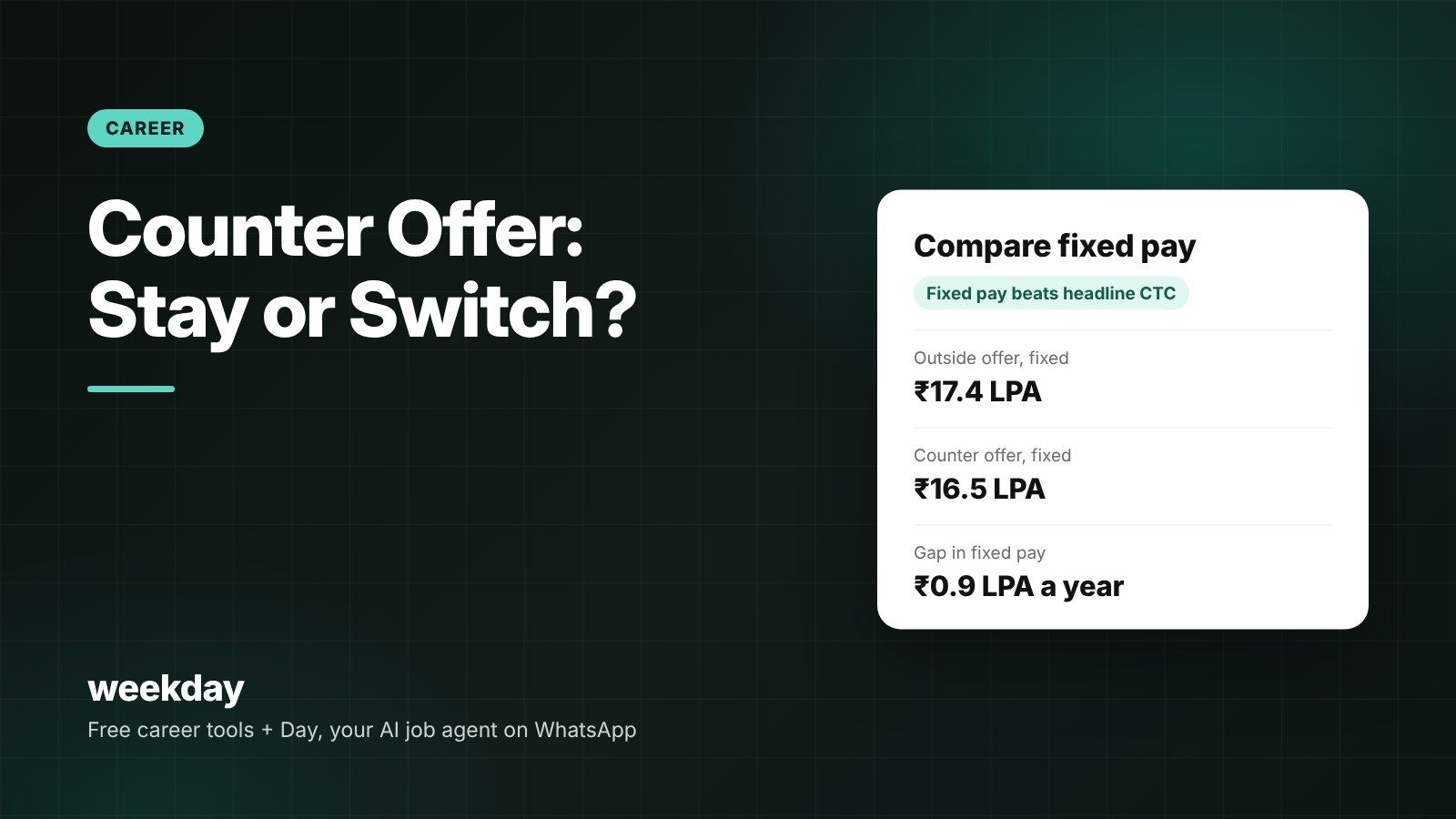
A Bengaluru backend developer with 4 years of experience was at ₹11 LPA in a product company. They got an offer from a large IT services company at ₹20.5 LPA CTC, with ₹17.4 LPA fixed. Their company countered with ₹16.5 LPA fixed and no variable, effective from the next cycle in October. They accepted, then started second-guessing (r/developersIndia).
The top replies split two ways. Stay if the current company is profitable and stable. Or think twice before moving from a product company to a services company, because of long-term growth. One reply warned the company might hire and train a replacement, then let them go later.
3. A promotion plus allowances
An employee resigned over slow growth and pay. Their company offered a next-level designation, a 7% immediate hike, a possible 4–5% more in April, a night allowance of ₹300 a night and a travel allowance of ₹600 a day for a night-shift role. They had hoped for about 30% outside but didn't have a confirmed offer yet (r/IndianWorkplace).
This one shows a common trap: comparing a real counter offer with an outside offer that doesn't exist yet.
Do the maths: compare fixed with fixed
Take case 2. Headline numbers make the outside offer look far better, but the gap in guaranteed pay is smaller.
| Outside offer | Counter offer | |
|---|---|---|
| Fixed pay | ₹17.4 LPA | ₹16.5 LPA |
| Fixed hike on ₹11 LPA | (17.4 − 11) ÷ 11 = 58.2% | (16.5 − 11) ÷ 11 = 50% |
| Gap in fixed pay | ₹0.9 LPA a year | |
| When it starts | From joining | From the next cycle |
Now the decision is about ₹0.9 LPA of fixed pay, plus variable pay that may or may not pay out, plus everything that isn't money: the work, the manager, and how stable each company is. Run your own numbers in the salary hike calculator, and read how variable pay works before you count it.
When a counter offer can make sense
- You resigned mainly over pay, and the counter fixes pay in fixed salary, not a one-time retention bonus.
- It comes with a revised letter, an effective date, and a new title or scope you wanted.
- The outside role is clearly riskier, for example a much shakier company or a role you're unsure about.
- You like your manager and team, and they were not part of why you were leaving.
Red flags
- Only verbal promises. "We'll take care of you in April" isn't an offer.
- A raise that starts months later, after the outside offer has expired.
- Money tied to a clawback or a lock-in that stops you leaving for a year.
- The reason you resigned isn't touched. If it was the manager, the hours or the work, more money rarely fixes it.
- You're comparing against an offer you don't have yet.
Scripts you can use
Declining the counter offer
"Thank you for the offer, and for the last two years. I've thought about it carefully, and I've decided to go ahead with my move. I'll make sure the handover is complete before my last day."
Accepting it, the safe way
"Thanks, I'd like to stay. Could you share the revised letter with the new fixed pay, the effective date and the new title? Once I have it, I'll withdraw my resignation in writing."
Telling the new company you're staying
"Thank you for the offer and your time. After a lot of thought, I've decided to stay in my current role. I'd be glad to stay in touch for future roles."
One Reddit reply suggested using a matched offer to ask the new company for 5–10% more. That can work once. Going back and forth many times can cost you both offers.
Want a second option before you decide?
Browse jobs on Weekday by role and city, from startups to large companies, and see what's open right now.
Frequently asked questions
What is the meaning of counter offer?
A counter offer is a reply to an offer with new terms. In jobs, it usually means your current employer offering more pay, a new title or a bonus to keep you after you resign.
Is it a good idea to accept a counter offer?
Only if it fixes why you wanted to leave, is in writing, and the fixed pay is close to or better than the outside offer. If you left because of the manager or the work, a raise rarely solves it.
Can I use a counter offer to negotiate with the new company?
Yes, once, politely and with real numbers. Share only real offers, because companies may ask for proof.
How do I decline a counter offer politely?
Thank your manager, say you've decided to go ahead with the move, and confirm you'll finish the handover. Keep it short and in writing.
Should I withdraw my resignation before getting the counter offer letter?
No. Wait for the revised letter with the new pay and effective date, then withdraw your resignation by email.





