
Last updated: November 2026 · Sources: Weekday analysis of 148 LinkedIn hiring posts, Reddit interview threads, Weekday salary pages
Most data analyst interviews in India test the same five things: SQL, Excel, a bit of Python, basic statistics and one business case. The case round is where most people lose the offer.
This guide gives you 40 real-style questions with short answers you can say out loud, plus a two-week plan to prepare.
In one line: practise medium SQL under a timer, learn to break down a "metric dropped" case, and be ready to explain one project in numbers. Hard LeetCode rarely shows up.
What data analyst interviews look like in 2026
One candidate on Reddit went through 7 to 8 data analyst rounds and shared what came up. Most of their hard LeetCode prep was never asked. What was asked: live SQL at medium level in about 20 minutes, a metrics case that decided offers, a project walkthrough for a non-technical manager, and deeper behavioural questions (r/analytics thread).
Hiring also comes in batches. In Weekday's analysis of 148 LinkedIn hiring posts (14 to 23 November 2026), only 2 posts were for data roles. We tagged each post by the role names in its job title. But one of those 2 posts listed 18 data and ML roles across Mumbai, Navi Mumbai and Bangalore for 3 to 11 years of experience, and the other was a Pune walk-in for data scientists. When a team hires analysts, it often hires many at once.
| Round | What they check |
|---|---|
| Screening | Basics, notice period, expected CTC |
| SQL / technical | Joins, GROUP BY, window functions, Excel |
| Case / metrics | How you find why a number moved |
| Project + HR | Your work in numbers, team fit |
SQL questions (1–12)
1. What's the difference between WHERE and HAVING?
WHERE filters rows before grouping. HAVING filters groups after GROUP BY, so you use it with aggregates like HAVING COUNT(*) > 5.
2. INNER JOIN vs LEFT JOIN?
INNER keeps only matching rows. LEFT keeps every row from the left table and fills NULLs where there's no match. Use LEFT to find customers with zero orders.
3. UNION vs UNION ALL?
UNION removes duplicates and is slower. UNION ALL keeps everything. This exact question showed up in a business analyst round at an Indian e-pharmacy, shared on r/developersIndia.
4. ROW_NUMBER vs RANK vs DENSE_RANK?
With a tie at 2nd place, ROW_NUMBER gives 1, 2, 3, RANK gives 1, 2, 2, 4 and DENSE_RANK gives 1, 2, 2, 3.
5. Find the top 3 salaries in each department.
Use DENSE_RANK() OVER (PARTITION BY dept ORDER BY salary DESC) in a subquery, then keep rank ≤ 3.
6. Calculate month-over-month growth in orders.
Group orders by month, then use LAG() to get last month's count. Growth = (this month − last month) / last month × 100.
7. Find duplicate emails in a users table.SELECT email, COUNT(*) FROM users GROUP BY email HAVING COUNT(*) > 1;
8. Keep only the latest record per customer.
ROW_NUMBER() partitioned by customer_id, ordered by updated_at DESC. Keep row 1.
9. Why does NOT IN return zero rows sometimes?
If the subquery has a NULL, NOT IN returns nothing. Use NOT EXISTS instead.
10. What is a CTE and why use it?
A named temporary result (WITH ... AS). It makes long queries readable and lets you reuse a step.
11. What does an index do?
It speeds up reads on a column, like a book index, but slows down writes a little.
12. Users who logged in 3 days in a row?
The "gaps and islands" trick: login date minus ROW_NUMBER stays the same during a streak. Group by it and keep groups with 3+ days.
More practice: SQL interview questions and advanced SQL questions.
Excel questions (13–18)
13. VLOOKUP vs XLOOKUP?
XLOOKUP can look left, defaults to exact match and doesn't break when you insert a column. Say you use it where your version supports it.
14. When do you use a pivot table?
To summarise big data fast, like sales by city and month, without writing formulas.
15. How do you remove duplicates and clean text?
Remove Duplicates, TRIM for extra spaces, PROPER or UPPER for case, and Text to Columns to split data.
16. SUMIFS vs COUNTIFS?
SUMIFS adds values that match several conditions. COUNTIFS counts rows that match them.
17. What is conditional formatting used for?
To make outliers visible, like red cells for orders below target.
18. How do you handle a 10 lakh row file that Excel struggles with?
Use Power Query or move it to SQL or Python. Big files make Excel slow and easy to break, so say you'd switch tools early.
Python and pandas questions (19–24)
19. How do you read a CSV and check it quickly?pd.read_csv(), then .head(), .info(), .describe() and .isnull().sum().
20. merge vs concat?
merge joins on a key, like SQL. concat stacks tables on top of or beside each other.
21. How do you fill missing values?
Depends on why they're missing. Median for skewed numbers, a "missing" label for categories, or drop rows if few and random.
22. groupby example?df.groupby('city')['revenue'].sum() gives revenue per city.
23. apply vs vectorised operations?
Vectorised (like df['a'] * 2) is much faster. Use apply only when you have no other way.
24. Your dataset has 50 million rows and won't fit in memory. What do you do?
Load only needed columns, push aggregations to SQL, read in chunks, and use PySpark only if you truly need it. This was asked in a recent interview shared on r/dataanalytics.
Brush up with our Python interview questions.
Statistics questions (25–30)
25. Mean vs median: which do you report for salaries?
Median. A few very high salaries pull the mean up.
26. What is a p-value?
The chance of seeing a result this extreme if there were truly no effect. Below 0.05 usually means "unlikely to be luck".
27. Correlation vs causation?
Ice cream sales and AC sales both rise in May. Neither causes the other. Summer causes both.
28. How would you set up an A/B test?
One clear metric, random split, enough sample size, fixed duration, then compare with a significance test.
29. What is an outlier and what do you do with it?
A value far from the rest. Check if it's an error first. Don't delete real big customers.
30. Standard deviation in plain words?
How spread out the numbers are from the average.
Case and metrics questions (31–36)
31. The dashboard shows a 40% drop in active users overnight. What do you check first?
Check the data before the business. Pipeline status, data refresh, tracking events, filters and recent releases. Only then look for a real cause. This one also came from the same Reddit thread.
32. Conversion dropped this month. How do you find why?
Split it: by platform, city, new vs returning users, and each funnel step. Find where the drop sits, then ask what changed there.
33. Which metrics would you track for a food delivery app?
Orders per day, delivery time, cancellation rate, repeat rate and average order value.
34. Guesstimate: how many paracetamol tablets are sold in Bangalore in a day?
Start with population, share of people unwell on a day, share who take paracetamol, tablets per person. State every assumption out loud. A similar question appeared in the e-pharmacy round above.
35. Revenue is up but profit is down. Why?
Higher discounts, costlier channels, more returns or a shift to low-margin products.
36. How do you explain an insight to a non-technical manager?
Lead with the answer and the rupee impact, then one chart, then the detail if they ask.
Project and HR questions (37–40)
37. Walk me through your best project.
Problem, data size, what you did, result in numbers. A sample line: "cut weekly report time from 3 hours to 20 minutes". That beats a list of tools.
38. Tell me about a time your analysis was wrong.
Pick a real one, show how you caught it and what you changed.
39. Which tool do you prefer, Power BI or Tableau?
Say which you've used and why. See our Power BI interview questions.
40. What's your expected CTC?
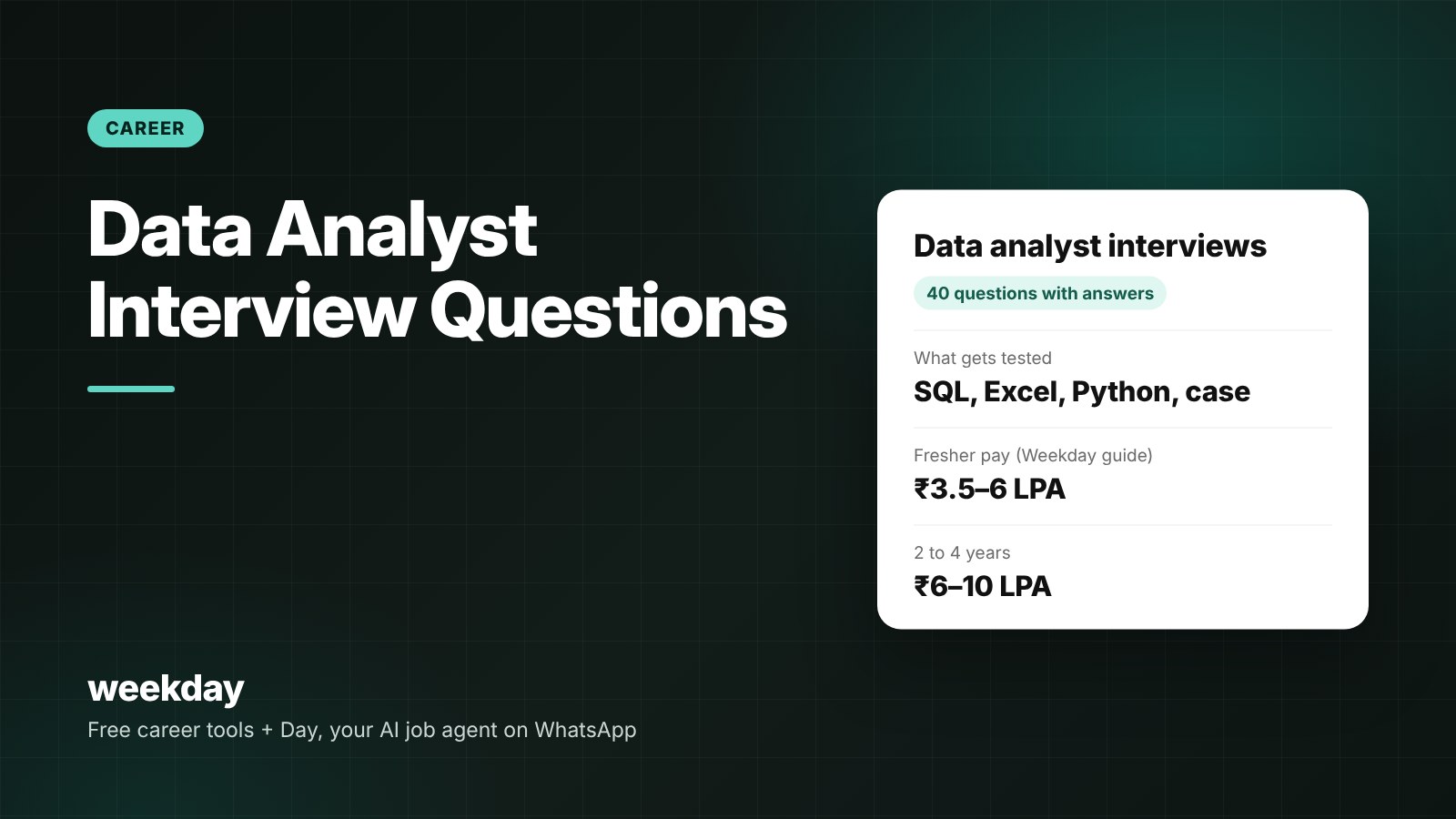
Give a range based on data. Weekday's data analyst salary guide puts freshers at ₹3.5–6 LPA and 2 to 4 years at ₹6–10 LPA.
A two-week prep plan
- Days 1–5: 3 timed SQL problems a day. Say your thinking out loud.
- Days 6–8: Excel pivots, XLOOKUP and one pandas cleaning task.
- Days 9–11: 2 metric cases a day. Practise splitting a drop by segment.
- Days 12–14: Rehearse your project story and 5 HR answers. Use our guide on how to introduce yourself.
New to the field? Start with the data analyst roadmap.
Ready to apply?
See open data analyst roles on Weekday at startups, product companies and GCCs, with filters for city and experience.
Frequently asked questions
What questions are asked in a data analyst interview for freshers?
Mostly SQL joins and GROUP BY, Excel pivots and lookups, basic statistics like mean vs median, and one simple business case. Expect a project walkthrough too.
Is SQL enough to get a data analyst job?
SQL is the most tested skill, but most rounds also check Excel, a dashboard tool like Power BI and how you reason through a business problem.
Do data analyst interviews have coding rounds?
Usually live SQL, sometimes light Python or pandas. Hard algorithm questions are rare for analyst roles.
How should I answer a case question in a data analyst interview?
Confirm the data is correct first, then split the metric by segment and funnel step, find where the change sits, and say what you'd check next.





