
Last updated: November 2026 · Salary data from Weekday salary pages
A data scientist uses data to predict what will happen and helps a company act on it. Think of a model that predicts which customers will cancel a subscription next month, or one that estimates how many orders a food app will get on a rainy Friday night.
This roadmap gives you the order to learn things in, a week-by-week plan, projects that get interviews, and what data scientists earn in India.
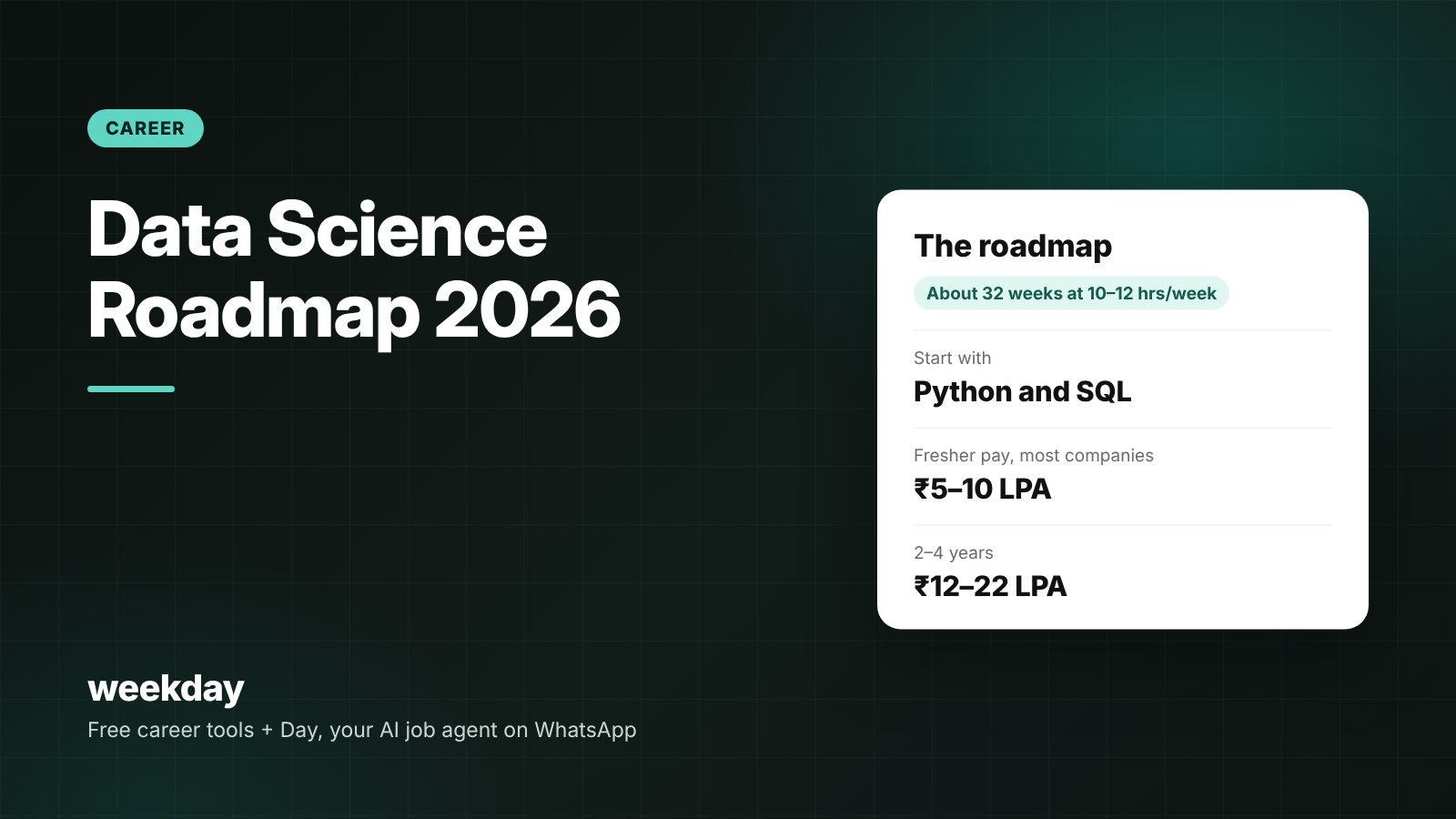
The roadmap in one line: Python → SQL → statistics and probability → data cleaning and analysis → machine learning → model evaluation → deep learning basics → communication and business sense → deployment basics → three projects. Our suggested plan fits this into about 32 weeks at 10 to 12 hours a week.
Data analyst vs data scientist vs ML engineer
| Role | Main question | Typical tools |
|---|---|---|
| Data analyst | What happened, and why? | Excel, SQL, Power BI or Tableau |
| Data scientist | What will happen, and what should we do? | Python, SQL, statistics, scikit-learn |
| ML engineer | How do we run this model reliably for millions of users? | Python, PyTorch, cloud, MLOps tools |
Many people start as analysts and move into data science. If that is you, our data analyst roadmap is the first step. If you want to build products on large language models instead, see the AI engineer roadmap.
The data science roadmap: 9 steps
Step 1: Python (weeks 1–4)
- Basics: variables, loops, functions, lists and dictionaries
- pandas and NumPy for tables and numbers
- Jupyter notebooks
Python is used by 57.9% of developers in the Stack Overflow Developer Survey 2025, and nearly every data science library supports it first. Revise with our Python interview questions.
Step 2: SQL (weeks 5–7)
Company data lives in databases. SQL is used by 58.6% of respondents in the same survey. Learn joins, GROUP BY, subqueries and window functions. Practise with our SQL interview questions.
Step 3: Statistics and probability (weeks 8–11)
- Mean, median, variance, percentiles
- Probability, distributions (normal, binomial)
- Sampling, confidence intervals, hypothesis tests and p-values
- A/B testing: how to tell if a change really worked
You are ready when: you can explain to a manager, in plain words, whether a 2% rise in sign-ups after a new button is real or just noise.
Step 4: Data cleaning and analysis (weeks 12–14)
- Handling missing values, outliers and wrong data types
- Exploratory data analysis (EDA) with charts
- Telling a story with data: one chart, one finding, one recommendation
Step 5: Machine learning (weeks 15–20)
- Regression and classification
- Decision trees, random forests and gradient boosting
- Clustering for grouping customers
- Train, validation and test splits; cross-validation
Use scikit-learn. Test yourself with our machine learning interview questions.
Step 6: Model evaluation and features (weeks 21–23)
- Accuracy, precision, recall, F1, ROC-AUC, RMSE: which one fits the problem
- Feature engineering: turning raw data into useful inputs
- Overfitting, data leakage and how to spot them
Interviewers push hard here. "Why did you pick recall over accuracy?" is a classic question.
Step 7: Deep learning basics (weeks 24–26)
Learn what neural networks are, train one simple model in PyTorch, and use a pre-trained model for text or images. You do not need research-level depth for most data scientist roles.
Step 8: Business sense and communication (ongoing)
The best model is useless if nobody acts on it. Practise turning results into a decision: "If we offer a discount to the 10% of users most likely to cancel, we keep more customers than we lose in discounts."
Step 9: Deployment basics (weeks 27–28)
Save a model, serve it through a small API with FastAPI, and put it in a Docker container. You do not need to be an ML engineer, but you should be able to hand over something that runs.
Week-by-week plan
| Weeks | Focus | Output by the end |
|---|---|---|
| 1–7 | Python, SQL | One cleaned dataset and 40 solved SQL problems |
| 8–14 | Statistics, EDA | An A/B test write-up and one EDA notebook |
| 15–23 | Machine learning, evaluation | Two models with honest evaluation |
| 24–28 | Deep learning, deployment | One model served through a simple API |
| 29–32 | Projects, resume, applications | 3 projects on GitHub, resume ready, applying every week |
3 projects that get interviews
- Customer churn prediction. Use a public telecom or subscription dataset. Predict who will cancel, explain the top reasons, and suggest one action.
- Demand forecasting. Forecast daily sales for a store or delivery app dataset. Compare a simple baseline with your model and show the error.
- A/B test analysis. Analyse a public A/B test dataset, check whether the result is significant, and write a one-page recommendation.
For each project, write the problem, data, method, result and recommendation. The last two matter most.
Data scientist salary in India
Weekday's data scientist salary guide puts freshers at ₹5–10 LPA at most companies, and ₹15–25 LPA at top product firms and GCCs. Data scientists with 2 to 4 years earn ₹12–22 LPA, and 5 to 7 years ₹22–38 LPA.
Here is the median Data Scientist salary at companies with enough data on Weekday (fixed pay, all experience levels, read on 20 November 2026):
| Company | Median | Typical range |
|---|---|---|
| PayPal | ₹24 LPA | ₹16.8–35 LPA |
| Ericsson | ₹20 LPA | ₹16.3–24.6 LPA |
| Optum | ₹18 LPA | ₹12.5–24 LPA |
| Tiger Analytics | ₹16 LPA | ₹12–20 LPA |
| Tredence | ₹14 LPA | ₹9.4–18 LPA |
| Ford | ₹11 LPA | ₹6.3–15 LPA |
The same guide calls moving from reporting-style work to models that run in production the biggest pay lever. To see any of these as monthly take-home, use the in-hand salary calculator.
How data science interviews work
- Online test: Python, SQL, statistics and sometimes aptitude
- Technical round: ML concepts, evaluation metrics, a coding task in pandas
- Case round: "How would you predict which sellers will leave our platform?"
- Project deep dive and HR round
Read our data scientist job description guide to see what employers ask for.
Mistakes that slow people down
- Jumping to deep learning first. Most business problems are solved with good data and simple models.
- Skipping statistics. It is what separates a data scientist from someone who runs code.
- Only Kaggle-style projects. Add a business recommendation, not just a score.
- Ignoring SQL. Many interviews start with a SQL test.
Ready to apply?
See open data scientist roles on Weekday, from startups to GCCs, with filters for experience and city.
Frequently asked questions
How long does it take to become a data scientist?
Our suggested plan takes about 32 weeks at 10 to 12 hours a week, covering Python, SQL, statistics, machine learning, evaluation, deep learning basics, deployment and three projects.
Can a fresher become a data scientist in India?
Yes, though many start as data analysts first. Weekday's salary guide puts data scientist freshers at ₹5–10 LPA at most companies.
Is maths required for data science?
Yes, mainly statistics and probability, plus some linear algebra. You need to understand results, not prove theorems.
Which is better, data analyst or data scientist?
Neither is better. Analysts explain what happened; data scientists predict what will happen. Analyst roles are often easier to enter, and many people move up later.
Which language should I learn for data science?
Python, plus SQL. Together they cover most data science work and interviews.





