
Last updated: 25 November 2026
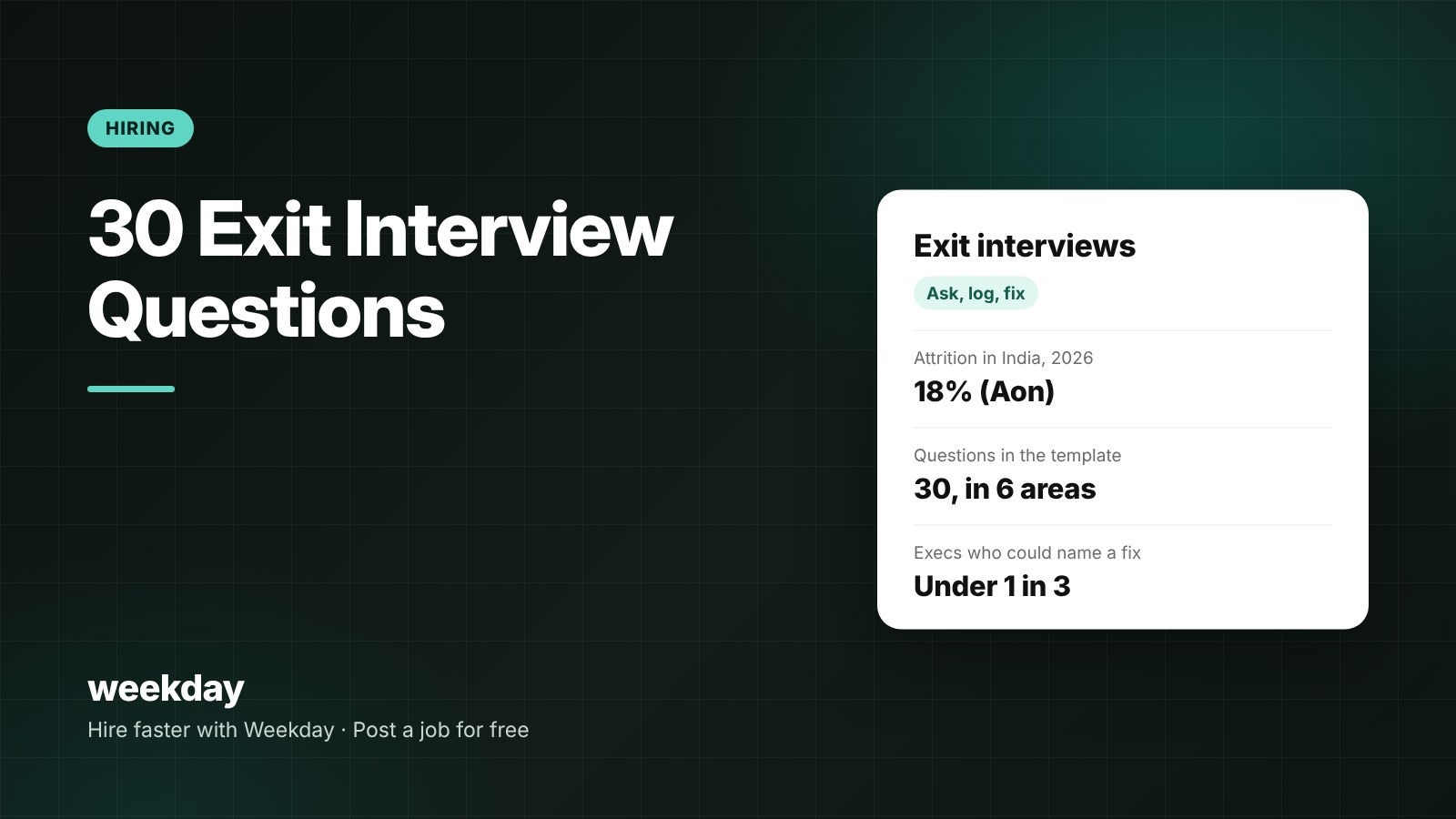
Quick answer: Ask 30 exit interview questions across six areas: why they're leaving, manager and team, role and growth, pay and ratings, workload and culture, and the way out. The questions are the easy part. The value is in what you do next. In one survey of 200+ executives reported by HBR, about 75% said their companies ran exit interviews, but fewer than a third could name one change those interviews led to. With India's attrition at 18% in 2026 (Aon), a 100-person company has about 18 chances a year to learn why people leave.
An exit interview is a short, honest conversation with someone who has resigned. You ask why they're leaving, what worked and what didn't. Then you look for patterns across many exits and fix the ones that keep coming up.
Below you'll find what people are leaving over in 2026, how to run the meeting, the 30 questions in a template (with why to ask each and what to do with the answer), and how to turn the answers into changes.
What people are leaving over in 2026
- Pay. A Blind survey of 2,178 Indian professionals found 35% got no hike or a pay cut this year, and 59% got 5% or less (Blind). Expect pay to come up in many exits.
- Leave and working hours. In a Weekday analysis of 400 top Reddit posts from the last 30 days, leave and working hours were the #1 theme in r/IndianWorkplace (13 of its 40 top posts). One thread, "Manager denied my sick leave because 6 people are already on leave", got 220 upvotes.
- What they'll miss. A r/IndianWorkplace thread asking "What do you miss the most about your previous job?" drew 263 upvotes and 138 comments in October 2026. People judge a job by what they lose when they leave, not only by what the new one offers. So ask that question before they go (question 25 below).
How to run an exit interview
- Who: HR or a skip-level manager. Not the direct manager.
- When: In the last week of notice, once the handover is mostly done. Add a short online form a few weeks after they've left, for anything they didn't want to say in person.
- How long: 30 to 45 minutes.
- Format: Mix fixed questions (so you can compare exits) with open follow-ups (so you hear the unexpected). HBR's authors recommend this semi-structured approach.
- Keep it separate from dues. Say upfront that their full and final settlement and relieving letter don't depend on anything they say.
- Listen, don't defend. If you argue, they'll stop talking.
30 exit interview questions (template)
1. Why they're leaving
| Question | Why ask it | What to do with the answer |
|---|---|---|
| 1. What made you start looking? | Finds the first trigger, not just the final offer | Tag the trigger (pay, manager, growth, workload, personal) in your exit log |
| 2. What does the new role offer that we didn't? | Shows the gap other employers fill | If it's pay, check market data. If it's scope, look at career paths |
| 3. Was there a moment you decided to leave? | Points to a specific event | Share the type of event, without names, with leadership |
| 4. Could anything have changed your mind? | Tells you if the exit was preventable | Mark "regrettable and preventable" exits and review them monthly |
| 5. Did you talk to anyone here before deciding? | Tests whether people feel safe raising issues | If no, start stay interviews or skip-level 1:1s |
2. Manager and team
| Question | Why ask it | What to do with the answer |
|---|---|---|
| 6. How would you describe your relationship with your manager? | The manager shapes daily work more than any policy | Look for patterns across exits under the same manager |
| 7. Did you get regular, useful feedback? | No feedback often means surprise ratings | Train managers on short monthly 1:1s |
| 8. Did you feel your work was recognised? | Recognition costs little and is easy to forget | Set one simple recognition habit per team |
| 9. How did the team work together? | Spots conflict or one person carrying the load | Check workload split in that team |
| 10. What should your manager keep doing, and change? | Gives balanced, usable feedback | Share themes privately once you have three or more exits |
3. Role and growth
| Question | Why ask it | What to do with the answer |
|---|---|---|
| 11. Was the job what we described when you joined? | A mismatch is a hiring problem, not a retention one | Fix the job description and interview loop |
| 12. Did you have the tools you needed? | Finds daily friction | List repeat asks and fund the top one |
| 13. Did you see a path to grow here? | Tells you if they hit a ceiling | Write down levels and what it takes to move up |
| 14. Did you get the training you needed? | Shows if learning budgets reach people | Set a per-person learning budget |
| 15. Which skills will you take with you? | Ends the section on a positive note | Use the answers in job posts and employer branding |
4. Pay, rating and benefits
| Question | Why ask it | What to do with the answer |
|---|---|---|
| 16. How did your pay compare with the market? | 35% of Blind respondents got no hike or a cut in 2026 | Compare with Aon's 9% average hike and fix outliers |
| 17. Was your last appraisal fair and clear? | Unclear ratings push people out | Review calibration and how ratings are explained |
| 18. Which benefits mattered, and which didn't? | Shows where benefit money is wasted | Cut unused benefits, fund the valued ones |
| 19. Was pay the deciding factor, or one of several? | Separates pay-only exits from deeper issues | Track the two groups separately |
| 20. Did any policy (leave, insurance, WFH) bother you? | Small policy rules can push people out | Review the wording and how it's applied |
5. Workload, leave and culture
| Question | Why ask it | What to do with the answer |
|---|---|---|
| 21. How was your workload in the last six months? | Burnout builds slowly | Compare hours and on-call across teams |
| 22. Could you take leave when you needed it? | Leave was the top r/IndianWorkplace theme in our scan | Check leave approvals and rejections by team |
| 23. Did you feel safe raising problems? | Silence hides problems until people quit | Review how escalations are handled |
| 24. How would you describe our culture to a friend? | Tests what you say in job posts | Rewrite your careers page if the two don't match |
| 25. What will you miss most about working here? | Shows what to protect | Keep these intact when you change other things |
6. Hiring, onboarding and the way out
| Question | Why ask it | What to do with the answer |
|---|---|---|
| 26. How was your first month here? | A bad first month is an early warning sign | Fix onboarding gaps for the next joiner |
| 27. Would you recommend us as an employer? | A simple score you can track | Track the "yes" share every quarter |
| 28. Would you consider coming back? | Good leavers can return later | Tag them as possible rehires |
| 29. Who could take over your work, inside or outside? | Speeds up the backfill | Start the replacement search that week |
| 30. What didn't we ask that we should have? | Catches what your list misses | Add repeat answers to next quarter's list |
What to do with the answers
- Code every exit. Give each one a main reason (pay, manager, growth, workload, personal, role mismatch) and mark it regrettable or not.
- Review every quarter. At 18% attrition, a 100-person company sees about 18 exits a year, enough to spot patterns.
- Share themes, not names. Leaders see the patterns. Managers see feedback about their own team, privately.
- Fix the top two. Pick the two most common preventable reasons and act on them this quarter.
- Tell people what changed. When staff see exit feedback lead to a fix, they speak up earlier, before they resign.
- Ask stayers too. Use the same questions as "stay interviews" with your best people. Read our retention strategies for more.
Need to replace someone who's leaving?
Post the role for free. Weekday's AI agents search 400M+ profiles, reach the best fits over email and WhatsApp, and send you the interested ones, so the seat isn't empty for long.
Frequently asked questions
What are the most important exit interview questions?
If you only have 10 minutes, ask: What made you start looking? Could anything have changed your mind? How was your relationship with your manager? How did you feel about your pay compared with the market? What will you miss most about working here?
Who should conduct an exit interview?
Someone from HR or a skip-level manager, not the person's direct manager. People are more open with someone who didn't manage them day to day.
Should exit interviews be mandatory?
Offer one to everyone who leaves, and keep it clearly separate from their dues and relieving letter. You can't force honest answers, but you can make it easy and safe to give them.
What should you not ask in an exit interview?
Don't push for details of their new salary, ask about their personal life, ask them to name colleagues to blame, or argue with their reasons. Don't ask them to sign anything during the meeting.
Sources
- Aon: Annual Salary Increase and Turnover Survey India 2026–27 (14 October 2026)
- Blind: 1 in 3 Indian tech workers got no hike or a pay cut this year
- Harvard Business Review: Making Exit Interviews Count (April 2016)
- Dawn: summary of the HBR exit interview survey (June 2016)
- Weekday analysis of 400 top Reddit posts, 420 LinkedIn posts and 400 X posts from the last 30 days (Nov 2026)
- Reddit: r/IndianWorkplace, "What do you miss the most about your previous job?"
- Reddit: r/IndianWorkplace, manager denied sick leave
- Weekday: full and final settlement guide





