
Last updated: 25 November 2026
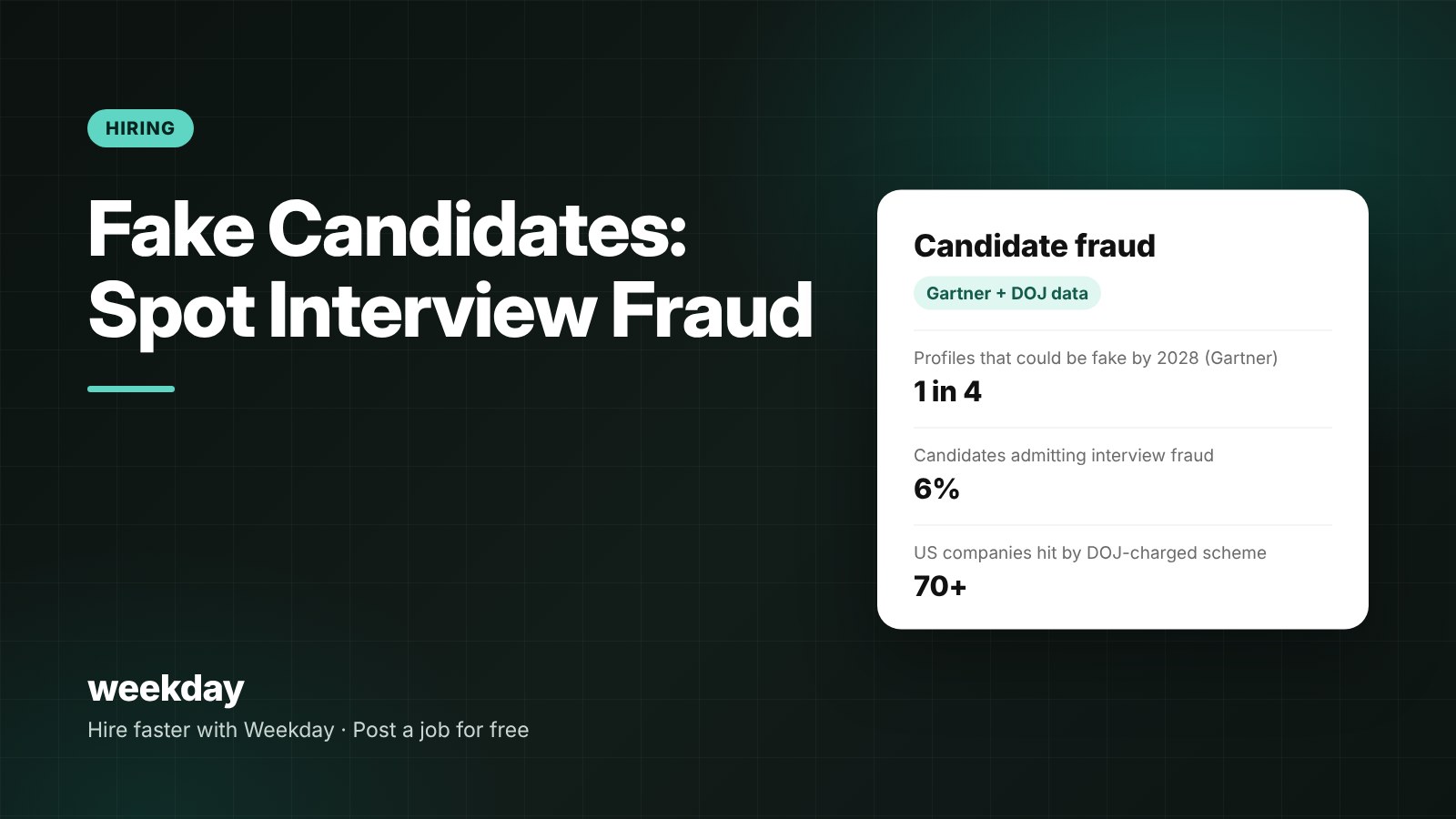
Quick answer: Candidate fraud is no longer rare. Gartner predicts that by 2028, 1 in 4 candidate profiles worldwide could be fake, and in its survey of 3,000 candidates, 6% admitted to interview fraud (posing as someone else or having someone interview for them). In October 2026, the US Justice Department charged 14 people over a North Korean remote IT worker scheme that reached more than 70 US companies. You don't need to treat every applicant as a suspect. You need small checks at every stage: match the person on video early, test them on their own work, verify ID after a conditional offer, and confirm the same person joins on day one.
Hiring managers on Reddit are already living this. An HR manager on r/humanresources said three fake applicants made it to interviews for remote accounts payable roles in a single month. A recruiter with 30 years in the job asked r/recruiting whether he'd just interviewed a fake candidate. This guide gives you a red-flags checklist and a simple verification process you can run without scaring off real people.
What counts as a fake candidate
| Type | What happens | Where you usually catch it |
|---|---|---|
| Made-up profile | Invented name, work history or degrees, often with a new LinkedIn profile | Resume review, reference and employment checks |
| Copied resume | Same resume sent under different names | Comparing applications for the same role |
| Proxy interview | Someone else takes the interview, or feeds answers off-camera | Video rounds, follow-up questions, day one |
| Live AI help | A hidden tool on screen writes answers in real time | Deep follow-up questions on their own work |
| Deepfake or face swap | Video or voice altered to look like someone else | Live video checks, ID match after offer |
| Stolen identity | A real person's details used by someone else, sometimes at scale | ID verification, address and payroll checks |
The bait-and-switch is the costly one. One person clears the interviews, and a different person logs in after joining. An X post on interview cheating grouped most cases into three buckets: a hidden AI tool on the screen, a second device just off camera, or someone else taking the interview.
How big is candidate fraud?
- 1 in 4 profiles fake by 2028. That's Gartner's prediction for candidate profiles worldwide (HR Dive).
- 6% admit it. In Gartner's survey of 3,000 job candidates, 6% said they had taken part in interview fraud. That's self-reported, so treat it as a floor.
- Candidates are fine with in-person steps. 62% said they were more likely to apply if a role required in-person interviews, and only about a quarter trust AI to evaluate them fairly (same Gartner survey).
- Organised schemes exist. The US Justice Department said in October 2026 that it charged 14 people over a North Korean remote IT worker scheme. It affected more than 70 US companies, and the FBI searched more than 40 suspected "laptop farms" in Texas and seized about 187 devices (US Department of Justice).
Remote roles with access to money, data or code are the main targets. The r/humanresources case was payroll and vendor payments. The DOJ case was IT work.
Red flags checklist
No single flag proves fraud. Two or three together mean you should check more before the next round.
| Stage | Red flag | What to do |
|---|---|---|
| Application | LinkedIn created recently but shows many years of experience | Ask about specific past projects and managers in the screen |
| Application | Resume matches another applicant's word for word | Compare applications for the same role. Flag both |
| Application | ATS flags IP and phone country mismatch or a proxy connection | Treat as a prompt to verify, not a reason to reject |
| Screen call | Camera "broken", or video pixelated and dropping at key moments | Reschedule. Ask for a stable video call before moving on |
| Screen call | Asks early about location rules that don't fit their profile | Confirm where they live and can work, in writing |
| Interview | Polished answers, but stalls on simple follow-ups about their own work | Go two levels deeper: "Why that choice? What broke?" |
| Interview | Eyes keep moving to one side, long pauses before every answer | Ask them to share their whole screen for a live task |
| Interview | Lips don't match the audio, or a cough or sneeze doesn't match the video | These are the deepfake signs the FBI flagged. Switch to a fresh call or meet in person |
| Interview | Leaves the call when pushed on a detail | Note it on the scorecard. Don't move them forward without a re-check |
| Checks | Past employer has no record of them | Ask for payslips or an experience letter and verify directly |
| Offer and day one | Wants laptop shipped to a different address than their ID | Ship only to the verified address, or ask them to collect it |
A verification process by stage
The r/humanresources poster put the problem well: leaning on the background check after the offer is too late, because the hiring manager has already spent hours on someone who doesn't exist. And a r/recruiting thread on identity checks asked the other side: asking every applicant for ID before a first chat is too much. The answer is light checks spread across the process.
- Application: filter for copies. Check for duplicate resumes, duplicate phone numbers and brand-new profiles. Use your ATS fraud flags as a prompt, not a verdict.
- Screen: cameras on, same person. Run the first call on video and take a short note of what the person looks and sounds like. Before the technical round, ask to see any government photo ID on camera. Don't record or keep a copy, and say you do this for every candidate.
- Technical round: test their own work. Ask them to walk you through something they built, with their screen shared. Follow-up questions are your best tool. A proxy can memorise answers. It's much harder to fake why a decision was made.
- Final round: one in-person or live step. For local candidates, meet once in person. For remote ones, run a short unscripted live task with a different interviewer. Gartner's data says most candidates are fine with this.
- Conditional offer: full checks. Verify ID, address, education and past employment. Run your normal background verification process and call references yourself, using numbers you find, not ones the candidate gives you. Our reference check questions help.
- Day one and the first month: confirm it's the same person. Match the face on the first video call to your screen notes. Ship equipment only to the verified address. Watch for logins from unexpected countries.
Free tool: Fraud is easier to catch when every interviewer asks the same core questions and writes down what they saw. Build a consistent rubric with Weekday's free interview scorecard generator, and add a line for "identity checked: yes or no".
Stay fair to real candidates
Most odd signals have honest causes. People move cities, use VPNs at work, have bad internet, or are new to a country and have thin profiles. The 30-year recruiter on r/recruiting said exactly this: the role was hard to fill and he didn't want to reject someone on a vague feeling or a risk flag alone.
- Use the same checks for everyone, and tell candidates upfront what you'll ask for and when.
- Write down the facts, not the feeling. "Video dropped three times during coding" is useful. "Seemed fake" isn't.
- Stop hiring managers from making up their own tests. The r/humanresources poster said one manager had started asking people to wave at the camera. Agree on one process instead.
- Be careful with face scanning and ID data. Rules on biometric and personal data differ by country and state. Check with your HR or a lawyer before you add any tool that scans faces or stores ID copies.
In India, document checks usually happen after the offer through a background verification partner. That's fine, as long as the earlier stages already confirmed you're talking to the same real person.
Want fewer strangers in your pipeline?
Weekday's AI sourcing agent finds real candidates for your role from 400M+ profiles and reaches them directly on email, WhatsApp and phone, so you're not only sorting through anonymous inbound applications. See how it works for your next role.
FAQ
How common are fake candidates?
Gartner predicts that by 2028, 1 in 4 candidate profiles worldwide could be fake. In its survey of 3,000 job candidates, 6% admitted to interview fraud, either posing as someone else or having someone else interview for them.
What are the signs of a fake candidate?
A new LinkedIn profile with years of experience on it, past employers who can't confirm them, resumes that match other applicants word for word, location mismatches, camera or audio trouble at key moments, answers that sound read out, and a reluctance to go deep on their own projects.
When should I check a candidate's identity?
Do light checks at every stage, not one big check at the end. Match the face and name on a live video call before the technical round, verify ID and documents after a conditional offer, and confirm the same person shows up on day one.
What is a proxy interview?
A proxy interview is when someone other than the real candidate takes the interview, either in place of them or by feeding answers. The person who joins is then not the person you assessed.
Can AI tools detect deepfake candidates?
Some ATS and identity tools flag risk signals such as IP and phone country mismatches or proxy connections. Treat these as prompts to check further, not proof. A live, unscripted conversation about the candidate's own work is still one of the best tests.
Sources
- HR Dive: Gartner on fake job candidates (survey of 3,000 candidates)
- US Department of Justice: coordinated actions against North Korean remote IT worker schemes (October 2026)
- Reddit: r/humanresources, three fake applicants made it to interviews; r/recruiting, did I just speak with a fake candidate?; r/recruiting, when should remote hiring include an identity check?
- FBI IC3: deepfakes and stolen personal data used to apply for remote jobs (June 2022)
- X post on the three common ways candidates cheat in coding tests
- Weekday analysis of 400 top Reddit posts, 420 LinkedIn posts and 400 X posts from the last 30 days (Nov 2026)





