
Last updated: 23 November 2026
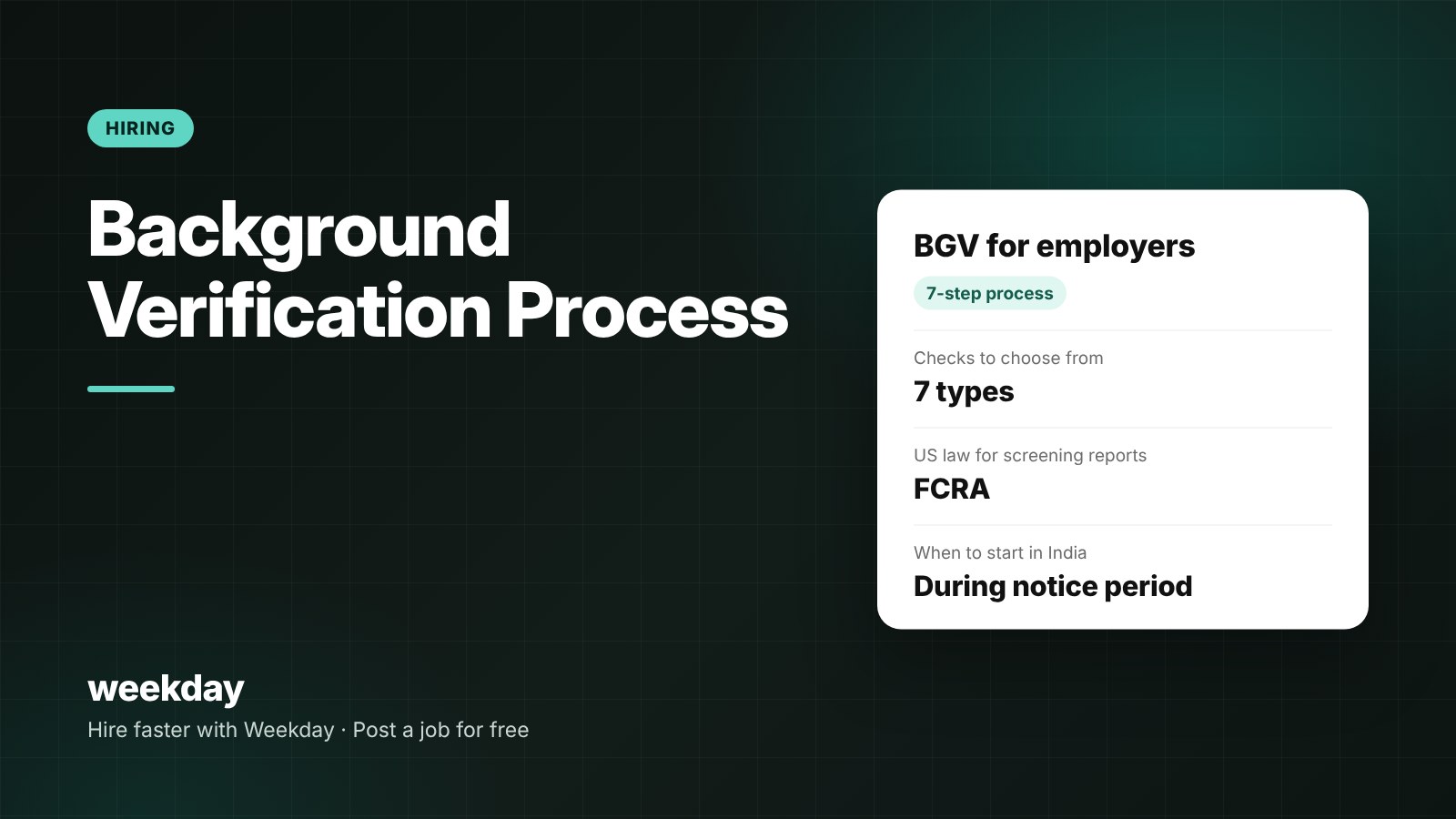
Quick answer: Background verification (BGV) is how you confirm that what a candidate told you is true. The usual checks are identity, address, education, past employment and, for some roles, criminal and credit records. Run BGV after the candidate accepts, make the offer conditional on a clear result, and get written consent first. In India, start it during the notice period so it is done before joining. In the US, a background report from a screening company falls under the Fair Credit Reporting Act, which has strict notice and consent steps.
Most candidates are honest. But a single fake degree, a made-up employer or, more and more often, a fake identity can cost a small team months. BGV is the step that catches those cases. Done well, it is quick, fair to the candidate and doesn't delay the joining date.
What background verification checks
| Check | What you confirm | How it is usually done | Who needs it |
|---|---|---|---|
| Identity | The person is who they say they are | Government ID such as PAN or passport, matched with a live video or in-person check | Every hire, especially remote |
| Address | Current and permanent address | Documents, a digital check or a physical visit | Most hires |
| Education | Degree, college, year | Confirmation from the university or board | Roles where the degree matters, and all freshers |
| Employment | Past employers, titles, dates, exit reason | Past HR teams, relieving letters, payslips, PF service history shared by the candidate | Every experienced hire |
| Criminal record | No relevant cases | Court record searches, police verification where needed | Roles with money, data, children or patients |
| Credit | Financial history | Credit report, with permission | Finance and senior roles with access to funds |
| References | How the person works | Calls with past managers | Senior and critical roles |
Pick checks by role. A sales intern doesn't need a credit check. A finance controller probably does.
The background verification process in 7 steps
- Decide the checks for each role. Write a simple matrix: role level and type on one side, checks on the other. Use it every time so no one is treated differently.
- Say it in the offer letter. Make the offer conditional on a satisfactory background check, and say which checks you run. Our offer letter format guide shows where this clause fits.
- Get written consent and documents. One consent form that lists the checks, plus the documents you need: ID, address proof, degree certificates, relieving letters and payslips.
- Run the checks. In-house for small teams, or through a verification firm when you hire in volume.
- Review the results. Mark each check clear, minor gap or serious issue.
- Talk to the candidate about any gap. Before you decide anything, ask them to explain. Many gaps have simple reasons.
- Decide, record and clean up. Note the decision and the reason. Keep only what you need, store it safely and delete it when you no longer need it.
Timing: run BGV during the notice period
In India, most candidates have a notice period of 30 to 90 days (Weekday notice period guide). That is plenty of time to finish BGV before day one, so start it the day the offer is accepted.
There is one catch. Don't contact the candidate's current employer until they have resigned and told you it is okay. A call to their current HR before that can cost them their job.
BGV is also a good reason to stay in touch during notice. A candidate who hears nothing for weeks is easier for a counter offer to pull back. A quick update like "your education check is done, employment is in progress" keeps them engaged.
Consent and data rules in India
Ask for written consent for every check. It is standard practice, and it protects you if a candidate later asks how their data was used. India's Digital Personal Data Protection Act, 2023 sets rules for how organisations collect, protect and delete personal data. In practice:
- Collect only what you need for the role.
- Tell the candidate what you will check and why.
- Share documents with verification firms only through secure channels, never on open WhatsApp groups.
- Limit who in your team can see the reports.
- Delete documents once the purpose is served.
This is general guidance, not legal advice. Check your consent form with a lawyer once.
How background checks work in the US
If you use a background screening company, the report is a "consumer report" under the Fair Credit Reporting Act. The FTC's guidance for employers lays out the steps:
- Before the check: tell the candidate in writing, in a stand-alone document, that you may use a report for the hiring decision. Get their written permission.
- Certify to the screening company that you got permission and will follow the law.
- Before rejecting someone because of the report: send them a copy of the report and a summary of their rights, so they can point out errors.
- After the decision: send an adverse action notice with the screening company's details and the candidate's right to dispute the report.
- Dispose of the report securely when you are done.
Some states and cities add their own limits, for example on credit checks. Check local rules too.
What does a check cost? It depends on the scope. In one r/humanresources thread, an HR professional looking for a one-off check on a senior hire with access to sensitive accounts wanted credit history and civil court records on top of criminal checks, with a budget of up to $300 and a preference for around $150.
BGV doesn't prove identity on its own
Remote hiring has made identity fraud a real problem. In 2024, security company KnowBe4 wrote that it hired a remote software engineer who passed four video interviews, a background check and reference checks. The identity was real but stolen, and the photo was an AI-edited stock image (KnowBe4).
In a r/recruiting thread from May 2026, a recruiter said a candidate's ID failed verification only after the offer had gone out and onboarding had started. They now run deeper ID, address and reference checks for remote tech roles.
For remote hires, add these to your BGV:
- A live video check where the candidate shows their ID on camera.
- The same face on every interview call. Keep cameras on.
- Payslips and bank details in the same name as the ID.
- Referees you contact through numbers you find yourself. Our reference check questions guide covers how to run those calls.
- Laptop shipped to the verified address only.
What to do when a check comes back with a gap
| What BGV found | Likely reason | What to do |
|---|---|---|
| Dates off by a few weeks | Notice period or memory | Ask, accept a reasonable explanation |
| Title slightly different | Internal vs external titles differ | Ask for an appointment letter or payslip |
| Past employer not responding | Company shut down or slow HR | Use payslips, PF records or a former manager |
| Gap not shown on the resume | Break, study, health, family | Ask. A gap is not a lie unless they hid it when asked |
| Degree not confirmed by the university | Possible fake degree | Serious. Ask for proof, then usually withdraw |
| Employer doesn't exist | Fake experience | Serious. Withdraw the offer |
| ID doesn't match the person | Identity fraud | Stop immediately. Revoke access |
Be consistent. Treat the same finding the same way for every candidate, and write down why you decided what you did.
Need more verified candidates in the pipeline?
Paste your job description and Weekday's AI agents scan 400M+ profiles, find verified email and WhatsApp contacts for the top matches, and reach out until they reply. Your first role is free, with 200 reach-outs and no credit card.
Post a free jobFrequently asked questions
What is background verification?
It is how an employer checks that a candidate's facts are true: identity, address, education, past employment and, for some roles, criminal or credit records.
When should background verification be done?
After the offer is accepted, with the offer conditional on a clear check. In India, run it during the notice period so it's done before joining.
Is consent needed for background verification?
Get written consent every time. In the US, the FCRA requires written disclosure and permission before you get a screening report. In India, consent is standard practice and the DPDP Act, 2023 sets rules for handling personal data.
What happens if a background verification check fails?
Talk to the candidate first. Small gaps often have simple reasons. Fake degrees, fake employers or identity mismatches usually end the offer.
How long does background verification take?
Identity and address checks are usually quickest. Employment and education take longer because past employers and universities have to reply. Start early and collect complete documents up front.
Sources
- FTC: Using consumer reports, what employers need to know
- Digital Personal Data Protection Act, 2023 (MeitY)
- KnowBe4: fake IT worker incident report (July 2024)
- r/recruiting: fake identities in remote tech hiring
- r/humanresources: background check provider recommendations
- Weekday: notice period guide, offer letter format





