
Last updated: November 2026 · Salary data from Weekday salary pages
A full stack developer builds both sides of an app: the screen you tap on (frontend) and the server and database behind it (backend). If you have ordered food on an app, the menu you scroll is frontend work, and the order that reaches the restaurant is backend work. A full stack developer can build both.
This roadmap gives you the order to learn things in, a month-by-month plan, three projects that get interviews, and what full stack developers earn in India.
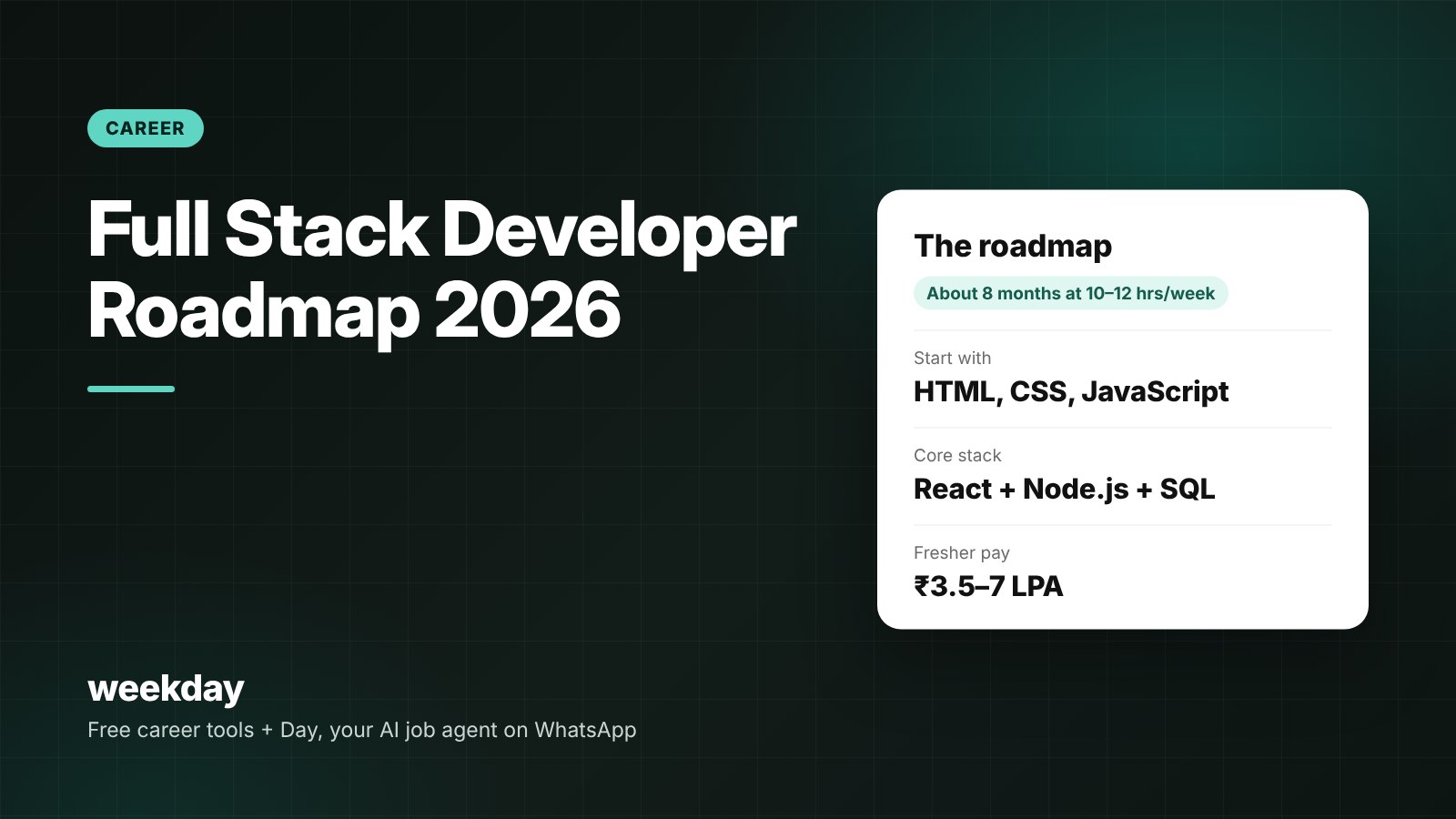
The roadmap in one line: HTML and CSS → JavaScript → Git → React → Node.js with Express → SQL and one NoSQL database → APIs and login → deployment with Docker and a cloud → three projects → apply. Our suggested plan fits this into about 8 months at 10 to 12 hours a week.
What does a full stack developer do?
A normal week might include:
- Building a new page in React, for example a "track my order" screen
- Writing the API that page calls, and the database query behind it
- Fixing a bug that sits somewhere between the two
- Reviewing a teammate's code and shipping to production
Startups like full stack developers because one person can ship a feature end to end. Larger companies often split frontend and backend, but still value people who understand both. For a longer look at the role, read what a full stack software engineer is.
Pick your stack first
You do not need to learn every language. Pick one stack and go deep. These are the common choices, with how widely each tool is used among developers in the Stack Overflow Developer Survey 2025:
| Stack | Frontend | Backend | Database | Good for |
|---|---|---|---|---|
| MERN | React (used by 44.7% of developers) | Node.js (48.7%) with Express | MongoDB (24%) | Startups, freshers, fastest to start |
| Java full stack | React or Angular (18.2%) | Spring Boot (14.7%) | MySQL or PostgreSQL | Banks, large companies, IT services |
| Python full stack | React | Django (12.6%) or FastAPI | PostgreSQL (55.6%) | Data-heavy products, AI features |
If you are unsure, start with JavaScript and the MERN-style stack, but use PostgreSQL as your main database. JavaScript is the most used language in the same survey (66% of respondents), so you will use it in every stack anyway.
The full stack developer roadmap: 9 steps
Step 1: HTML and CSS
- Semantic HTML: headings, forms, tables, buttons
- CSS layout with Flexbox and Grid
- Responsive design for mobile screens
- One CSS framework such as Tailwind, after you know plain CSS
You are ready when: you can copy the layout of a real website from a screenshot, and it works on a phone.
Step 2: JavaScript
- Variables, functions, arrays, objects, loops
- The DOM and events (clicks, form submits)
- Promises, async/await and the fetch API
- Modern syntax: destructuring, spread, modules
- TypeScript basics once JavaScript feels comfortable
You are ready when: you can build a to-do app that saves tasks and loads data from a public API. Test yourself with our JavaScript interview questions.
Step 3: Git and GitHub
Learn to commit, branch, merge, open a pull request and fix a merge conflict. Push every project from here on to GitHub. Recruiters do open those links.
Step 4: React
- Components, props and state
- Hooks: useState, useEffect, and custom hooks
- Routing between pages
- Forms and calling APIs
- Next.js later, once plain React is clear
Practise with our React interview questions.
Step 5: Backend with Node.js and Express
- Building a REST API: routes, controllers, status codes
- Middleware, validation and error handling
- Environment variables and config
- Calling third-party APIs, for example a payment or SMS service
Step 6: Databases
- SQL first: tables, joins, indexes, transactions (PostgreSQL or MySQL)
- One NoSQL database, usually MongoDB
- An ORM such as Prisma or Sequelize
- Designing a schema for a real app, such as users, orders and payments
Use our SQL interview questions to check your joins.
Step 7: Login, security and APIs
- Sign up and login with hashed passwords
- Sessions vs JWT tokens
- Roles: user vs admin
- Basic security: input validation, SQL injection, CORS, rate limits
Step 8: Deployment and DevOps basics
- Docker: write a Dockerfile for your app (Docker is used by 71.1% of developers in the Stack Overflow 2025 survey)
- Deploy to one cloud: AWS, Azure or Google Cloud
- A simple CI pipeline with GitHub Actions that runs tests on every push
- Logs and basic monitoring
Step 9: Data structures, testing and system design basics
Product companies test DSA in coding rounds, so practise a few problems a week from Step 2 onwards. Our DSA interview questions are a good start. Add unit tests to your projects, and learn the basics of caching, queues and load balancing so you can answer simple design questions.
Month-by-month plan
| Month | Focus | Output by the end |
|---|---|---|
| 1 | HTML, CSS, Git | Two responsive pages on GitHub |
| 2 | JavaScript | A to-do app and a weather app using a public API |
| 3 | React | A multi-page React app with routing and forms |
| 4 | Node.js, Express | A REST API with full create, read, update and delete |
| 5 | Databases | The same API backed by PostgreSQL, plus one MongoDB version |
| 6 | Login and security | Sign up, login and admin roles working end to end |
| 7 | Docker, cloud, CI | Your app live on a public URL with automatic tests |
| 8 | Projects, DSA, applications | 3 projects live, resume ready, applying every week |
In college or working full time? Stretch the plan. The order matters more than the speed.
3 projects that get you interviews
- Expense tracker with UPI-style categories. Login, add expenses, monthly charts by category, export to CSV. Shows forms, auth, SQL and charts.
- Mini job board. Companies post jobs, candidates apply with a resume upload, admins approve posts. Shows roles, file uploads and search.
- Real-time order tracker. A restaurant dashboard where order status updates live for the customer. Shows WebSockets, state management and deployment.
For each project, write a short README: the problem, the stack, a live link, and one hard bug you fixed. Interviewers often ask about that bug. Our guide to a GitHub portfolio website shows how to present them.
Full stack developer salary in India
Weekday's full stack developer salary guide puts freshers at ₹3.5–7 LPA, or ₹10–18 LPA at strong product startups. Mid-level developers with 4 to 6 years earn ₹10–22 LPA, and seniors with 7 to 9 years earn ₹18–35 LPA.
The company matters even more than the title. Here is median fixed pay from Weekday's salary pages, read on 20 November 2026:
| Company and role | Median | Typical range |
|---|---|---|
| PhonePe, Software Engineer | ₹30 LPA | ₹21–40 LPA |
| Swiggy, Software Engineer | ₹25.6 LPA | ₹18–34.1 LPA |
| Meesho, Software Engineer | ₹24.8 LPA | ₹21–34.5 LPA |
| Razorpay, Software Engineer | ₹19 LPA | ₹13.2–25 LPA |
| SAP, Full Stack Developer | ₹17.1 LPA | ₹15.4–22 LPA |
| Freshworks, Software Engineer | ₹13 LPA | ₹10.1–16 LPA |
| Zoho, Software Engineer | ₹12 LPA | ₹8.8–16 LPA |
| Paytm, Software Engineer | ₹12 LPA | ₹7.5–16 LPA |
| NxtWave, Full Stack Developer | ₹4 LPA | ₹3–5 LPA |
The pattern: the same skills earn very different pay depending on the company. Moving from a services role to a product company is often the biggest jump you can make. To see what a package means per month, use the in-hand salary calculator.
How full stack interviews work
- Online test: DSA problems, sometimes with JavaScript or SQL questions
- Frontend round: build a small component live, explain state and rendering
- Backend round: design an API, write a query, discuss auth
- Project deep dive: walk through one project and the trade-offs you made
- HR round: notice period, expected CTC, why this company
Prepare with our full stack developer interview questions.
Your full stack resume
- Lead with projects and live links, not a long list of courses.
- Write each project as a result: "Built a job board in React and Node.js with role-based login and resume uploads."
- Match your skills section to the job post's order.
- See our full stack developer fresher resume examples, then run your resume through the free ATS resume checker.
Mistakes that slow people down
- Jumping between stacks. Finishing one stack beats starting three.
- Skipping plain JavaScript. React makes sense only after you understand JavaScript itself.
- Only watching tutorials. Build something after every topic, even if it is small.
- Never deploying. A project with a live link gets far more attention than one that runs only on your laptop.
- Ignoring DSA. Many product companies still filter on a coding round.
Ready to apply?
See open full stack developer roles on Weekday, from startups to large product companies, with filters for city and experience.
Frequently asked questions
How long does it take to become a full stack developer?
Our suggested plan takes about 8 months at 10 to 12 hours a week: HTML and CSS, JavaScript, React, Node.js, databases, login, deployment and three projects. It can be faster if you study full time.
Which stack is best for a full stack developer in 2026?
For most freshers, JavaScript with React and Node.js is the fastest start, because JavaScript is used on both sides. Java with Spring Boot is common in banks and large companies. Pick based on the jobs you want.
Is full stack development good for freshers?
Yes. Startups hire full stack freshers because they can ship features end to end. Weekday's salary guide puts fresher pay at ₹3.5–7 LPA, and ₹10–18 LPA at strong product startups.
Do full stack developers need DSA?
For product companies, yes. Coding rounds usually test data structures and algorithms. Service companies and smaller startups focus more on projects and practical skills.
Can I become a full stack developer without a degree?
Yes. Many companies hire on skills and projects. A strong GitHub profile with live, working projects matters more than the degree for many startup roles.





