
Last updated: 25 November 2026
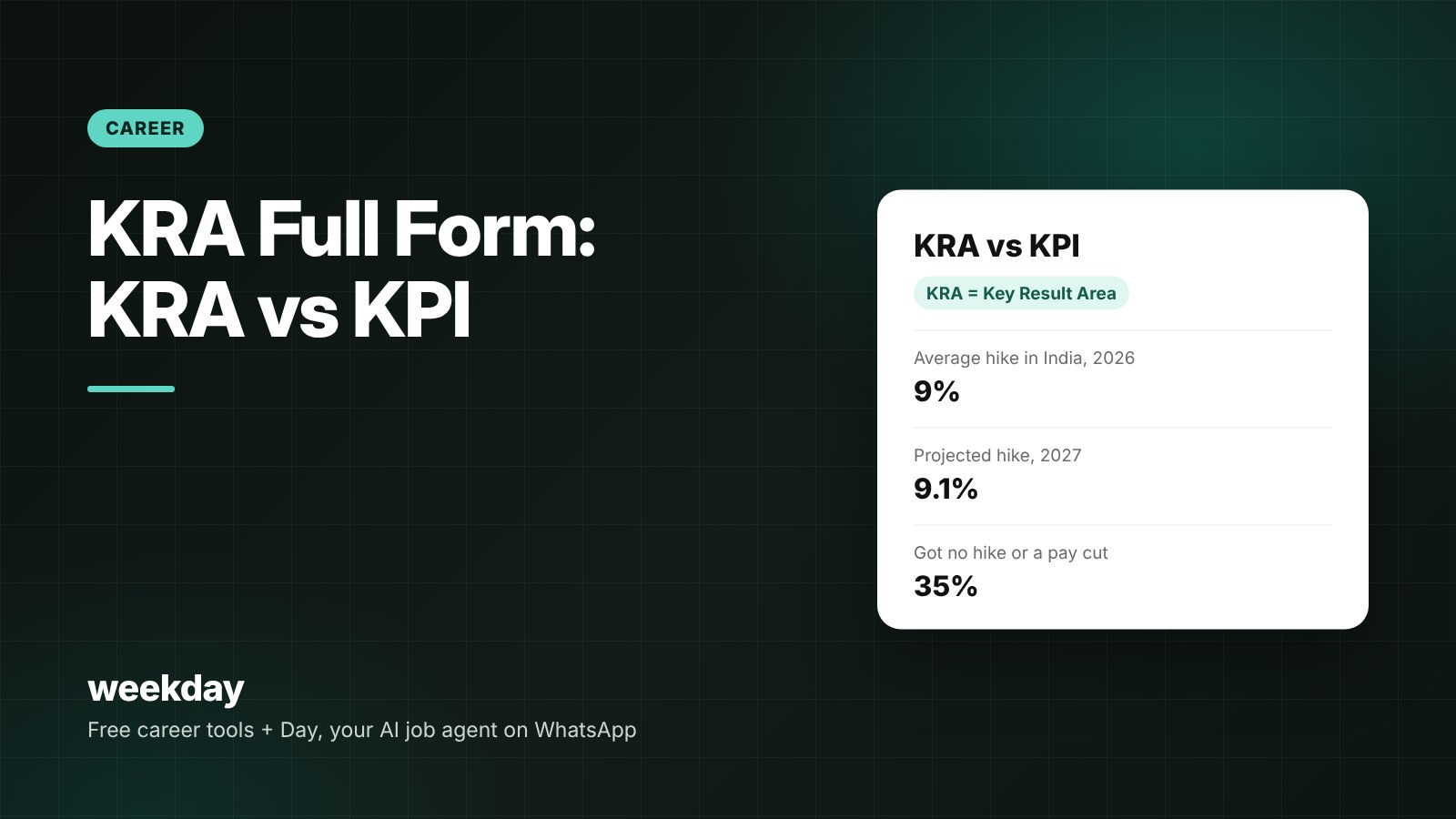
Short answer: KRA full form is Key Result Area: a main area of your job you're responsible for. KPI means Key Performance Indicator: the number used to measure that area. Example: a salesperson's KRA is "new revenue", and the KPI is "₹40 lakh closed per quarter". KRAs decide your appraisal, and your appraisal decides your hike. That matters this year: Aon found Indian companies gave a 9% average hike in 2026 and project 9.1% for 2027, but in Blind's survey of 2,178 India-based professionals, 35% got no hike or a pay cut.
Your manager says, "Let's set your KRAs for the year." Your HR portal shows a goal sheet with weights. Then at appraisal time, those same KRAs decide your rating. If you don't understand them in April, you'll be surprised in March. This guide explains KRA and KPI in simple words, with examples for six common roles.
What is KRA?
KRA stands for Key Result Area. It answers one question: what are the few big things this role must deliver?
A KRA is a short phrase, not a number. "Customer satisfaction." "New revenue." "Hiring." Each KRA usually has a weight, like 40% or 20%, that shows how much it counts in your rating.
Keep it to a few, usually 3 to 6. With too many KRAs, nothing is a priority.
You'll also hear these terms:
- KPA: Key Performance Area. Many companies use it to mean the same thing as KRA.
- OKR: Objectives and Key Results. A goal-setting style popular in startups, where each objective has a few measurable key results.
- Goal sheet: the document in your HR portal that lists your KRAs, KPIs and weights.
One more meaning, so you don't get confused. In stock trading and mutual funds, KRA means KYC Registration Agency, a SEBI-registered agency that stores your KYC details. That's unrelated to your appraisal.
What is KPI?
KPI stands for Key Performance Indicator. It answers: how will we know you did well in that area?
A good KPI is a number with a time frame. "CSAT of 90% or more each month." "Close ₹40 lakh of new business per quarter." If you can't measure it, it's not a KPI yet.
KRA vs KPI: the difference
| Point | KRA | KPI |
|---|---|---|
| Full form | Key Result Area | Key Performance Indicator |
| Question it answers | What do I own? | How is it measured? |
| Form | Short phrase | Number with a deadline |
| Example (support) | Customer satisfaction | CSAT 90%+ every month |
| How many | A few per role | One to three per KRA |
| How often it changes | Rarely, unless your role changes | Every year or quarter, as targets move |
| Who sets it | Role design, by manager and HR | You and your manager, at goal setting |
The easy way to remember: the KRA is the area, the KPI is the scoreboard.
KRA and KPI examples for 6 roles
Here are two KRAs per role with sample KPIs. The numbers are sample targets to show the format. Your company's targets will differ.
| Role | KRA | Sample KPIs |
|---|---|---|
| Software engineer | Feature delivery | 90% of sprint stories shipped on time; fewer than 2 production bugs per release |
| Software engineer | Code quality and reliability | Code reviews done within 24 hours; 70%+ test coverage on new code |
| Sales | New revenue | ₹40 lakh closed per quarter; 20% win rate on qualified deals |
| Sales | Pipeline building | 30 qualified meetings a month; pipeline worth 3x the quarterly target |
| HR | Hiring | 15 roles filled per quarter; time to hire under 35 days |
| HR | Employee retention | First-year attrition under 15%; onboarding feedback score 8/10+ |
| Marketing | Lead generation | 500 marketing qualified leads a month; cost per lead under ₹800 |
| Marketing | Organic growth | Organic traffic up 25% in 6 months; 8 new pages ranking on page 1 |
| Operations | On-time delivery | 98% of orders dispatched on time; delivery within 48 hours in metro cities |
| Operations | Cost control | Cost per order down 10% year on year; vendor invoices cleared within 30 days |
| Customer support | Customer satisfaction | CSAT 90%+ each month; complaint escalations under 3% |
| Customer support | Resolution speed | First response within 2 hours; 80% of tickets solved on first contact |
See the pattern? Every KRA has a clear owner, and every KPI has a number and a time frame. If your goal sheet says "Improve quality" with no number, ask for one.
How KRAs decide your appraisal and hike
At appraisal time, each KRA gets a score, and the weights turn those scores into one rating. Here's a sample for a support executive:
| KRA | Weight | Score (out of 5) | Weighted score |
|---|---|---|---|
| Customer satisfaction | 40% | 4 | 1.6 |
| Resolution speed | 30% | 4 | 1.2 |
| Quality audits | 20% | 3 | 0.6 |
| Team and knowledge base | 10% | 5 | 0.5 |
| Total | 100% | 3.9, rounded to 4 |
A rating of 4 ("exceeds expectations") typically means a 9–14% hike, and a 3 ("meets") means 6–10%, according to the indicative ranges in Weekday's appraisal guide. Your company's budget and your place in the pay band move the final number.
The budget is tight this year. Aon's survey of 1,200+ companies in India found an average hike of 9% in 2026, with 9.1% projected for 2027. But averages hide a lot. In Blind's October 2026 survey of 2,178 India-based professionals, 35% got no hike (30%) or a pay cut (5%), and 59% got 5% or less, up from 34% in 2025.
Here's what a 9% hike means in rupees. On a CTC of ₹8,00,000, 9% is ₹72,000 a year, so your new CTC is ₹8,72,000. That's ₹6,000 more a month before tax. Use Weekday's hike meaning guide to see how hike percentage is calculated.
How to write better KRAs (or fix the ones you got)
- Make every KPI a number with a date. Bad: "Improve customer satisfaction." Good: "Raise CSAT from 82% to 88% by March."
- Agree on where the number comes from. CRM report, Jira, the helpdesk tool. Then nobody argues about it at appraisal time.
- Match weights to how you spend your time. If 60% of your week goes to one KRA, it shouldn't carry 10%.
- Include one KRA you control. Revenue depends on the market. Response time and quality depend on you.
- Get it in writing. If KRAs are set in a call, send a summary email that day.
- Review mid-year. If your role or targets change, ask to update the goal sheet. Old KRAs judged against new work hurt your rating.
What to do at appraisal time
- Write one short paragraph per KRA: what you did, the number and the proof. "Cut average first response from 5 hours to 2 by adding macros."
- Add work outside your KRAs. Projects you picked up, people you trained, fires you put out.
- Ask before ratings lock: "Am I on track for a 4 on my KRAs?"
- Check your hike letter. Compare the new CTC with what the rating should give.
- Know your market value. If your hike is far below market, a switch may pay more than waiting a year.
Check what your hike is really worth
Enter your current CTC and hike percentage in Weekday's free salary hike calculator. It shows your new CTC and the monthly difference in seconds.
Frequently asked questions
What is the full form of KRA?
KRA stands for Key Result Area. It's one of the main areas of your job that you're responsible for, like new revenue for a salesperson or feature delivery for a software engineer.
What is the full form of KPI?
KPI stands for Key Performance Indicator. It's the number used to measure how well you did in a KRA, like revenue closed per quarter or average ticket resolution time.
What is the difference between KRA and KPI?
A KRA is the area you own, written as a short phrase. A KPI is the measure for that area, written as a number with a deadline. For example, the KRA is customer satisfaction and the KPI is CSAT of 90% or more each month.
How many KRAs should a role have?
Keep it to a few, usually 3 to 6. With too many KRAs nothing feels like a priority, and your appraisal turns into a long checklist.
What is KRA in mutual funds and stock trading?
In investing, KRA means KYC Registration Agency, a SEBI-registered agency that stores your KYC details so you don't have to repeat KYC with every broker or fund house. It's unrelated to the KRA in your appraisal.
Sources
- Aon Annual Salary Increase and Turnover Survey India 2026-27 (14 Oct 2026)
- People Matters on the Aon survey
- Blind: 1 in 3 Indian tech workers got no hike or a pay cut this year (survey of 2,178 India-based professionals, 15–26 Oct 2026)
- People Matters on the Blind survey
- Weekday: Appraisal meaning, ratings and typical hikes
- Weekday: Hike meaning in salary





