Last updated: 9 November 2026
- What appraisal means, in plain words
- The appraisal cycle, step by step
- Rating scales and what they mean
- Typical hike % by rating
- How to write your self-appraisal
- 40 self-appraisal comments by role and competency
- How to respond to a low rating
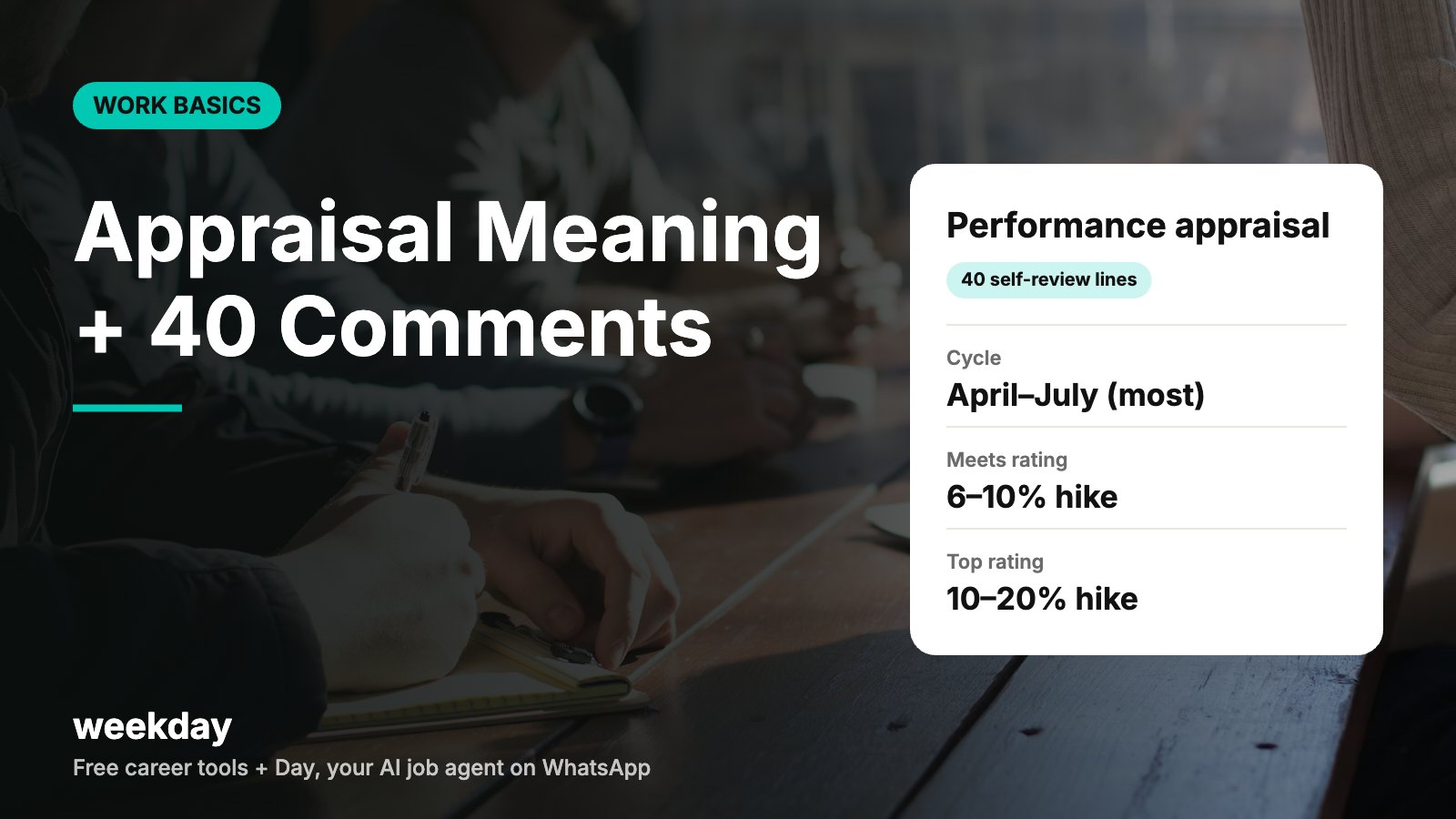
- Most Indian companies follow the April–March financial year, so annual reviews usually happen between April and July.
- Common scales: 5-point (1–5), 4-point, or labels such as Exceeds / Meets / Below expectations.
- Salary surveys by consulting firms such as Aon have put average Indian increments at around 9% in recent years.
- Many larger companies use calibration (sometimes a bell curve), so a manager can't rate everyone at the top.
Sources: Indian company practice; published salary increase surveys (Aon, others). Hike ranges are indicative.
Day, Weekday's free AI job agent, finds jobs that match your skills and pay, and applies when you say yes. On WhatsApp.
Say hi to Day on WhatsAppHow Day works →What appraisal means, in plain words
To appraise means to judge the value of something. A performance appraisal (also called a performance review or annual review) is how your employer judges your work against the goals set at the start of the year. It usually decides four things: your rating, your increment, your bonus or variable pay, and whether you're promoted.
| Term | Meaning |
|---|---|
| Self-appraisal / self-review | Your own written assessment of your year |
| KRA / KPI | Key result areas and the measures used to judge them |
| Goal sheet | The list of goals agreed at the start of the cycle |
| Calibration / normalisation | Managers compare ratings across teams to keep them fair and within budget |
| Increment / hike | The % rise in your salary after the appraisal |
| PIP | Performance improvement plan, given after a low rating |
The appraisal cycle, step by step
| Stage | Typical timing (April–March year) | What happens | What you should do |
|---|---|---|---|
| Goal setting | April–May | You and your manager agree KRAs | Make every goal measurable |
| Mid-year review | October–November | Check progress, adjust goals | Ask directly: "Am I on track for a top rating?" |
| Self-appraisal | January–March | You rate yourself and write comments | List results with numbers and proof |
| Manager review | March–April | Manager rates you and adds comments | Have a 1:1 to discuss before ratings lock |
| Calibration | April–May | Ratings compared across teams | Make sure your skip-level knows your work |
| Hike letter | May–July | Rating, new CTC, bonus, promotion announced | Check the numbers; ask questions within a week |
Some companies, especially startups and MNCs on a calendar year, run reviews in December–March or twice a year. Check your HR policy for the exact dates.
Rating scales and typical hike % by rating
| 5-point rating | Common label | Typical share of employees | Typical hike (indicative) |
|---|---|---|---|
| 5 | Outstanding / Far exceeds | 5–10% | 12–20%, often with promotion |
| 4 | Exceeds expectations | 20–25% | 9–14% |
| 3 | Meets expectations | 50–60% | 6–10% |
| 2 | Partially meets / Needs improvement | 10–15% | 0–5% |
| 1 | Does not meet | Under 5% | 0%, often with a PIP |
These ranges are typical, not rules. Your hike depends on your company's budget, your position in the pay band and the market for your skill. Someone low in their band may get more for the same rating.
Worked example: what a hike means in rupees
Current CTC: ₹8,00,000
Rating: 4 (Exceeds)
Hike: 12%

New CTC = 8,00,000 × 1.12 = ₹8,96,000
Increase = ₹96,000 a year, or ₹8,000 a month before tax and deductions.

If promoted with a 20% hike instead: 8,00,000 × 1.20 = ₹9,60,000
How to write your self-appraisal
- Collect evidence first. Go through your goal sheet, emails, dashboards and messages of thanks. Note every result with a number.
- Write against each goal. One short paragraph per KRA: what you did, the result, and the proof.
- Use the result formula: action + number + impact. "Cut report time from 3 days to 1 by automating the data pull."
- Add work outside your goals. Mentoring, hiring, firefighting and process fixes count.
- Rate yourself honestly. Rate 4 where you clearly beat the goal, 3 where you met it. Over-rating everything hurts trust.
- Add one or two growth areas, each with a plan.
- State what you want next: a bigger project, a promotion, a skill. Managers can't support goals they don't know.
Self-appraisal template (one goal)
Goal: Reduce customer refund processing time.

What I did: Mapped the refund process with finance, removed two manual approval steps and set up an auto-alert for refunds pending more than 48 hours.

Result: Average refund time fell from 7 days to 3 days (Apr–Dec). Refund-related complaints dropped 30%.

Proof: Monthly support dashboard; email from the finance head dated 14 Nov.

Self-rating: 4 – Exceeds expectations.
40 self-appraisal comments
By role (1–20)
Software engineer
1. I delivered the payments retry service two weeks ahead of plan, which cut failed transactions by 18% in Q3.

2. I reviewed 140+ pull requests this year and wrote our team's code review checklist, which reduced production bugs from 11 to 4 a quarter.
Sales executive
3. I achieved 112% of my annual target (₹2.24 crore against ₹2 crore) and added 14 new accounts, including our first two hospital chains.

4. I cut my average deal cycle from 52 to 38 days by qualifying leads earlier and sending proposals within 24 hours of the first meeting.
Customer support
5. I handled an average of 62 chats a day with a CSAT of 4.7/5, above the team average of 4.4.

6. I wrote 15 help articles for the most common refund questions, which cut repeat tickets on that topic by about 25%.
HR / recruiter
7. I closed 48 positions this year with an average time-to-hire of 31 days, against a target of 40.

8. I redesigned our onboarding checklist, and 90-day attrition of new joiners fell from 14% to 8%.
Finance / accounts
9. I reduced the monthly close from 8 working days to 5 by automating bank reconciliations in Excel and Power Query.

10. I filed all GST returns on time for three entities, with zero notices this year.
Operations
11. I improved warehouse dispatch accuracy from 96.5% to 99.1% by introducing barcode checks at packing.

12. I negotiated new courier rates that saved about ₹18 lakh a year without slowing delivery times.
Marketing
13. I ran 9 performance campaigns that brought 21,000 leads at a cost per lead 22% below target.

14. I relaunched our newsletter; open rates rose from 19% to 31% and it now drives 8% of demo bookings.
Data analyst
15. I built a sales dashboard in Power BI that replaced 12 manual Excel reports and saves the team about 10 hours a week.

16. My churn analysis identified three at-risk customer segments; the retention team's follow-up saved accounts worth about ₹40 lakh a year.
Team manager
17. I led a team of 8 that delivered 4 of 5 planned projects on time; the fifth was moved to Q1 by agreement after a scope change.

18. I promoted two team members and kept regretted attrition at zero this year.
Fresher (first year)
19. I completed all onboarding training in my first month and took ownership of the weekly reporting task by month three.

20. I learned SQL on the job and now write my own queries; I'd like to take on a small analytics project next year.
By competency (21–40)
Teamwork
21. I covered for a teammate during her two-week leave and kept all her client deliveries on schedule.

22. I set up a weekly 15-minute sync with the design team, which reduced rework requests noticeably.
Communication
23. I sent weekly status updates to stakeholders throughout the migration, so there were no surprise escalations.

24. I presented our quarterly results to the leadership team for the first time and received positive feedback on clarity.
Leadership
25. I led the vendor selection project across three teams and reached a decision in 6 weeks instead of the planned 10.

26. I mentored two new joiners, both of whom were working independently within 8 weeks.
Problem solving
27. When our main supplier failed in August, I lined up an alternate within 3 days and avoided a stock-out.

28. I traced a recurring billing error to a rounding rule and fixed it, ending about 200 customer complaints a month.
Initiative
29. I proposed and built a simple tracker for pending approvals that the whole department now uses.

30. I volunteered to run campus hiring at two colleges, which brought in 6 interns.
Learning and growth
31. I completed the AWS Solutions Architect – Associate certification and applied it to cut our cloud bill by 12%.

32. I learned Python basics this year and automated two weekly data pulls.
Time management
33. I met 95% of my deadlines this year; the two I missed were flagged at least a week in advance with a new plan.

34. I moved routine reports to a fixed Monday slot, which freed about 4 hours a week for project work.
Customer focus
35. I personally followed up on every 1- or 2-star rating within 48 hours; 40% of those customers later updated their rating.

36. I ran 12 customer interviews that shaped two features in our roadmap.
Quality
37. My work had zero audit observations this year.

38. I introduced a peer-check step for client reports, cutting correction requests from 9 to 2 a quarter.
Areas to improve (honest and positive)
39. I sometimes take on too much myself. This year I'll delegate more and agree priorities with my manager each month.

40. I'd like to improve my presentation skills and have signed up for an internal speaking programme in Q1.
Words to use and avoid
| Use | Avoid |
|---|---|
| Delivered, reduced, increased, launched, led, saved | Hardworking, dedicated, sincere (with no proof) |
| Specific numbers: %, ₹, days, customers | "Many", "a lot", "significantly" |
| "I" for your work, "we" for team results | Taking sole credit for team work |
| Calm, factual tone | Complaints about colleagues or the company |
How to respond to a low rating
- Don't react on the spot. Say you'd like time to think and ask for a follow-up meeting.
- Ask for specifics: which goals were missed, and what examples led to the rating.
- Share your evidence calmly if you believe something was missed.
- Agree a clear plan: 2–3 measurable goals and a review date.
- Put it in writing with a short summary email.
- Use the formal route (HR or skip-level review) only if facts were clearly wrong.
Email after a low rating
Subject: Follow-up on my performance review

Hi Sameer,

Thank you for the review discussion yesterday. I've thought about the feedback and would like to understand it better.

Could we meet this week to go through the goals marked as not met? I'd also like to share two results I don't think were captured: the vendor onboarding project (onboarding time cut from 21 to 9 days) and the Q3 audit closure.

Most of all, I want to agree on clear goals for the next six months so we're aligned on what a 'Meets' or 'Exceeds' looks like. I'll send a short draft before we meet.

Thanks,
Pooja
If your hike is below market and the conversation doesn't change anything, it may be time to look outside. Our guide on how to negotiate salary has scripts for both an internal raise and a new offer, and the Career Path Predictor shows where your skills could take you next.
FAQs
What is the meaning of appraisal?
A performance appraisal is a formal review of your work over a period, usually a year, which decides your rating, salary hike, bonus and promotion.
What is self-appraisal?
It's your own written review of your performance, usually against the goals set at the start of the year, submitted before your manager rates you.
When do appraisals happen in India?
Most companies follow the April–March financial year and complete appraisals between April and July. Some run on a calendar year.
What is a good appraisal hike in India?
Around 6–10% is typical for a 'meets expectations' rating and 10–20% for top ratings. Promotions often bring more.
What should I write in my self-appraisal?
Your results against each goal, with numbers and proof, extra work beyond your goals, one or two growth areas with a plan, and what you want next.
What is a bell curve in appraisal?
A forced distribution in which only a fixed share of employees can get top ratings and some must get lower ones. Many companies now use softer calibration instead.
What does a rating of 3 out of 5 mean?
It usually means 'meets expectations': you did your job well, and you'll get a standard hike.
How should I respond to a low appraisal rating?
Stay calm, ask for specific examples, share any missed evidence, and agree written goals and a review date.
Can I negotiate my appraisal hike?
Sometimes. If you have strong evidence or a market gap, ask your manager for a review or a mid-year correction.
What is a PIP?
A performance improvement plan sets specific goals over 30–90 days after a low rating. Take it seriously and document your progress.