
Last updated: 25 November 2026
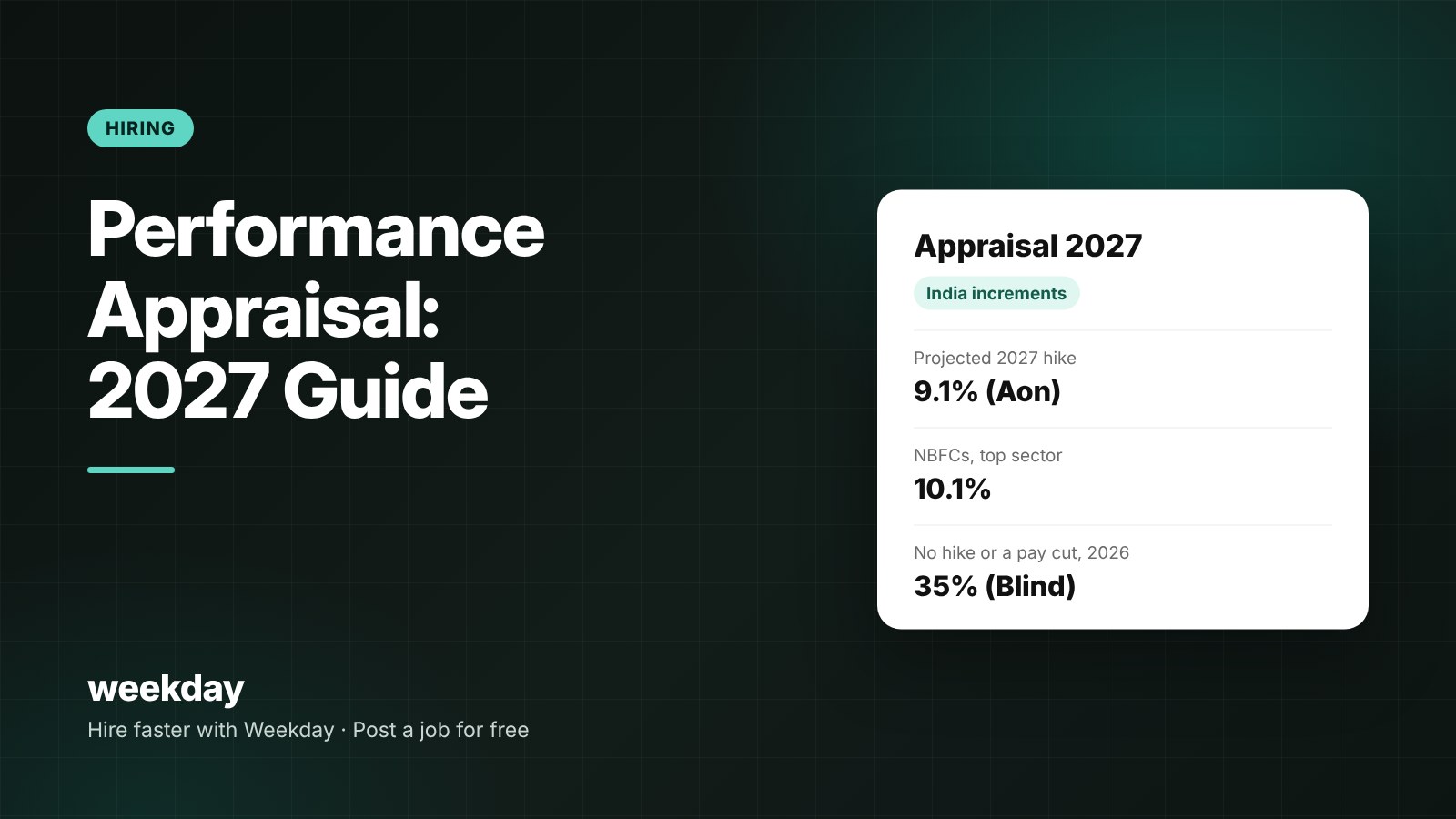
Quick answer: A performance appraisal is a regular review of an employee's work against agreed goals. It usually decides their rating, hike, bonus and promotion. Indian companies project a 9.1% average increment for 2027, after 9% in 2026 (Aon, 1,200+ companies). But in a Blind survey of 2,178 Indian professionals, 35% got no hike or a pay cut in 2026. The budget is only half the story. How you rate and explain it decides who stays.
Performance appraisal means sitting down with each person, looking at what they were asked to do and what they did, and agreeing on a rating. That rating then drives money and growth decisions. Done well, people leave the meeting knowing exactly where they stand. Done badly, they leave it and update their CV.
This guide is for founders, HR and managers. Looking for the employee side, with self-appraisal comments? Read our appraisal meaning guide.
What a performance appraisal is for
- Pay: who gets what hike and bonus.
- Promotion: who is ready for the next level.
- Growth: what each person should learn next.
- Records: a written trail if performance needs a formal plan later.
Appraisal is an event, usually once a year. Performance management is the year-round work around it: goal setting, check-ins and feedback. If you only do the event, the rating will feel random.
2027 increment budgets in India, by sector
Aon's Annual Salary Increase and Turnover Survey (14 October 2026) covers 1,200+ organisations in 45 industries. Average increments: 9% actual in 2026, 9.1% projected for 2027 (Aon).
| Sector | Actual 2026 | Projected 2027 |
|---|---|---|
| NBFCs | 9.6% | 10.1% |
| Energy (oil, gas, power) | 9.7% | 9.9% |
| Real estate and infrastructure | 10.3% | 9.8% |
| Life sciences | 9.5% | 9.6% |
| Funds and asset management | 9.4% | 9.6% |
| Technology platforms and products | 9.5% | 9.5% |
| Global capability centres (GCCs) | 9.3% | 9.4% |
| Retail | 8.9% | 9.4% |
| FMCG | 9% | 9.1% |
| Banking | 8.6% | 8.5% |
| Technology consulting and services | 6.6% | 6.6% |
| All industries | 9% | 9.1% |
Aon's Roopank Chaudhary put it simply: "Stable salary budgets are enabling a more targeted approach to pay." In plain words, the budget isn't growing much, so companies are giving more to some people and less to others.
The employee view: 35% got nothing
That targeting shows up in employee data. Blind surveyed 2,178 India-based professionals between 15 and 26 October 2026 (Blind):
- 30% got no hike and 5% took a pay cut, so 35% in total.
- 59% got a hike of 5% or less, up from 34% in 2025.
- Among Microsoft respondents, 91% got 5% or less (People Matters).
So the "average" 9% hides a wide spread. If your average person reads the 9% headline and then gets 4%, your appraisal process has to explain why, in rupees, before they hear it from a recruiter.
Performance appraisal methods compared
| Method | How it works | Best for | Watch out for |
|---|---|---|---|
| MBO (management by objectives) | Manager and employee agree on 3–5 goals; the rating is based on how many were met | Sales, ops, roles with clear outputs | Goals set once and never updated |
| 360-degree feedback | Input from manager, peers, reports and sometimes clients | Managers and leaders | Friends rating friends; slow to run |
| Bell curve (forced distribution) | Ratings must fit fixed shares across a group | Large teams with a fixed hike pool | Unfair in small or strong teams |
| OKR-linked review | Rating looks at progress on quarterly objectives and key results | Startups and product teams | Stretch OKRs punished as "misses" |
| Continuous feedback | Monthly or quarterly check-ins; the annual rating sums them up | Fast-changing teams | Check-ins that quietly stop by month three |
| Rating scale | Score each person 1–5 on set skills and results | Small companies starting out | Everyone rated 3 or 4 |
Most teams mix them. A common startup setup: OKRs or MBO for results, a short peer input for behaviour, and quarterly check-ins so the annual rating isn't a surprise.
Bell curve appraisal: how it works and when to skip it
In a bell curve, managers rank people against each other. Then the ratings must fit a fixed shape, for example a small top band, a big middle and a small bottom band. The hike pool follows the bands, so the budget never overshoots.
Indian IT has gone back and forth on it. In 2016, Business Standard reported that TCS had moved away from the bell curve (Business Standard). In May 2026, Business Today, citing Mint, reported that TCS managers were asked to place at least 5% of employees in the lowest band, Band D (Business Today). The report carried no TCS comment on the change.
| Use a bell curve if | Skip it if |
|---|---|
| Each rating pool has dozens of people doing similar work | Each rating pool is small, like one manager and a few reports |
| Ratings have drifted up and everyone is "exceeds" | You just hired carefully and most people are strong |
| You need a hard cap on the hike budget | Collaboration matters more than individual output |
A softer option is calibration: managers meet, compare ratings and fix obvious gaps, without a forced shape.
The performance appraisal process in 7 steps
- Set goals (start of year). 3–5 goals per person, written down, agreed by both sides.
- Check in every quarter. 20 minutes: what's on track, what changed, what help is needed.
- Self-appraisal. The employee lists results with numbers and proof.
- Manager review. The manager rates each goal and adds examples from the whole year, not just the last month.
- Calibration. Managers compare ratings across teams so a "4" means the same everywhere.
- Appraisal conversation. Share the rating, the reasons and the hike in rupees. No surprises.
- Development plan. One or two skills to build next year, with a named owner.
Worked example: splitting a 9.1% budget
Sample numbers for a 40-person company with an average CTC of ₹15 lakh, so annual payroll is ₹6 crore. At Aon's 9.1%, the increment pool is about ₹54.6 lakh.
| Rating (sample) | People | Hike | Cost |
|---|---|---|---|
| 5: Outstanding | 4 | 15% | ₹9 lakh |
| 4: Exceeds | 10 | 11% | ₹16.5 lakh |
| 3: Meets | 20 | 8% | ₹24 lakh |
| 2: Partly meets | 4 | 4% | ₹2.4 lakh |
| 1: Below | 2 | 0% | ₹0 |
| Total | 40 | 8.65% average | ₹51.9 lakh |
That leaves about ₹2.7 lakh for market corrections, such as one engineer who is clearly underpaid against current offers. Plan that line up front. It's cheaper than a counter-offer after they resign.
Free tool: Show each person what their hike means in rupees with Weekday's salary hike calculator.
Mistakes that turn appraisals into resignations
- Recency bias. Rating someone on the last six weeks. Keep a simple notes file per person all year.
- Surprise ratings. If the rating is a shock, the check-ins didn't happen.
- Only talking percentages. "8%" means little. "₹1.2 lakh more a year, ₹10,000 a month before tax" lands.
- No path forward. A low rating with no plan reads as "please leave".
- No backup plan. Some people will leave after the cycle anyway. Know which roles you'd need to refill.
Expect a few exits after appraisals?
Weekday's AI sourcing agent finds and reaches passive candidates over email and WhatsApp, so a resignation doesn't stall a team for months. See how it works on a call.
Frequently asked questions
What are the main methods of performance appraisal?
The common ones are management by objectives (MBO), 360-degree feedback, the bell curve (forced distribution), OKR-linked reviews, continuous feedback with regular check-ins, and simple rating scales. Most Indian companies mix two or three of them.
What is bell curve appraisal?
In a bell curve appraisal, managers rate people relative to each other and must fit ratings into fixed shares, such as a small top band, a large middle and a small bottom band. It controls the hike budget but can feel unfair in small teams where everyone did well.
What is the average increment in India for 2027?
Aon's October 2026 survey of 1,200+ companies projects a 9.1% average increment for 2027, after an actual 9% in 2026. NBFCs (10.1%) and energy (9.9%) are at the top, and technology consulting and services (6.6%) is the lowest.
How often should you do performance appraisals?
Most Indian companies tie pay to one annual cycle, usually around April. Add short quarterly check-ins on goals so the annual rating holds no surprises.
Sources
- Aon: Annual Salary Increase and Turnover Survey India 2026–27 (14 October 2026)
- People Matters: Indian companies project 9.1% salary hikes in 2027
- Blind: 1 in 3 Indian tech workers got no hike or a pay cut this year
- People Matters: Microsoft pay hikes in India, 2026
- Business Standard: Companies move away from the bell curve appraisal system (2016)
- Business Today: TCS managers reportedly asked to place 5% in the lowest band (May 2026)
- Weekday: appraisal meaning, the employee guide





