Last updated: 27 November 2026
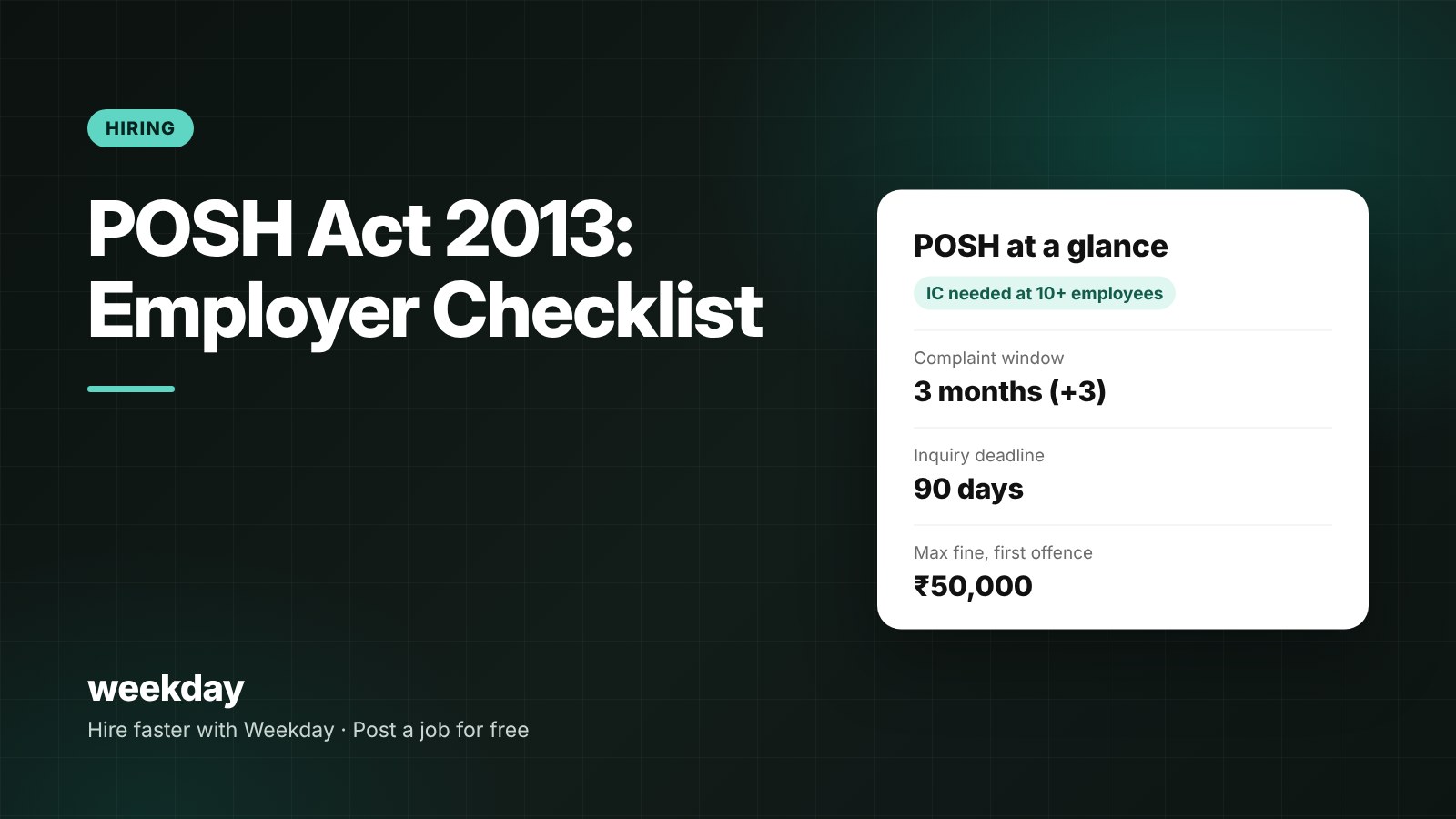
Quick answer: If you have 10 or more employees, the POSH Act says you must set up an Internal Committee (IC). A senior woman leads it, at least half its members are women, and one member comes from outside the company. A woman can complain within 3 months of an incident (the IC can allow 3 more), the inquiry must finish within 90 days, and you must act on the IC's report within 60 days. Not setting up an IC can cost a fine of up to ₹50,000, doubled for a repeat. More employees are using the process: Nifty 50 companies reported 1,327 POSH complaints in FY26, up 4.6% from 1,269 the year before.
POSH is short for the Sexual Harassment of Women at Workplace (Prevention, Prohibition and Redressal) Act, 2013. This guide covers who must comply, the committee, the deadlines, the penalties and training, with a checklist at the end. It's a summary, not legal advice, so check with your lawyer before you finalise your policy.
What the 2026 POSH numbers say
Listed companies now publish their complaint counts. Three numbers stand out:
| Data point | What it shows | Source |
|---|---|---|
| Nifty 50 companies: 1,327 complaints in FY26 vs 1,269 in FY25 | Reporting is up 4.6% in a year | Economic Times analysis, via The People's Board |
| India's top 30 listed companies: complaints up 6.2% in FY25 | Two years in a row of growth | KPMG India |
| 300 NSE-listed companies, FY23: 1,160 cases came from just 81 companies; 219 reported zero | Most companies report nothing, year after year | CEDA data, via LiveLaw (S.S. Rana & Co) |
More complaints don't always mean more harassment. Often they mean people know the IC exists and trust it. KPMG lists the usual weak spots: employees who don't know who sits on the IC, repetitive training, fear of retaliation and untrained IC members. A zero in your report is only good news if your team knows how to complain.
Who must comply with the POSH Act
| Your situation | What the law needs from you |
|---|---|
| 10 or more employees | Set up an IC by written order. If your offices or units are in different places, each one needs its own IC (section 4). |
| Fewer than 10 employees | No IC. Complaints go to your district's Local Committee (section 6). General duties, like a safe workplace, still apply. |
| The complaint is against the employer (for example, the founder) | It goes to the Local Committee, not your IC (section 6). |
| Any company under the Companies Act | Since 14 July 2025, the board report must state complaints received, disposed of and pending over 90 days (Khaitan & Co). |
Three definitions catch founders out:
- Employee includes temporary and daily-wage staff, contract workers, probationers, trainees and apprentices (section 2(f)). Count them all for the 10-person line.
- Aggrieved woman means a woman "of any age whether employed or not" (section 2(a)). A candidate or client harassed at your workplace can complain too.
- Workplace includes places visited for work, transport you provide, and "a dwelling place or a house" (section 2(o)). So remote and hybrid work is covered.
Internal Committee: who sits on it
| Seat | Who can fill it | Rule |
|---|---|---|
| Presiding Officer | A woman employed at a senior level. If you don't have one, she can come from another office or unit, another workplace of the same employer, or another organisation. | Section 4(2)(a) |
| Employee members | At least 2 employees, preferably committed to the cause of women, or with social work experience or legal knowledge | Section 4(2)(b) |
| External member | 1 person from an NGO or association working for women, or someone familiar with sexual harassment issues, such as a social worker with 5+ years' experience or a person who knows labour, service, civil or criminal law | Section 4(2)(c), Rule 4 |
| Gender balance | At least half the members must be women | Section 4(2), proviso |
| Term | Up to 3 years, set by you | Section 4(3) |
| Fees | The external member is paid fees or allowances for proceedings | Section 4(4) |
Example: a 60-person Bengaluru startup forms a 4-member IC. A senior woman engineering manager presides, a woman from finance and a man from sales are employee members, and a lawyer who handles POSH cases is the external member. Three of four are women, so the balance rule is met. Good practice: keep founders off the IC and name a backup member for conflicts.
The Local Committee, and why courts are checking
Every district's District Officer must form a Local Committee (section 6). It handles complaints from workplaces with fewer than 10 workers and complaints against employers. In December 2024, the Supreme Court told states and union territories to appoint district officers by 31 December 2024 and set up Local Committees by 31 January 2025 (The Wire, LiveLaw).
In August 2025, it ordered district-wise surveys of whether employers have set up ICs, with the data going onto the government's SHe-Box portal (LiveLaw). DLA Piper's note on the order warns that non-compliant employers risk having licence renewals refused until they comply (DLA Piper).
POSH timelines: complaint, inquiry and report
| Step | Time limit | Rule |
|---|---|---|
| Woman files a written complaint | Within 3 months of the incident (or the last in a series). The IC can extend by up to 3 months, with written reasons. | Section 9(1) |
| IC sends the complaint to the respondent | Within 7 working days | Rule 7 |
| Respondent replies | Within 10 working days of getting it | Rule 7 |
| Conciliation (optional) | Before the inquiry, only if she asks. No money settlement allowed. | Section 10 |
| Inquiry completed | Within 90 days | Section 11(4) |
| IC report to the employer | Within 10 days of finishing the inquiry | Section 13 |
| Employer acts on the report | Within 60 days of getting it | Section 13(4) |
| Appeal against the recommendations | Within 90 days | Section 18 |
During the inquiry, if she asks in writing, the IC can recommend moving her or the respondent, or up to 3 months of leave for her (section 12). Neither side can bring a lawyer before the IC (Rule 7), and the complaint stays confidential (section 16).
If the complaint is proved, the IC can recommend action from a written warning to termination (Rule 9). Our show cause notice and termination letter templates help you document the next step.
Annual report and board disclosures
- IC annual report. Each calendar year, the IC sends you and the District Officer a report (section 21): complaints received, disposed of and pending over 90 days, workshops held and action taken (Rule 14).
- Your own annual report. Include the number of cases filed and how they were closed (section 22).
- Board report (companies). The same three complaint numbers, plus a statement on Maternity Benefit Act compliance (Companies (Accounts) Second Amendment Rules, 2025).
POSH Act penalties
Under section 26, you can be fined up to ₹50,000 if you:
- don't set up an IC,
- don't take the action required under sections 13, 14 and 22, such as acting on the IC's report and reporting case numbers, or
- break any other provision of the Act or its rules.
Do it again and the penalty is twice the first one, and your licence or registration can be cancelled or not renewed. For most companies the bigger cost isn't the fine. It's an inquiry that falls apart because the IC wasn't formed properly, and the trust you lose.
POSH training: what the Act expects
Section 19 and Rule 13 list your duties. In plain words:
- Write a POSH policy and share it widely.
- Display the penal consequences, the order forming the IC, and IC members' names and contacts. For remote teams, put them on the intranet too.
- Run awareness workshops for employees at regular intervals.
- Run orientation and skill-building sessions for IC members.
- Treat sexual harassment as misconduct under your service rules.
- Help the woman file a police complaint if she chooses to.
The law doesn't fix how often. A rhythm that works: a session in every new joiner's first month, a yearly refresher for everyone, an extra one for managers, and yearly IC training. Keep attendance records as proof.
POSH compliance checklist for 2026
| # | Check | Done when | Law |
|---|---|---|---|
| 1 | POSH policy | Written, dated, shared at onboarding and on the intranet | Rule 13 |
| 2 | IC formed | Written order, one IC per office with 10+ employees | Section 4(1) |
| 3 | IC make-up | Senior woman presides, 2+ employees, 1 external member, half women | Section 4(2) |
| 4 | IC term | Under 3 years, with a renewal date set | Section 4(3) |
| 5 | Notices displayed | Penal consequences, IC order and member contacts, in office and online | Section 19, Rule 13 |
| 6 | Complaint channel | An email or form that reaches the Presiding Officer confidentially | Sections 9, 16 |
| 7 | Inquiry process | A written SOP with the 7-day, 10-day, 90-day, 10-day and 60-day steps | Sections 11, 13; Rule 7 |
| 8 | Employee training | Sessions held and attendance recorded this year | Section 19 |
| 9 | IC training | All members trained, including new ones | Rule 13 |
| 10 | IC annual report | Sent to you and the District Officer for the calendar year | Section 21, Rule 14 |
| 11 | Disclosures | Case numbers in your annual report and, for companies, the board report | Section 22; Companies (Accounts) Rules |
Next on most teams' list: a clear leave policy, which also helps when the IC recommends interim leave.
Growing your team?
When you're ready to hire, post the role for free and Weekday's AI agents reach matching candidates for you. Want a walkthrough first? Book a demo.
Frequently asked questions
Is the POSH Act mandatory for companies with fewer than 10 employees?
You don't need an Internal Committee below 10 employees. Complaints go to your district's Local Committee, and general duties like a safe workplace still apply.
What is the time limit to file a POSH complaint?
Three months from the incident, or from the last incident in a series. The Internal Committee can extend this by up to three more months if it records in writing why she couldn't file earlier.
Can a man file a complaint under the POSH Act?
The Act protects women only. Many companies add a gender-neutral policy so anyone can raise a complaint with the same committee.
Does the POSH Act apply to work from home?
Yes. The Act's definition of workplace includes a dwelling place or a house, and any place visited for work.
Sources
- India Code: POSH Act, 2013
- Indian Kanoon: Section 4, Internal Committee
- POSH Rules, 2013 (CAG of India copy)
- The People's Board: Nifty 50 POSH complaints, FY26 (Economic Times analysis)
- KPMG India: Compliance to credibility (April 2026)
- LiveLaw (S.S. Rana & Co): POSH reporting trends
- Khaitan & Co: MCA amendments to Accounts Rules
- The Wire: Supreme Court POSH directions (Dec 2024)
- LiveLaw: Supreme Court POSH directions (3 Dec 2024)
- LiveLaw: district-wise POSH survey order (Aug 2025)
- DLA Piper: six-week POSH compliance survey