
Last updated: 25 November 2026
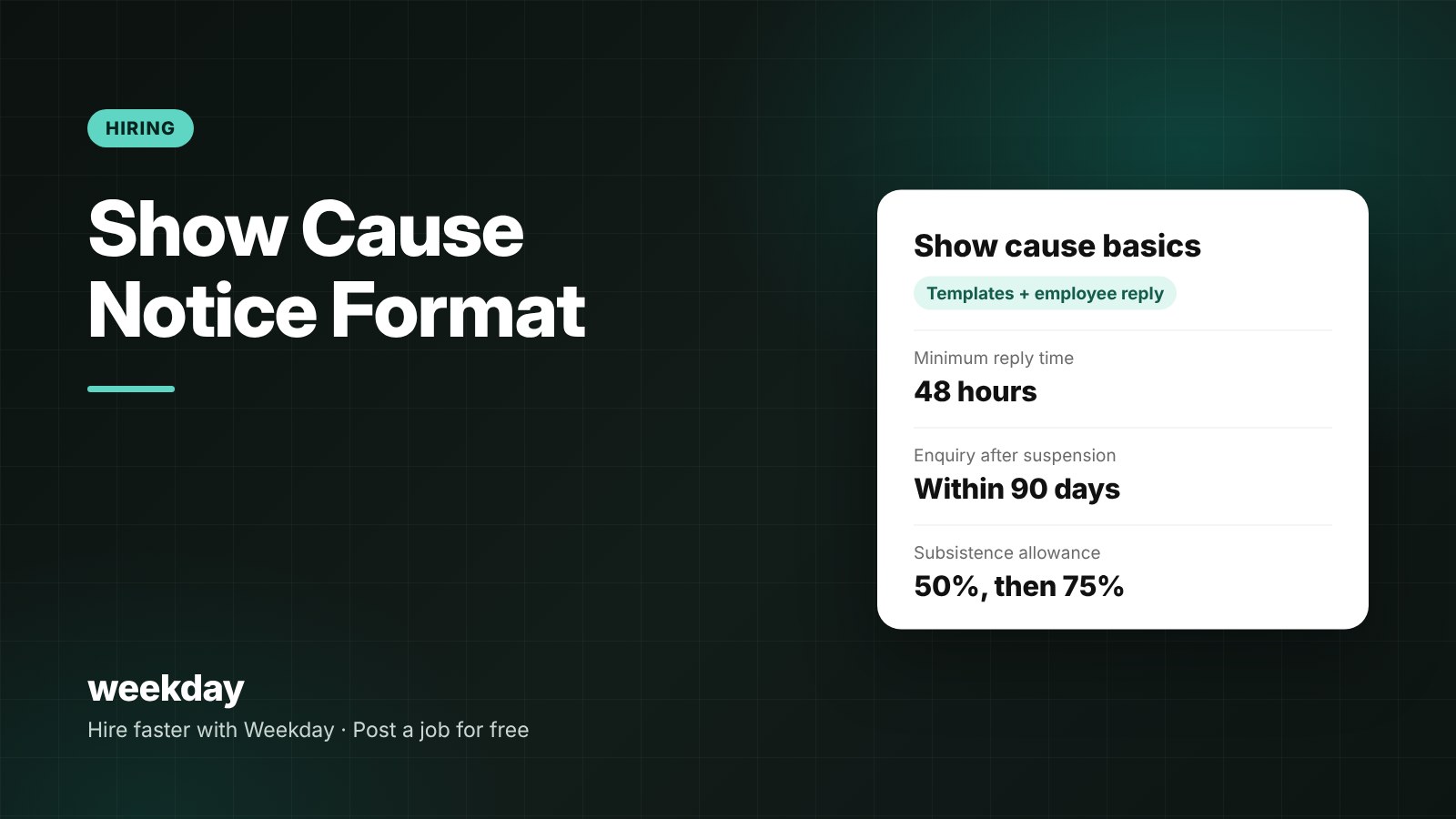
Quick answer: A show cause notice (SCN) tells an employee exactly what they're accused of and asks them to explain in writing why action shouldn't be taken. No single law fixes the reply time for private employers. Give "reasonable time": not less than 48 hours, as a People Matters guide on misconduct advises, and more for complex charges. For serious misconduct, the SCN leads to a charge sheet, an enquiry, a report and a reasoned order. Under the Model Standing Orders, 2026, an enquiry into a suspended worker should ordinarily finish within 90 days. Templates for the company and the employee are below.
A show cause notice is the step that makes a disciplinary decision fair and defensible. Skip it, and even a correct decision can fall apart if it's challenged. Use it well, and you'll often learn something that changes the decision.
Discipline and exits are a big worry for employees right now. In a Weekday analysis of 400 top Reddit posts from the last 30 days, layoffs, firing and buyouts was the biggest theme (67 posts, 20,387 comments). One r/IndianWorkplace thread (198 upvotes, 87 comments) came from a manager asking whether to fire a direct report after two outbursts in 10 days. That's exactly the moment for an SCN: put the facts in writing, hear the other side, then decide.
SCN vs warning letter vs charge sheet
| Document | Purpose | When to use | What comes next |
|---|---|---|---|
| Warning letter | Record a problem and ask for change | Minor or first-time issues | Review, then a final warning if needed |
| Show cause notice | Ask the employee to explain before you act | Serious issues, or after warnings fail | Close it, warn, or issue a charge sheet |
| Charge sheet | Formal list of charges that starts an enquiry | When the SCN reply isn't satisfactory | Domestic enquiry |
| Second show cause notice | Share the enquiry report and proposed penalty | After the charges are proved | Final order, then appeal |
For smaller matters, one combined "show cause notice cum charge sheet" is common.
How much time to give for a reply
There's no fixed number in law for most private companies. Your standing orders or HR policy should set one. Courts look at whether the time was reasonable for the charge. Here's what we suggest:
| Type of issue | Suggested reply window | Why |
|---|---|---|
| Simple facts (absence, one missed deadline) | 48 to 72 hours | The employee knows the facts already |
| Behaviour or conduct complaint | 3 to 5 working days | They may want to name witnesses |
| Fraud, data or money issues | 5 to 7 working days, plus document access | They need time to check records |
If they ask for more time with a fair reason, give it once. Send one reminder if there's no reply. You don't have to wait forever (Taxmann).
The process, step by step
This is the standard domestic enquiry route, based on the rules of natural justice (Taxmann). Check with your HR or a lawyer for your specific case.
- Preliminary check. Is there enough material to act? Collect emails, logs, CCTV, statements.
- Show cause notice. Specific charge, documents, reply deadline.
- Consider the reply. Close it, warn, or move to a charge sheet.
- Charge sheet and enquiry officer. Pick someone neutral, not the complainant or their manager.
- Hearing. The employee can see the evidence, question witnesses and bring their own.
- Report. Findings with reasons: proved or not proved. No punishment recommended.
- Second notice. Share the report and the proposed penalty, and ask for a response.
- Final order and appeal. A reasoned order. The Model Standing Orders, 2026 allow an appeal within 21 days (JSA).
Suspension. For establishments under standing orders (300+ workers), a suspended worker's enquiry should ordinarily finish within 90 days. Subsistence allowance is 50% of wages for the first 90 days and 75% after that, if the delay isn't the worker's fault (JSA).
Show cause notice templates
Add your letterhead, date, reference number and the employee's details on top. Fill in the [brackets].
1. General show cause notice
2. Show cause notice for unauthorised absence
3. Show cause notice with suspension
4. Second show cause notice (proposed penalty)
5. Reply to a show cause notice (employee side)
If you're the employee: stick to facts, attach proof, keep a copy, and reply before the deadline. If you need more time, ask in writing before it runs out.
Mistakes that sink a show cause notice
A good notice gives reasonable time, includes or points to the relevant material, states the possible consequences and invites an explanation (Mondaq). Most failures break one of these.
- Deciding before the reply. If the notice already says "you are terminated", it isn't a show cause notice.
- Vague charges. "Unprofessional behaviour" isn't a charge. Dates, actions and documents are.
- Hiding evidence. Share what you'll rely on, or offer to show it.
- Unreasonably short deadlines. Same-day replies for complex charges invite a challenge.
- A biased enquiry officer. The complainant's manager shouldn't run it.
Once a decision is made, use our termination letter templates or, for smaller issues, a written warning. For exits, plan the full and final settlement in advance.
Hiring to fill a gap after an exit?
Post the role for free. Weekday's AI agents find matching candidates and reach out for you, so the team isn't stretched for months.
Frequently asked questions
What is a show cause notice?
A written notice that tells an employee what they're accused of, shares the supporting documents, and asks them to explain why disciplinary action shouldn't be taken.
How many days are given to reply to a show cause notice?
No law fixes it for most private employers. Give reasonable time, not less than 48 hours, and 5 to 7 working days for complex charges. Your standing orders or policy should set the number.
What happens if the employee doesn't reply?
Send one reminder. If there's still no reply, you can proceed on the records you have, and note that the employee was given a chance to respond.
Can an employee be suspended during an enquiry?
Yes. Under the Model Standing Orders, 2026, the enquiry should ordinarily finish within 90 days of suspension, with subsistence allowance at 50% of wages for the first 90 days and 75% after that if the delay isn't the worker's fault.
Is a show cause notice needed before termination?
For misconduct, yes in practice. Courts expect the employee to know the charge and have a fair chance to reply. Retrenchment and contract expiry follow different rules.
Sources
- Weekday analysis of 400 top Reddit posts, 420 LinkedIn posts and 400 X posts from the last 30 days (Nov 2026)
- r/IndianWorkplace: Two aggressive outbursts in 10 days
- People Matters: Handling misconduct by employees at the workplace
- Taxmann: Domestic enquiry in labour law
- JSA: Model Standing Orders, 2026
- Mondaq: Drafting show cause notices and charge sheets





