Last updated: 17 November 2026
- What SAP is and who uses it
- The main SAP modules, in plain words
- Which module suits which degree
- Course and certification: the honest picture
- Typical pay and the consultant ladder
- 10 SAP interview questions with sample answers
- Resume bullets and placement scams
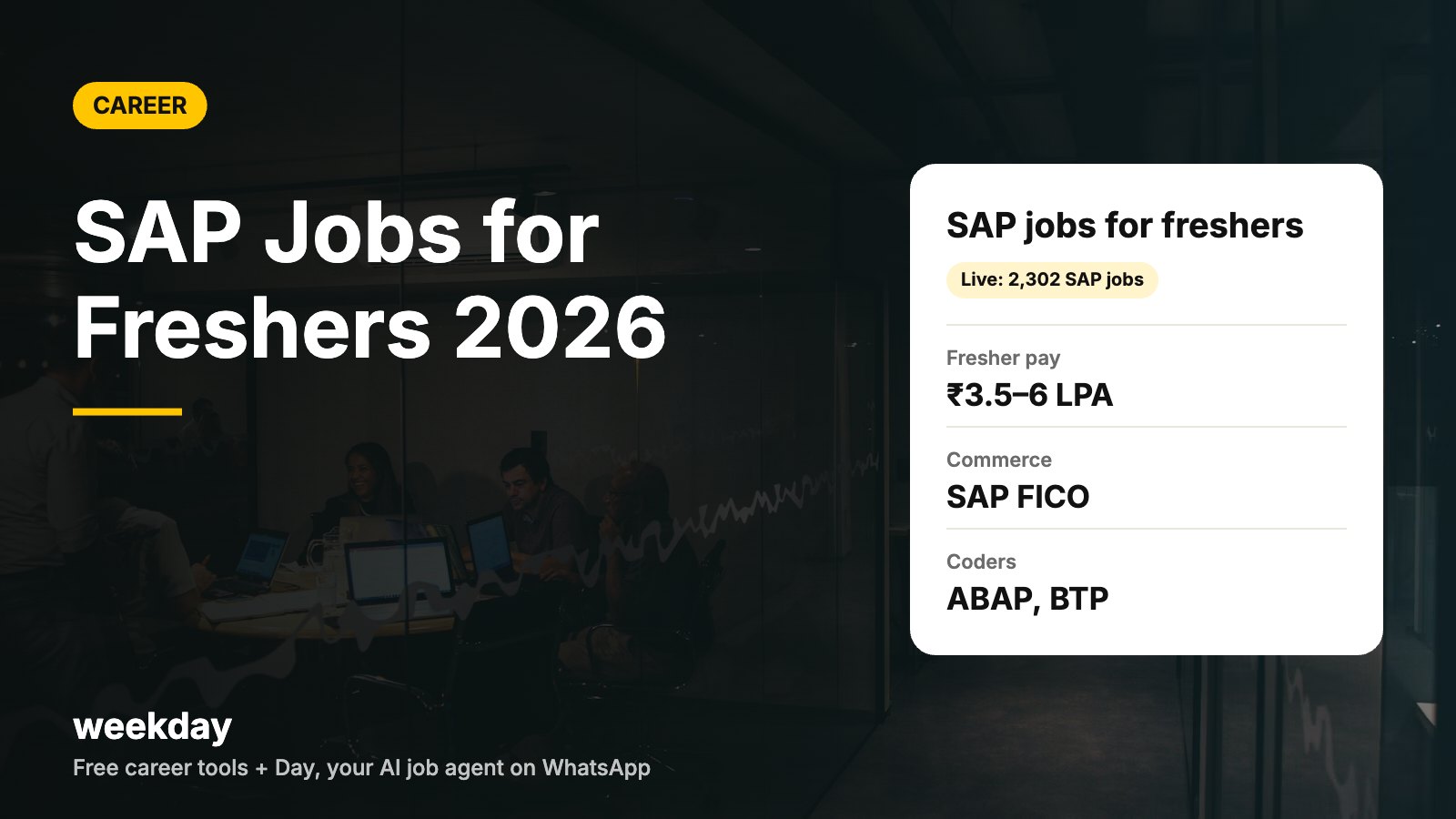
- SAP jobs: 2,302 open, 490 new this week
- Remote SAP jobs: 1,549 open, 278 new this week
Sources: Weekday job listings (jobs posted in the last 30 days), counted on 17 November 2026. Pay ranges are indicative, based on typical Indian listings.
- Open ChatGPT and go to Plugins.
- Search Weekday Jobs and tap Try in chat (or open Weekday Jobs in ChatGPT).
- Ask in plain words, for example:
- “Find SAP jobs for freshers or 0–1 years of experience posted this week”
- “Show SAP FICO or SAP MM associate consultant jobs in Bengaluru, Pune or Hyderabad”
- “List remote SAP ABAP or SAP support jobs, sorted by pay”
Day, Weekday's free AI job agent, finds jobs that match your skills and pay, and applies when you say yes. On WhatsApp.
Say hi to Day on WhatsAppHow Day works →What is SAP, and why are there so many SAP jobs?
SAP is a German company whose ERP (enterprise resource planning) software runs core processes for many of the world's large companies: accounting, buying, selling, stock, manufacturing and HR. Inside one system, a sales order can trigger stock movement, an invoice and an accounting entry automatically.
Because the software is large and every company configures it differently, businesses need people who understand both the business process and the system. Those people are SAP consultants. India has a big SAP workforce because many global IT services firms and in-house global capability centres run SAP projects and support from Indian cities.
Most SAP work today is moving from the older ECC system to S/4HANA, SAP's newer ERP. These migrations create steady demand for people who know both.
The main SAP modules, explained simply
| Module | What it covers | Typical work |
|---|---|---|
| FICO (Finance and Controlling) | General ledger, payables, receivables, assets, cost centres, profit centres | Configure accounting rules, fix posting issues, support month-end close |
| MM (Materials Management) | Purchasing, vendors, inventory, goods receipt, invoice verification | Set up purchase processes, solve stock and vendor issues |
| SD (Sales and Distribution) | Quotes, sales orders, pricing, delivery, billing | Configure pricing and order flows, fix billing errors |
| ABAP | SAP's programming language | Write reports, interfaces, enhancements and forms |
| HCM / SuccessFactors | HR: employee data, payroll, hiring, performance. SuccessFactors is SAP's cloud HR suite | Configure HR processes, support payroll and talent modules |
| S/4HANA | SAP's current ERP suite that the modules above now run on | Migration and implementation projects |
| BTP (Business Technology Platform) | SAP's cloud platform for building apps, integrations and extensions | Integration, low-code apps, cloud development |
This is a general overview. Module scope and names change over time; check SAP's official learning site for current details.
Which module suits which degree?
| Your background | Best-fit module(s) | Why |
|---|---|---|
| B.Com, M.Com, BBA Finance, CA Inter, MBA Finance | FICO | You already know debits, credits, ledgers and costing |
| MBA Operations, B.Tech Mechanical/Industrial, supply chain roles | MM, sometimes PP (production planning) | Purchasing and inventory logic will feel familiar |
| MBA Marketing, BBA, sales experience | SD | Pricing, orders and billing match what you studied or did |
| B.Tech/BCA/MCA with coding skills | ABAP, BTP | Technical roles reward programming logic |
| MBA HR, HR executives | SuccessFactors / HCM | HR process knowledge is the main skill |
| Working professional in accounts, purchase or sales who uses SAP daily | The module you already use | Your end-user experience is a real advantage |
A simple rule: choose the module where your existing knowledge gives you a head start. Learning SAP screens is the easy part; understanding the business process behind them is what makes you useful.
SAP course and certification: the honest picture
SAP offers official training and certification exams through its own learning platform. A certification can help your resume get past a screen, especially as a fresher. But it is not a job guarantee, and many employers hire freshers through campus programmes and train them on SAP after joining.
| Route | Roughly what it involves | Good to know |
|---|---|---|
| Campus hiring into IT services | Get hired as a graduate trainee; the company trains you and may place you on SAP | Most common fresher route; you may not get to choose SAP or the module |
| Official SAP learning and certification | Self-study or instructor courses, then a proctored exam | Check current pricing and exam availability on SAP's site; prices change |
| Private training institutes | 4–12 week courses, often with practice system access | Quality varies a lot; fees can be high |
| End-user to consultant | Use SAP in finance, purchase or sales jobs for 1–3 years, then switch | Often the most reliable path for non-engineers |
Warning about 'guaranteed placement' SAP courses. Some institutes charge ₹50,000 to ₹2,00,000 or more and promise a job after training. Before paying, ask for a written refund policy, names of companies that hired last batch, and speak to two or three alumni you find yourself on LinkedIn. Be very cautious of anyone offering to add 'fake experience' to your resume; background checks usually catch it and it can cost you the job later. No genuine employer asks you to pay for a job.
Day-to-day work of a junior SAP consultant
| Task | Example |
|---|---|
| Support tickets | A user can't post an invoice; you find the missing configuration and fix it |
| Testing | Run test scripts before a new process goes live |
| Documentation | Write functional specs and user guides |
| Configuration | Set up a new company code, pricing condition or purchase document type under guidance |
| User training | Show a team how to use a new screen |
Typical pay and the consultant ladder
| Level | Experience | Typical pay (India) | Focus |
|---|---|---|---|
| Trainee / Associate Consultant | 0–2 years | ₹3.5–6 LPA | Support tickets, testing, documentation |
| SAP Consultant | 2–5 years | ₹6–12 LPA | Configuration, small implementations |
| Senior Consultant | 5–8 years | ₹12–22 LPA | Lead a module on projects, client workshops |
| Lead / Solution Architect | 8–12 years | ₹20–35 LPA | Design across modules, S/4HANA migrations |
| Project / Delivery Manager | 12+ years | ₹30 LPA and above | Budgets, teams, client relationships |
Ranges are indicative and vary by module, company and city. S/4HANA, BTP and integration skills often command more.
Worked example: a realistic first three years
Commerce graduate, campus hire into IT services: ₹4 LPA
Year 2: moved to SAP FICO support, ₹5.2 LPA after appraisal
Year 3: switched to an S/4HANA project at another firm as consultant, ₹8.5 LPA (≈63% jump)

The big jumps usually come from switching with real project experience, not from courses.
How freshers break in
- Choose one module using the table above. Don't try to learn three at once.
- Learn the business process first: for FICO, the procure-to-pay and order-to-cash flows; for MM, purchasing; for SD, order to billing.
- Use SAP's free learning content and practice systems where available, and consider an official certification once you're sure of the module.
- Apply to graduate trainee roles at IT services companies, SAP support roles, and end-user roles in accounts or purchase that use SAP daily.
- On LinkedIn, write your module in your headline, e.g. 'SAP FICO fresher | B.Com | Procure-to-pay'.
10 SAP interview questions, with sample answers
Answers 1–5
1) What is SAP ERP?
Software that connects a company's core processes, such as finance, purchasing, sales and HR, in one system so data flows between them automatically.

2) What is the difference between ECC and S/4HANA?
ECC is SAP's older ERP. S/4HANA is the newer suite built on the HANA in-memory database, with simpler data models and a modern Fiori interface.

3) Explain procure-to-pay.
Purchase requisition → purchase order → goods receipt → invoice verification → payment to vendor.

4) Explain order-to-cash.
Inquiry or quote → sales order → delivery → billing → customer payment.

5) (FICO) What is a company code?
The smallest unit for which a complete set of accounts can be drawn up for legal reporting.
Answers 6–10
6) (FICO) Cost centre vs profit centre?
A cost centre tracks where costs happen, like an HR department. A profit centre tracks both revenue and costs for a part of the business, like a product line.

7) (MM) What is a three-way match?
Checking the purchase order, goods receipt and vendor invoice agree before payment.

8) (ABAP) What is a BAPI?
A standard SAP interface that lets programs read or write business data safely.

9) Why SAP, and why this module?
[Commerce fresher] I studied accounting for three years, and FICO lets me apply that inside a system used by large companies. I like seeing how one sales order becomes an accounting entry.

10) A user says an invoice won't post. How would you start?
Read the exact error message, check the document and the relevant configuration, try to reproduce it in a test system, and document the fix so it doesn't repeat.
Sample resume bullets
Copy-ready resume bullets (use real details only)
Fresher
• Completed SAP FICO training covering GL, AP, AR and asset accounting; configured a test company code end to end
• Mapped the procure-to-pay process for a college project on a manufacturing firm's purchase cycle
• B.Com (2026), 78%; strong Excel (VLOOKUP, pivot tables)

Experienced
• Resolved 300+ SAP FICO support tickets within SLA over 18 months
• Configured new tax codes and payment terms for an S/4HANA rollout across 3 company codes
• Wrote 12 functional specs for custom reports with the ABAP team
See more ways to present your skills in our skills for resume guide, and if you want openings matched to you, Day, Weekday’s AI job agent can apply when you approve.
FAQs
Can a fresher get an SAP job?
Yes, mainly through graduate trainee programmes at IT services firms, SAP support roles, and end-user jobs in finance, purchase or sales that use SAP. Freshers usually start in support and testing.
Which SAP module is best for freshers?
The one that matches your degree: FICO for commerce, MM or SD for operations and sales, ABAP or BTP for programmers, and SuccessFactors for HR graduates.
What is the salary of an SAP fresher in India?
Usually around ₹3.5–6 LPA. Pay depends on the company, module and city. Technical and S/4HANA skills often lead to faster raises.
Is SAP certification worth it for a fresher?
It can help your resume stand out, but it is not a job guarantee. Many employers hire on aptitude and train you. Check SAP's official site for current exam details and costs.
Is an SAP course with placement guarantee genuine?
Be cautious. Ask for a written refund policy and named past placements, and talk to alumni yourself. Never pay anyone to get you a job, and never add fake experience to your resume.
Can a non-IT graduate do SAP?
Yes. Functional modules like FICO, MM, SD and SuccessFactors suit commerce, management and HR graduates. Coding is needed mainly for ABAP and some BTP roles.
What is SAP S/4HANA?
SAP's current ERP suite, running on the HANA database. Many companies are migrating to it from the older ECC system, which creates steady demand for consultants.
Are there remote SAP jobs?
Yes. On 17 November 2026, Weekday listed 1,549 remote SAP jobs, mostly for people with some experience.
How many SAP jobs are live on Weekday?
On 17 November 2026, 2,302 SAP jobs were live on Weekday, with 490 new that week.