Last updated: 17 November 2026
- What a manual tester does all day
- SDLC and STLC in plain words
- A sample test case table and bug report
- Tools: bug trackers, test management, Postman
- Pay, and the route from manual to automation
- 10 interview answers, resume bullets and scams
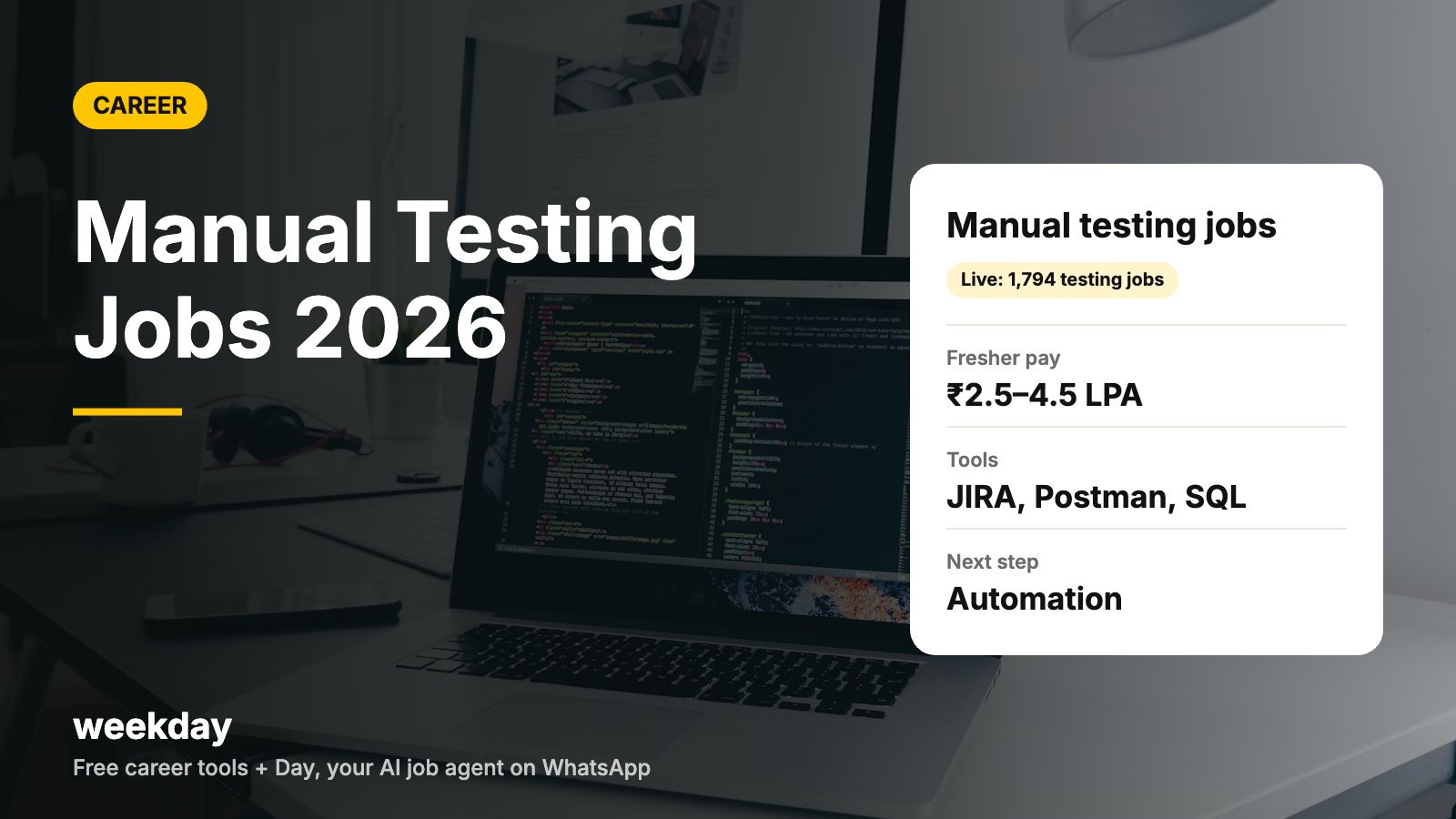
- Software testing jobs (manual, automation, QA): 1,794 open, 452 new this week
- Remote software testing jobs: 921 open, 212 new this week
- Related: SAP jobs for freshers (SAP functional roles often need testing skills too)
Sources: Weekday job listings (jobs posted in the last 30 days), counted on 17 November 2026. Pay ranges are indicative, based on typical Indian listings.
- Open ChatGPT and go to Plugins.
- Search Weekday Jobs and tap Try in chat (or open Weekday Jobs in ChatGPT).
- Ask in plain words, for example:
- “Find manual testing or QA jobs for freshers posted this week in Pune, Bengaluru or Hyderabad”
- “Show remote software testing jobs that ask for API testing with Postman, 0–2 years experience”
- “List QA engineer jobs moving from manual to automation, sorted by pay”
Day, Weekday's free AI job agent, finds jobs that match your skills and pay, and applies when you say yes. On WhatsApp.
Say hi to Day on WhatsAppHow Day works →What does a manual tester do?
A manual tester uses the product the way a real user would, and a few ways a real user should not, to find problems before customers do. You read the requirement, decide what to test, write test cases, run them on the build, log bugs, and re-test once developers fix them. You do not need to write code for most manual testing work, but you must think clearly and write precisely.
A typical day: a stand-up meeting with developers, re-testing yesterday's fixed bugs, running test cases on today's build, logging new bugs with screenshots, and updating the test status for the release. Before a release you run regression testing, checking that old features still work after new changes.
| Testing type | What it checks | Example |
|---|---|---|
| Functional testing | Each feature works as the requirement says | Login works with a valid email and password |
| Smoke testing | The build is stable enough to test at all | App opens, login and home page load |
| Regression testing | Old features still work after a change | Payment still works after a new coupon feature |
| UI / usability testing | Layout, text, buttons and flows make sense | Error message is readable on a small phone |
| API testing | Back-end requests return the right data and status codes | GET /orders returns 200 and the right order list |
| UAT support | Business users confirm it meets their need | Finance team signs off the invoice screen |
SDLC and STLC in plain words
SDLC (Software Development Life Cycle) is how the whole product gets built. STLC (Software Testing Life Cycle) is the testing team's part of it.
| STLC phase | What the tester does | Output |
|---|---|---|
| Requirement analysis | Read the requirement, ask questions, find what is testable | List of doubts, testable points |
| Test planning | Decide scope, approach, environments, timelines, risks | Test plan |
| Test case design | Write step-by-step test cases with expected results | Test cases, test data |
| Environment setup | Check the test server, devices, accounts and data are ready | Ready environment |
| Test execution | Run cases, mark pass or fail, log bugs | Execution report, bug reports |
| Test closure | Summarise coverage, open bugs, lessons | Test summary report |
In Agile teams these phases happen inside every two-week sprint rather than once per project. Say that in interviews: it shows you know how real teams work.
Sample test case table
A good test case is specific enough that another tester can run it and get the same result. Here are five cases for a login screen.
| ID | Scenario | Steps | Test data | Expected result |
|---|---|---|---|---|
| TC_LOGIN_01 | Valid login | Open app → enter email and password → tap Login | user@test.com / Valid@123 | Home page opens; user name shown |
| TC_LOGIN_02 | Wrong password | Enter valid email, wrong password → Login | user@test.com / wrong1 | Error: “Incorrect email or password”; stays on login page |
| TC_LOGIN_03 | Empty fields | Leave both blank → Login | — | Login button disabled or both fields show “Required” |
| TC_LOGIN_04 | Account lock | Enter wrong password 5 times | user@test.com / wrong1 ×5 | Account locked message; unlock link sent to email |
| TC_LOGIN_05 | Password masking | Type password | Valid@123 | Characters shown as dots; eye icon toggles view |
Add columns for actual result, status (pass/fail/blocked) and bug ID when you execute. Use boundary values and equivalence classes to choose test data: if a field accepts 6–20 characters, test 5, 6, 20 and 21.
Sample bug report
Copy-ready bug report format
Bug ID: BUG-1042
Title: App crashes when applying coupon on cart with 1 item (Android)
Environment: Android 14, app build 3.8.2 (staging), Wi-Fi
Severity: High (crash, blocks purchase)
Priority: P1 (sale starts Friday)

Steps to reproduce:
1. Log in as user@test.com
2. Add any one item to cart
3. Open cart and enter coupon SAVE10
4. Tap Apply

Expected: 10% discount applied, cart total updated
Actual: App closes immediately; reopening shows the cart without the coupon
Reproducible: 5 out of 5 times; does not happen with 2+ items
Attachments: screen recording, crash log
Assigned to: Cart module developer
Severity is how bad the impact is. Priority is how soon it must be fixed. A spelling mistake in the company name on the home page is low severity but high priority. Interviewers love this example.
Tools you will use
| Tool type | What it does | What to learn |
|---|---|---|
| Bug and task tracker (JIRA is the most common) | Logging bugs, tracking sprint tasks, workflows | Create a bug, link it to a story, move it through statuses, filter your bugs |
| Test management tool (TestRail-style tools, or JIRA add-ons) | Storing test cases, test runs and results | Write a suite, run it, read the run report |
| Postman (API testing) | Sending requests to APIs and checking responses | GET/POST requests, status codes, JSON body, simple tests on the response |
| Browser developer tools | Seeing network calls and console errors | Check a failed request and attach it to a bug |
| SQL basics | Checking the data saved in the database | SELECT with WHERE and JOIN |
| Spreadsheets | Test data, quick reports | Filters, pivot tables, VLOOKUP or XLOOKUP |
Many companies give free or trial versions of these tools for learning. Practise on a public demo site or any open app: write 30 test cases, log 10 bugs in a free tracker, and test a public API in Postman. That small project is worth more than a certificate.
Pay and the route from manual to automation
| Role | Typical experience | Typical pay (India) |
|---|---|---|
| QA / test engineer (manual) | 0–2 years | ₹2.5–4.5 LPA |
| QA engineer (manual + API) | 1–3 years | ₹4–7 LPA |
| Automation test engineer (Selenium, Playwright, API automation) | 1–4 years | ₹5–10 LPA |
| SDET / senior QA | 4–7 years | ₹10–20 LPA |
| QA lead / manager | 7+ years | ₹15–30 LPA |
Pay ranges are indicative, based on typical Indian listings in 2026. Product companies usually pay more than service companies at the same level.
The usual path: learn manual testing and API testing first, then one programming language (Java or Python are most common in Indian QA jobs, JavaScript for Playwright), then one automation framework, then version control and running tests in a CI pipeline. Many testers do this in 12–18 months while working. Pure manual roles still exist, especially in banking, insurance, SAP and domain-heavy projects, but most job posts now ask for at least some automation or API skill.
Worked example: why automation matters for pay
Fresher manual QA offer: ₹3.6 LPA → in-hand about ₹28,000/month
After 18 months, switch to automation role at ₹6.5 LPA → in-hand roughly ₹49,000–₹52,000/month
That is an ~80% jump in CTC, typical of what a move to automation can bring, though it varies a lot by company.
10 manual testing interview questions, with answers
Answers 1–5
1) What is the difference between verification and validation?
Verification checks we are building the product right (reviews of documents and designs). Validation checks we built the right product (actually testing the software against user needs).

2) Severity vs priority?
Severity is impact; priority is urgency. A crash in a rarely used admin report is high severity, low priority. A typo in the brand name on the home page is low severity, high priority.

3) What is regression testing?
Re-testing existing features after a change to make sure nothing else broke. It is the best candidate for automation because it repeats every release.

4) What is the bug life cycle?
New → Assigned → Open → Fixed → Retest → Closed. It can also go to Reopened, Rejected, Duplicate or Deferred.

5) What is boundary value analysis?
Testing at the edges of valid input. If age must be 18–60, I test 17, 18, 60 and 61, because bugs cluster at boundaries.
Answers 6–10
6) Smoke vs sanity testing?
Smoke is a quick broad check that a new build is stable enough to test. Sanity is a narrow check that a specific fix or feature works before deeper testing.

7) What would you do if a developer says your bug is not a bug?
I re-check it against the requirement, share steps, a recording and logs, and if we still disagree, I ask the product owner to decide. I keep it about the product, not the person.

8) How do you test an API with Postman?
Send the request with the right method, headers and body; check the status code, response time and the JSON fields; then test negatives such as a missing token, which should return 401.

9) Write test scenarios for a pen.
Functional: it writes, ink flows evenly, cap fits. Usability: grip comfort. Durability: drop from desk height. Negative: writing on wet paper. Then I ask what the pen is for, because requirements decide the priority.

10) Why manual testing, and what next?
Manual testing teaches me how users and products behave. I am already learning API testing and Java basics, and my goal is to automate regression suites within a year.
Resume bullets for testers
Copy-ready resume bullets for a QA fresher (use your real numbers)
• Wrote 120+ test cases for login, cart and payment flows of a demo e-commerce site; found 34 bugs, 9 of them high severity.
• Tested 15 public API endpoints in Postman, covering status codes, schema checks and negative cases.
• Logged and tracked bugs in JIRA with steps, recordings and logs; 90% were accepted without clarification.
• Ran regression suites across 3 browsers and 2 Android versions before each sprint demo.
• Wrote basic SQL queries to verify order data after checkout tests.
Most testing jobs are filtered by an applicant tracking system first, so mirror the job's words (manual testing, test cases, JIRA, API testing, SQL). Our guide on what an ATS resume is explains the format, and the HR interview questions guide covers the non-technical round.
Scams to avoid
Software testing attracts two common traps. First, “training with 100% placement” institutes that charge ₹30,000 to ₹1,50,000 and then hand you a list of walk-ins. Second, “backdoor entry” or “job guarantee” offers where someone asks for money to place you in a known IT company, sometimes with fake offer letters. Real companies never charge for a job, an interview or an offer letter.
| Sign | Genuine | Red flag |
|---|---|---|
| Money | No fee to apply or join | Fee for interview, ‘processing’, laptop or ‘background check’ |
| Offer letter | Sent from the company's own email domain after interviews | Offer with no technical round, from a free email address |
| Training | Paid course is your choice; outcomes and past students are verifiable | ‘Guaranteed job’ or ‘backdoor’ placement for a fee |
Verify any offer by calling the company's official number from its website. If you want genuine openings sent to you, Day, Weekday’s AI job agent matches you to live testing roles and applies only when you say yes.
FAQs
What is the salary of a manual tester fresher in India?
Fresher manual testers usually earn around ₹2.5–4.5 LPA. Adding API testing and automation skills usually raises pay to around ₹5–10 LPA within a few years.
Can a non-IT graduate get a manual testing job?
Yes. B.Com, B.Sc and BA graduates do get testing jobs, especially in banking, insurance and domain-heavy projects. Clear logic, good written English and a small practice project help.
Is manual testing still a good career in 2026?
It is a good entry point, but most job posts now also ask for API testing or some automation. Plan to learn automation within 12–18 months.
What is the difference between SDLC and STLC?
SDLC covers building the whole product, from requirements to release. STLC is the testing part: requirement analysis, test planning, test case design, environment setup, execution and closure.
Which tools should a fresher tester learn?
A bug tracker such as JIRA, a test management tool, Postman for API testing, browser developer tools, basic SQL and spreadsheets.
Do I need ISTQB certification?
It is not mandatory. Some employers like it because it shows you know standard terms, but a practice project with real test cases and bug reports usually matters more.
Are software testing jobs available remotely?
Yes. On 17 November 2026, 921 of the 1,794 software testing jobs live on Weekday were remote.
What is the difference between severity and priority?
Severity is how badly a bug affects the product. Priority is how urgently it must be fixed. They are set separately.
How many software testing jobs are live on Weekday?
On 17 November 2026, 1,794 software testing jobs were live on Weekday, with 452 new that week.