Last updated: 9 November 2026
- What the HR round really checks
- 30 questions with sample answers, in 5 groups
- How HR scores your answers
- 30-second vs 2-minute answers
- Follow-up questions to expect
- Mistakes and fixes
- A Hinglish sample answer
- The HR round is often the last round, but at many Indian companies it's also the first phone screen.
- Typical length: 20–40 minutes.
- Notice periods of 30–90 days are common in India; many IT companies use 60–90 days.
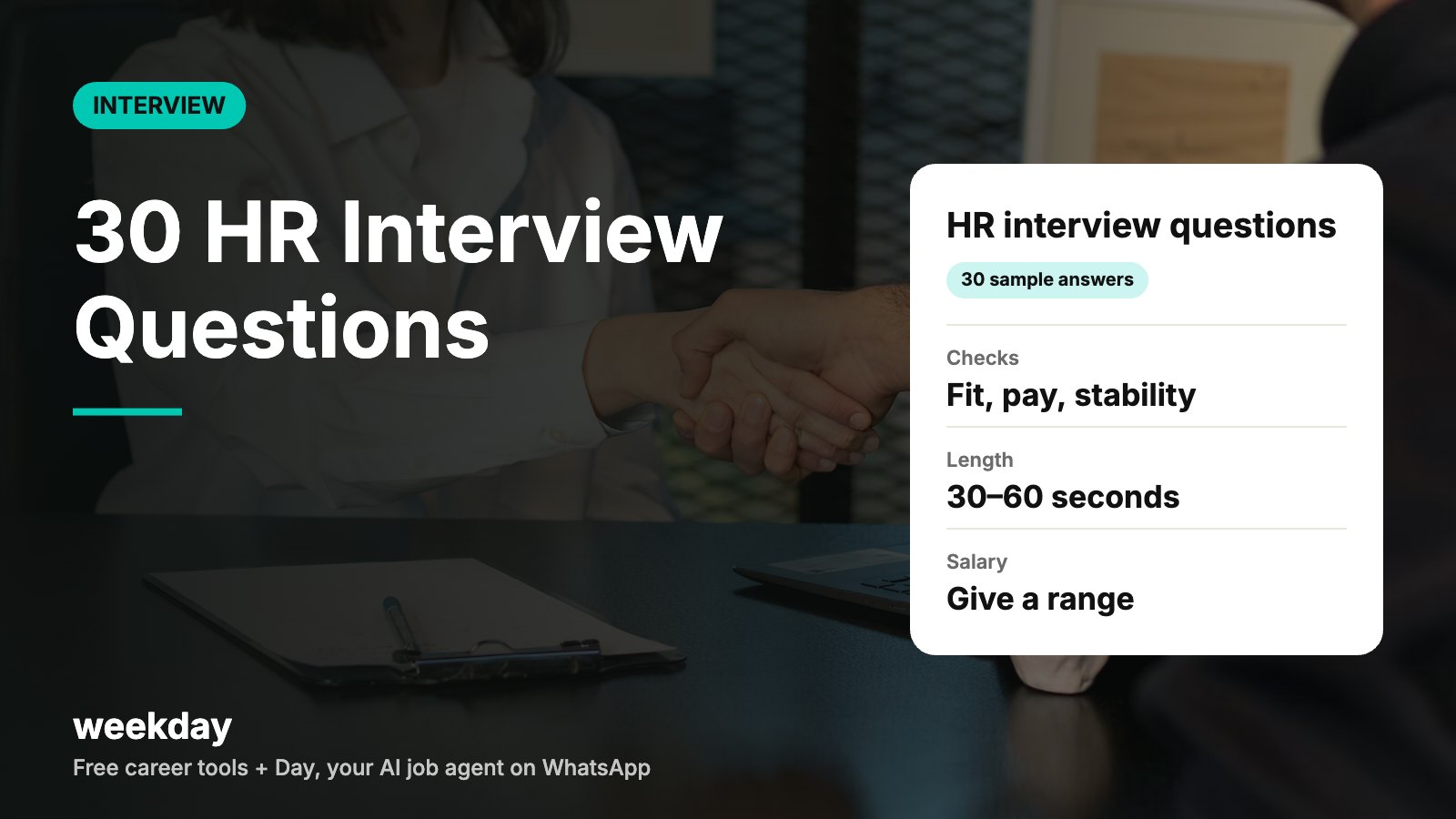
- A typical HR question takes 30–60 seconds to answer, about 70–150 words at a normal speaking pace.
Sources: Common hiring practice at Indian companies; typical conversational speaking rates.
Day, Weekday's free AI job agent, finds jobs that match your skills and pay, and applies when you say yes. On WhatsApp.
Say hi to Day on WhatsAppHow Day works →What the HR round really checks
| What HR is checking | Questions that test it |
|---|---|
| Fit with team and company | Tell me about yourself, why us, what motivates you |
| Stability | Why leaving, job changes, gaps |
| Pay and timing | Salary expectations, current CTC, notice period, other offers |
| Availability | Relocation, shifts, travel |
| Behaviour | Conflict, failure, pressure, criticism |
Group 1: About you
These open most HR rounds. For longer answers, see our guides to tell me about yourself, introducing yourself, why you want to join, why should we hire you, strengths and weaknesses and where you see yourself in 5 years.
1. Tell me about yourself. (Fresher)
I'm Priya, a B.Tech CSE graduate from SRM with an 8.4 CGPA. I built a library API now used by 3,000 students and interned at a fintech startup writing test cases. I want to start my career in backend development, which is what this role is about.
2. Why do you want to join our company? (Sales)
Two reasons. You're growing your payments business in tier-2 cities, which is where I've done most of my sales. And your team promotes from within; two of your area managers started as executives.
3. Why should we hire you? (Finance)
You need someone who can run month-end close without hand-holding. I've done it for three entities for four years and cut our close from 9 days to 6. I can do the same here from the first quarter.
4. What are your strengths? (Operations)
Planning under pressure. At my dark stores I redesigned picking routes and brought order-to-dispatch time from 9 minutes to 6 during the festive peak.
5. What is your biggest weakness?
I used to say yes to every request and end up late on my own work. Now I block two hours a day for priority tasks and tell people when I can actually help. My missed deadlines dropped to almost zero last quarter.
6. Where do you see yourself in five years? (Career switcher)
Leading a small product team and owning one area of the product end to end. First I want to get very strong at research and data here.
Group 2: Why you're moving
HR wants to know you're moving towards something, not running away. One honest reason, no complaints, and what you learnt.
7. Why are you leaving your current job? (IT)
I've learnt a lot in three years, and I've led two big releases. The next step for me is owning a larger system, and there isn't a role like that open on my team. This position offers exactly that.
8. Why did you leave your last job so soon?
The role turned out to be mostly data entry, not the analysis work in the job description. I gave it four months and spoke to my manager, but it couldn't change. I've learnt to ask sharper questions about the day-to-day before accepting.
9. Can you explain the gap in your resume? (Career gap)
I took 10 months off in 2025 to care for my mother after surgery. She's recovered well. During the break I completed an automation testing course and built a Selenium framework on GitHub. I'm ready to work full-time now.
10. Why are you changing careers? (Career switcher)
In support, I kept building Excel dashboards to find complaint patterns, and I enjoyed that more than the calls. I've since learnt SQL and Power BI and done two freelance projects. This analyst role lets me do that full-time.
11. Were you laid off?
Yes. In March my company cut 20% of the team when a funding round fell through. My manager has agreed to be a reference. I used the time to finish an AWS certification.
12. Why have you changed jobs three times in four years?
The first company shut down, and the second was a 1-year contract. My current role is the only one I chose to leave, after two years, to move into a bigger role. I'm looking for a place to stay for a long time.
Group 3: Salary, CTC and notice period
Do your homework first. Know your fixed and variable pay, and what the role pays in the market. Give a range, not one number.
Worked example: setting your salary range
Current fixed pay: ₹8,40,000
Market range for the role: ₹11–13 LPA
Your ask: ₹12–13 LPA (43–55% on fixed, but in line with the market)
Walk-away number: ₹11 LPA
13. What are your salary expectations? (IT)
Based on the role and market data for 4 years in backend roles in Pune, I'm looking at ₹16–18 LPA fixed. I'm flexible depending on the overall package and the work. What range have you set for this role?
14. What is your current CTC? (Sales)
My CTC is ₹9.6 LPA, of which ₹8.4 LPA is fixed and the rest variable. I'm happy to share my payslips at the offer stage.
15. Why are you asking for a 40% hike?
My current pay is below market because I joined as a fresher and the yearly hikes were small. For this role and my skills, ₹14 LPA is in line with what similar roles pay. I'd rather talk about the value of the role than the percentage.
16. Can you join with a lower salary?
I'm keen on this role, so I'm open to discussing it. Could we look at a joining bonus, or a salary review after six months based on agreed goals?
17. What is your notice period?
My notice period is 60 days. I'll request an early release and can probably join in 30–45 days. I can also offer to buy out part of it if needed.
18. Do you have other offers?
Yes, I have one offer and I'm in the final round with another company. This role is my first choice because of the team and the product, so I'd like to see if we can make it work.
More on this in how to negotiate salary and notice periods.
Group 4: Availability and behaviour
19. Are you willing to relocate? (Operations)
Yes. I've discussed it with my family and I'm ready to move to Hyderabad. If you offer relocation support, that would help with the first month.
20. Are you comfortable with night shifts or rotational shifts? (Customer support)
Yes. I've worked US shifts for a year in my current role. I'd just like to know the rotation pattern and whether cab facility is provided.
21. Are you okay with travel? (Sales)
Yes. In my current role I travel about 10 days a month across Gujarat. I'm comfortable with that level, or more if the role needs it.
22. Can you work under pressure? (Customer support)
Yes. During the Big Billion Days sale, our ticket volume tripled. I helped set up a shared FAQ sheet that let new agents close easy tickets faster, and we kept our CSAT above 4.5.
23. Tell me about a conflict with a colleague. (IT)
A designer and I disagreed on a checkout change. Instead of arguing in the meeting, I suggested we test both versions for a week. Hers won by 3%. We shipped it, and we've worked together well since.
24. Tell me about a failure. (Sales)
I once promised a client a delivery date before checking stock. We missed it by four days. I called the client myself, offered a discount and now confirm stock with the warehouse before giving any date.
Group 5: Attitude and closing
25. How do you handle criticism? (Finance)
I listen fully, ask for an example and fix it. My manager once said my reports were too long. I cut them to one page with a summary on top, and the CFO now reads them.
26. What motivates you? (Operations)
Seeing a number move because of something I did. When my store's on-time rate went from 82% to 95%, I was happier than on any bonus day.
27. How do you manage a team that is missing targets? (Experienced manager)
First I look at the data to see if it's the whole team or two people. Then I have one-to-ones, fix blockers and set weekly targets. In my last role, this took the team from 78% to 104% of target in two quarters.
28. What do you know about our company?
You started in 2018 as a B2B payments company, now serve about 40,000 merchants and launched lending last year. I also read your CEO's post about expanding to tier-3 towns, which is where I'd be working.
29. Do you have any questions for us?
Yes. What does success look like in the first 90 days? And what's the biggest challenge the team is facing right now?
30. Is there anything else you'd like us to know?
Only that I'm genuinely excited about this role. I've used your app for two years, and I'd love to help more small shops use it.
How HR scores your answers
| What they judge | Weak (1/5) | Strong (5/5) |
|---|---|---|
| Honesty | Vague or rehearsed-sounding | Clear, owns mistakes |
| Proof | Adjectives only | One example with a number |
| Attitude to past employers | Complains, blames | Neutral, focused on growth |
| Pay clarity | "Anything is fine" or a random figure | A researched range |
| Length | Over 2 minutes | 30–60 seconds |
30-second vs 2-minute answers
30-second version: why are you leaving?
I'm leaving because I want to own a bigger system. In three years I've led two major releases, and there's no larger role open on my team. This position gives me that.
For a 2-minute version, keep the same core and add a specific result ("our billing move cut deploys from two hours to 15 minutes"), what you'd like to learn next and why this company in particular. Use it only when the interviewer asks you to say more.
Follow-up questions to expect
| After you say… | HR may ask… |
|---|---|
| "I'm looking for growth" | "What does growth mean to you?" |
| A salary range | "What's the lowest you'd accept?" |
| "I can join in 30 days" | "What if your company doesn't release you early?" |
| A career gap | "How did you stay updated?" |
| "I have another offer" | "What would make you choose us?" |
Mistakes and fixes
| Mistake | Fix |
|---|---|
| Badmouthing your manager | Talk about what you want next |
| Lying about CTC | Companies often check payslips; be accurate |
| "I'll join immediately" when you can't | Give a realistic date |
| No questions at the end | Prepare two about the role or team |
| Memorised answers | Learn the points, not the sentences |
Hinglish sample: "Aap job kyun badalna chahte hain?"
Hinglish answer
Maine teen saal mein bahut kuch seekha hai aur do bade releases lead kiye hain. Ab main ek bade system ki poori zimmedari lena chahta hoon, lekin meri current team mein abhi aisa role khaali nahi hai. Yeh position mujhe wahi mauka deti hai.
Want the full Hinglish guide? Read interview kaise de.
FAQs
What are the most common HR interview questions?
Tell me about yourself, why do you want to join us, why are you leaving, salary expectations, notice period, strengths and weaknesses, and where you see yourself in five years.
How should I answer salary expectations in an HR interview?
Research the market, give a range based on the role (not just your current pay), and say you're flexible on the overall package.
How do I explain why I'm leaving my job?
Give one honest reason that points to what you want next, such as a bigger role or new skills. Don't criticise your employer.
How do I explain a career gap?
Say why in one line, what you did during the gap (courses, projects, freelance work) and that you're ready to work now.
What should I say about my notice period?
State it accurately, say you'll ask for an early release, and give a realistic joining date.
Is the HR round an elimination round?
Often yes. Candidates are dropped for unrealistic pay, long notice periods, poor attitude or red flags about stability.
How long is an HR interview?
Usually 20–40 minutes.
Should I tell HR about other offers?
Yes, honestly and politely. It can help speed things up, but don't use it as a threat.
What questions should I ask HR at the end?
Ask what success looks like in 90 days, the team's biggest challenge, and the next steps in the process.
Can I answer HR questions in Hindi?
If the interviewer is comfortable with it, yes. Keep the same structure: reason, example, link to the job.