Last updated: 5 November 2026
- What the interviewer is really checking
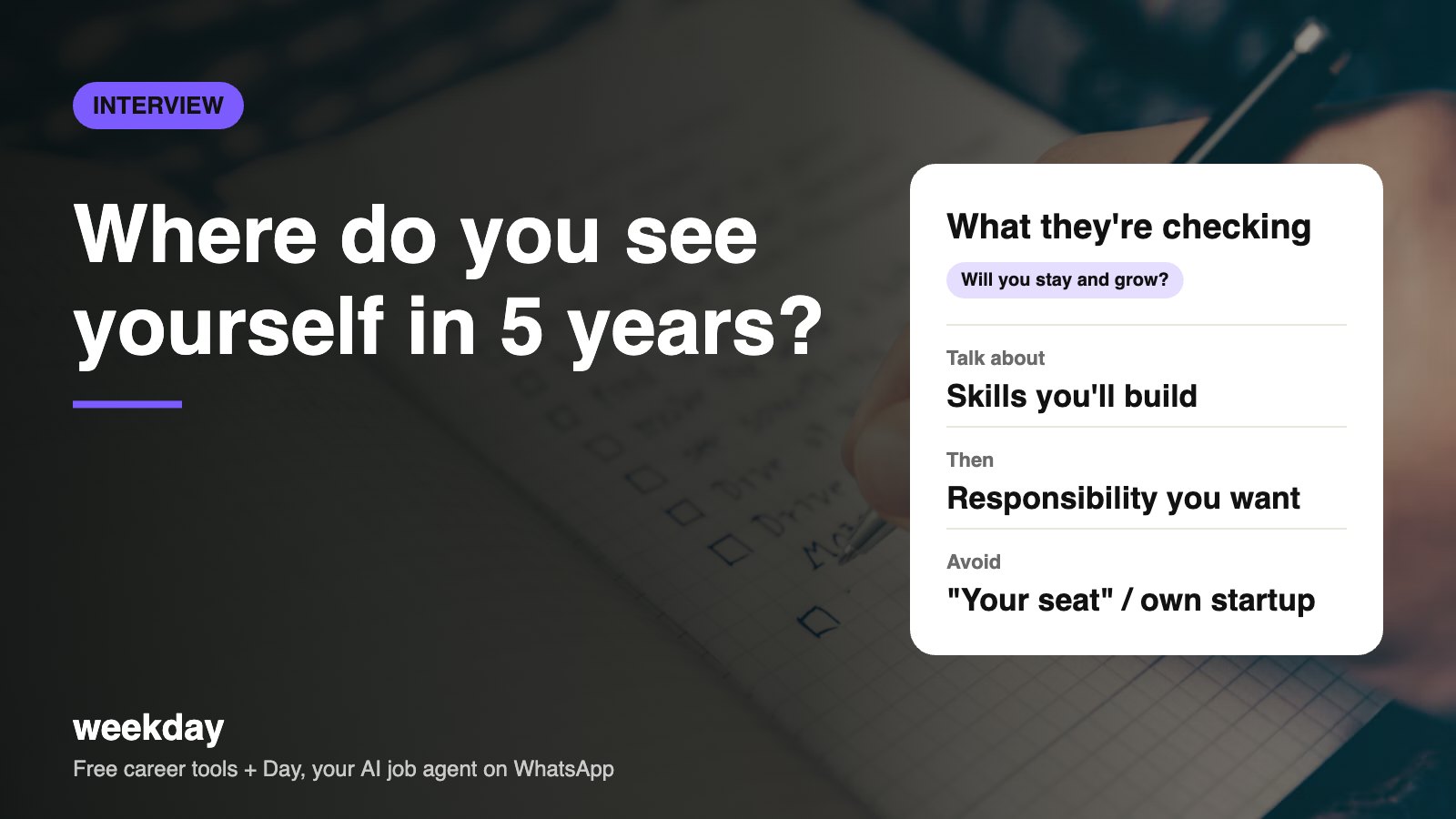
- The 3-part formula and a fill-in template
- A year-by-year 5-year plan you can defend
- Typical 5-year paths in Indian careers
- 12 sample answers by role
- 30-second and 2-minute versions
- Rubric, follow-ups, mistakes and a Hinglish sample
- Employers in the World Economic Forum's Future of Jobs Report 2025 expect about 39% of workers' core skills to change by 2030. A plan built on skills sounds more realistic than one built on titles.
- The same report names analytical thinking as the top core skill; about 7 in 10 employers call it essential.
- IBPS PO 2026 recruits for 11 public sector banks, with a starting basic of ₹48,480. Bank interviews ask this question often.
- Ideal answer length: 45–60 seconds, or about 100–150 spoken words.
Sources: WEF Future of Jobs Report 2025; IBPS PO 2026 notification.
Day, Weekday's free AI job agent, finds jobs that match your skills and pay, and applies when you say yes. On WhatsApp.
Say hi to Day on WhatsAppHow Day works →What the interviewer is really checking
| They want to know | Good sign | Red flag |
|---|---|---|
| Will you stay? | Your plan fits inside this company | MBA abroad, own startup, government exam next year |
| Have you thought about your career? | Specific skills and steps | "I haven't really thought about it" |
| Do your goals match this role? | The role is a logical next step | Goals in a different field altogether |
| Are you realistic? | Growth in 2–3 steps | "CEO in 5 years" or an exact title and salary |
| Are you ambitious? | You want more responsibility | "Same job, same team, that's fine" |
The 3-part formula
| Part | What to say | Example |
|---|---|---|
| 1. Skill | What you want to be really good at | "…very strong at system design…" |
| 2. Responsibility | What you want to own or lead | "…owning a module and mentoring juniors…" |
| 3. Why here | How this role and company get you there | "…and your scale and mentoring make this the place." |
Fill-in template
In five years I want to be [very good at skill], and to be [owning / leading responsibility]. In the first two years I'd focus on [learning goal tied to this role]. This role and your [specific thing about the company] make it the right place to build that.
A year-by-year plan you can defend
Interviewers trust answers that sound planned. Write your plan in three stages before the interview, even if you only say one sentence of it.
| Stage | Focus | What to say (example: junior developer) |
|---|---|---|
| Year 1 | Learn the job, deliver reliably | "Learn your codebase, ship features on time, get strong code reviews" |
| Years 2–3 | Own something | "Own a module or service, handle on-call, help new joiners" |
| Years 4–5 | Lead and widen impact | "Design systems, mentor 2–3 people, maybe lead a small team" |
Worked example: why skills matter more than titles
Illustration only (don't say numbers in the interview)
Path A – same job, 10% raise a year
₹6.0 LPA → 6.6 → 7.26 → 7.99 → 8.78 → 9.66 LPA after 5 years

Path B – one promotion after building a new skill (30% jump in year 3), 10% other years
₹6.0 LPA → 6.6 → 7.26 → 9.44 → 10.38 → 11.42 LPA after 5 years

Difference in year 5: about ₹1.76 LPA, from one skill-led step up.
This is why a skill-and-responsibility answer isn't just interview polish. It's also how careers actually grow. Raises and promotions vary a lot by company, so treat these as round numbers.
Typical 5-year paths in Indian careers
| Field | Year 0–1 | Years 2–3 | Years 4–5 |
|---|---|---|---|
| Software (product / IT services) | SDE-1 / Associate engineer | SDE-2 / Senior engineer | Senior / Tech lead |
| Customer support / BPO | Associate | Senior associate / SME | Team leader / Quality analyst |
| B2B sales | Sales executive / SDR | Account executive | Key account manager / Team lead |
| Finance | Analyst / Executive | Senior analyst | Manager / FP&A lead |
| Public sector bank (PO) | Probationary officer | Assistant manager (Scale I) | Manager (Scale II), via internal promotion |
| Marketing | Executive / Associate | Senior executive / Brand associate | Assistant brand manager |
Titles and timelines vary by company. Use the path for your field to make your answer concrete.
12 sample answers
1. Fresher – software
In five years I want to be a strong full-stack engineer who can design a feature end to end, not just code parts of it. In the first two years I'd like to get very good at your stack and code reviews. After that, I'd like to own a module and help new joiners. Your mentoring programme and product scale make this the right place to build that.
2. Fresher – BPO / customer support
I'd like to grow from handling customer calls to leading a small team, maybe as a team leader or quality analyst. First I want to hit my quality scores consistently and learn the product inside out. I know your company promotes many team leaders from within, which is a big reason I applied.
3. IT – 3 years (developer)
I see myself as a senior engineer who owns a critical system and mentors two or three juniors. Right now I'm strong at building APIs. Over the next few years I want to get much better at system design and reliability, which this role's on-call and architecture work will push me on.
4. Data analyst – 2 years
I want to move from reporting data to influencing decisions with it, perhaps leading analytics for one business unit. In the next two years I'd like to master experimentation and forecasting. Sitting close to the product team, as this role does, is the right first step.
5. Sales – 4 years
In five years I'd like to be a key account manager handling some of the company's largest clients. In the first two years I want to beat my targets every quarter and understand your product deeply. After that, I'd like to take on bigger, multi-city accounts.
6. Operations – 5 years
I want to be running operations for a whole region, not just a set of stores. That means getting better at planning, budgeting and hiring. Your expansion into tier-2 cities gives me the chance to build that experience from the ground up.
7. Finance – CA, 4 years
I'd like to be leading FP&A for a business unit, working with business heads on plans and not just reports. In the next couple of years I want to get strong at forecasting and business partnering, which is exactly what this role does.
8. HR – 5 years
I see myself leading talent acquisition for a growing company, with a small team and clear hiring metrics. I want to get better at employer branding and workforce planning, and this role, hiring across three functions during a growth phase, gives me that.
9. Career switcher – teaching to instructional design
Having moved from teaching to instructional design, I want to spend the next few years becoming an expert at designing learning for adults, and eventually lead a small content team. This role is the most direct path there.
10. Experienced manager – 10 years
In five years I want to be leading a larger product group and developing other managers, not just shipping features. I also want to have built a team that keeps performing without me in every meeting. Your company's scale and growth make that possible here.
11. Bank PO interview
I see myself growing from a probationary officer to a branch manager, serving customers and building a strong loan book in my branch. In the first few years I want to learn credit, operations and customer service well, and clear the internal promotion exams on time.
12. Honest and unsure
Honestly, I'm still deciding whether I enjoy product or engineering more, and this role gives me exposure to both. In five years I want to be very good at one of them. I'm confident this team will help me find out which, and I'd like to grow here while I do.
30-second and 2-minute versions
30-second version (~45 words)
In five years I want to be a senior engineer who owns a critical system and mentors juniors. I'm strong at APIs today; I want to get much better at system design. This role's architecture work is the right next step.
For a 2-minute version, walk through the three stages above: what you'll learn in year one, what you'd like to own by year three, and what leading looks like by year five. Add one line on how you'll get there (a certification, a stretch project, mentoring) and close with why this company fits.
How interviewers score this answer
| Criterion | Weak | Strong |
|---|---|---|
| Direction | Vague or none | Clear skill and responsibility |
| Fit | Plan points away from this company | Plan runs through this role |
| Realism | Big title jumps | Steady steps with learning |
| Specificity | "Grow a lot" | Named skill, named responsibility |
| Length | Over 90 seconds | 45–60 seconds |
Questions that usually come next
| Follow-up | How to answer |
|---|---|
| "What will you do to get there?" | One concrete action: a course, a stretch project, finding a mentor |
| "What if there's no promotion in 3 years?" | Say you'd focus on scope and skills, and talk to your manager about the path |
| "Do you plan to do an MBA or higher studies?" | If not soon, say so. If yes, say it's a later idea and not your current focus |
| "Are you preparing for government exams?" | Be honest. If you're committed to this job, say so clearly |
| "Why should we invest in you?" | Match their needs to your proof. See why should we hire you |
Mistakes, and how to fix each one
| Mistake | Why it hurts | Fix |
|---|---|---|
| "In your seat." | An old joke; can sound arrogant | Talk about skills and the scope you want |
| "Running my own startup." | Signals you'll leave | Keep long-term dreams out of this answer |
| "I haven't thought about it." | Signals no direction | Use the 3-part formula |
| "Doing an MBA abroad." | Signals a 2-year exit | Mention learning you can do on the job |
| "Team lead with ₹20 LPA." | Too rigid; may not exist there | Describe the responsibility, not the title or pay |
| Same answer for every company | Shows no research | Change the "why here" line each time |
Hinglish mein: 5 saal baad aap kahan honge?
Structure same rakhiye: kya seekhna hai → kya responsibility leni hai → yeh company kyun.
Hinglish sample
Paanch saal mein main ek senior developer banna chahta hoon jo ek important system poora sambhal sake aur juniors ki madad kare. Abhi main APIs banane mein achha hoon, lekin system design aur reliability mein aur strong hona chahta hoon. Is role mein architecture ka kaam hai, isliye yeh mere liye sahi agla kadam hai.
Bank aspirant? See bank manager kaise bane for the PO-to-manager path. Next, prepare why do you want to join our company.
FAQs
Why do interviewers ask where you see yourself in 5 years?
To check if your goals fit the role and whether you're likely to stay and grow with them.
What is the best answer to 'Where do you see yourself in 5 years'?
Name a skill you want to master and a responsibility you want to own, then show how this role gets you there.
What should a fresher say?
Focus on learning the job well in year one, owning work by year three, and helping others by year five, linked to the company's training or scale.
Is it okay to say I want to be a manager?
Yes, if you frame it around leading people or owning outcomes, not around a title.
Can I say I want to start my own business?
Avoid it. It tells the interviewer you plan to leave.
Should I mention an MBA or higher studies?
Only if it's far off or the company supports it. Otherwise keep it out.
What if I genuinely don't know?
Say what you're exploring and how this role helps you decide. Honest uncertainty with a plan works.
How long should the answer be?
45–60 seconds. Keep a 30-second version too.
What should I say in a bank PO interview?
Talk about learning credit and operations, clearing internal promotion exams and growing towards branch manager.
5 saal baad aap kahan dekhte hain, iska jawab kaise dein?
Skill, responsibility aur company ka link batayiye. 'Aapki seat' ya 'apna business' jaise jawab se bachiye.