Last updated: 17 November 2026
- What a CSM does, day to day
- CSM vs account manager vs support
- Metrics explained: NRR, churn, NPS, QBRs
- Typical pay by experience
- How to break in, and a 30-60-90 plan
- 10 CSM interview questions with sample answers
- Resume bullets and career path
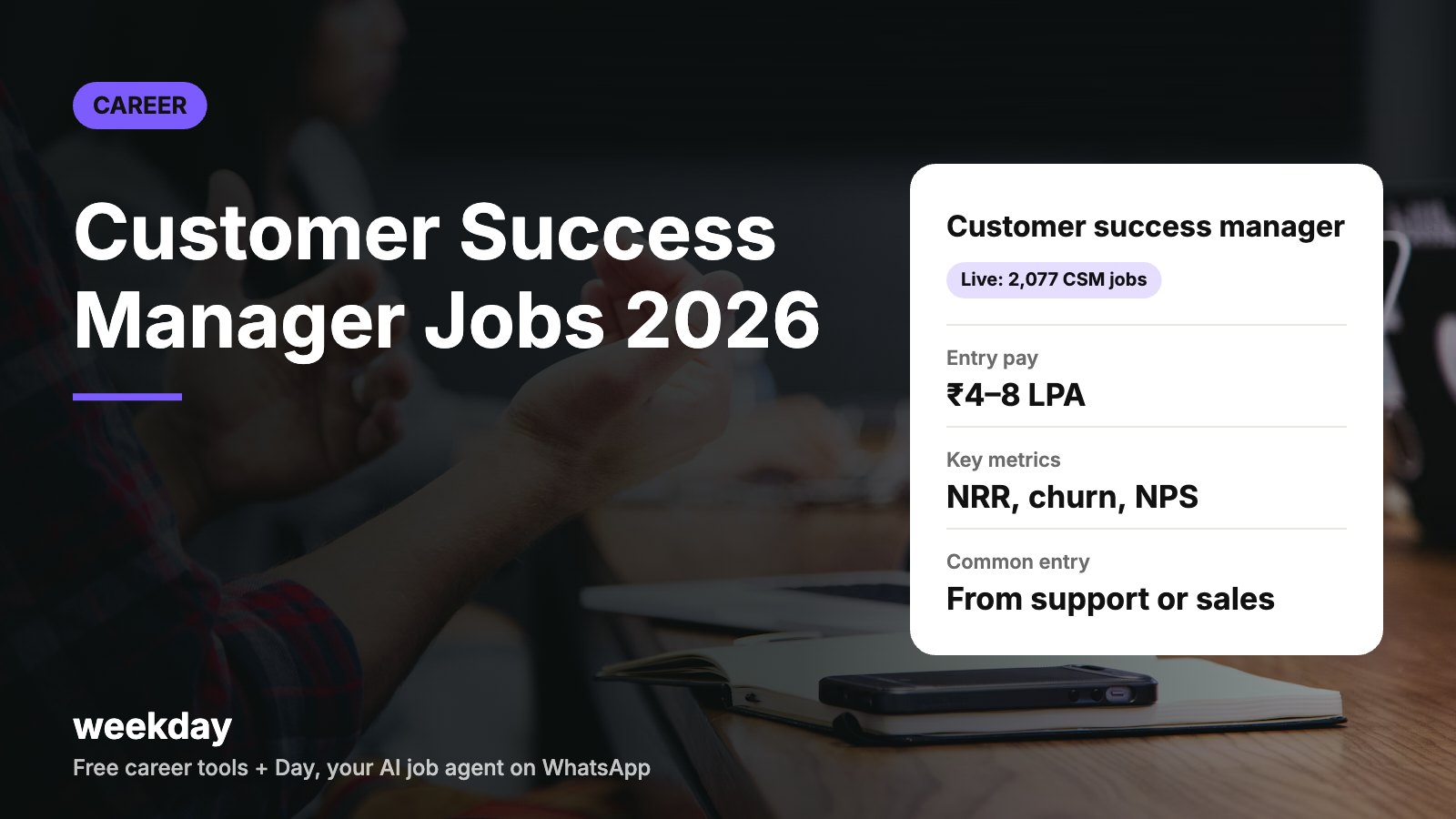
- Customer success manager jobs: 2,077 open, 611 new this week
- Remote CSM jobs: 625 open, 149 new this week
Sources: Weekday job listings (jobs posted in the last 30 days), counted on 17 November 2026. Pay ranges are indicative, based on typical Indian listings.
- Open ChatGPT and go to Plugins.
- Search Weekday Jobs and tap Try in chat (or open Weekday Jobs in ChatGPT).
- Ask in plain words, for example:
- “Find customer success manager jobs at SaaS startups posted this week”
- “Show remote customer success roles for 1–3 years of experience with pay above ₹6 LPA”
- “List customer success associate jobs in Bengaluru or Gurugram for people moving from support”
Day, Weekday's free AI job agent, finds jobs that match your skills and pay, and applies when you say yes. On WhatsApp.
Say hi to Day on WhatsAppHow Day works →What is a customer success manager?
Subscription businesses, especially SaaS (software sold as a monthly or yearly subscription), only make money if customers keep paying. A customer who signs a one-year deal and barely uses the product is likely to leave at renewal. The CSM's job is to stop that from happening by helping customers reach the result they bought the product for.
Support fixes problems when a customer raises them. Customer success is proactive: it looks for problems before the customer notices, and helps them use more of the product over time. CSMs work closely with sales, support and product teams.
A typical week
| Day | Main tasks |
|---|---|
| Monday | Review account health dashboard; flag accounts with falling usage |
| Tuesday | Two onboarding calls with new customers; set up their success plan |
| Wednesday | Quarterly business review with a large account; prepare the deck the day before |
| Thursday | Renewal call; loop in sales for an upsell; share product feedback with the product team |
| Friday | Write check-in emails, update CRM notes, plan next week's risk accounts |
Common tools: a CRM such as Salesforce or HubSpot, a customer success platform such as Gainsight, ChurnZero or Vitally, a help desk like Zendesk or Freshdesk, product analytics dashboards, and video calls. Many teams also use Excel or Sheets for account planning.
CSM vs account manager vs support
| Customer Success Manager | Account Manager | Customer Support | |
|---|---|---|---|
| Main goal | Customer gets value, renews and grows | Grow revenue from existing accounts | Solve the customer's issue quickly |
| Approach | Proactive, long-term | Commercial, relationship-led | Reactive, ticket by ticket |
| Typical metric | Retention, NRR, product adoption, health score | Upsell revenue, renewals | Response time, resolution time, CSAT |
| Who they talk to | Users and decision makers | Buyers and budget owners | End users with a problem |
| Owns renewal? | Often, or shares it with sales | Usually yes | No |
| Common entry path | Support, sales, account management, consulting | Sales, BDE | Freshers, any graduate |
In smaller companies one person may do all three. Read the job description to see whether the role is more about relationships, revenue or troubleshooting.
Metrics, explained simply
| Metric | What it means | Simple formula |
|---|---|---|
| Churn rate | Share of customers or revenue you lost in a period | Lost ÷ starting total × 100 |
| Gross revenue retention (GRR) | Revenue kept from existing customers, ignoring upsells | (Start − churn − downgrades) ÷ start × 100 |
| Net revenue retention (NRR) | Revenue kept from existing customers, including upsells | (Start − churn − downgrades + expansion) ÷ start × 100 |
| NPS (Net Promoter Score) | How likely customers are to recommend you, on a 0–10 scale | % scoring 9–10 minus % scoring 0–6 |
| Health score | A combined score of usage, support tickets, NPS and engagement | Set by each company |
| QBR (Quarterly Business Review) | A meeting every quarter to review results and agree next goals | Not a formula; a meeting |
Worked example: churn, GRR and NRR
Your book of accounts at the start of the quarter: ₹1,00,00,000 annual recurring revenue (ARR)
During the quarter:
• Two customers left: −₹6,00,000 (churn)
• One customer reduced seats: −₹2,00,000 (downgrade)
• Three customers added users/modules: +₹14,00,000 (expansion)

GRR = (1,00,00,000 − 6,00,000 − 2,00,000) ÷ 1,00,00,000 = 92%
NRR = (1,00,00,000 − 6,00,000 − 2,00,000 + 14,00,000) ÷ 1,00,00,000 = 106%

NRR above 100% means your existing customers grew even after losses.
Worked example: NPS
50 customers answered the NPS survey
• 25 scored 9 or 10 (promoters) = 50%
• 15 scored 7 or 8 (passives) = 30%
• 10 scored 0 to 6 (detractors) = 20%
NPS = 50 − 20 = +30

Next step: call every detractor within a week to understand why.
A simple QBR agenda
1. Goals we agreed last quarter, and where we are (with numbers)
2. What's working: top 3 wins
3. Adoption: which teams use the product, which don't
4. Open issues and what we're doing about them
5. Product updates relevant to you
6. Goals for next quarter, owners and dates
Skills a CSM needs
| Skill | Why it matters | How to show it |
|---|---|---|
| Communication | You explain, persuade and calm people down | Examples of difficult conversations handled well |
| Product knowledge | You can't advise on what you don't understand | Learn the product's free trial before the interview |
| Data comfort | Health scores and usage trends guide your day | Excel or Sheets examples; basic dashboards |
| Commercial sense | Renewals and upsells are part of the job | Any target you've owned |
| Organisation | You may own 20–80 accounts | How you tracked tasks in previous roles |
Typical pay in India (2026)
| Level | Experience | Typical pay | Usual book |
|---|---|---|---|
| Customer Success Associate / Executive | 0–2 years | ₹4–8 LPA | Many smaller accounts, onboarding-heavy |
| Customer Success Manager | 2–5 years | ₹8–16 LPA | Mid-market accounts, renewals |
| Senior / Enterprise CSM | 5–8 years | ₹15–28 LPA | Large, complex accounts |
| CS Lead / Head of Customer Success | 8+ years | ₹25–50 LPA | Team, process, retention targets |
Indicative ranges. Roles supporting US or global customers, and enterprise SaaS, usually pay more. Some roles include a variable component tied to renewals or NRR.
How to break in
- From customer support: the most common route. Ask to handle onboarding or key accounts, then apply internally.
- From sales or BDE: you already understand buyers and targets; highlight relationships you kept after the sale.
- From teaching, training or consulting: explaining things clearly and planning outcomes is the core of CS.
- As a fresher: apply for customer success associate, onboarding specialist or account executive roles at SaaS startups.
Before interviews, sign up for the company's free trial and write down three things a new customer might struggle with. It's the single best way to stand out. Our HR interview questions guide covers the general round.
Your 30-60-90 day plan
| Period | Focus | Outcome |
|---|---|---|
| Days 1–30: Learn | Product training, shadow senior CSMs, read account history, meet sales and support | Know your accounts, top risks and the product's main use cases |
| Days 31–60: Own | Run your own check-ins and onboardings, build success plans, fix data in the CRM | Every account has a contact, a goal and a health status |
| Days 61–90: Improve | Lead your first QBRs, save one at-risk account, find one upsell, suggest one process fix | Measurable result you can share in your first review |
Sample answer: 'What will you do in your first 90 days?'
In my first 30 days I'd learn the product deeply, read every account's history and meet the sales and support leads. By day 60 I'd have a success plan and health status for each account. By day 90 I'd run my own QBRs, have a clear plan for the three riskiest accounts, and bring one idea to reduce onboarding time.
10 CSM interview questions, with sample answers
Answers 1–5
1) What is customer success, in your words?
Making sure customers reach the result they paid for, so they stay and grow with us.

2) How is it different from support?
Support reacts to problems. Customer success plans ahead to prevent them and drive adoption.

3) A large customer's usage dropped 40% this month. What do you do?
Check the data for which teams dropped, look at recent tickets, then call my main contact to ask what changed. I'd agree a plan with dates and follow up weekly.

4) What is NRR and why does it matter?
Net revenue retention: revenue from existing customers after churn, downgrades and upsells. Above 100% means the existing base is growing by itself.

5) Tell me about handling an angry customer.
[Support background] A customer's payroll export failed on the last day of the month. I acknowledged the impact, got engineering on a call within an hour, gave updates every 30 minutes and followed up with a root-cause note. They renewed later that year.
Answers 6–10
6) How do you prioritise 60 accounts?
By health and revenue. Red accounts first, then large accounts up for renewal in 90 days, then growth opportunities.

7) How do you run a QBR?
Share an agenda in advance, start with their goals and our results, discuss gaps honestly, and end with agreed next steps and owners.

8) A customer asks for a feature we don't have. What do you say?
I thank them, ask what problem it would solve, check for a workaround, and log the request with the product team with business impact.

9) When would you involve sales?
When I see an expansion opportunity, a pricing discussion, or a renewal at risk that needs commercial flexibility.

10) Why customer success?
I enjoy long-term relationships and seeing customers get results. In my last role I liked onboarding more than one-off tickets, so this is a natural next step.
Sample resume bullets
Copy-ready resume bullets (use your real numbers)
Moving from support
• Resolved 1,200+ tickets at 94% CSAT; handled onboarding for 25 new SMB accounts
• Created a 6-email onboarding series that cut 'how-to' tickets by 30%

Experienced CSM
• Managed a ₹3.2 crore ARR book of 45 mid-market accounts at 108% NRR
• Reduced logo churn from 14% to 8% in a year through health-score alerts and QBRs
• Identified ₹40 lakh in upsell opportunities, closed with the sales team
Career path
| Stage | Years | Next moves |
|---|---|---|
| CS Associate / Onboarding Specialist | 0–2 | CSM |
| CSM | 2–5 | Senior or Enterprise CSM, Account Manager |
| Senior / Enterprise CSM | 5–8 | CS Team Lead, Customer Success Operations |
| Head / VP Customer Success | 8+ | Chief Customer Officer, revenue leadership |
CSMs also move into product management, sales and customer success operations. If you'd like matching roles sent to you, Day, Weekday’s AI job agent applies only when you say yes.
Red flags in CSM job offers
- A 'CSM' title that's really a cold-calling sales role: check whether the targets are new-logo revenue.
- Any fee for training, a laptop or 'onboarding' before you join. Real employers never charge you.
- No written variable pay policy for renewal or NRR incentives.
FAQs
What does a customer success manager do?
A CSM helps customers get value from a product they've bought, so they renew and expand. Work includes onboarding, check-ins, QBRs, monitoring usage and spotting churn risk early.
What is the salary of a customer success manager in India?
Entry-level customer success roles usually pay around ₹4–8 LPA, CSMs with 2–5 years around ₹8–16 LPA, and senior or enterprise CSMs more. Ranges vary by company and market served.
Is customer success the same as customer support?
No. Support reacts to issues customers raise. Customer success is proactive and focused on long-term value, renewals and growth.
Can a fresher become a customer success manager?
Freshers usually start as customer success associates, onboarding specialists or support executives, then move to CSM in one to three years.
What is NRR in customer success?
Net revenue retention: the revenue kept from existing customers after churn and downgrades, plus upsells, divided by starting revenue. Above 100% means growth from the existing base.
What is a QBR?
A quarterly business review: a meeting with a customer to review results against their goals and agree priorities for the next quarter.
What skills are needed for customer success?
Communication, product knowledge, comfort with data, organisation and commercial sense. Empathy and calm under pressure matter a lot.
Are there remote customer success jobs?
Yes. On 17 November 2026, Weekday listed 625 remote customer success manager jobs.
How many customer success manager jobs are live on Weekday?
On 17 November 2026, 2,077 customer success manager jobs were live on Weekday, with 611 new that week.