
Last updated: 25 November 2026
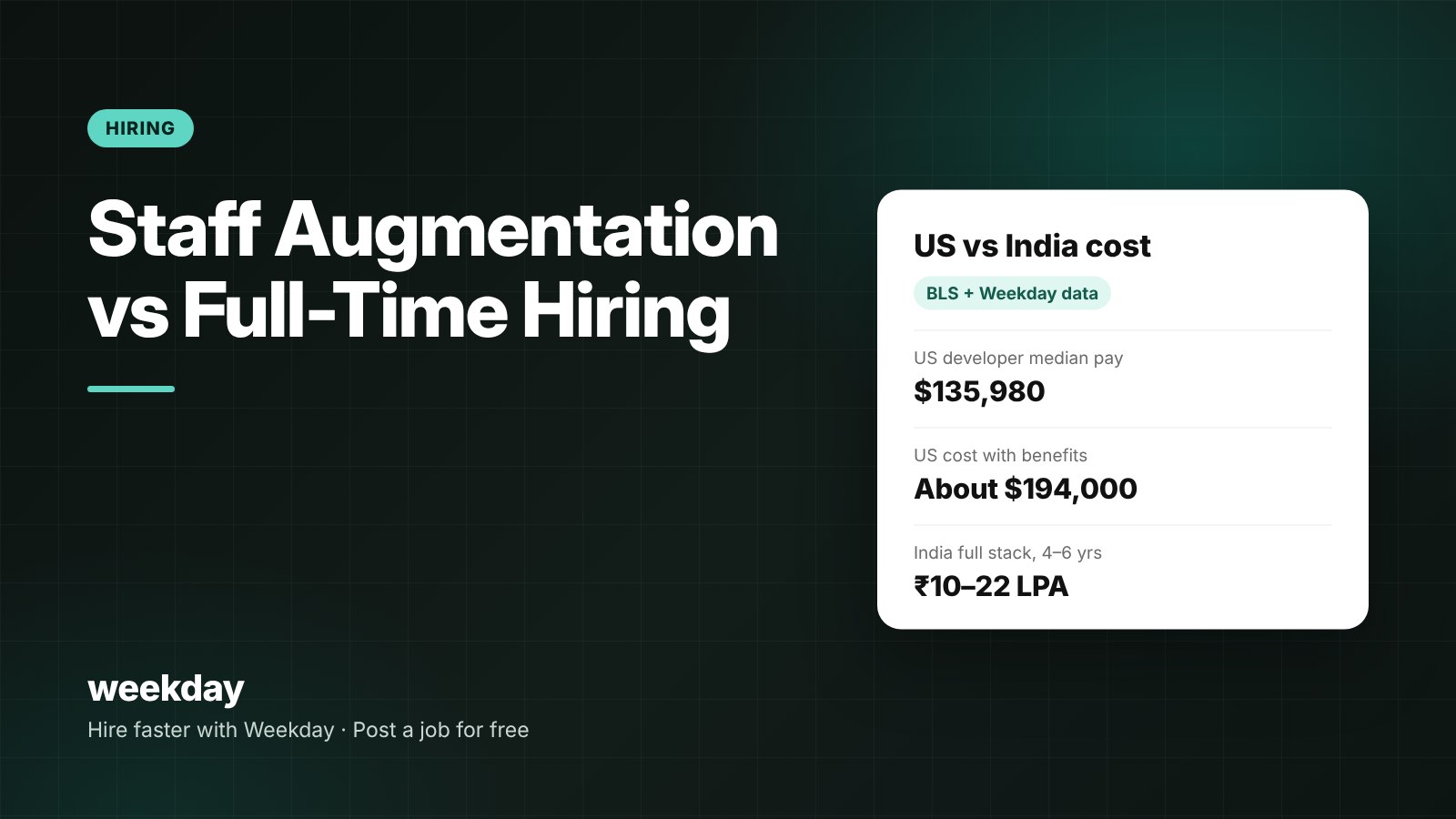
Quick answer: Staff augmentation means adding contract engineers from a vendor to your team for a set period. You manage their work; the vendor employs and pays them. It's the right call for short, well-defined work or a skill you need for months, not years. Hire full-time for your core product. Cost check: a US software developer's median pay is $135,980 (BLS, May 2025), and benefits make up 30% of private employers' compensation cost (BLS, June 2026), so a full-time US hire runs close to $194,000 a year. In India, mid-level full stack developers earn about ₹10–22 LPA, and ₹18–35 LPA at product companies and GCCs (Weekday salary guide). The big risk with contractors isn't price. It's the knowledge that walks out when the contract ends.
Most founders hit this choice the same way. A deadline is close, the team is stretched, and a vendor offers two senior engineers who can start Monday. That's often a fine decision. But it gets expensive when you use contractors for work that should live inside your company.
What staff augmentation is (and isn't)
With staff augmentation, a vendor supplies people who work inside your team, on your tools, in your standups. You decide what they build. The vendor handles their contracts, payroll and replacement if someone leaves.
It's different from outsourcing. With outsourcing (or managed services), you hand over an outcome, and the vendor runs the team. It's also different from recruiting, where an agency finds people you then employ yourself. If you're weighing recruiting models, see our guide to contingency vs retained vs subscription recruiting.
| Staff augmentation | Full-time hire | Outsourcing / managed team | |
|---|---|---|---|
| Who manages daily work | You | You | The vendor |
| Who employs the person | The vendor | You | The vendor |
| Typical length | Weeks to months | Years | Project or contract term |
| Speed to start | Fast, if the vendor has people on the bench | Slow: sourcing, interviews, notice period | Medium: scoping first |
| Who keeps the knowledge | Leaves with the person unless you document it | Stays with you | Stays with the vendor |
| Best for | Spikes, migrations, niche skills | Core product, long-term ownership | Non-core work you can spec clearly |
What it costs: India vs US
Here's the pay side of the decision, using public data. Vendor rates for augmented staff vary a lot, and there's no reliable public benchmark for vendor margins, so we don't quote one. Ask every vendor to show you what the engineer is paid and what they keep.
| Benchmark | Figure | Source |
|---|---|---|
| US software developer, median base pay | $135,980 a year | BLS, May 2025 |
| Benefits share of US private-sector compensation cost | 30.0% (wages 70.0%) | BLS, June 2026 |
| US developer, rough total yearly cost | About $194,000 ($135,980 ÷ 0.70) | Our calculation from the two BLS figures |
| Back-end developer median, US vs India | $175,000 vs $22,086 | Stack Overflow Developer Survey 2025 |
| India full stack developer, 4–6 years | ₹10–22 LPA (₹18–35 LPA at product companies and GCCs) | Weekday full stack salary guide |
| India software engineer at Adobe, median | ₹19.8 LPA (93 salaries) | Weekday salary data |
| India, 2–3 years, median fixed pay | Microsoft ₹23 L, Google ₹20 L, Amazon ₹17.3 L | Weekday salaries hub |
Two things stand out. First, the US-to-India gap is large on any measure: the Stack Overflow survey puts the median back-end developer in the US at roughly 8 times the Indian median. Second, India's top payers are well above the averages, so "India is cheap" only holds if you're not competing with big tech for the same people. You can check any company's pay on the Weekday salaries page.
For an India hire, most offers quote CTC, and employer PF usually sits inside it. If you hire full-time in India, plan for notice periods too. Many good engineers can't start for 30 to 90 days, which is often the real reason teams reach for augmentation.
The risks nobody puts in the vendor deck
1. Knowledge walks out
A r/cscareerquestions thread with 1,048 upvotes and 460 comments shows how this plays out. A backend engineer with 7+ years on the platform team of a US SaaS company was laid off in March, after the company said one engineer plus AI tools could run the platform. Since summer, the company has had three major outages. Two came from AI-generated database migrations that locked a very large table during peak traffic. The CTO asked the laid-off engineer to come back as a contractor for 3 months, at $2,500 a month with no benefits. That's half his old $5,000 monthly pay. He said no.
The lesson for founders: the person who built your deploy pipeline is not a line item you can swap. If you cut full-time people and plan to buy the same knowledge back as contract hours, you may not get it back at all.
2. Contractors leave first
Augmented engineers are usually first out when budgets tighten, and they know it. In a Weekday analysis of 400 top Reddit posts from the last 30 days (Nov 2026), layoffs, firing and buyouts were the top theme, with 67 posts. People who feel temporary act temporary. Expect turnover and plan handovers from day one.
3. Misclassification
If a "contractor" works fixed hours, reports to your manager and has done so for years, labour law in India or the US may treat them as your employee. Contracts through a proper vendor lower that risk but don't remove it. Check with your HR or a lawyer before you keep anyone on contract long term.
4. Security and IP
Make sure the vendor contract assigns all code and IP to you, and that access is removed the day someone rolls off.
Full-time hiring has its own risks
Full-time isn't risk-free either. Aon's 2026–27 salary survey of 1,200+ organisations in India found attrition rose to 18% in 2026, from 16.2% in 2025 (Aon). A bad full-time hire takes months to fix. And demand is high: Weekday lists 26,785 remote software engineer jobs in India as of 25 November 2026, so strong engineers have options.
When to use each
| Your situation | Best fit | Why |
|---|---|---|
| Core product, needed for 12+ months | Full-time | You want the knowledge and ownership to stay |
| Fixed project: migration, integration, audit | Staff augmentation | Clear end date and clear scope |
| Niche skill for 3–6 months | Staff augmentation | Hiring full-time for a short need is wasteful |
| Deadline spike while you hire | Augmentation now, full-time in parallel | Covers the 30–90 day notice gap |
| Work you can spec end to end and don't want to manage | Outsourcing | The vendor owns delivery |
| Unsure if the role is permanent | Contract-to-hire | Both sides test fit before committing |
How to run augmented staff well
- Write a one-page scope. What they'll ship, by when, and how you'll know it's done.
- Pair every contractor with a full-time owner. The owner reviews code and keeps the context.
- Make documentation part of done. No ticket closes without a short write-up.
- Interview them yourself. Don't accept a vendor's CV pack at face value. Run the same technical round you'd run for a full-time hire.
- Agree a handover window. Two weeks of overlap with the person taking over.
- Review every quarter. If the "temporary" need is still there after two quarters, it's a full-time role. Hire for it.
Free tool: Use Weekday's interview scorecard generator to score contractors and full-time candidates on the same bar.
Need engineers you'll keep?
Weekday's AI agents find and reach out to engineers in India and the US who aren't actively applying, so you can fill core roles with full-time people instead of renting them. See how it works for your open roles.
Frequently asked questions
What is staff augmentation?
Staff augmentation is when a vendor supplies contract engineers or specialists who work inside your team for a set period. You direct their work; the vendor employs and pays them.
Is staff augmentation cheaper than hiring full-time?
Per hour, usually not, because the vendor adds a margin. It's cheaper when the need is short, because you skip recruiting time, notice periods and long-term salary. For work you need for more than a year, full-time is usually cheaper and keeps the knowledge in-house.
What's the difference between staff augmentation and outsourcing?
With staff augmentation you manage the people and own the outcome. With outsourcing you hand a defined outcome to the vendor, and the vendor manages the team.
Can I hire an augmented contractor full-time later?
Often yes, but check the vendor contract first. Many include a conversion fee or a no-hire period. Agree the terms before the engagement starts.
How much does a software developer cost in the US vs India?
The US median for software developers is $135,980 a year (BLS, May 2025), or about $194,000 once benefits are added. In India, mid-level full stack developers earn about ₹10–22 LPA, and ₹18–35 LPA at product companies and GCCs (Weekday salary guide).
Sources
- US Bureau of Labor Statistics: Software developers, median pay May 2025
- US Bureau of Labor Statistics: Employer Costs for Employee Compensation, June 2026
- Stack Overflow Developer Survey 2025: salary by developer type and country
- Weekday: Full stack developer salary in India 2026
- Weekday: Company salaries in India (412 companies) and Adobe software engineer salary
- Reddit r/cscareerquestions: laid off for AI, asked back as a contractor at half pay
- Weekday analysis of 400 top Reddit posts, 420 LinkedIn posts and 400 X posts from the last 30 days (Nov 2026)
- Aon Annual Salary Increase and Turnover Survey India 2026–27
- Weekday: Remote software engineer jobs in India (live count, 25 Nov 2026)





