
Last updated: 23 November 2026 · Based on a Weekday analysis of 148 LinkedIn hiring posts
You've seen the posts. Someone in Pune works for a San Francisco startup, gets paid in dollars and logs off at midnight. It sounds like a secret that everyone knows except you.
It's real. But it's rarer than your LinkedIn feed makes it look, and it almost never comes from setting the job search to "United States". We went through 148 LinkedIn hiring posts from November 2026 to see what US roles actually ask for, and what the India-friendly ones look like.
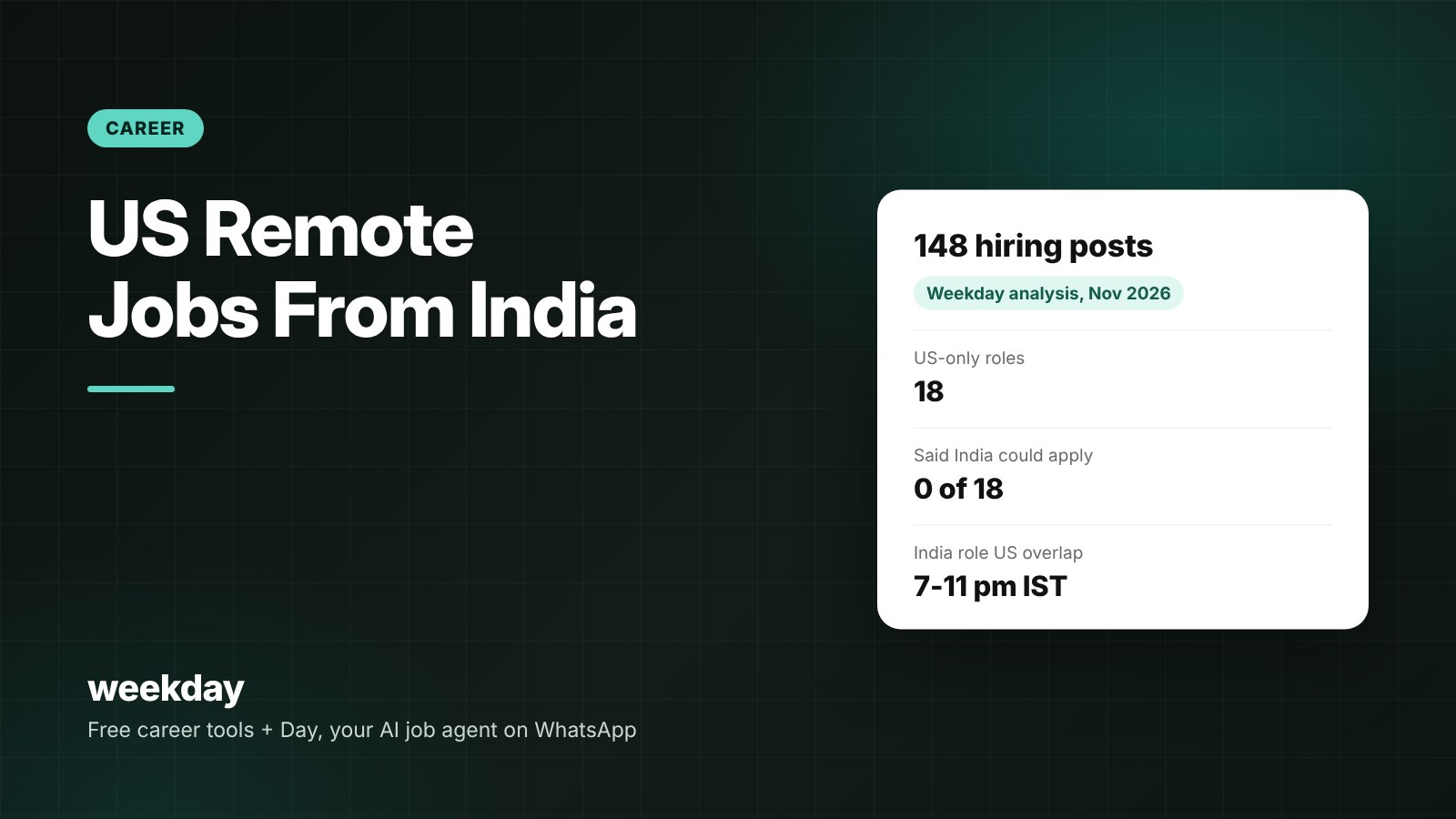
Short answer: Most US-based jobs want you in the US. In our sample of 148 LinkedIn hiring posts, 18 roles were based only in the US and not one said candidates in India could apply. The US work Indians actually get comes in four shapes: "Remote, India" roles with US-hours overlap, contracts paid through a platform like Deel, US startups hiring for an India team, and referrals from ex-colleagues or old clients. Search with India as the location plus the remote filter, read the eligibility line first, and be ready to work a few US hours.
What 148 LinkedIn hiring posts tell you about US remote jobs
We tracked 148 hiring posts on LinkedIn posted between 14 and 23 November 2026 (Weekday analysis of 148 LinkedIn hiring posts, Nov 2026). For each one we noted the role, the location and any rule on who can apply. A post counted as "US-only" when every location it listed was in the US.
| What we counted | Posts |
|---|---|
| Roles based only in the US | 18 |
| Of those: in office 5 days a week or "in person" | 8 |
| Of those: hybrid, with some days in a US office | 3 |
| Of those: said "remote" | 4 |
| Of those: no work mode given | 3 |
| Of those: limited to US citizens, green card holders, "US candidates only" or US security clearance | 3 |
| Of those: said candidates in India could apply | 0 |
| Roles split between a US city and Bangalore | 3 |
| Remote roles open to India, with US or global teams | 3 |
Two things stand out. First, "remote" in a US post often means remote inside the US. One remote design role said "US candidates only". Another remote role in California said it may need US security clearance. Second, the big numbers you see are for people who live there. One full stack AI engineer role in San Francisco listed $150K to $200K for 1 to 3 years of experience, but it was on-site five days a week.
The India-friendly posts looked different:
- A lead product engineer role listed as "Remote, India", on contract, with US-hours overlap from 7 pm to 11 pm IST.
- A remote technical writing contract for 20+ hours a week with overlap in US Pacific time, open to select countries including India.
- A remote marketing role open worldwide, with pay listed as $2,500 base plus about $500 tied to KPIs.
- Three US startups hiring for both a US city and Bangalore. If you're in India, you apply for the Bangalore side.
The 4 ways Indians actually work for US companies
| Setup | How it works | What to check before you say yes |
|---|---|---|
| Direct contractor | You send the US company an invoice every month. Pay comes by bank transfer or through a platform like Deel. | Contract length, notice period, who pays platform fees, your tax filing |
| Employer of record (EOR) | A third-party firm employs you in India for the US company. You get Indian payslips. | Which company is on your offer letter, whether PF is part of CTC, leave policy |
| US company with an India team | The startup has an Indian entity, often in Bangalore. You're a regular Indian employee who works with a US team. | Pay band (usually in rupees), ESOPs, overlap hours |
| Indian company with US clients | You work for an Indian firm or agency that sells to US clients. Not "direct", but the hours and work look similar. | Who your employer is vs who the client is, bench risk, shift allowance |
Know which setup you're applying for. In the Reddit threads we read, the contractor setup came up most, and it brings the most paperwork questions.
Where these jobs actually come from
A thread on r/developersIndia asked how Indian developers land direct US remote roles. It drew more than 190 comments. The answers were less mysterious than you'd think:
- LinkedIn, with India as the location. One developer found their role by searching remote jobs with India set as the location. The company had half its team in the US and half in India, so it listed Indian cities with "remote".
- Open source. Another said their open-source contributions built a network that led to a role paying 60,000 USD a year.
- Ex-colleagues and old clients. One person's services company in Bangalore shut down. They reached out to former colleagues and clients, and that's how they got their US job.
- Company careers pages. A developer with 7+ years in one domain applied straight on the careers site. The interviews were about past trade-offs and product thinking, not puzzles.
- Visibility. A commenter with 7 to 9 years of experience said LinkedIn and referrals worked for US, EU and Singapore roles. Their advice: keep a visible public profile.
You can read the full thread here: How are Indian devs actually getting direct US remote roles? Many said luck played a part. But almost every story had a warm path or public proof of work behind the luck.
How to get a US remote job from India: a step-by-step plan
- Search where they actually post. On LinkedIn Jobs, set the location to India and pick "Remote". Then search posts too: "hiring" plus "remote" plus your role plus "India". Many India-friendly roles show up as posts from founders before they reach a job board. Our remote jobs in India report shows which roles are open right now.
- Read the eligibility line first. Skip anything that says US citizens, green card, "US candidates only", security clearance or "must live in PST".
- Decide your US hours before the interview. One India role in our sample wanted overlap from 7 pm to 11 pm IST. Pacific-time overlap pushes later than that. People on r/developersIndia shared their real schedules in this thread on working hours.
- Show proof, not just a resume. A GitHub with real commits, a short write-up of a system you built, or a two-minute demo video. See our developer portfolio guide.
- Write like someone who works async. Your note should be 5 or 6 lines: what you built, the result, the hours you can overlap, and when you can start.
- Use warm paths. Ex-colleagues abroad, old clients, open-source maintainers you've worked with. A short referral message beats a cold application.
- Price yourself in the right currency. Know your number in USD per month, and what it means in rupees after platform fees and tax. Don't quote your Indian CTC and let them anchor on it. Our salary negotiation guide has scripts.
The contractor catch: payslips, PF and your next job
Many US startups don't have an Indian entity, so they hire you as a contractor. That's fine for pay, but it changes your paperwork.
One r/developersIndia user worked two years for a US startup as a contractor through Deel. When they started looking for jobs in India, they worried because Indian MNCs ask for the last three months of payslips (thread). Another asked if having no PF or EPFO history would cause trouble in background checks later (thread).
What helps:
- Keep your contract, every invoice and the bank credit for every payment in one folder.
- Ask for an experience letter on company letterhead before you leave.
- File your income tax return every year. Contract income is taxed as business or professional income, and you pay advance tax yourself. Talk to a CA before your first invoice, not after your first year.
- Write "Contract" on your resume and explain it in one line. A background check will see the missing PF record anyway, so say it first.
Joining through an employer of record? Check which company is named on the offer letter. Our offer letter checklist helps.
Red flags in "remote US job" posts
- Commission-only "remote sales". In our sample, one fully remote role selling websites to US, UK and EU businesses paid commission only. No base pay at all.
- Long paid trials. One remote developer role offered a 15-day paid trial at ₹8,000 to ₹12,000 before a longer contract. A short paid trial can be fair. A long or unpaid one isn't.
- Fees. A real employer never asks you to pay for "training", "registration" or a "visa process" for a remote role.
- No company name, only a WhatsApp or Telegram number. Check the company website and LinkedIn page before you send documents.
Looking for remote roles you can do from India?
Weekday lists remote jobs open to candidates in India, across engineering, product, design, data and sales. Filter by role and apply in a few clicks.
Frequently asked questions
Can I work remotely for a US company from India?
Yes. Most people do it as a contractor paid by bank transfer or a platform like Deel, through an employer of record, or by joining the India team of a US startup. Always read the eligibility line, because many US remote jobs are open only to people living in the US.
How do Indians find US remote jobs?
Search LinkedIn with India as the location and the remote filter on, watch hiring posts from US startup founders, ask ex-colleagues and old clients, and build public proof of work such as open-source contributions. In a large r/developersIndia thread, most people credited LinkedIn, referrals or open source.
Do US remote jobs from India pay in dollars?
Contract roles usually pay in USD. Roles at a US company's Indian entity usually pay in rupees. One developer on Reddit said open source led them to a role paying 60,000 USD a year, but pay varies a lot by role and experience.
What are the working hours for US remote jobs from India?
Expect some overlap with US time. One India role in our sample asked for overlap from 7 pm to 11 pm IST. Overlap with US Pacific time usually means later nights than that.
Do I need a US visa to work remotely for a US company?
Not if you work from India as a contractor or through an Indian entity. A visa matters only if you plan to work from inside the US.
Sources
- Weekday analysis of 148 LinkedIn hiring posts, 14-23 November 2026. We counted posts by listed location, work mode and eligibility rules.
- r/developersIndia: How are Indian devs actually getting direct US remote roles?
- r/developersIndia: Payslips after working remotely for a US startup





