
Last updated: 18 November 2026
Quick answer: Campus hiring means recruiting final-year students directly from colleges, usually through the college placement cell. For a startup, it works best when you (1) hire for a few clear roles, (2) pick colleges where you can actually get a good slot, (3) plan around the placement calendar, (4) make a fresher offer that beats IT services, and (5) decide within days, not weeks. Pair it with off-campus hiring and internships so one bad season does not leave you short.
Is campus hiring worth it in 2026?
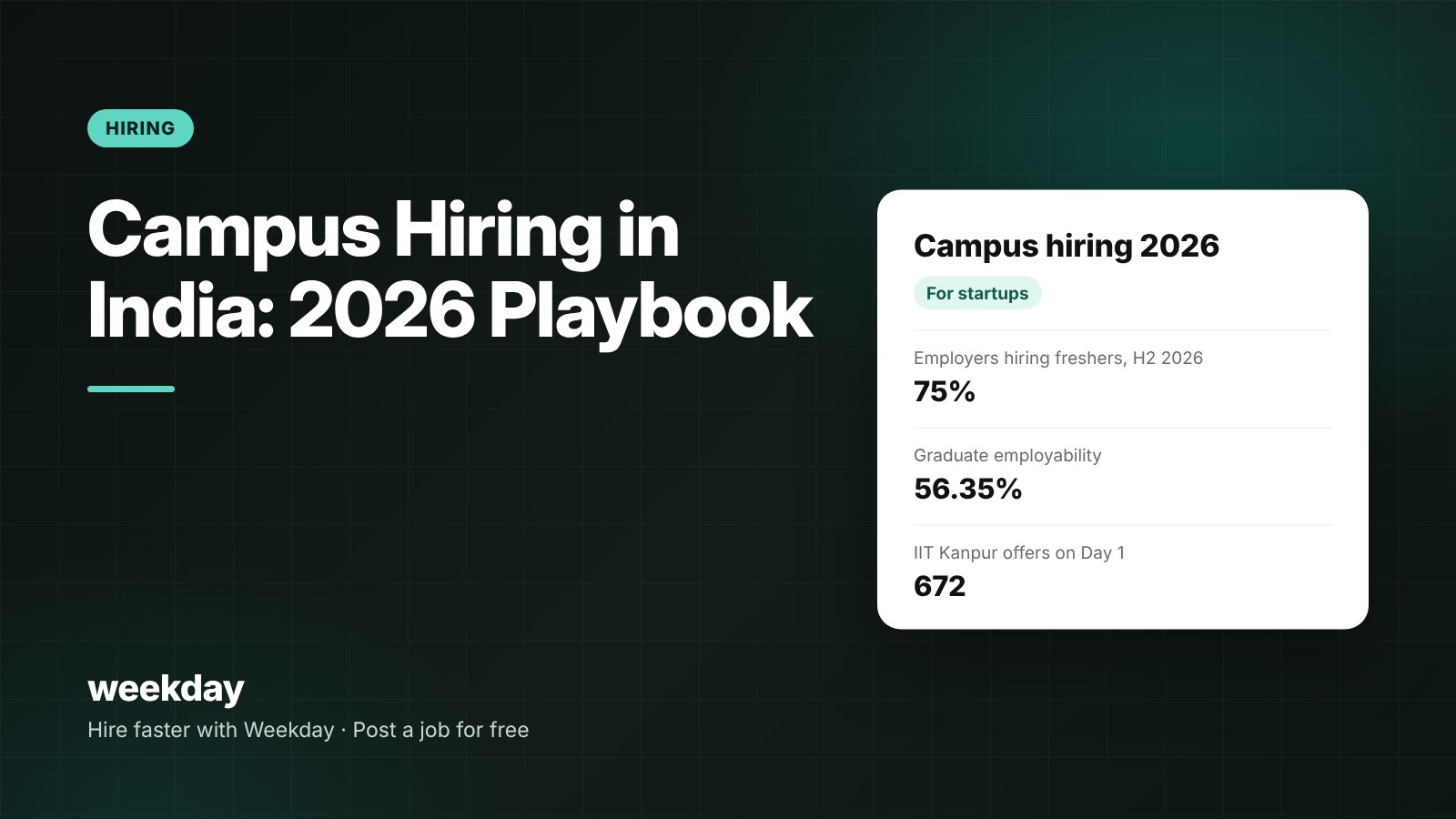
Employers think so. In TeamLease EdTech's Career Outlook survey of 1,097 employers, 75% plan to hire freshers between July and December 2026, up from 73% in the first half of the year (People Matters, August 2026). The details matter more than the headline:
- E-commerce and tech start-ups, and retail, show the highest intent at 93% each.
- IT sector intent fell from 81% to 76%. When the big IT employers slow down, smaller companies get a better shot at strong graduates.
- By city, Bengaluru leads at 89%, followed by Mumbai at 75% and Chennai at 71%.
- Roles in demand include AI Application Developer, Junior Semiconductor Design Engineer and Data Centre Operations Associate.
The talent pool is also getting stronger. The India Skills Report 2026 puts graduate employability at 56.35%, up from 54.81% a year earlier and 46.2% in 2022 (Careers360). In plain words: a bit more than half of graduates tested as job-ready. Your process has to find that half.
Campus, off-campus or internship first?
Campus hiring is one channel, not the only one. Here is how the three main fresher routes compare for a small team:
| On-campus drive | Off-campus / open fresher job | Internship first | |
|---|---|---|---|
| Best for | Hiring 5+ freshers at once | Hiring 1–4 freshers any time of year | Testing people before a full-time offer |
| Timing | Fixed by the college calendar | Any time | Before or during the final year |
| Effort | High: travel or virtual drive, tests, many interviews | Low to medium | Medium: you need someone to mentor |
| Main risk | Offer drop-outs before joining | Too many unfiltered applicants | Intern takes a bigger offer later |
A mix usually works best for a small team. Edtech company Edoofa, for example, runs 20–25 campus hires during peak cycles and hires experienced people through other channels (Weekday case study).
Step 1: Decide the roles and the number
Start with the work, not the college list. For each role, answer:
- What will this person do in their first 90 days?
- Who will train them, and how many hours a week can that person give?
- How many can we take this year without hurting the team?
A simple rule: if you cannot name a mentor for every fresher, hire fewer freshers.
Step 2: Pick colleges where you can win
Early slots at top campuses are in high demand and can be hard for a small company to get. A startup can often do better at strong tier-2 colleges, where it gets a better slot and more of the placement cell's time.
How to shortlist colleges:
- Look at where your best current employees studied.
- Check each college's published placement report and NIRF data for median salary and the share of students placed.
- Ask placement officers which companies hired there last year and at what package. This tells you who you are competing with.
- Keep a short list. Five colleges you visit every year beat twenty you contact once.
Step 3: Plan around the placement calendar
Each college sets its own calendar, so ask the placement cell early. At the IITs, the first phase of placements for the 2025–26 season began on 1 December 2025, and IIT Kanpur alone recorded 672 offers on Day 1 (IIT Kanpur). Pre-placement offers (PPOs) from internships also rose by 10–20% across IIT campuses that season, while salaries stayed flat (Careers360).
Two lessons from this: register early, and use summer internships to build your own PPO pipeline.
Step 4: Make an offer that beats IT services
Expect freshers to compare your offer with the big IT services packages. Weekday's off-campus drives guide lists typical 2026 ranges:
| Company | Typical fresher package |
|---|---|
| TCS (NQT) | approx. ₹3.36 LPA to ₹9 LPA+ |
| Infosys | approx. ₹3.6 LPA to ₹10 LPA+ |
| Wipro (Elite NTH) | approx. ₹3.5 LPA to ₹7 LPA |
| Capgemini | approx. ₹4.25 LPA to ₹7.5 LPA |
| Accenture | approx. ₹4.5 LPA to ₹9 LPA |
Product startups usually pay more for strong engineers. For example, Weekday's guides put fresher full stack developers at ₹3.5–7 LPA in general but ₹10–18 LPA at strong product startups (full stack salary guide), and fresher AI engineers at ₹8–14 LPA (AI engineer salary guide).
If you cannot beat the number, beat the role: real ownership, a named mentor, and a clear path to a raise after 12 months. Put these in writing in the offer letter, not just in the pitch.
Step 5: Run a short, fair selection process
- Pre-placement talk (20 minutes): what the company does, what the fresher will build, and the exact offer.
- One skills test: a short coding, writing or case task that matches the real job.
- Two interviews at most: one for skills, one with the future manager.
- Decide within 48 hours: placement cells move fast, and good students sign the first good offer.
Step 6: Close and keep them until joining day
Students sign offers in their final year and join after they graduate, so the gap between offer and joining is often several months. That is where startups lose people. Stay in touch every month, invite selected students to a project or event, and give them a small paid project if they finish exams early. Students who feel part of the team are less likely to switch.
Hiring graduates in the US
US campus recruiting runs on a different cycle, but the logic is the same. NACE's spring 2026 update shows employers plan to hire 5.6% more graduates from the Class of 2026 (NACE), and the average starting salary for computer science graduates is projected at $81,535 (NACE). If you are a US startup thinking about hiring engineers in India, read our guide for US startups hiring in India.
Do not rely on campus alone
Off-campus fresher hiring is now very large. On 13 November 2026, Weekday listed 7,902 live fresher jobs and 3,859 internships in India, and 93.2% of the fresher jobs were remote (Weekday fresher jobs report). Graduates who did not get placed on campus are actively looking. A fresher job post running all year catches them, and it costs you far less time than another campus visit.
Hiring freshers or interns this season?
Post your fresher role on Weekday for free. Your first role includes 200 reach-outs to matching candidates, with no credit card.
Post a free jobFrequently asked questions
What is campus hiring?
Campus hiring, also called campus recruitment, is when a company hires final-year students directly from a college, usually through the college's placement cell, before they graduate.
What is the difference between on-campus and off-campus hiring?
On-campus hiring happens through one college's placement process. Off-campus hiring is open to students and graduates from any college, usually through an online job post or a company-run drive.
When does the placement season start in India?
It depends on the college. At the IITs, Phase 1 of the 2025–26 season started on 1 December 2025. Ask each placement cell for its calendar as early as possible.
How much should a startup pay freshers?
Use IT services packages as the floor and role-specific salary data as the guide. Weekday's role salary guides, such as the data analyst guide, list fresher ranges.
Can a small startup do campus hiring?
Yes. Start with two to five colleges, one or two roles, and an internship program that feeds full-time offers.
Sources
- TeamLease EdTech Career Outlook H2 2026, via People Matters
- India Skills Report 2026, via Careers360
- IIT Kanpur, Day 1 of 2025–26 placement season
- Careers360, IIT placements 2025–26
- NACE Job Outlook 2026 spring update and Winter 2026 Salary Survey
- Weekday: fresher jobs report, off-campus drives 2026, Edoofa case study





