Last updated: 16 November 2026
- What a cloud support engineer does
- Skills: Linux, networking, AWS/Azure, scripting
- Certifications employers ask for
- Salary ranges in India
- A 6-week home lab plan
- 10 interview questions with answers
- Career path
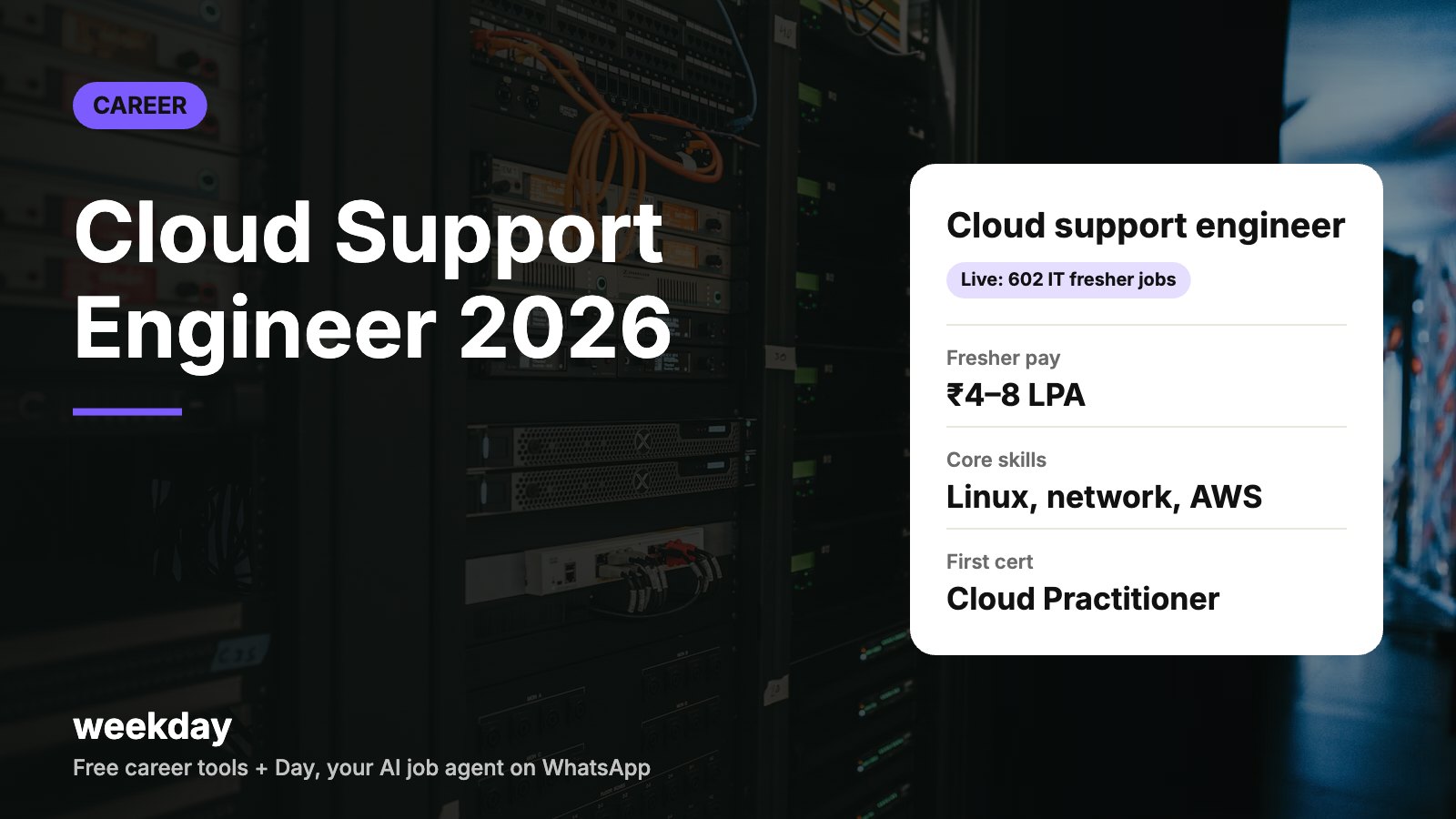
- IT fresher jobs: 602 open, 138 new this week
- Python developer jobs: 8,532 open, 1,823 new this week
- Cyber security jobs: 1,270 open, 338 new this week
- Internships: 4,188 open, 931 new this week
- Fresher jobs: 8,637 open, 2,350 new this week
Sources: Weekday job listings (jobs posted in the last 30 days), counted on 16 November 2026. Pay ranges are indicative, based on typical Indian listings.
- Open ChatGPT and go to Plugins.
- Search Weekday Jobs and tap Try in chat (or open Weekday Jobs in ChatGPT).
- Ask in plain words, for example:
- “Find cloud support engineer or AWS support jobs for freshers in Bengaluru or Hyderabad”
- “Show remote cloud or DevOps support jobs with 0–2 years experience posted this week”
- “List entry-level Linux and AWS jobs at startups with pay above ₹5 LPA”
Day, Weekday's free AI job agent, finds jobs that match your skills and pay, and applies when you say yes. On WhatsApp.
Say hi to Day on WhatsAppHow Day works →What does a cloud support engineer do?
Companies run their apps on cloud platforms like AWS, Microsoft Azure and Google Cloud. When something breaks, someone has to find out why. That's the cloud support engineer. You take a ticket, ask the right questions, read logs and metrics, reproduce the issue, and either fix it or guide the customer to the fix.
There are two flavours. Provider-side support sits inside a cloud company and helps its customers. Customer-side support (often called cloud operations, L1/L2 cloud support or NOC) sits inside an IT services firm, product company or startup and looks after that company's own cloud setup.
| Typical task | Example ticket | What you use |
|---|---|---|
| Connectivity | “I can't SSH into my server” | Security groups, network ACLs, route tables, key pairs |
| Performance | “Our app slowed down at 2 PM” | CloudWatch or Azure Monitor metrics, top, logs |
| Access and permissions | “Access denied when uploading to S3” | IAM policies, bucket policies, roles |
| DNS and domains | “Our domain isn't resolving” | Route 53 or Azure DNS, dig, nslookup |
| Deployments | “Our container won't start” | Container logs, task definitions, CI logs |
| Cost and limits | “We hit a service quota” | Quota pages, billing reports |
Skills you need
| Area | Must know for a fresher | Nice to have |
|---|---|---|
| Linux | Files and permissions, processes, systemctl, logs in /var/log, ssh, df, top, grep | Package managers, cron, disk and LVM basics |
| Networking | OSI and TCP/IP, IP addressing and CIDR, DNS, HTTP/HTTPS, ports, TCP vs UDP | Load balancers, VPN, routing basics |
| One cloud platform | AWS: EC2, S3, IAM, VPC, CloudWatch, RDS. Or Azure: VMs, Storage, Entra ID, VNets, Monitor | Containers (ECS, EKS, AKS), serverless (Lambda, Functions) |
| Scripting | Bash for small automations; basic Python | AWS CLI or Azure CLI scripts, Terraform basics |
| Troubleshooting | Start from symptoms, check one layer at a time, write clear notes | Root-cause write-ups |
| Communication | Explain a fix simply in an email or ticket | Handling escalations calmly |
You do not need to be a developer. But you do need to read error messages carefully and know where to look next. Interviewers test that more than memorised definitions. Python helps a lot; there are 8,532 Python jobs live on Weekday, and many cloud roles list it as a plus.
Certifications commonly asked for
| Certification | Level | Who it suits |
|---|---|---|
| AWS Certified Cloud Practitioner | Foundational | Freshers and career switchers; proves cloud basics |
| AWS Certified Solutions Architect – Associate | Associate | The one most often seen in cloud job listings; good after 2–3 months of hands-on work |
| AWS Certified SysOps Administrator – Associate (now CloudOps Engineer) | Associate | Support and operations roles; check the current name and exam code |
| Microsoft Azure Fundamentals (AZ-900) | Foundational | Azure-focused companies and services firms |
| Microsoft Azure Administrator (AZ-104) | Associate | Azure support and admin roles |
| Google Cloud Associate Cloud Engineer | Associate | Companies on Google Cloud |
| Linux (e.g. RHCSA) or CCNA | Associate | Strong signal for Linux or networking depth |
Exam fees, codes and names change. AWS foundational exams have usually cost around US$100 and associate exams around US$150; check the official site before you book. A certificate helps you get shortlisted, but interviews test hands-on skill.
Cloud support engineer salary in India (2026)
| Level | Experience | Typical CTC (indicative) |
|---|---|---|
| L1 cloud support / NOC at an IT services firm | 0–2 years | ₹3–₹5 LPA |
| Cloud support associate / engineer at a product or cloud company | 0–2 years | ₹5–₹10 LPA |
| Cloud support engineer II / L2 cloud ops | 2–4 years | ₹8–₹15 LPA |
| Senior cloud / DevOps / SRE engineer | 4–7 years | ₹15–₹30 LPA |
| Cloud architect / lead | 8+ years | ₹30 LPA and above |
Ranges are indicative, based on typical Indian listings. Shift work (many support roles are 24×7) often adds an allowance. Large cloud providers and well-funded startups usually pay at the top of these bands.
Worked example: choosing between two offers
Offer A: L1 cloud support, IT services firm, ₹4 LPA, rotational shifts, training on AWS and Azure.
Offer B: Cloud support associate, product startup, ₹6.5 LPA, day shift, small team.

Offer B pays ₹2.5 LPA more (about ₹20,800 a month before tax).
Offer A gives structured training and exposure to many client setups.

Rule of thumb: if you are weak on fundamentals, A can teach you faster. If you already have a home lab and one certification, B's pay and ownership usually win.
A 6-week home lab plan
A home lab is the best proof you can bring to an interview. Use a cloud free tier or trial credits, and set a billing alert on day one so you never get a surprise bill. Delete resources when you're done.
| Week | Build this | What you learn |
|---|---|---|
| 1 | Ubuntu VM on your laptop (VirtualBox) or a small cloud VM; practise 40 Linux commands | Linux basics, ssh, permissions, logs |
| 2 | A custom VPC with public and private subnets, an internet gateway and route tables | Networking, CIDR, routing |
| 3 | A web server (Nginx) on a VM behind a load balancer; break the security group and fix it | Troubleshooting connectivity |
| 4 | An S3 bucket hosting a static site; an IAM user and role with least privilege | Storage, permissions, policies |
| 5 | CloudWatch alarm for high CPU; a Bash or Python script that checks disk usage and emails you | Monitoring and scripting |
| 6 | Write it all up on GitHub with diagrams and a “what broke and how I fixed it” section | Communication, a portfolio |
Put the lab on your resume as a project with numbers: “Built a 2-tier web app on AWS with an ALB and auto scaling; cut test page load from 2.1s to 0.8s.” A GitHub portfolio makes it easy to share.
10 cloud support interview questions, with answers
Sample answers
1. What happens when you type a URL in the browser?
The browser checks its cache, then asks DNS to resolve the domain to an IP. It opens a TCP connection (and a TLS handshake for HTTPS), sends an HTTP request, the server responds, and the browser renders the page.

2. TCP vs UDP?
TCP is connection-based and reliable: it confirms delivery and order, used for web and SSH. UDP is connectionless and faster with no delivery guarantee, used for DNS queries, video and voice.

3. A customer can't SSH into an EC2 instance. How do you troubleshoot?
Check the instance is running and status checks pass, the security group allows port 22 from their IP, the network ACL and route table allow it, the instance has a public IP or they're on a VPN, and they're using the right key and username. Then check the system log.

4. Security group vs network ACL?
Security groups work at the instance level and are stateful, so return traffic is allowed automatically. NACLs work at the subnet level, are stateless and have numbered allow and deny rules.

5. What is a VPC, and public vs private subnet?
A VPC is your own isolated network in the cloud. A public subnet has a route to an internet gateway. A private subnet doesn't; it reaches the internet, if needed, through a NAT gateway.

6. IAM user vs IAM role?
A user is an identity with long-term credentials for a person or app. A role is assumed temporarily and gives short-term credentials, which is safer for services like EC2 accessing S3.

7. A Linux server is slow. What do you check?
CPU and load with top, memory with free -m, disk space with df -h, disk I/O with iostat, then the app and system logs to see what changed and when.

8. How does DNS resolution work?
The resolver checks its cache, then asks root servers, then the TLD servers (.com), then the domain's authoritative name server, which returns the record. Results are cached for the TTL.

9. What S3 storage classes do you know?
Standard for frequent access, Standard-IA for infrequent access, Intelligent-Tiering to move data automatically, and Glacier classes for archives with slower, cheaper retrieval.

10. How do you handle a ticket you can't solve?
I gather logs, steps to reproduce and what I've already ruled out, update the customer with a clear timeline, and escalate to L2 or the service team with all of that so no one starts from zero.
You will also face HR questions. Prepare a short “tell me about yourself” that mentions your home lab, and be ready for shift questions, since many support teams run 24×7.
Career path
| Stage | Typical title | Skills to add |
|---|---|---|
| Year 0–2 | Cloud support associate / L1 cloud ops | Linux, networking, one cloud, ticket handling |
| Year 2–4 | Cloud support engineer II / L2 | Containers, IaC (Terraform), deeper service expertise |
| Year 4–6 | DevOps engineer / SRE / cloud engineer | CI/CD, Kubernetes, observability, Python automation |
| Year 6+ | Cloud architect / SRE lead / security engineer | Design, cost optimisation, security, leading teams |
Many support engineers move sideways into security. If that interests you, track cyber security jobs too. For a deeper look at the next role up, read our guide to cloud engineer roles, responsibilities and skills.
Where to find AWS jobs for freshers
- Weekday: filter IT fresher jobs for cloud, Linux or support titles. Also look at internships, which often convert to full-time cloud roles.
- Titles to search: cloud support associate, cloud support engineer, cloud operations engineer, AWS engineer, NOC engineer, system administrator, DevOps trainee.
- Company career pages: cloud providers, large IT services firms and managed service providers hire fresher batches.
- Day on WhatsApp: let Day apply to matching cloud roles for you after you say yes.
Never pay a “placement fee” to anyone promising a cloud job. Paying for a genuine certification exam or course is different, and you should still check reviews before you buy.
FAQs
What does a cloud support engineer do?
A cloud support engineer troubleshoots problems on cloud platforms like AWS or Azure, such as connectivity, permissions, performance and deployment issues, for customers or for their own company's systems.
What is the salary of a cloud support engineer in India?
Freshers usually earn around ₹4–₹8 LPA. L1 roles at IT services firms often start near ₹3–₹5 LPA, while product and cloud companies may pay ₹5–₹10 LPA. With 2–4 years, ₹8–₹15 LPA is common.
Can a fresher get an AWS job?
Yes. Look for cloud support associate, L1 cloud ops and NOC roles. A home lab, a foundational certification and solid Linux and networking basics make the biggest difference.
Which certification is best for a cloud support engineer?
Start with AWS Certified Cloud Practitioner or Azure AZ-900, then move to an associate-level exam such as AWS Solutions Architect – Associate or Azure AZ-104. Check current exam names and fees on the official sites.
Is coding required for cloud support?
Heavy coding is not. Basic Bash and Python scripting is expected for automation and reading logs, and it helps you move into DevOps later.
Is cloud support a good career?
Yes, it's a solid entry into cloud. After 2–4 years many people move into DevOps, SRE, cloud engineering or security roles, which usually pay more.
Do cloud support engineers work night shifts?
Many support teams run 24×7, so rotational or night shifts are common, especially in the first years. Ask about shift patterns and allowances before accepting.
Is the AWS free tier really free?
New accounts get free usage limits or credits for a period, but going beyond them costs money. Set a billing alarm on day one and delete resources after each lab.
What is the difference between cloud support and DevOps?
Cloud support fixes issues as they come in through tickets. DevOps builds and automates the systems, like CI/CD pipelines and infrastructure as code, so fewer issues happen.