Last updated: 16 November 2026
- US healthcare RCM in plain words
- What an AR caller does on a night shift
- Pay ranges, with a worked example
- Glossary: CPT, ICD-10, EOB, denial codes
- 10 interview questions with answers
- A fresher route into medical billing
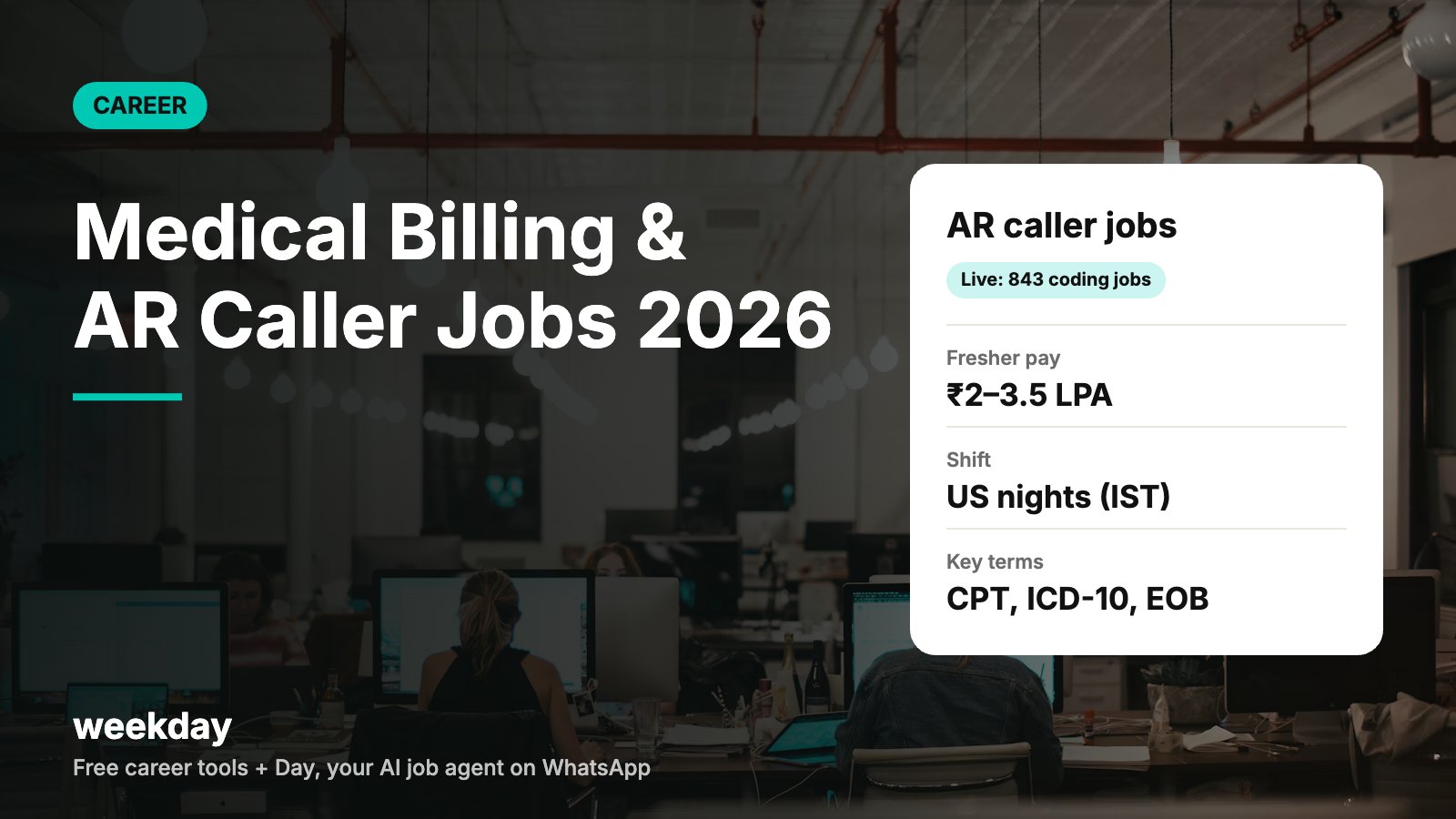
- Medical coding jobs: 843 open, 215 new this week
- Remote medical coding jobs: 61 open, 19 new this week
- Customer service jobs: 13,720 open, 3,834 new this week
- Fresher jobs: 8,637 open, 2,350 new this week
Sources: Weekday job listings (jobs posted in the last 30 days), counted on 16 November 2026. Pay ranges are indicative, based on typical Indian listings.
- Open ChatGPT and go to Plugins.
- Search Weekday Jobs and tap Try in chat (or open Weekday Jobs in ChatGPT).
- Ask in plain words, for example:
- “Find AR caller or medical billing jobs for freshers in Hyderabad or Chennai posted this week”
- “Show remote medical billing and medical coding jobs with US shift, 1–3 years experience”
- “List AR calling jobs with night shift allowance and pay above ₹25,000 a month”
Day, Weekday's free AI job agent, finds jobs that match your skills and pay, and applies when you say yes. On WhatsApp.
Say hi to Day on WhatsAppHow Day works →What is medical billing? US healthcare RCM in plain words
In the US, most patients do not pay the full bill at the clinic. The doctor or hospital (the provider) sends a claim to the patient's insurance company (the payer). The payer checks it, pays part of it, denies it or asks for more information. The patient pays whatever is left, such as a copay or deductible.
This whole money journey is called revenue cycle management (RCM). US providers outsource large parts of it to India, because it needs many trained people working on US hours. That is why cities like Hyderabad, Chennai and Noida have thousands of medical billing seats.
| RCM stage | What happens | Typical Indian job title |
|---|---|---|
| Front end: scheduling and registration | Patient details and insurance are entered before the visit | Patient registration executive |
| Eligibility and benefits verification | Check that the patient's plan is active and covers the service | Eligibility / EVBV executive |
| Prior authorization | Get payer approval before certain procedures or scans | Prior auth executive |
| Medical coding | Turn the doctor's notes into CPT and ICD-10 codes | Medical coder (CPC, CCS) |
| Charge entry | Enter codes, charges and provider details into the billing software | Charge entry executive |
| Claim submission | Send clean claims to payers, usually through a clearinghouse | Billing executive |
| Payment posting | Record payments and adjustments from EOBs and ERAs | Payment posting executive |
| AR follow-up | Chase unpaid and denied claims with payers | AR caller / AR analyst |
| Denial management | Find the root cause of denials, appeal and correct | Denial management analyst |
What does an AR caller actually do?
An AR caller works a list of unpaid claims, usually sorted by age and value. For each one, you check the claim in the billing software, then call the payer's provider helpline (or use the payer's online portal), speak with a representative and find out the status. Then you note the outcome and take the next action: resubmit, correct, appeal or send to coding.
Sample AR call (simplified)
Representative: Thank you for calling. How can I help you?
AR caller: Hi, this is [Name] calling on behalf of [Provider name]. I'm calling to check the status of a claim. Can I give you the provider's NPI and tax ID?
Representative: Go ahead.
AR caller: NPI is [10 digits], tax ID [number]. Patient name [Name], date of birth [DOB], member ID [ID]. Date of service 12 September 2026, billed amount $240.
Representative: I see the claim. It was denied on 3 October.
AR caller: May I know the denial reason and the reason code?
Representative: CO-16, missing information. The referring provider's details were not on the claim.
AR caller: Thank you. Can it be corrected and resubmitted, and what is the timely filing limit?
Representative: Yes, send a corrected claim. Filing limit is 90 days from the date of service.
AR caller: Got it. May I have the call reference number and your name, please?

Note in software: DOS 09/12/26, denied CO-16, referring provider missing. Rep [name], ref # [number]. Corrected claim to be sent; TFL 90 days from DOS. Sent to billing team.
A typical night shift
| Time (IST) | What you do |
|---|---|
| 7:00–7:30 PM | Log in, team huddle, get your claim worklist and targets for the day |
| 7:30–11:30 PM | Calls and portal checks; aim for your daily target of claims worked |
| 11:30 PM–12:30 AM | Meal break (often 30–60 minutes split across the shift) |
| 12:30–3:30 AM | More calls, appeals, corrected claims, notes in the billing software |
| 3:30–4:30 AM | Update tracker, quality checks, hand over pending items |
Exact timings depend on the US time zone your client is in and on daylight saving. A US Eastern client usually means about 6:30 PM–3:30 AM IST in US summer and 7:30 PM–4:30 AM IST in US winter. West Coast clients start later. Many companies give a night allowance and cab drop, so ask about both at the offer stage. Our guide to night shift jobs from home has tips on sleep and health.
AR caller salary in India (2026)
| Level | Experience | Typical CTC (indicative) |
|---|---|---|
| Trainee / fresher AR caller | 0–1 year | ₹2–₹3.5 LPA |
| AR caller / AR analyst | 1–3 years | ₹3–₹4.8 LPA |
| Senior AR analyst / denial specialist | 3–5 years | ₹4.5–₹6.5 LPA |
| Team lead / SME | 5+ years | ₹6–₹9 LPA |
Ranges are indicative, based on typical Indian listings. Large RCM firms and big-city offices usually pay more; shift allowance, incentives and cab facility vary by company.
Worked example: what lands in your account
Offer: ₹2.8 LPA CTC for an AR caller fresher, plus ₹2,000 a month night allowance.

Monthly CTC: ₹2,80,000 ÷ 12 ≈ ₹23,333
Employee PF (12% of basic; say basic ₹11,700): ≈ ₹1,404
Professional tax (varies by state): about ₹200
Estimated monthly in-hand: ≈ ₹21,700
Plus night allowance ₹2,000 → about ₹23,700 a month
Run your own numbers in the In-Hand Salary Calculator before you accept.
Skills you need
| Skill | Why it matters | How to build it |
|---|---|---|
| Clear spoken English, US accent-neutral | You spend most of the shift on the phone with US reps | Record yourself; practise the call script above |
| Listening and note-taking | Wrong notes mean wrong follow-up and lost money | Write the 5 Ws for every call: what, why, when, who, ref # |
| RCM basics | You must know where a denial came from | Free YouTube RCM series, short paid courses |
| Denial codes and appeals | Core of the job | Learn the 15 most common codes first |
| Excel | Worklists, aging reports, trackers | Filters, VLOOKUP, pivot tables |
| Billing software and payer portals | Daily tools | Learned on the job in training |
Glossary: terms you'll hear on day one
| Term | Meaning (in simple words) |
|---|---|
| CPT | Codes for what the doctor did: a visit, test or procedure. Five characters, maintained by the American Medical Association. |
| ICD-10-CM | Codes for why the patient came: the diagnosis. The diagnosis must support the procedure, or the claim may be denied. |
| NPI | The provider's 10-digit National Provider Identifier. |
| CMS-1500 / UB-04 | Standard claim forms: CMS-1500 for doctors and clinics, UB-04 for hospitals. |
| EOB / ERA | Explanation of Benefits (paper or PDF) and Electronic Remittance Advice. They show what was paid, adjusted or denied, and why. |
| Denial / reason codes | Standard codes on the EOB that explain a denial or adjustment, grouped as CO (contractual), PR (patient responsibility) or OA (other). |
| Timely filing limit | Deadline to submit or correct a claim. It differs by payer and contract. |
| AR aging | Unpaid claims grouped by age: 0–30, 31–60, 61–90, 90+ days. Older AR is harder to collect. |
| Appeal | A formal request asking the payer to reconsider a denied claim, often with medical records. |
| HIPAA | US law on protecting patient health information. You'll sign a confidentiality agreement. |
Common denial reasons, described generally
| Example code | General meaning | Usual next step |
|---|---|---|
| CO-16 | Claim is missing information or has an error | Find the missing field, send a corrected claim |
| CO-29 | Timely filing limit has passed | Look for proof of earlier submission; appeal if you have it |
| CO-45 | Charge is above the contracted fee | Usually an adjustment, not a true denial |
| CO-50 | Service not deemed medically necessary | Check coding; appeal with records if valid |
| CO-97 | Payment included in another service | Review bundling and modifiers with coding |
| CO-197 | Prior authorization missing | Check if auth exists; if not, appeal or bill per policy |
| PR-1 / PR-2 / PR-3 | Deductible, coinsurance or copay owed by the patient | Bill the patient; not a payer issue |
Codes and their exact wording are set by US standards bodies and can change. Your employer's training will cover the current list and each client's rules.
10 AR caller interview questions, with answers
Sample answers
1. What is RCM?
Revenue cycle management is the full process of getting a US healthcare provider paid, from patient registration and insurance checks to coding, billing, payment posting and AR follow-up on unpaid claims.

2. What does an AR caller do?
I call insurance companies about unpaid or denied claims, find the reason, and take the next step so the provider gets paid: resubmit, correct, appeal or move it to the right team.

3. What is the difference between CPT and ICD-10?
CPT codes describe what was done to the patient. ICD-10 codes describe why, the diagnosis. The diagnosis must support the procedure.

4. What is an EOB?
An Explanation of Benefits. It shows what was billed, what the payer allowed and paid, what the patient owes, and the reason codes for any adjustment or denial.

5. What is a denial vs a rejection?
A rejection happens before the payer accepts the claim, often for format errors, so it is fixed and resent. A denial happens after the payer processes it and refuses payment for a reason.

6. What will you ask the rep on a denied claim?
Denial date, reason and code, whether it can be corrected or needs an appeal, the filing or appeal limit, where to send it, and the call reference number and rep name.

7. What is timely filing?
The deadline to send a claim or correction to a payer. If you miss it, the claim can be denied and the money lost, so I always ask for it.

8. What is AR aging and why does it matter?
It groups unpaid claims by age. Older claims are harder to collect, so we prioritise high-value claims close to their deadlines.

9. How would you handle a rude or unhelpful representative?
Stay polite, ask clear questions, and if needed, request a supervisor or call back for another rep. My goal is the information, not winning the argument.

10. Are you comfortable with night shifts?
Yes. I have planned my sleep and family routine around US hours, and I understand that consistency on shift is part of the job.
For general HR rounds, also prepare “Tell me about yourself” with a 30-second version that mentions your communication skills and interest in healthcare.
Fresher route into medical billing
| Weeks | Focus | Output |
|---|---|---|
| 1–2 | Learn RCM stages, CPT vs ICD-10, EOB basics | Explain RCM in 1 minute without notes |
| 3–4 | Memorise 15 common denial codes; practise the call script aloud | Two mock calls recorded and reviewed |
| 5–6 | Excel: filters, VLOOKUP, pivot for AR aging | A sample aging sheet for interviews |
| 7–10 | Apply to AR caller, AR analyst, medical billing and eligibility roles | 30–40 applications; walk-in drives where offered |
| 11–12 | Voice and versant-style English tests, HR rounds | First offer; plan a move to denial management or coding |
Most companies hire any graduate, and some take 12th pass candidates with good English. Life science graduates (B.Pharm, B.Sc, nursing) have an edge if they later want to move into medical coding, which usually needs a certification such as CPC and pays more over time. Remote coding roles are fewer (61 live on Weekday), so most people start in an office.
Scam warning
Real RCM companies do not charge you for training or a job. Some institutes sell “guaranteed placement” packages; check reviews and placement proof before paying for any course. To skip the noise, let Day, Weekday’s AI job agent send you matching AR caller roles and apply when you say yes.
FAQs
What is an AR caller job?
An AR caller works in US medical billing. You call US insurance companies about unpaid or denied claims for doctors and hospitals, find the reason and take action so the claim gets paid.
What is the salary of an AR caller in India?
Freshers usually earn around ₹2–₹3.5 LPA. With 1–3 years, it's often ₹3–₹4.8 LPA, and senior analysts or team leads earn around ₹4.5–₹9 LPA. Night allowance and incentives vary.
Is AR calling a night shift job?
Mostly yes. You work on US hours, which is usually around 6:30 PM–3:30 AM or 7:30 PM–4:30 AM IST, depending on the client's time zone and US daylight saving.
Can a fresher become an AR caller?
Yes. Many RCM companies hire freshers with good spoken English and train them for 2–6 weeks. Any graduate can apply; some roles accept 12th pass.
What is the difference between medical billing and medical coding?
Coding turns doctors' notes into CPT and ICD-10 codes. Billing uses those codes to create claims, send them and follow up for payment. AR calling is part of billing.
Are there work-from-home AR caller jobs?
Some, mostly for experienced callers, because of data security rules. On 16 November 2026, Weekday listed 61 remote medical coding jobs; check each RCM listing for its work mode.
What are CO and PR codes?
They are groups of reason codes on an EOB. CO usually means a contractual adjustment the provider must absorb, and PR means the patient is responsible for that amount.
What is the career growth for an AR caller?
Common steps are senior AR analyst, denial management specialist, quality analyst, team lead and RCM manager. Some move into medical coding or US healthcare analytics.