
Last updated: November 2026 · Salary data from Weekday salary pages
A DevOps engineer makes sure code gets from a developer's laptop to real users quickly and safely, and keeps it running once it is there. When a payments app updates on a Friday evening without going down, a DevOps team made that possible.
This roadmap shows what to learn, in what order, a week-by-week plan, projects to build, and what DevOps engineers earn in India, using salaries shared on Weekday.
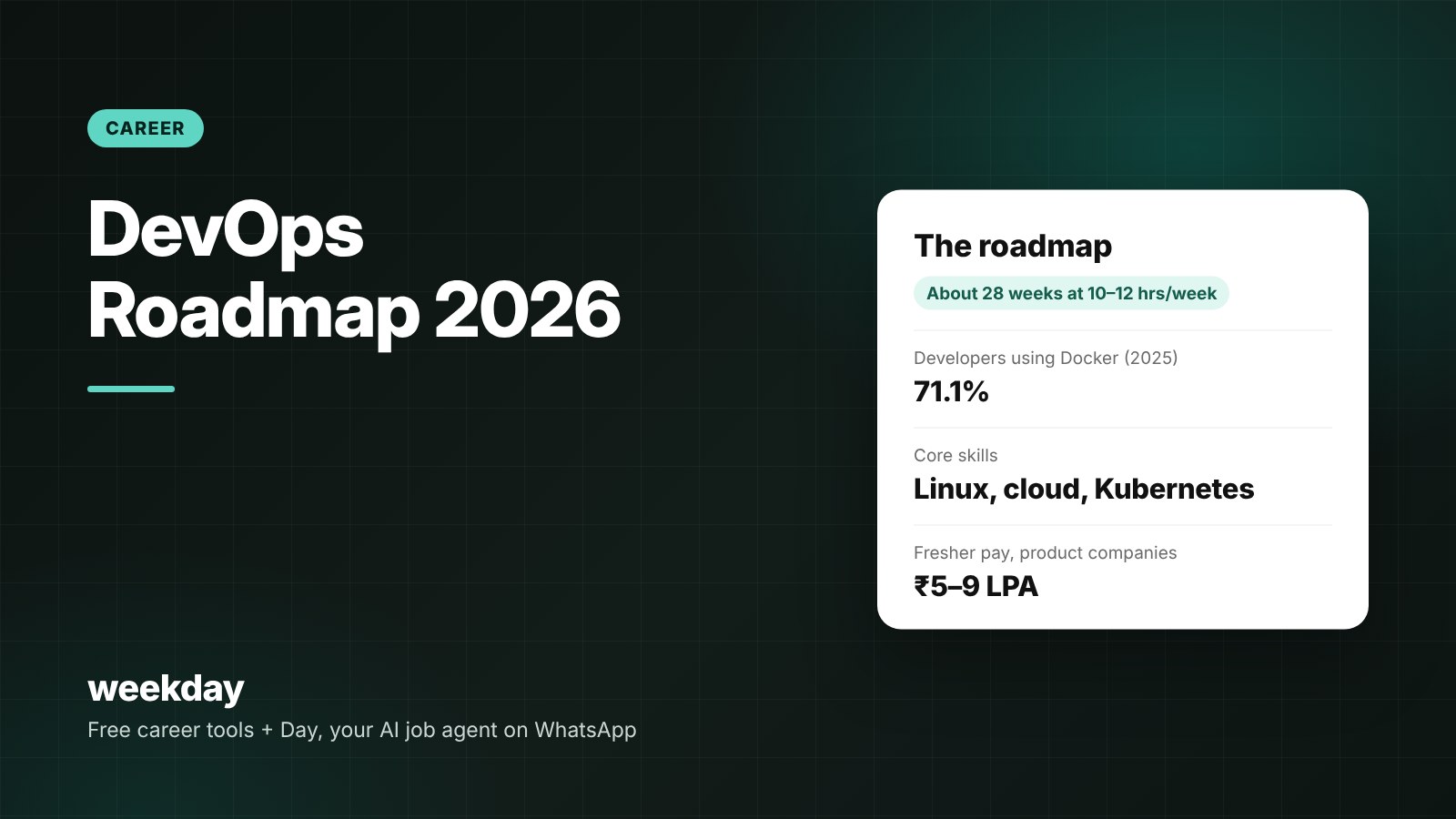
The roadmap in one line: Linux → networking basics → Git → Bash and Python scripting → one cloud (AWS, Azure or GCP) → Docker → CI/CD → Kubernetes → Terraform → monitoring → projects. Our suggested plan fits this into about 28 weeks at 10 to 12 hours a week.
What does a DevOps engineer do?
Most of the work falls into four buckets:
- Build and release: pipelines that test and deploy code automatically
- Infrastructure: servers, networks and databases in the cloud, written as code
- Reliability: monitoring, alerts and fixing outages
- Cost and security: keeping the cloud bill and access under control
Titles vary. You will see DevOps Engineer, Cloud Engineer, Site Reliability Engineer (SRE) and Platform Engineer in job posts. The skills overlap heavily. See our guide to DevOps engineer roles and skills for the detail.
Why these tools? A quick reality check
The Stack Overflow Developer Survey 2025 shows how widely DevOps tools are now used by developers in general:
| Tool | Share of all respondents using it |
|---|---|
| Docker | 71.1% |
| AWS | 43.3% |
| Kubernetes | 28.5% |
| Microsoft Azure | 26.3% |
| Google Cloud | 24.6% |
| Terraform | 17.8% |
Docker usage jumped 17 percentage points from 2024 to 2025, according to Stack Overflow's survey announcement. In plain words: containers are now a basic skill, and DevOps engineers are expected to know them well.
The DevOps roadmap: 10 steps
Step 1: Linux (weeks 1–3)
- The command line: files, permissions, users, processes
- Package managers, services and logs (systemctl, journalctl)
- Editing files with vim or nano over SSH
You are ready when: you can set up a fresh Linux server, install a web server and find out why it crashed from the logs.
Step 2: Networking basics (weeks 4–5)
- IP addresses, ports, DNS, HTTP and HTTPS
- Load balancers, proxies and firewalls
- Debugging with ping, curl, dig and netstat
Step 3: Git (week 6)
Branches, merges, pull requests and tags. Every pipeline you build later starts with a Git push.
Step 4: Scripting with Bash and Python (weeks 7–9)
- Bash: loops, variables, cron jobs, small automation scripts
- Python: reading files, calling APIs, writing a small CLI tool
Python is used by 57.9% of developers in the same Stack Overflow survey, so it is worth learning properly. Revise with our Python interview questions.
Step 5: One cloud (weeks 10–13)
Pick one cloud and learn it well. AWS is a safe default because it is the most used cloud in the survey above; choose Azure or Google Cloud if the companies you target use them.
- Compute (EC2), storage (S3), networking (VPC, security groups)
- Identity and access (IAM), managed databases (RDS)
- Billing alerts, so a test project never surprises you with a bill
Our AWS interview questions show what gets asked.
Step 6: Docker (weeks 14–15)
- Images, containers, volumes and networks
- Writing a clean Dockerfile, multi-stage builds
- Docker Compose for an app plus database
Step 7: CI/CD (weeks 16–18)
- GitHub Actions or Jenkins: build, test, deploy on every push
- Secrets, environments and approvals
- Rollbacks when a release goes wrong
Step 8: Kubernetes (weeks 19–22)
- Pods, deployments, services, ingress
- ConfigMaps, secrets and resource limits
- Helm charts and a managed cluster (EKS, AKS or GKE)
You are ready when: you can deploy a three-service app to a cluster, scale it and roll back a bad release.
Step 9: Infrastructure as Code with Terraform (weeks 23–24)
Write your cloud setup as code: a VPC, a server, a database and a load balancer. Learn state, modules and plan/apply. Ansible is useful later for configuring servers.
Step 10: Monitoring and security (weeks 25–26)
- Prometheus and Grafana for metrics and dashboards
- Centralised logs and alerts that wake the right person
- Scanning images and code for known vulnerabilities
Week-by-week plan
| Weeks | Focus | Output by the end |
|---|---|---|
| 1–5 | Linux, networking | A web server you set up and debugged yourself |
| 6–9 | Git, Bash, Python | Three automation scripts on GitHub |
| 10–13 | One cloud | An app running on a cloud VM with a domain and HTTPS |
| 14–18 | Docker, CI/CD | A pipeline that builds, tests and deploys on every push |
| 19–24 | Kubernetes, Terraform | A cluster created by Terraform, running your app |
| 25–28 | Monitoring, projects, applications | Dashboards and alerts live, resume ready, applying every week |
3 DevOps projects worth building
- End-to-end pipeline. A small web app with tests, a Docker image, a GitHub Actions pipeline and automatic deploys to the cloud.
- Kubernetes with Terraform. Create a managed cluster with Terraform, deploy a frontend, backend and database with Helm, and add autoscaling.
- Monitoring stack. Prometheus and Grafana dashboards for your app, with an alert when error rates go up. Write down how you tested the alert.
Document each one: a diagram, the steps to run it, and one thing that broke and how you fixed it.
Certifications: useful, not required
Certifications help your resume get past a filter, especially at service companies. The common ones are AWS Certified Cloud Practitioner, then AWS Solutions Architect Associate, Microsoft Azure Administrator, Certified Kubernetes Administrator (CKA) and HashiCorp Terraform Associate. Do them after the projects, not instead of them.
DevOps engineer salary in India
Weekday's DevOps engineer salary guide puts freshers at ₹5–9 LPA at product companies and ₹3.5–5.5 LPA at IT services firms. Engineers with 2 to 4 years earn ₹12–22 LPA, and seniors with 8 to 11 years earn ₹38–65 LPA.
Here is the median DevOps Engineer salary at companies with enough data on Weekday (fixed pay, all experience levels, read on 20 November 2026):
| Company | Median | Typical range |
|---|---|---|
| SAP | ₹15 LPA | ₹8.9–18.8 LPA |
| Amdocs | ₹12 LPA | ₹9–16 LPA |
| Persistent Systems | ₹10.5 LPA | ₹8.7–14.6 LPA |
| To The New | ₹10 LPA | ₹9–13 LPA |
| IBM | ₹8.5 LPA | ₹6.5–13 LPA |
| Ericsson | ₹8.5 LPA | ₹6.4–11.5 LPA |
| Capgemini | ₹8.2 LPA | ₹5–10.8 LPA |
| Jio | ₹8 LPA | ₹5.8–9.5 LPA |
| Virtusa | ₹7.1 LPA | ₹5.6–11.2 LPA |
| Wipro | ₹7 LPA | ₹5–8.3 LPA |
| Infosys | ₹6.4 LPA | ₹4.3–10 LPA |
| Cognizant | ₹6.2 LPA | ₹4.9–7.2 LPA |
| TCS | ₹6 LPA | ₹4.5–9 LPA |
Two lessons. First, product and platform companies such as SAP and Amdocs pay about twice what large IT services firms pay for the same title. Second, the range inside one company is wide, so deep Kubernetes and cloud skills can move you to the top of the band. Weekday's salary guide also notes that SRE roles typically pay 20–30% more than DevOps at the same experience.
Three ways into DevOps
- From support or system admin: you already know Linux and production issues. Add scripting, Docker and one cloud.
- From development: you know code and Git. Add Linux, networking and infrastructure as code.
- As a fresher: follow the full roadmap, and apply for cloud support, junior DevOps and build/release roles. See our DevOps fresher resume guide.
How DevOps interviews work
- Screening: Linux commands, networking basics and Git
- Technical round: Docker, CI/CD, Kubernetes and your cloud of choice
- Scenario round: "The site is slow after a deploy. What do you check first?"
- Project deep dive and HR round
Prepare with our DevOps interview questions and Azure DevOps interview questions.
Mistakes that slow people down
- Starting with Kubernetes. Without Linux and networking, Kubernetes errors make no sense.
- Collecting certificates without projects. Interviewers ask what you built.
- Learning three clouds at once. Go deep on one first.
- Leaving cloud resources running. Set billing alerts on day one.
Ready to apply?
See open DevOps engineer roles on Weekday at startups, product companies and GCCs, with filters for experience and city.
Frequently asked questions
How long does it take to become a DevOps engineer?
Our suggested plan takes about 28 weeks at 10 to 12 hours a week, covering Linux, networking, scripting, one cloud, Docker, CI/CD, Kubernetes, Terraform, monitoring and three projects.
Can a fresher become a DevOps engineer?
Yes. Many freshers start in cloud support or junior DevOps roles. Weekday's salary guide puts fresher pay at ₹5–9 LPA at product companies and ₹3.5–5.5 LPA at IT services firms.
Does DevOps need coding?
Some. You need Bash and Python for automation, and you must read application code and YAML files. You do not need to be a full-time developer.
Which cloud should I learn for DevOps?
Start with AWS unless your target companies use Azure or Google Cloud. AWS was used by 43.3% of developers in the Stack Overflow 2025 survey, more than Azure or Google Cloud.
Is DevOps a good career in India?
Yes. Every company that runs software in the cloud needs DevOps skills, and pay grows quickly with experience: Weekday's salary guide puts engineers with 2 to 4 years at ₹12–22 LPA.





