Last updated: November 2026
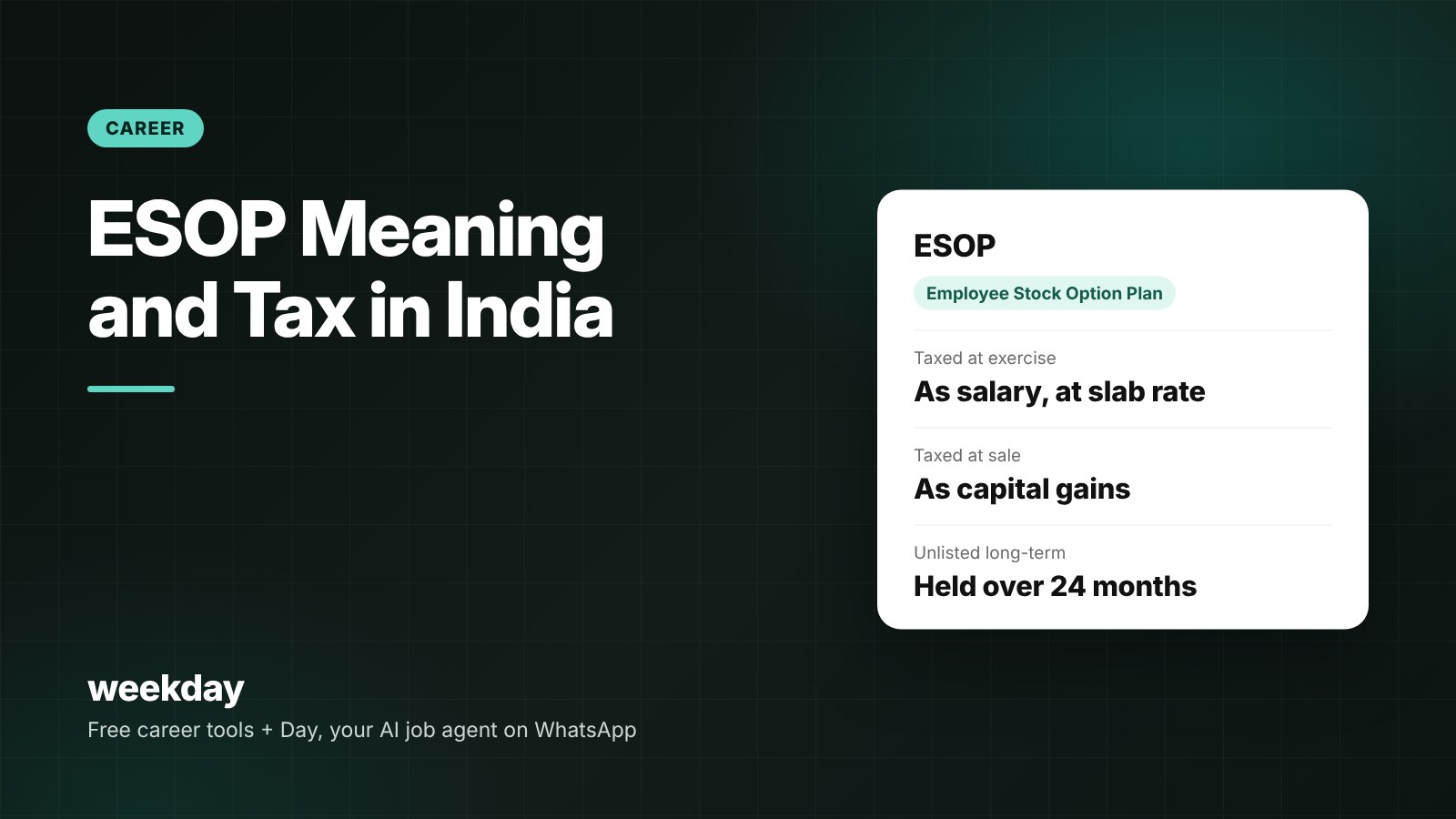
ESOP stands for Employee Stock Option Plan. It gives you the right, but not the duty, to buy a fixed number of your company's shares at a fixed price, after you have worked there for a set time (Treelife).
Example: a startup grants you 1,000 options at ₹50 each. Two years later, the share is valued at ₹300. You can pay ₹50,000 to buy shares worth ₹3 lakh on paper. That ₹2.5 lakh gap is what makes ESOPs valuable, and also what gets taxed.
Below: how ESOPs work step by step, how they are taxed in India, the special rule for startups, and how to value ESOPs in a job offer.
How ESOPs work: grant, vest, exercise, sell
| Step | What happens | Tax? |
|---|---|---|
| 1. Grant | The company promises you a number of options at a set exercise price | No |
| 2. Vesting | Options become yours over time, as per the vesting schedule | No |
| 3. Exercise | You pay the exercise price and get actual shares | Yes, as salary |
| 4. Sale | You sell the shares in a buyback, IPO or on the stock market | Yes, as capital gains |
Grant and vesting are not taxed. Exercise and sale are the two taxable events (EquityList). Until you exercise, options carry no voting rights or dividends.
Key ESOP terms
- Exercise (strike) price: what you pay per share. In early startups it is often very low.
- Vesting schedule: how options become yours. A common pattern is 25% a year over 4 years.
- Cliff: the minimum time before anything vests. With a 1-year cliff, nothing vests if you leave before your first anniversary.
- Exercise period: the window to exercise vested options, especially after you leave. If you miss it, the options lapse.
- Fair market value (FMV): the share's value on a date. For unlisted companies, it comes from a registered valuer.
- Buyback: when the company or an investor buys shares back from employees. For a private company, this is often the only way to turn ESOPs into cash before an IPO.
How ESOPs are taxed in India
You pay tax twice: once when you exercise, and again when you sell.
1. At exercise: taxed as salary
The gain at exercise is a "perquisite" and is added to your salary for that year:
It is taxed at your slab rate, your employer deducts TDS on it, and it shows in your Form 16 (EquityList). For an unlisted company, the FMV must come from a SEBI-registered Category I merchant banker's valuation not older than 180 days.
2. At sale: taxed as capital gains
Your cost is the FMV on the exercise date, not the price you paid. So the capital gain is sale price minus FMV at exercise. The rate depends on the type of share and how long you held it (EquityList):
| Shares | Short-term | Long-term |
|---|---|---|
| Listed (on an Indian exchange) | Held 12 months or less: 20% | Held over 12 months: 12.5% on gains above ₹1.25 lakh a year |
| Unlisted (most startups) | Held 24 months or less: your slab rate | Held over 24 months: 12.5% |
Worked example
You exercise 1,000 options at ₹50 when the FMV is ₹300, and you are in the 30% slab. Later you sell all 1,000 unlisted shares at ₹420 in a buyback, 20 months after exercise. Ignoring surcharge:
| Amount | |
|---|---|
| You pay to exercise (1,000 × ₹50) | ₹50,000 |
| Perquisite at exercise (1,000 × ₹250) | ₹2,50,000 |
| Tax at exercise (30% + 4% cess) | ₹78,000 |
| Capital gain at sale (1,000 × ₹120) | ₹1,20,000 |
| Tax at sale (short-term, slab rate 30% + 4% cess) | ₹37,440 |
| Total tax | ₹1,15,440 |
| Cash you keep (₹4,20,000 − ₹50,000 − ₹1,15,440) | ₹2,54,560 |
Notice the trap: the ₹78,000 is due when you exercise, even though you cannot sell unlisted shares until a buyback or IPO. Plan the cash before you exercise.
The startup tax deferral
Employees of eligible startups can delay the exercise-time tax. The startup must be DPIIT-recognised and hold the certificate that makes it eligible for the startup tax benefit. The tax is then due at the earliest of: 48 months from the end of the assessment year, when you sell the shares, or when you leave the company (Treelife). Under the Income-tax Act, 2025, for shares allotted from 1 April 2026, the window is 60 months from the end of the tax year of allotment (EquityList).
Few startups qualify. Fewer than 4,000 hold the certificate, out of nearly 2 lakh DPIIT-recognised startups (Outlook Business). So ask HR directly whether your ESOPs get the deferral.
ESOP vs RSU vs ESPP
| ESOP | RSU | ESPP | |
|---|---|---|---|
| What you get | Option to buy shares at a set price | Shares given to you on vesting | Right to buy shares at a discount |
| Do you pay? | Yes, the exercise price | No | Yes, the discounted price |
| Taxed as salary when | You exercise | Shares vest | You buy (on the discount) |
| Common at | Startups | Listed tech companies and MNCs | Listed MNCs |
RSUs have no exercise price, so their full value at vesting is taxed as salary (Treelife). That is simpler, but in an unlisted company it means tax with no shares to sell.
How to value ESOPs in a job offer
A startup offer might say "₹30 LPA fixed + ₹10 lakh ESOPs". The ₹10 lakh is a paper value. Ask HR these questions before you count any of it:
- How many options, and what share of the company is that?
- What is the exercise price, and what is the latest FMV per share?
- What is the vesting schedule and cliff?
- How long can I exercise vested options after I leave?
- Has the company ever done an ESOP buyback?
- Do my ESOPs qualify for the startup tax deferral?
Then compare offers on fixed pay first. That is how Weekday's salary pages report pay: fixed CTC, excluding bonus and stock. See the fixed pay at Razorpay, CRED or Meesho before you negotiate. Treat ESOPs as a bonus that may pay off, not as salary. For the cash parts, read CTC vs in-hand salary, and use our salary negotiation guide to ask for more fixed pay.
What happens to your ESOPs when you leave
- Unvested options lapse on your last day.
- Vested options must be exercised within the exercise period in your plan, or they lapse. Read this clause before you resign.
- Exercising means paying the exercise price plus the perquisite tax. If you were on the startup deferral, leaving ends it, so the deferred tax falls due.
- Already-exercised shares stay yours. You sell them in a later buyback or IPO.
Weighing a startup offer with ESOPs?
Tell Day, Weekday's free AI recruiter on WhatsApp, what you want. For example: "Backend dev, 4 yrs, want 30+ LPA fixed at a funded startup". Day finds roles that match your pay and skills and applies when you say yes.
Frequently asked questions
What is the full form of ESOP?
Employee Stock Option Plan. Some companies call it an Employee Stock Ownership Plan, but in India "ESOP" almost always means stock options.
Is ESOP part of CTC?
Some offers show ESOPs inside "total compensation", but they are never part of your monthly salary. Compare offers on fixed pay and treat ESOPs as extra.
When are ESOPs taxed in India?
Twice. At exercise, the gap between FMV and exercise price is taxed as salary. At sale, the gain over the FMV at exercise is taxed as capital gains.
What happens to ESOPs if I resign?
Unvested options lapse. Vested options must be exercised within the window in your plan, or they lapse too.
Are RSUs better than ESOPs?
RSUs are simpler because you do not pay to get the shares, and listed-company RSUs can usually be sold soon after they vest. ESOPs in a startup can be worth more if the company grows, but they carry more risk and need cash to exercise.