
Last updated: 23 November 2026
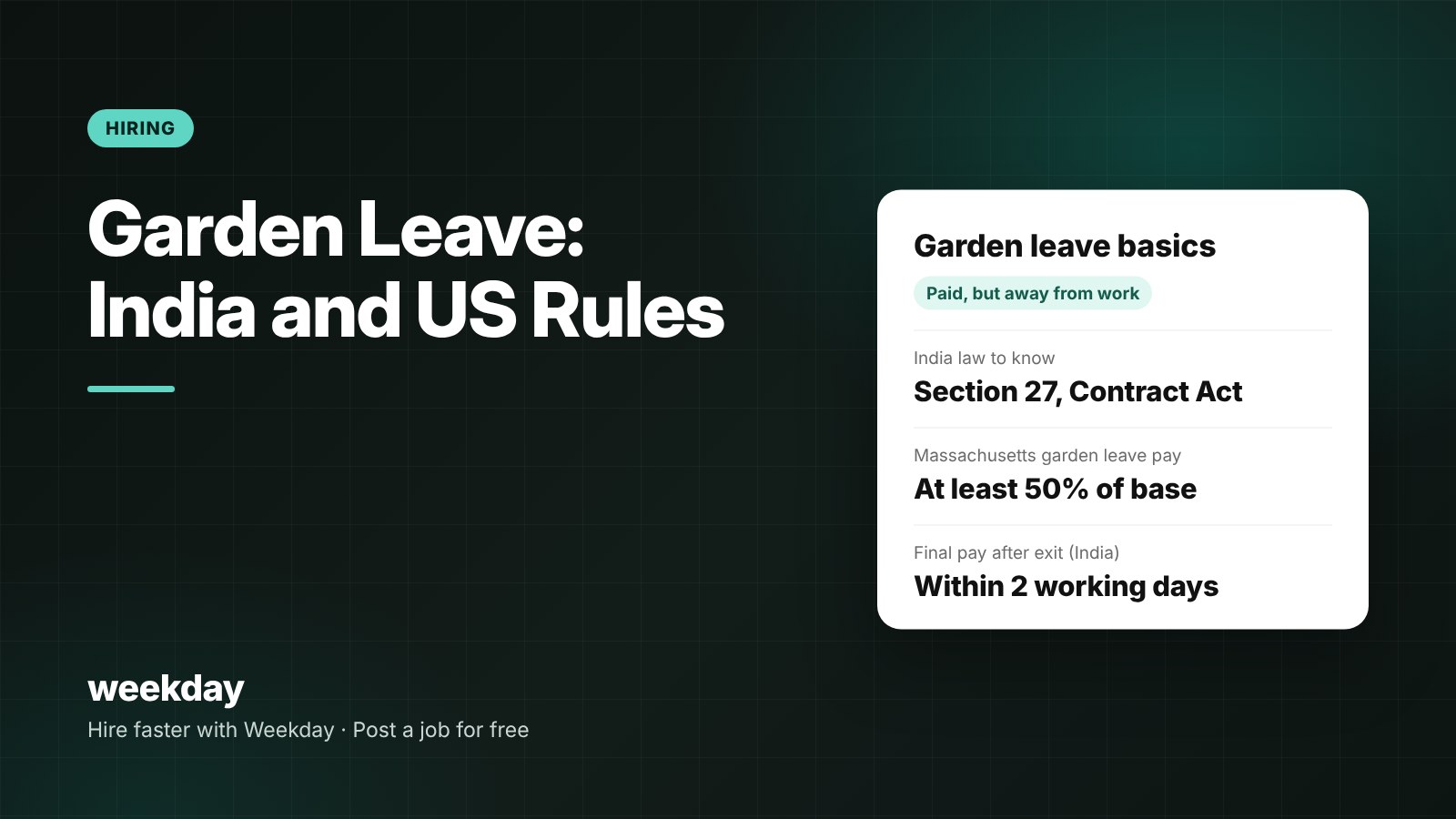
Quick answer: Garden leave is when you keep paying an employee who is leaving but ask them not to come to work. It usually covers all or part of their notice period. They stay on your payroll, but they lose access to your systems, clients and team. In India, garden leave is safest when it stays inside the notice period and you pay full salary. A clause that stops someone from working after their employment ends is likely to fail under Section 27 of the Indian Contract Act. In the US, it is mostly used for senior and finance roles, and Massachusetts ties it to non-compete agreements.
Most employees in India serve a notice period of 30 to 90 days, and senior roles can go longer (Weekday notice period guide). For most roles, that time is useful. The person hands over work and helps hire their replacement. But sometimes you don't want the person in the building at all. Maybe they are joining a direct competitor. Maybe they own your top client relationships. That is where garden leave comes in.
What garden leave means
The name comes from the UK. The idea is simple: the employee is paid to stay home and "tend the garden" instead of working. They are still your employee until the last working day. So they still owe you the duties in their contract, like confidentiality, and they can't start a new job yet.
Example: a sales head at a Bengaluru SaaS company resigns with a 90-day notice period. She is joining a competitor. The company asks her to spend two weeks on handover, then puts her on garden leave for the rest of her notice. She gets her full salary and benefits. Her laptop and CRM access are switched off, and she doesn't call clients. Her new employer gets her on day 91, not earlier.
Garden leave vs notice period vs pay in lieu
| Option | Is the person still employed? | Do they work? | When it fits |
|---|---|---|---|
| Serving the notice period | Yes | Yes, full duties | Most exits. You need the handover. |
| Garden leave | Yes, until the last day | No, or only answers questions | Person going to a competitor or holding sensitive data |
| Pay in lieu of notice / early release | No, employment ends early | No | You want a clean, fast exit and don't need to stop them joining someone else |
| Post-exit non-compete | No | No restriction while employed. The restriction starts after exit | Hard to enforce in India. Restricted in parts of the US |
If you only want the person gone fast, early release is simpler. Weekday's notice period guide covers buyouts and early release from the employee side.
Is garden leave legal in India?
There is no separate garden leave law in India. It comes from the employment contract. The key rule is Section 27 of the Indian Contract Act, 1872, which makes agreements that restrain someone from a lawful profession or trade void.
Indian courts have drawn a line between the time someone is employed and the time after:
- During employment, including notice: asking someone to stay home on full pay is generally treated as part of the job you are paying for.
- After employment ends: stopping someone from working is a restraint of trade. In VFS Global Services v. Suprit Roy (Bombay High Court, 2008), the court refused to enforce a garden leave clause that was meant to operate after the employment had ended.
So the safe pattern for Indian employers is: keep garden leave inside the notice period, pay the full salary and benefits, and don't stretch it past the last working day.
One more rule changed recently. Under Section 17 of the Code on Wages, 2019, in force since 21 November 2025, wages must be paid within two working days of a termination or resignation. If someone is on garden leave until 28 February, plan their full and final settlement for the first working days after that date, not weeks later.
This is general guidance, not legal advice. Have your lawyer check the clause before you use it.
How garden leave works in the US
Most US jobs are at-will, so the employer can usually end employment without a long notice period. That makes garden leave less common. When people in HR discussed it in a r/humanresources thread, the top replies said it rarely comes up in the US outside contracts with fixed notice terms, usually at the C-suite level. A recruiter who hires for banks said it is fairly common for high-paying, high-impact roles, and another reply said finance firms use it even for fairly junior staff.
Massachusetts is the big exception. Under the Massachusetts Noncompetition Agreement Act, a non-compete must be backed by a garden leave clause or other agreed consideration. A garden leave clause there must pay, during the restricted period, at least 50 percent of the employee's highest annualized base salary from the two years before they left.
When employers should use garden leave
Use it when the risk of the person being at work is higher than the cost of paying them to stay away. Good cases:
- They are joining a direct competitor. You don't want them sitting in pricing or roadmap meetings for 60 more days.
- They own key client relationships. Sales heads and account managers can move deals while still on your payroll.
- They have deep system or data access. Engineers with production access, finance leads, people with your hiring pipeline.
- A sensitive event is coming. A fundraise, a launch or a big deal closing during their notice.
Skip it when the role is junior, when nothing sensitive is at stake, or when you need the person's handover more than you need the distance. Garden leave ends the handover, so get the handover done first.
How to set up garden leave (step by step)
- Put the clause in the contract. Add it to the offer letter or appointment letter for senior and sensitive roles. Our offer letter format guide shows where clauses like this sit.
- Finish the handover first. Give the person one or two weeks to document work and brief their replacement or manager.
- Tell them in writing. State the start date, the last working day, that pay and benefits continue, and what they can and can't do.
- Switch off access the same day. Laptop, email, code repos, CRM, Slack. Collect devices.
- Keep them reachable. Ask them to answer occasional handover questions by phone or personal email.
- Remind them of ongoing duties. Confidentiality and non-solicitation of clients and staff still apply.
- Plan the full and final settlement for the two working days after the last working day.
Sample garden leave clause (plain English)
"After you or the Company gives notice to end your employment, the Company may ask you not to attend work or perform some or all of your duties for all or part of the notice period. During this time you will remain an employee, receive your full salary and benefits, and continue to be bound by your duties of confidentiality and good faith. You must not start work with any other employer before your last working day."
Use this as a starting point and have your lawyer adapt it.
Hiring someone who is on garden leave
The other side matters too. When you hire a senior person, their current employer may put them on garden leave. They will feel free, but legally they still work there until the last day.
- Set the joining date after the last working day, not before.
- Don't give them work, system access or client calls before that date.
- Stay in touch every week so a counter offer doesn't pull them back.
This is part of why notice periods shape hiring plans in India. In a Weekday analysis of 148 LinkedIn hiring posts from 14 to 23 November 2026, 8 posts asked for immediate joiners or capped the notice period (for example "30 days or less" or "up to 2 months"). All 8 were roles based in India. We counted posts whose job details mentioned "immediate joiner" or a notice limit. Employers want people fast. Garden leave and long notice periods are the reason they often can't get them.
Someone senior just went on garden leave?
Start the backfill the same day. Paste your job description and Weekday's AI agents scan 400M+ profiles, check salary expectations and notice period, and reach out on email and WhatsApp. Your first role is free, with 200 reach-outs and no credit card.
Post a free jobFrequently asked questions
What is garden leave?
It is when an employer keeps paying an employee who is leaving but asks them to stay away from work, usually for all or part of the notice period. They stay on the payroll but lose access to systems, clients and the office.
Is garden leave paid?
Yes. The person is still employed, so they get their normal salary and benefits until the last working day. Unpaid time off is not garden leave.
Is garden leave legal in India?
Garden leave inside the notice period, on full pay, is generally treated as part of employment. A clause that stops someone working after employment ends runs into Section 27 of the Indian Contract Act, as the Bombay High Court found in VFS Global v. Suprit Roy.
Can an employee join a new company during garden leave?
Usually not. They are still employed until the last working day, so starting elsewhere earlier can breach their contract. New employers should set the joining date after garden leave ends.
Is garden leave a bad thing?
Not by itself. It is a normal way to protect clients and confidential information when someone senior leaves. It feels bad only when it is used as a punishment or explained badly.
Sources
- India Code: Section 27, Indian Contract Act, 1872
- VFS Global Services v. Suprit Roy, Bombay High Court (Indian Kanoon)
- PIB explainer: Code on Wages, 2019 (November 2025)
- Massachusetts General Laws, Chapter 149, Section 24L
- r/humanresources discussion on garden leave
- Weekday analysis of 148 LinkedIn hiring posts, Nov 2026 (posts dated 14 to 23 November 2026)
- Weekday: notice period guide





