
Last updated: 18 November 2026
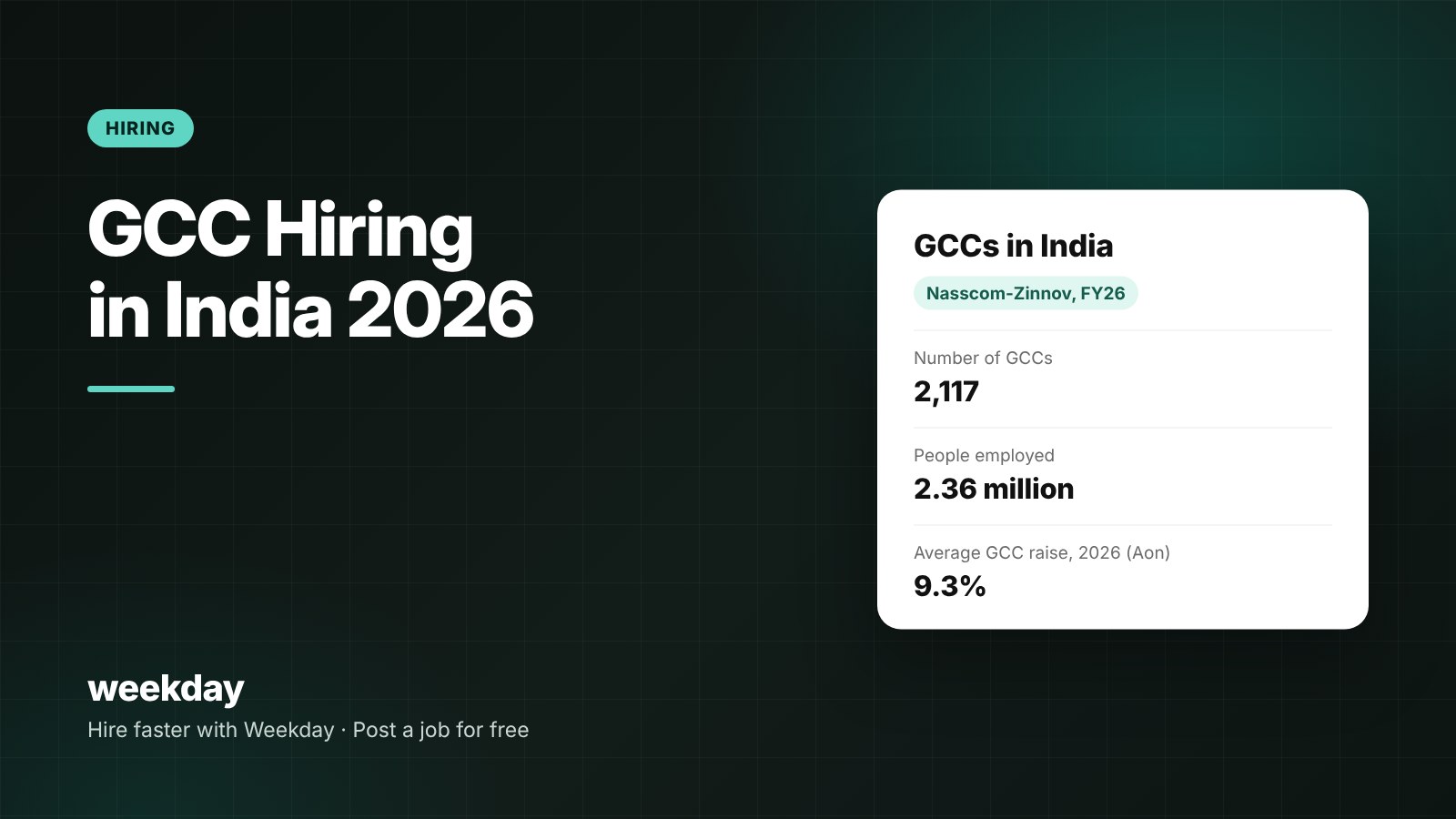
Quick answer: India has 2,117 global capability centres (GCCs) employing 2.36 million people, and they added nearly 200,000 employees in FY26, more than IT services firms did. To hire well for a GCC, benchmark against other GCCs and product companies (not IT services), plan for 60–90 day notice periods, build an AI hiring track early, and hire your first leaders before you scale the team.
What is a GCC?
A global capability centre (GCC) is a company's own office in another country that does core work for the parent company: engineering, product, data, finance, operations and more. Unlike outsourcing, the people are the parent company's own employees.
The GCC market in India, in numbers
From the Nasscom-Zinnov "GCC Value Orbit" report (YourStory):
- India is home to 2,117 GCCs employing 2.36 million professionals.
- GCC revenue reached $98.4 billion in FY26.
- GCCs have a talent base of 250,000 AI professionals, and more than 1,200 GCCs have AI and machine learning capabilities.
- 96% of GCCs set up after FY21 started with product or portfolio mandates from day one, not just support work.
Hiring is strong too. GCCs added nearly 200,000 employees in FY26, compared with around 110,000 at IT services firms, and pay salaries that are up to 40% higher. By 2030, GCCs plan to add roughly 400 new centres and grow their workforce to 3.5 million (NewsBytes, June 2026).
What GCCs pay in 2026
GCCs sit near the top of the Indian pay market, so they compete with product companies more than with IT services.
| Role (3–5 years) | GCC pay range | Source |
|---|---|---|
| AI engineer | ₹30–65 LPA | Weekday AI engineer guide |
| Data scientist | ₹28–62 LPA | Weekday data scientist guide |
| Full stack developer (4–6 years) | ₹18–35 LPA (product companies and GCCs) | Weekday full stack guide |
Raises are steady as well. Aon reports that GCCs gave an average salary increase of 9.3% in 2026 and project 9.4% for 2027, against 6.6% at technology consulting and services firms (Aon, October 2026).
The 5 hardest parts of GCC hiring
- Competing with other GCCs. Your best candidates are often already at another GCC or a product company. Benchmark pay against them, not against IT services.
- Notice periods. At MNCs and GCCs, notice is usually 60–90 days (Weekday notice period guide). A role filled in October may not start until January.
- AI and data talent. GCCs are moving from support to product and AI mandates. AI skills carry a premium: Aon says AI talent premiums in India rose about 10% from 2025.
- Hiring the first leaders. The site lead and first engineering managers shape everything. Rushing these hires is costly.
- Explaining the mandate. Expect senior candidates to ask early on: "Will I own real product work, or just tickets from headquarters?" Have a clear answer.
A hiring plan for a new or growing GCC
Phase 1: Leaders first (months 0–3)
Hire the site lead, one or two engineering managers and a talent acquisition lead. These people will interview everyone after them, so set a high bar and take your time.
Phase 2: Senior core (months 3–6)
Hire senior engineers and tech leads who can work directly with headquarters teams. Look for people who have worked across time zones and owned a product area end to end.
Phase 3: Scale (months 6–18)
Add mid-level and junior engineers in pods around each senior lead. This is where a fresher or campus program pays off. See Weekday's off-campus drives guide for what freshers are offered elsewhere.
Where to find GCC talent
- Other GCCs and product companies in the same city, especially in the main tech hubs: Bengaluru, Hyderabad, Pune, Chennai and Delhi NCR.
- Engineers at IT services firms who have worked on product teams for global clients and want to own product work.
- Returning Indians who worked abroad and want to come back.
- Passive candidates. Many strong senior engineers are not on job boards. Outbound with a specific, honest pitch about the mandate works better than a generic post.
Interview and offer tips
- Use structured interviews with the same questions and scorecards across HQ and India interviewers, so both sides agree on the bar.
- Show the full offer: base, bonus, stock (if any) and benefits. GCC candidates compare total pay carefully.
- Plan for counteroffers during long notice periods. Stay in touch every two weeks until the joining date.
- Consider buyouts. A new employer can cover a notice buyout as a joining bonus; it is taxed as salary, per Weekday's notice period guide.
How Weekday helps GCCs
Weekday's AI sourcing agent finds senior and specialist candidates, including passive ones, and reaches them over email, WhatsApp and phone. Weekday reports a 50%+ response rate across its platform (Weekday; a platform figure, not a promise for every role). You see interested candidates with their current and expected pay and notice period before you commit interview time.
Build an AI hiring track early
GCCs are becoming AI hubs. The Nasscom-Zinnov report counts 250,000 AI professionals in India's GCCs and more than 1,200 GCCs with AI and machine learning capabilities. If your GCC will own AI work, plan for it from the start:
- Create separate job levels and pay bands for AI and ML roles instead of squeezing them into general engineering bands.
- Hire one senior AI lead before junior AI engineers, so someone can set the technical bar.
- Use practical interviews, such as building a small retrieval system with evaluation, rather than theory-only rounds.
Ways to staff GCC hiring
A new GCC rarely has a full recruiting team on day one. Most mix two or three of these models:
| Model | Good for | Watch out for |
|---|---|---|
| In-house talent acquisition team | Long-term control, employer brand, steady hiring | Takes months to build; needs leaders first |
| Recruitment agency (contingency) | A few senior or niche roles fast | Fees per hire; quality varies by agency |
| Build-operate-transfer partner | Setting up the entity, office and first team together | Less control early; plan the hand-over carefully |
| AI sourcing and outreach platform | Building pipelines quickly for many roles at once | Still needs your team to interview and close |
One practical path is to start with a partner or agencies for the first leadership hires, then build an in-house team that uses sourcing tools to scale. Whatever the mix, keep one owner for the hiring plan and one shared scorecard per role, so quality stays the same as volume grows.
Setting up or scaling a GCC in India?
See matching senior talent, expected pay and notice periods for your roles.
Book a demoFrequently asked questions
What is a GCC in India?
A global capability centre is a multinational company's own office in India that does core work, such as engineering, data and operations, for the global business.
How many GCCs are there in India?
2,117, employing 2.36 million people, according to the Nasscom-Zinnov GCC Value Orbit report.
Do GCCs pay more than IT services companies?
Generally, yes. GCCs pay salaries up to 40% higher, per the Nasscom-Zinnov findings, and gave 9.3% average raises in 2026 against 6.6% at tech services firms (Aon).
How long does it take to hire for a GCC?
Add 60–90 days of notice to your interview time. Plan senior hires a quarter ahead.
Which cities are best for a GCC?
Bengaluru, Hyderabad, Pune, Chennai and Delhi NCR are the main tech hubs and among the highest-paying cities in Weekday's salary guides. Pick based on the skills you need and where your leaders want to live.





