
Last updated: 18 November 2026
Quick answer: A graduate trainee program hires fresh graduates into a structured track of training, mentoring and real project work, usually for 6–12 months, before they move into a permanent role. In India, median trainee pay on Weekday's salary data ranges from ₹3.5 LPA (Business Development Trainee at BYJU'S) to ₹7 LPA (Graduate Engineering Trainee at JSW Group), with top tech employers paying far more. Keep it simple: a short bootcamp, real work by week four, clear confirmation criteria and a fair salary.
Hiring freshers one at a time is slow and messy. A trainee program turns it into a system: one hiring cycle, one training plan and a batch of people who learn your way of working. Here is how to set one up, what to pay and where to find your first batch.
What is a graduate trainee program?
It is an entry-level hiring track for recent graduates. Trainees join as a group, go through planned training and rotations, and are confirmed into a regular role if they meet clear goals. Common names in India:
| Program name | Usually for | Typical employers |
|---|---|---|
| Graduate Engineer Trainee (GET) | Core engineering: mechanical, electrical, civil, production | Manufacturing, steel, energy, automotive |
| Software Engineer / Programmer Analyst Trainee | Software development, testing, support | IT services and tech companies |
| Management Trainee (MT) | Operations, finance, HR, sales leadership track | Banks, FMCG, consulting, BPM |
| Business Development Trainee | Sales and customer acquisition | Startups, edtech, SaaS |
Why run one in 2026
Fresher hiring is picking up. In TeamLease EdTech's Career Outlook survey of 1,097 employers, 75% planned to hire freshers between July and December 2026, up from 73% in the first half (People Matters).
But job-readiness is still uneven. The India Skills Report 2026 puts graduate employability at 56.35% (Careers360). In plain words: roughly half of graduates are ready to work on day one. A trainee program is how you hire for potential and close the rest of the gap yourself.
What companies pay graduate trainees in India
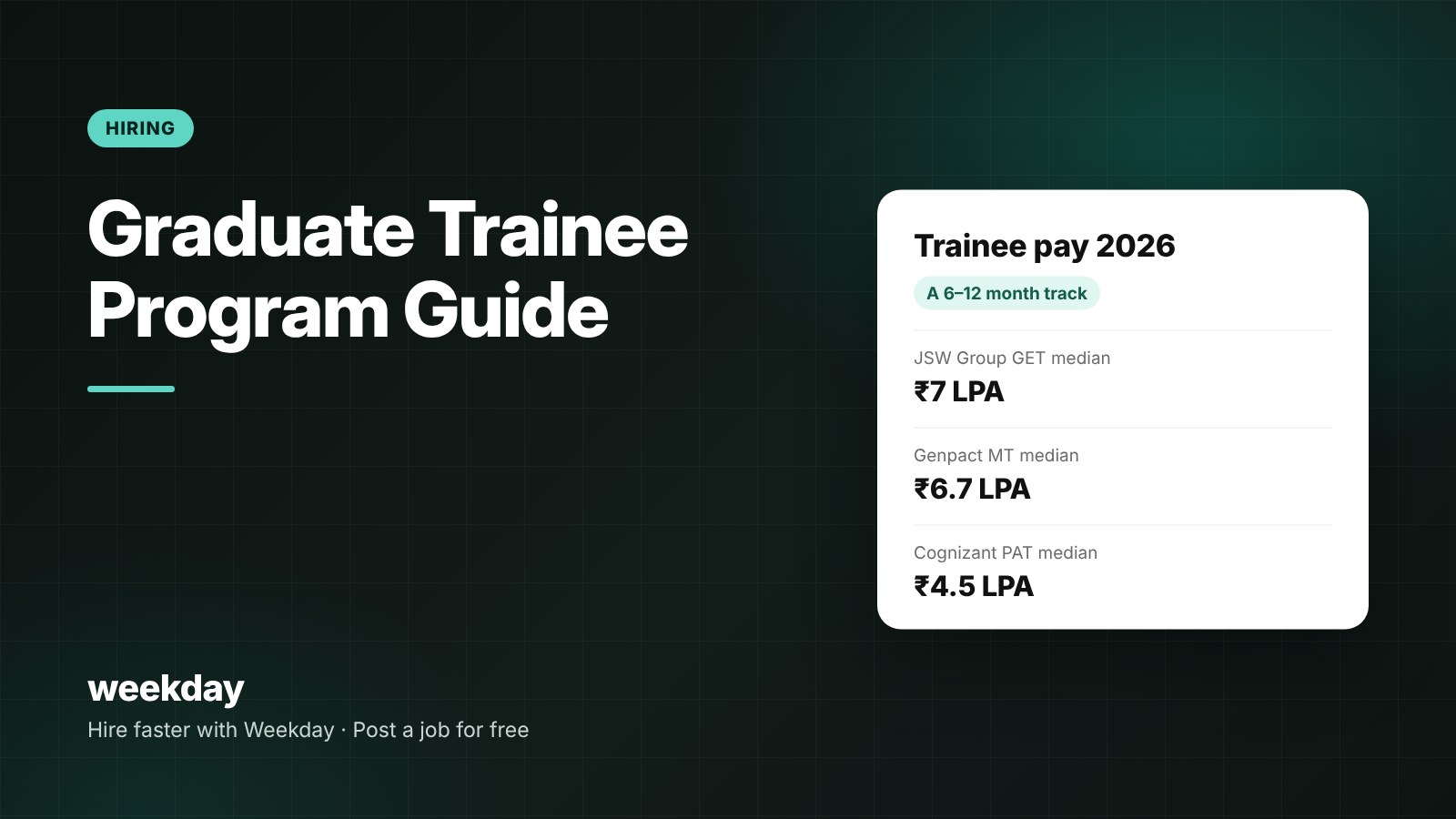
Median fixed pay (CTC excluding bonus and stock) from Weekday's salary data, November 2026:
| Employer and title | Median | Middle half | Salaries |
|---|---|---|---|
| JSW Group, Graduate Engineering Trainee | ₹7 LPA | ₹5.5–8 LPA | 47 |
| Genpact, Management Trainee | ₹6.7 LPA | ₹5.7–7.8 LPA | 255 |
| Cisco, Software Engineer Trainee | ₹4.5 LPA | ₹4.5–5 LPA | 64 |
| Cognizant, Programmer Analyst Trainee | ₹4.5 LPA | ₹4–4.5 LPA | 54 |
| KPIT Technologies, Trainee | ₹4.5 LPA | ₹4–4.8 LPA | 47 |
| BYJU'S, Business Development Trainee | ₹3.5 LPA | ₹3–5 LPA | 72 |
| Tesco, Graduate Software Development Engineer | ₹22.3 LPA | ₹22–24.2 LPA | 41 |
For context, freshers (0–1 year) at TCS earn a median of ₹4.3 LPA on the same data (Weekday). Product companies pay more for strong freshers: Weekday's salary guides put fresher full stack developers at ₹10–18 LPA at strong product startups and fresher DevOps engineers at ₹5–9 LPA at product companies (full stack, DevOps).
Three pay decisions to make up front:
- Salary during training. Pay the full trainee salary from day one. A low "stipend" during training makes your best trainees leave for the next offer.
- Revision on confirmation. State the salary after confirmation in the offer letter, so trainees know what they are working towards.
- In-hand clarity. Freshers compare monthly take-home, not CTC. Show both. Our guide to CTC vs in-hand salary explains the gap.
How to design the program: 6 steps
- Pick roles and batch size. Start with one or two roles where you hire freshers every year. A batch of 5–15 is easier to mentor well than a batch of 50.
- Set the length. A common shape is a 2–4 week bootcamp, then 3–6 months of supervised project work, then confirmation. Twelve months suits core engineering roles with plant or site rotations.
- Give real work by week four. Trainees learn fastest on real tickets, real customers or real production lines, with a mentor reviewing their work.
- Assign mentors and managers. Every trainee needs a named mentor with time blocked for it. Without this, the program becomes a waiting room.
- Define confirmation criteria. Write down what "ready" means at 30, 60 and 90 days and at the end: skills shown, projects shipped, feedback scores. Align this with your probation period rules.
- Be careful with training bonds. Many Indian employers use service agreements to recover training costs. Courts tend to allow reasonable compensation for actual loss, not penalties far above it (Indian Contract Act s.73–74, as explained in Weekday's notice period guide). Tie any bond to real costs, keep it short and take legal advice.
How to hire your first batch
- Campus placements. Each college sets its own calendar. At the IITs, Phase 1 of 2025–26 placements began on 1 December 2025 (Careers360), so talk to placement cells months ahead.
- Off-campus drives. Many graduates actively track off-campus drives. Big IT firms run them too, as our off-campus drives 2026 list shows, so a clear off-campus process helps a smaller company compete.
- Internships that convert. Interns who already know your work are the safest trainees. In the US, NACE found 63.1% of the 2024–25 intern class became full-time hires (NACE). The same logic works in India through pre-placement offers.
- Job posts. A free job post with a clear trainee title, salary and training plan reaches graduates who are not on any campus list, including those from tier-2 and tier-3 colleges.
For assessment, use a short aptitude or skills test, one simple work sample and a structured interview. Avoid filtering only on CGPA or college name. It shrinks your pool without predicting who will do well.
Common mistakes
- Training without work. Weeks of slides and no real tasks lose good trainees fast.
- No clear finish line. If confirmation criteria are vague, trainees feel stuck and managers can't decide.
- Bonds as the main retention tool. Growth, mentoring and fair pay keep people. Bonds only delay exits.
- Paying well below the market. Check the trainee benchmarks above before setting your number.
- Hiring a batch with no manager time. Plan mentor hours before you plan the batch size.
Start with a free job post
Weekday lets you post trainee and fresher roles for free and reach candidates who join its marketplace every day. For specialist or senior roles alongside your trainee batch, Weekday's AI sourcing agent can reach passive candidates too (Weekday).
Hiring your first trainee batch?
Post your graduate trainee role on Weekday for free and start getting applications from fresh graduates.
Post a free jobFrequently asked questions
What is a graduate trainee program?
An entry-level hiring track where fresh graduates join as a batch, get structured training and real project work, and are confirmed into a permanent role if they meet clear goals.
What is the salary of a graduate engineer trainee in India?
It varies by employer. On Weekday's salary data, JSW Group Graduate Engineering Trainees earn a median of ₹7 LPA fixed, and most IT trainee roles sit around ₹4–4.5 LPA.
How long is a graduate trainee program?
Usually 6–12 months: a short bootcamp, a few months of supervised project work, then confirmation. Core engineering programs with rotations often run for a full year.
What is the difference between a GET and a management trainee?
A Graduate Engineer Trainee joins a technical or engineering track. A Management Trainee joins a business track such as operations, finance or sales, often with rotations across functions.
Is a training bond legal in India?
Service agreements are common, but courts generally allow only reasonable compensation for actual loss, not heavy penalties. Keep bonds tied to real training costs and take legal advice.





